February 03, 2025, 19:05:00 GMT
permalink Post: 11820804
On January 7, 1952, after five years of testing and modifications to a radar system used
by the Army and Navy in World War II, the Civil Aeronautics Administration
inaugurated radar departure control procedures at its Washington National Airport. Six
months later it began radar approach control procedures at the airport.\x94
How do we connect the dots from 1952 to the tragedy described in this thread? 72 years later we have devolved to visual separation.
Subjects
FAA
Radar
Separation (ALL)
Visual Separation
Links are to this post in the relevant subject page so that this post can be seen in context.
Reply to this quoting this original post. You need to be logged in. Not available on closed threads.
February 03, 2025, 20:05:00 GMT
permalink Post: 11820851
Subjects
Separation (ALL)
Visual Separation
Links are to this post in the relevant subject page so that this post can be seen in context.
Reply to this quoting this original post. You need to be logged in. Not available on closed threads.
February 03, 2025, 20:19:00 GMT
permalink Post: 11820865
On January 7, 1952, after five years of testing and modifications to a radar system used
by the Army and Navy in World War II, the Civil Aeronautics Administration
inaugurated radar departure control procedures at its Washington National Airport. Six
months later it began radar approach control procedures at the airport.”
How do we connect the dots from 1952 to the tragedy described in this thread? 72 years later we have devolved to visual separation.
But remember , here the APP radar controllers with the proper ratings and radar tools ( including Conflict alerts) are not in the TWR cab in DC, , they are located in Potomac TRACON , another town , in Warrenton , Virginia ,
.
A UK Tower/LC can’t give headings unless they are radar qualified and current, and have the appropriate equipment.
Last edited by ATC Watcher; 3rd February 2025 at 20:24 . Reason: adding comment to jumpseater post
Subjects
FAA
Radar
Separation (ALL)
Visual Separation
Links are to this post in the relevant subject page so that this post can be seen in context.
Reply to this quoting this original post. You need to be logged in. Not available on closed threads.
February 03, 2025, 20:22:00 GMT
permalink Post: 11820867
Subjects
Separation (ALL)
Visual Separation
Links are to this post in the relevant subject page so that this post can be seen in context.
Reply to this quoting this original post. You need to be logged in. Not available on closed threads.
February 03, 2025, 21:07:00 GMT
permalink Post: 11820895
and
.
If you are a controller you know how we work , Problem identified , = Conflict with PT detected , solution found = delegate separation , delegation accepted = problem solved. Next ... The guy was quite busy with departing and arrival traffic in runway one . Now of course with hindsight ,, what he should, and could perhaps have done is very easy for us to say . Feel very sorry for the guy . I hope he is not made the scapegoat for this mess.
Subjects
ATC
DCA
NTSB
Radar
Separation (ALL)
Links are to this post in the relevant subject page so that this post can be seen in context.
Reply to this quoting this original post. You need to be logged in. Not available on closed threads.
February 03, 2025, 22:06:00 GMT
permalink Post: 11820948
I assume the altitude reading that the Altimeter in the aircraft displays in the cockpit is identical to the Transponded signal that ATC shows on it's screen? Is there a chance
that the Helicopter would have a different altimeter setting set? A new ATIS came out recently, or a pressure front was moving in?
Although the route / approach crossed the main plan was surely to never let two aircraft on different courses /stages get even 10 times that close in passing . . which takes us back to the real issue
Subjects
ATC
Altimeter (All)
DCA
Separation (ALL)
Vertical Separation
Links are to this post in the relevant subject page so that this post can be seen in context.
Reply to this quoting this original post. You need to be logged in. Not available on closed threads.
February 03, 2025, 23:43:00 GMT
permalink Post: 11821022
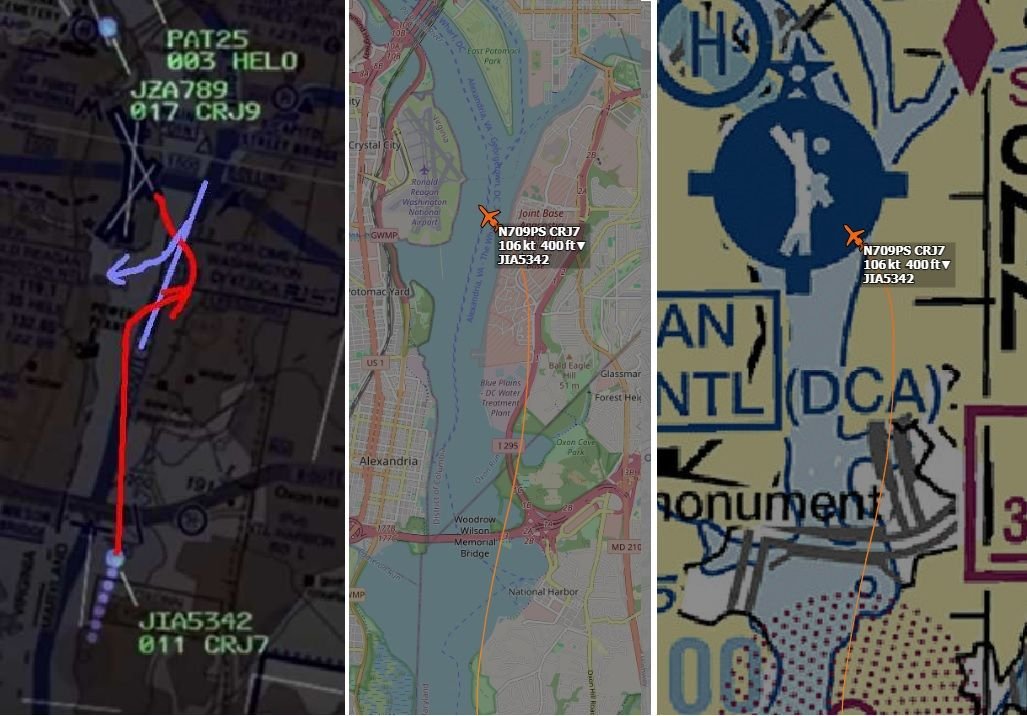
I agree that these are just guesses, but the alternative seems to be that the helo just drifted to the right randomly, for no specific reason, which seems unlikely.
Subjects
CRJ
Radar
Route 4
Separation (ALL)
Links are to this post in the relevant subject page so that this post can be seen in context.
Reply to this quoting this original post. You need to be logged in. Not available on closed threads.
February 04, 2025, 00:28:00 GMT
permalink Post: 11821044
- Any policy that permits visual separation from traffic at NIGHT should be reviewed.
- Any policy that permits routes - especially with such minimal planned separation - that cross final approach tracks should be reviewed.
- Any policy that permits 'band-boxing' of UHF and VHF radio communication frequencies should be reviewed, especially as it does not enable the crew of the UHF and VHF aircraft to hear the transmissions of the other crew. This reduces flight crew situational awareness (SA).
Some other items not directly related to this incident, but that could lead to collisions are:
- Land and Hold Short (LAHSO) operations should be reviewed.
- Clearing aircraft to land with traffic ahead but yet to land, should be reviewed. (e.g. "XXXX123 number 4 cleared to land")
- Having Ramp areas uncontrolled by ATC.
- Encouraging crew to 'report visual' (and thus becoming completely responsible for their own separation from that moment) should be reviewed.
787 Capt / SE / TRI / TRE
Subjects
ATC
Land and Hold Short
Separation (ALL)
Situational Awareness
Visual Separation
Links are to this post in the relevant subject page so that this post can be seen in context.
Reply to this quoting this original post. You need to be logged in. Not available on closed threads.
February 04, 2025, 00:36:00 GMT
permalink Post: 11821050
https://www.youtube.com/shorts/bHBKptJWXtU
I agree that these are just guesses, but the alternative seems to be that the helo just drifted to the right randomly, for no specific reason, which seems unlikely.
Subjects
CRJ
Radar
Route 4
Separation (ALL)
Links are to this post in the relevant subject page so that this post can be seen in context.
Reply to this quoting this original post. You need to be logged in. Not available on closed threads.
February 04, 2025, 00:44:00 GMT
permalink Post: 11821056
There are many comments in this thread which say procedure X should not be allowed. The procedures that were applied by ATC immediately before the accident are \x91standard\x92 and used the world over. None are intrinsically unsafe but their application (as with all the other rules that need to be followed) needs to be appropriate. Visual separation at night is likely to be fine on a clear night with just two or three aircraft in the sky but, as others have pointed out, it\x92s not in any way appropriate in high traffic density environments. Just because there\x92s a rule that says you can do something doesn\x92t mean it\x92s necessarily a good idea.
Subjects
ATC
Separation (ALL)
Visual Separation
Links are to this post in the relevant subject page so that this post can be seen in context.
Reply to this quoting this original post. You need to be logged in. Not available on closed threads.
February 04, 2025, 08:47:00 GMT
permalink Post: 11821199
Subjects
ATC
Separation (ALL)
Visual Separation
Links are to this post in the relevant subject page so that this post can be seen in context.
Reply to this quoting this original post. You need to be logged in. Not available on closed threads.
February 04, 2025, 09:36:00 GMT
permalink Post: 11821226
I think there is no problem for RA below 1000ft, it would only be like \x94TRAFFIC AHEAD, PULL UP\x94 in Airbus World. Horizontal separation might be smaller and system takes into account whether the traffic is between you and touch down. This DCA case is problematic because you join the final below 500ft, that is not acceptable in any case with an airliner.
TCAS 8 is getting closer and sooner after this horrific accident.
Subjects
Blackhawk (H-60)
CRJ
DCA
Separation (ALL)
TCAS (All)
TCAS RA
Links are to this post in the relevant subject page so that this post can be seen in context.
Reply to this quoting this original post. You need to be logged in. Not available on closed threads.
February 04, 2025, 10:43:00 GMT
permalink Post: 11821285
This means the automated tools (which don\x92t know the aircraft are using visual means to deconflict) will go off based on a predicted or actual loss of the separation criteria that they\x92ve been programmed with. If the helicopter in this instance had passed 1/4m behind and below the CRJ, a CA may still have been generated although the conflict had been resolved visually. The controller actually picks up on the apparent proximity and queries the heli that they are still visual, to which they reply in the affirmative - there is no minimum separation for visual avoidance, just sometimes it\x92s too dang close. Which is an Airprox.
Subjects
ATC
CRJ
IFR
Separation (ALL)
TCAS (All)
Visual Separation
Links are to this post in the relevant subject page so that this post can be seen in context.
Reply to this quoting this original post. You need to be logged in. Not available on closed threads.
February 04, 2025, 10:52:00 GMT
permalink Post: 11821295
Radar orders also need to be given and actions taken sooner than if the crews are doing it of their own initiative. So a radar CA needs to be visible say 15 second pre-collision so ATC can wait for the radio to be clear then order pilots to manoeuvre. Pilots can aim to cross visually at more like 5 seconds.
I'm not saying that this is overall a good idea, but the fundamental reason you fit more planes in with visual separation is that you can put them closer together with (given good visibility) not too dissimilar safety.
[Edit: too late... Fullwings got this.]
TCAS 8 is getting closer and sooner after this horrific accident.
Subjects
ATC
Blackhawk (H-60)
CRJ
DCA
Radar
Separation (ALL)
TCAS (All)
TCAS RA
Visual Separation
Links are to this post in the relevant subject page so that this post can be seen in context.
Reply to this quoting this original post. You need to be logged in. Not available on closed threads.
February 04, 2025, 10:54:00 GMT
permalink Post: 11821297
Subjects
Route 4
Separation (ALL)
Situational Awareness
Links are to this post in the relevant subject page so that this post can be seen in context.
Reply to this quoting this original post. You need to be logged in. Not available on closed threads.
February 04, 2025, 11:44:00 GMT
permalink Post: 11821332
CA will activate whenever certain separation minima are going to be lost (600\x92 and 2 miles for example).
Visual separation is a perfectly legal tool that allows separation to reduce below radar minima.
CA will (almost) always activate when applying visual separation. That doesn\x92t mean the aircraft are on a collision course or are definitely going to crash, it just means they will be in confliction and separated by less than the IFR radar minima.
Its activation in this scenario (and countless others in the days before) was totally normal. Anyone who thinks it should have been reacted to differently or that it was a last line of defence really doesn\x92t understand the role of Conflict Alert.
And it\x92s not the role of the radar centre to phone tower and warn them of a conflict alert between two aircraft they would expect to be visually separated - that\x92s a scenario that probably happens several times a day.
Subjects
IFR
Radar
Separation (ALL)
Visual Separation
Links are to this post in the relevant subject page so that this post can be seen in context.
Reply to this quoting this original post. You need to be logged in. Not available on closed threads.
February 04, 2025, 13:02:00 GMT
permalink Post: 11821410
Subjects
ATC
Separation (ALL)
Links are to this post in the relevant subject page so that this post can be seen in context.
Reply to this quoting this original post. You need to be logged in. Not available on closed threads.
February 04, 2025, 19:05:00 GMT
permalink Post: 11821639
Now here we are having a public debate about whether the helicopter was at 200 or 300 feet. My question is at what point would you consider the CRJ to be impermissibly low at that point? At the point of impact they were less than 5000 feet from the aiming point and, I presume, the PAPI. That's less than 4000 feet from the numbers. It's a short runway, 3 degrees to the numbers is 208 feet, to the aiming point 260 feet. So how low can they be at this point without violating some FAR or other rule? Keep in mind it is a visual approach at this point.
Subjects
CRJ
Separation (ALL)
Links are to this post in the relevant subject page so that this post can be seen in context.
Reply to this quoting this original post. You need to be logged in. Not available on closed threads.
February 04, 2025, 19:20:00 GMT
permalink Post: 11821649
Now here we are having a public debate about whether the helicopter was at 200 or 300 feet. My question is at what point would you consider the CRJ to be impermissibly low at that point? At the point of impact they were less than 5000 feet from the aiming point and, I presume, the PAPI. That's less than 4000 feet from the numbers. It's a short runway, 3 degrees to the numbers is 208 feet, to the aiming point 260 feet. So how low can they be at this point without violating some FAR or other rule? Keep in mind it is a visual approach at this point.
Subjects
CRJ
Separation (ALL)
Vertical Separation
Links are to this post in the relevant subject page so that this post can be seen in context.
Reply to this quoting this original post. You need to be logged in. Not available on closed threads.
February 04, 2025, 21:02:00 GMT
permalink Post: 11821702
Subjects
ATC
PAT25
Separation (ALL)
Vertical Separation
Visual Separation
Links are to this post in the relevant subject page so that this post can be seen in context.
Reply to this quoting this original post. You need to be logged in. Not available on closed threads.