March 29, 2025, 16:10:00 GMT
permalink Post: 11856721
There is tower-applied visual separation . That is not relevant to the DCA accident.
There is also pilot-applied visual separation . That is what PAT25 requested and the LC approved.
As for the perfectly-safe visual separation, the DCA accident might have been avoided had the LC applied all of the elements of pilot-applied visual separation; i.e.
(e) Advise the pilots if the targets appear likely to merge.
Subjects
ATC
DCA
NTSB
PAT25
Preliminary Report
Separation (ALL)
Situational Awareness
Visual Separation
Links are to this post in the relevant subject page so that this post can be seen in context.
Reply to this quoting this original post. You need to be logged in. Not available on closed threads.
March 30, 2025, 21:14:00 GMT
permalink Post: 11857551
.
The primary cause of this collision is airspace design and normalization of deviance over the years.
Some people are making out that if the Helicopter had ADSB-out switched on/ activated, then this would never have happened.
Someone correct me if I am wrong but if the Blackhawk has ADSB-out switched on then nothing changes for the CRJ on that night. The TCAS behaves the same, there is no display of the Blackhawk on the CRJ\x92s Nav display\x85..nothing changes. The CRJ crew are still conducting an approach that requires a lot of fast mental processing close to the ground, at night onto a short runway while ensuring checklists/configuration etc is correct. ie they have a high workload. During this high workload phase, \x91the system\x92 has seen fit to allow a single Human ( the helicopter Captain) to be responsible for the separation of the two aircraft visually, at night, in a busy environment while conducting a check, on NVG\x92s.
Is it likey that a single Human, with the sole responsibility, will make a mistake? It\x92s not just likely, it\x92s inevitable, regardless of how sharp and well trained they are, if you run the program long enough their vision, or their SA will fail them and we get what we got here.
The system should never have devolved to the point where one person accepted the responsibility for visual sep 6nm away, at night, in a busy traffic environment while dealing with their own high workload.
The Blackhawk crew had a high workload, the CRJ crew had a high workload, the ATC had a high workload, there was no fat left in the system. Humans make mistakes and any good system will be tolerant of those mistakes.
The system was not tolerant of a mistake, ergo, the system is at fault.
Subjects
ADSB (All)
ADSB Out
ATC
Blackhawk (H-60)
CRJ
Normalization of Deviance
Route 4
Separation (ALL)
Situational Awareness
TCAS (All)
Links are to this post in the relevant subject page so that this post can be seen in context.
Reply to this quoting this original post. You need to be logged in. Not available on closed threads.
April 16, 2025, 14:25:00 GMT
permalink Post: 11868036
If you want to see the standard visual flight path into 33 at DCA, today is a good day to observe. IAD also operating single crosswind runway for arrivals.
There is one point not mentioned in the thread. The two people with probably the best overall situational awareness of what was developing would have been the RJ crew. They received a traffic alert 18 seconds before the collision and the TCAS should have displayed the threat all the way to impact. I never allowed a threat inside a half a mile on a collision course even if they claimed they had me in sight unless I could visually see the threat. I got scolded by tower at DCA for going around once when we could not see VFR traffic tower said had us in sight. I didn\x92t care even though it was daylight. With a threat bearing down on TCAS you need to take action to mitigate the threat. Hoping they really have you in sight is not a good strategy.
Subjects
DCA
Situational Awareness
TCAS (All)
VFR
Links are to this post in the relevant subject page so that this post can be seen in context.
Reply to this quoting this original post. You need to be logged in. Not available on closed threads.
April 20, 2025, 04:03:00 GMT
permalink Post: 11870326
There is one point not mentioned in the thread. The two people with probably the best overall situational awareness of what was developing would have been the RJ crew. They received a traffic alert 18 seconds before the collision and the TCAS should have displayed the threat all the way to impact. I never allowed a threat inside a half a mile on a collision course even if they claimed they had me in sight unless I could visually see the threat. I got scolded by tower at DCA for going around once when we could not see VFR traffic tower said had us in sight. I didn\x92t care even though it was daylight. With a threat bearing down on TCAS you need to take action to mitigate the threat. Hoping they really have you in sight is not a good strategy.
After waiting a few days to find out whether replies would be posted by other knowledgeable aviators besides Sailvi767, and despite status as just SLF/attorney, I've got to ask: Is it a reasonable inference to draw from the quoted post, especially the part underlined, that the RJ crew perhaps was not completely without responsibility for the collision? I do not lightly (this has been batted about previously) even so much as imply responsibility for accidents on the part of pilots. Yet the quoted post seems to suggest that in this specific instance for the specific reasons stated, the RJ crew might have had a share of the responsibiity.
I admit I had thought of the RJ crew as having been not aware of any information suggesting or indicating immiment danger (despite having written an academic paper about Uberlingen a few years ago). And, the facts which potentially lead to assigning a share of responsibility to the RJ crew also would then change the contours and progression of the litigation, quite dramatically, and not only in terms of impact on familly members. Bringing in the airline as a defendant would direct the complaint drafter's mind to questions of the most effective style, organization and content to make the case for punitive damages. Forum readers following the legal aspects of the accident on the thread may recall that punitive damages are not recoverable in a tort claim brought against the United States Federal Government The airline company or companies here have no such protection.
Subjects
DCA
Situational Awareness
TCAS (All)
VFR
Links are to this post in the relevant subject page so that this post can be seen in context.
Reply to this quoting this original post. You need to be logged in. Not available on closed threads.
April 20, 2025, 17:20:00 GMT
permalink Post: 11870628
Regrets: in my post trying to comment on Sailvi767's observation regarding the RJ crew having the best situational awareness, in retrospect I should have emphasized and explained what I meant by using the the word "imminent". The thread previously did clearly reference factors such as the inhibition of TAs and RAs at specified heights, and the TA alert. What seemed different in the post about the RJ crew's SA was what I, as only SLF/attorney, understood as the suggestion that a different crew with different mindset might have realized before the last second prior to impact that "erring on the side of caution" was the correct action to take. Please note - this is not an effort to put words into Sailvi767's post whatsoever.
Perhaps it was already pretty clear to others, but I had thought - for the reasons your post H&H talks about - that naming the airline as a defendant in the lawsuits would be just for form's sake at best, and to draw in its insurance coverages. Every law student (in the U.S. that is, I don't know about other systems) is taught that a shorthand for negligence is whether the alleged negligent party "knew or should have known" about the risk of harm the party was creating. The observation that I think the post about the RJ crew's SA justifies is certainly not that they "knew". But it does suggest that although it is highly unlikely they "should have known", there either are some facts supporting the assertion that they "could have known", or at least enough facts to warrant making the airline a defendant.
About prior safety-related reports and whether any risk assessments were done and what those assessments showed, it appears very likely if not certain that some answers to "who knows" will be found through the discovery process particularly, although not only, if the airline is named as defendant.
(Lastly, I apologize for convoluting the thread.)
WR 6-3
Subjects
Situational Awareness
TCAS RA
Links are to this post in the relevant subject page so that this post can be seen in context.
Reply to this quoting this original post. You need to be logged in. Not available on closed threads.
April 20, 2025, 17:29:00 GMT
permalink Post: 11870631
Regrets: in my post trying to comment on Sailvi767's observation regarding the RJ crew having the best situational awareness, in retrospect I should have emphasized and explained what I meant by using the the word "imminent". The thread previously did clearly reference factors such as the inhibition of TAs and RAs at specified heights, and the TA alert. What seemed different in the post about the RJ crew's SA was what I, as only SLF/attorney, understood as the suggestion that a different crew with different mindset might have realized before the last second prior to impact that "erring on the side of caution" was the correct action to take. Please note - this is not an effort to put words into Sailvi767's post whatsoever.
Perhaps it was already pretty clear to others, but I had thought - for the reasons your post H&H talks about - that naming the airline as a defendant in the lawsuits would be just for form's sake at best, and to draw in its insurance coverages. Every law student (in the U.S. that is, I don't know about other systems) is taught that a shorthand for negligence is whether the alleged negligent party "knew or should have known" about the risk of harm the party was creating. The observation that I think the post about the RJ crew's SA justifies is certainly not that they "knew". But it does suggest that although it is highly unlikely they "should have known", there either are some facts supporting the assertion that they "could have known", or at least enough facts to warrant making the airline a defendant.
About prior safety-related reports and whether any risk assessments were done and what those assessments showed, it appears very likely if not certain that some answers to "who knows" will be found through the discovery process particularly, although not only, if the airline is named as defendant.
(Lastly, I apologize for convoluting the thread.)
WR 6-3
In real life the pilots were on short final and paying attention to airspeed and glideslope lights. Traffic that said they had them in sight and would fly behind them would not be a priority. Even if there was no tower at all, they owned that last 500 feet, random crossing traffic would not have right of way.
Subjects
Situational Awareness
TCAS RA
Traffic in Sight
Links are to this post in the relevant subject page so that this post can be seen in context.
Reply to this quoting this original post. You need to be logged in. Not available on closed threads.
April 20, 2025, 21:30:00 GMT
permalink Post: 11870704

The baseline is that a TA on it's own is not enough and can even lead to issues if reacted to without knowing exactly where that contact is and what it is doing. You should, if you have the time (hence my comment re workload for the RJ crew at that point), try and get visual on the traffic but, tbh, it's very difficult to do, especially at low level at night against backlighting. You don't even really have time to "debate" a "shall we react (against SOP) to (yet another?) TCAS alert at DCA?" with all else that is going on at that point of a flight. SOP/Training says "fly on"! You need compelling evidence to go against that. I fact, IIR, the NTSB noted that the CRJ had full "up" elevator at the time of impact - that implies the crew finally saw the helo and reacted ..... but with no time to change their flight path.
If you want to "do" the airline - I feel a much better case could be made based on the fact the evidence of issues for that approach at DCA was sat in the Safety Databases for anyone who went looking, that maybe even crews had raised the issue themselves through internal reporting in the Airline, and/or there was no process in place within the Airline to review operations into DCA - or any other airport. This is promoted by the FAA who state that "The [airline] SMS promotes a defined structure and a \x93learning culture\x94 within an aviation organization that continually seeks and analyzes information, then turns that information into action that eliminates or mitigates safety risks, before they become unwanted events.". The full ref is here. And that also applies equally to the Metropolitan Washington Airports Authority who I believe operate DCA as an independent organisation. How the MWAA fit in to US Government - I'm not sure!
Anyway, hope this helps. Cheers, H 'n' H
Subjects
CRJ
DCA
FAA
NTSB
Situational Awareness
TCAS (All)
TCAS RA
Links are to this post in the relevant subject page so that this post can be seen in context.
Reply to this quoting this original post. You need to be logged in. Not available on closed threads.
April 28, 2025, 09:48:00 GMT
permalink Post: 11874753
Subjects
ADSB (All)
DCA
Separation (ALL)
Situational Awareness
Traffic in Sight
Visual Separation
Links are to this post in the relevant subject page so that this post can be seen in context.
Reply to this quoting this original post. You need to be logged in. Not available on closed threads.
July 30, 2025, 19:22:00 GMT
permalink Post: 11930888
1. PAT25 PF started to turn right at Cabin John (American Legion Bridge), which would have taken them toward Great Falls; i.e., up the Potomac. IP had to tell PF to turn left, which would start track down Potomac River (helo route 1). Odd. Not the best SA by PF.
2. No discussion in the PAT25 cockpit about the called CRJ traffic.
3. PSA Captain/PF expressed to PM a preference for continuing to runway 1 but accepted runway 33. Media will make a big deal out of this. I don\x92t think it is.
Subjects
CRJ
CVR
NTSB Docket
PAT25
Situational Awareness
Links are to this post in the relevant subject page so that this post can be seen in context.
Reply to this quoting this original post. You need to be logged in. Not available on closed threads.
July 31, 2025, 19:18:00 GMT
permalink Post: 11931506
For TF/TA radalt is the go-to instrument, but for coordinating multiple aircraft to maintain vertical separation, barometric altitude is more suitable. The problem being that barometric altimeters are subject to a lot of measurement and reporting errors.
I am sure that GPS-RTK could be used to fix the absolute altitude with great precision, but I am also sure that depending on an easily denied measurement source on a military aircraft is not going happen.
The correct solution for operating in a civilian airspace is to use ADS-B In/Out for all manned aircraft to provide appropriate and timely situational awareness. While ADS-B is also subject to denial, it offers far greater benefit in civilian airspace over GPS-RTK in that it tells the pilots where all the other aircraft are rather than simply being more precise about where their own aircraft is.
It is clear that the helicopter crew not knowing where the passenger jet was was the primary cause of the collision.
Arguments about the error in the altimeter readings are suitable to emphasize that depending on them in a crowded airspace is a fool's choice and should have been spotted a long time ago as insufficient to provide clearance.
Subjects
ADSB (All)
Altimeter (All)
Radio Altimeter
Separation (ALL)
Situational Awareness
Vertical Separation
Links are to this post in the relevant subject page so that this post can be seen in context.
Reply to this quoting this original post. You need to be logged in. Not available on closed threads.
August 01, 2025, 22:40:00 GMT
permalink Post: 11932083
And they acknowledged it, although in a very short reply (understandable to keep R/T's as short as possible).
But replying with " traffic circling 33 in sight " just might have improved their own SA, helping to build the mental picture that mentioned traffic was going to move slightly to their left and was at some point going to cross their route from left to right. And if they didn't have that mental picture of what "circling 33" meant for their routing, then a lot was wrong long before the impact.
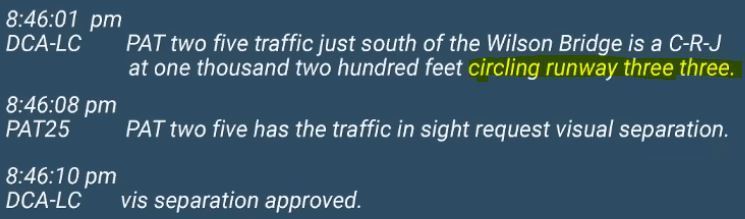
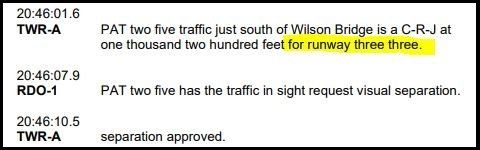
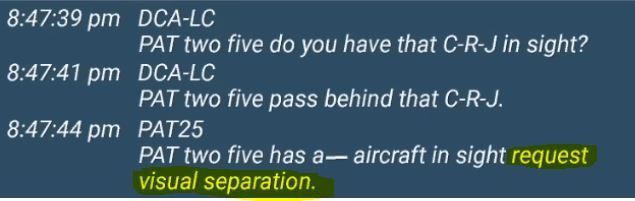
And what strikes me over and over again, is this mutual 'pavlovian' "request visual separation"-"approved" thing, as if proclaiming these words, absolves all involved from any rules/restriction that might hinder the smooth flow of things (which it does - kind of).
Even at the last chance of averting disaster by the controller (by clearly indicating the target), the pavlovian reaction was there again (totally meaningless as it was already requested and approved 96 second earlier)...
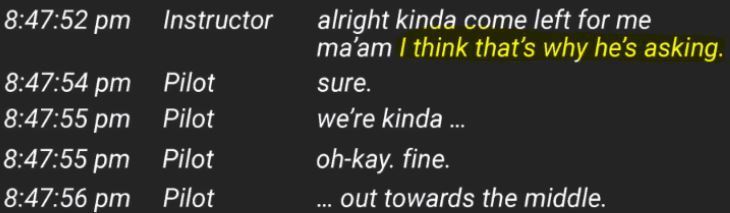
Last edited by DIBO; 2nd August 2025 at 22:03 . Reason: add extract from UH60 CVR transcript (not available/included in NTSB debrief animation)
Subjects
ATC
CVR
Night Vision Goggles (NVG)
Separation (ALL)
Situational Awareness
Visual Separation
Links are to this post in the relevant subject page so that this post can be seen in context.
Reply to this quoting this original post. You need to be logged in. Not available on closed threads.
September 29, 2025, 09:41:00 GMT
permalink Post: 11961394
If the SOP requirement was instituted by the airline out of a safety concern, to reduce the workload on the pilots during that critical phase of flight, then that has a bearing on how responsibility is apportioned.
Subjects
ATC
PSA Procedures
Situational Awareness
Links are to this post in the relevant subject page so that this post can be seen in context.
Reply to this quoting this original post. You need to be logged in. Not available on closed threads.
September 29, 2025, 10:20:00 GMT
permalink Post: 11961413
If the SOP requirement was instituted by the airline out of a safety concern, to reduce the workload on the pilots during that critical phase of flight, then that has a bearing on how responsibility is apportioned.
Subjects
ATC
Situational Awareness
Links are to this post in the relevant subject page so that this post can be seen in context.
Reply to this quoting this original post. You need to be logged in. Not available on closed threads.
September 29, 2025, 12:35:00 GMT
permalink Post: 11961473
This is the problem with enthusiastic amateurs and blood-thirsty lawyers: all these peripheral issues take centre-stage and the real causes are not addressed. Easier to spear the pilots of the CRJ for not doing a unneeded briefing or missing a TCAS alerts than get the FAA and army boffins that approved that sh1tshow in the first place...
Subjects
ATC
CRJ
FAA
Situational Awareness
TCAS (All)
Links are to this post in the relevant subject page so that this post can be seen in context.
Reply to this quoting this original post. You need to be logged in. Not available on closed threads.
September 29, 2025, 15:04:00 GMT
permalink Post: 11961546
Clearly not a pilot, again. Pilots, especially of multi-crew aircraft should NOT have to listen every transmission to every other aircraft to "maintain situational awareness".
This is the problem with enthusiastic amateurs and blood-thirsty lawyers: all these peripheral issues take centre-stage and the real causes are not addressed. Easier to spear the pilots of the CRJ for not doing a unneeded briefing or missing a TCAS alerts than get the FAA and army boffins that approved that sh1tshow in the first place...
Subjects
ATC
CRJ
FAA
Situational Awareness
TCAS (All)
Links are to this post in the relevant subject page so that this post can be seen in context.
Reply to this quoting this original post. You need to be logged in. Not available on closed threads.
September 29, 2025, 15:28:00 GMT
permalink Post: 11961563
This is the problem with enthusiastic amateurs and blood-thirsty lawyers: all these peripheral issues take centre-stage and the real causes are not addressed. Easier to spear the pilots of the CRJ for not doing a unneeded briefing or missing a TCAS alerts than get the FAA and army boffins that approved that sh1tshow in the first place...
I also don't advocate for that issue taking center stage, but to taboo it and to say we can't talk about it ever doesn't seem right, either. The central issue in this accident is ATC's decision to routinely leave separation in the hands of a heli crew with night vision goggles and less than 75 feet of procedural separation. But we all know this by now if we've watched the NTSB presentation, so please excuse me for not repeating this with every post.
The central issue of the lawsuit is whether the level of safety provided by FAA rules, FAA/ATC procedures, Airline decisions and SOPs, Army decisions and SOPs, and pilot performance on the day are sufficient to legal standards. It's a complex interplay of factors, and even though it's clearly far from the deciding factor, I'm not going to say that a late approach briefing did not matter at all.
Subjects
CRJ
FAA
NTSB
Separation (ALL)
Situational Awareness
TCAS (All)
Links are to this post in the relevant subject page so that this post can be seen in context.
Reply to this quoting this original post. You need to be logged in. Not available on closed threads.
October 22, 2025, 09:42:00 GMT
permalink Post: 11974140
1. These persons, making such SA, won't be part of any investigation especially not part of court trial process.
2. Bad systems do not have independent and respecred SA - that is the first reason- why they are bad for workers, customers and society
3. Last, but no least, it is very hard to prove financial benefits of making independent SA and respect it afterwards.
Subjects
Normalization of Deviance
Separation (ALL)
Situational Awareness
Visual Separation
Links are to this post in the relevant subject page so that this post can be seen in context.
Reply to this quoting this original post. You need to be logged in. Not available on closed threads.
October 23, 2025, 10:56:00 GMT
permalink Post: 11974883
From a European / EASA perspective :
Re the "Lateral separation" you mention : in that scenario so close to the Runway threshold it would mean only a left turn is possible, i.e. away from the thresholds of both runways , it would mean flying over build up areas , and doing so at 200ft above buildings with possible antennas on top , etc.. ,not really safe , and definitively not at night . As to \x93pass behind\x94 , the standard wake turbulence separation criteria would not be met , especially passing behind/below and I would not even try that at 200ft under a large jet..
So , applying standard safety assessment criteria , allowing visual separation to aircraft on that route, even less at night where danger of mis identification is increased . would definitively not be considered \x93 Safe\x94 .
During the interviews, one Heli pilot from that same group ,mentioned that asking for visual separation was a routine request , even if you did not see the traffic at time of the request . That fact alone, if really proven to be systematically the case , would also add to the normalization of deviance case and put full responsibility on the regulator, not the pilots
Subjects
CRJ
FAA
Normalization of Deviance
Pass Behind
Pass Behind (All)
Separation (ALL)
Situational Awareness
Visual Separation
Links are to this post in the relevant subject page so that this post can be seen in context.
Reply to this quoting this original post. You need to be logged in. Not available on closed threads.
October 23, 2025, 21:30:00 GMT
permalink Post: 11975262
Re the "Lateral separation" you mention : in that scenario so close to the Runway threshold it would mean only a left turn is possible, i.e. away from the thresholds of both runways , it would mean flying over build up areas , and doing so at 200ft above buildings with possible antennas on top , etc.. ,not really safe , and definitively not at night . As to \x93pass behind\x94 , the standard wake turbulence separation criteria would not be met , especially passing behind/below and I would not even try that at 200ft under a large jet..
Subjects
ATC
Blackhawk (H-60)
FAA
NTSB
Normalization of Deviance
Separation (ALL)
Situational Awareness
Traffic in Sight
Visual Separation
Links are to this post in the relevant subject page so that this post can be seen in context.
Reply to this quoting this original post. You need to be logged in. Not available on closed threads.
December 13, 2025, 05:20:00 GMT
permalink Post: 12004479
As a result of this investigation, we issued 2 urgent new recommendations. We issued recommendations to:
To the Federal Aviation Administration:
Prohibit operations on Helicopter Route 4 between Hains Point and the Wilson Bridge when runways 15 and 33 are being used for departures and arrivals, respectively, at Ronald Reagan Washington National Airport (DCA). (Urgent)
Designate an alternative helicopter route that can be used to facilitate travel between Hains Point and the Wilson Bridge when that segment of Route 4 is closed. (Urgent)
The CRJ was equipped with TCAS, which may or may not have been applicable at this low altitude as it is suppressed at 400 ft. The preliminary report does not indicate the helicopter having a TCAS or having an operating one. It did have the ability to produce ADS-B Out. Neither aircraft is reported to have had ADS-B In.
Since many operators seem to loath spending money on ADS-B In, the recommendation from the NTSB was to (1) stop simultaneous flight path use and (2) go elsewhere when the approaches were in use. The FAA agreed.
Per https://data.ntsb.gov/carol-main-pub...tails/A-25-001 the FAA did what was recommended about simultaneous use.
Per https://data.ntsb.gov/carol-main-pub...tails/A-25-002 the FAA made a satisfactory response concerning planning the alternate route(s)
This legislation is the exact opposite of that recommendation.
No doubt the anger isn't just that the NTSB has yet again been ignored, it's that the FAA agreements to safety measures are targeted for destruction in a way that recreates the circumstance of the tragic event.
I said at first, on seeing this collision a few hours after the event, that I felt rage that so many safety measures are available and yet none of them was actually used.
This section, 373, is what I consider an intentional sabotage of the safe operations around DCA.
The FAA literally had advertising videos showing the use of ADS-B In on helicopters for this exact purpose, to give situational awareness to the pilots long before there would be a need to deconflict with other traffic (see end) . No sudden swerves as TCAS attempts to make a last moment save of a terrible situation. TCAS alone cannot be the solution as TCAS gets shut off to avoid nuisance complaints about the terrain the plane is intentionally going to run into or other proximate planes waiting for takeoff.
ADS-B In is for noting where everyone else is in the neighborhood of the aircraft. Had the helicopter been equipped with ADS-B In they would have known the speed and direction of the CRJ and seen it was on a collision course.
As usual it appears there is no name attached nor meeting notes about who submitted what became Section 373. There is certainly no justification paper that will see the light of day.
If those exist, please, someone, prove me wrong.
I cannot find it on YouTube.
An actual user who avoided a mid-air using ADS-B In (Trent Palmer, if anyone wants to avoid him; not everyone is liked):
Subjects
ADSB (All)
ADSB In
ADSB Out
CRJ
DCA
FAA
NTSB
Preliminary Report
Route 4
Section 373 of the FY26 NDAA
Situational Awareness
TCAS (All)
Links are to this post in the relevant subject page so that this post can be seen in context.
Reply to this quoting this original post. You need to be logged in. Not available on closed threads.