February 04, 2025, 10:52:00 GMT
permalink Post: 11821295
Radar orders also need to be given and actions taken sooner than if the crews are doing it of their own initiative. So a radar CA needs to be visible say 15 second pre-collision so ATC can wait for the radio to be clear then order pilots to manoeuvre. Pilots can aim to cross visually at more like 5 seconds.
I'm not saying that this is overall a good idea, but the fundamental reason you fit more planes in with visual separation is that you can put them closer together with (given good visibility) not too dissimilar safety.
[Edit: too late... Fullwings got this.]
TCAS 8 is getting closer and sooner after this horrific accident.
Subjects
ATC
Blackhawk (H-60)
CRJ
DCA
Radar
Separation (ALL)
TCAS (All)
TCAS RA
Visual Separation
Links are to this post in the relevant subject page so that this post can be seen in context.
Reply to this quoting this original post. You need to be logged in. Not available on closed threads.
February 04, 2025, 11:56:00 GMT
permalink Post: 11821350
The only solution I personally see is airspace segregation based on equipment . Class A, B and C restricted to aircraft carrying ADS-B out and TCAS equipped , and both Working and on the MEL as no go item s ( not the case today ) Waiting for AOPA and ATA remarks
Subjects
ADSB (All)
ADSB Out
ATC
DCA
TCAS (All)
Links are to this post in the relevant subject page so that this post can be seen in context.
Reply to this quoting this original post. You need to be logged in. Not available on closed threads.
February 04, 2025, 12:52:00 GMT
permalink Post: 11821404
Then there is the question of the C150s, you raised , of course no TCAS, we are talking ADS-B out, but even then, do you really want to have them anywhere near the approach path of a major busy airport airspace to start with ?
Subjects
ADSB (All)
ADSB Out
DCA
TCAS (All)
Links are to this post in the relevant subject page so that this post can be seen in context.
Reply to this quoting this original post. You need to be logged in. Not available on closed threads.
February 04, 2025, 13:17:00 GMT
permalink Post: 11821423
Then there is the question of the C150s, you raised , of course no TCAS, we are talking ADS-B out, but even then, do you really want to have them anywhere near the approach path of a major busy airport airspace to start with ?
I was a frequent visitor to DCA in C-150s and C-172s pre 9-11, it was a nice way to get to the city for dinner from the island I live on. Unless the airlines start buying their own private airports there is no sorting out of airplanes like that, public airports are for everyone with an airplane (9-11 bullcrap excepted). They would do "river tours" back then too, you got a trip up and down the Potomac with some great sightseeing. Back then airplane ramp fees were less than you could end up paying to park a car

Subjects
ADSB (All)
ADSB Out
ATC
DCA
TCAS (All)
Links are to this post in the relevant subject page so that this post can be seen in context.
Reply to this quoting this original post. You need to be logged in. Not available on closed threads.
February 04, 2025, 13:36:00 GMT
permalink Post: 11821443
I was a frequent visitor to DCA in C-150s and C-172s pre 9-11, it was a nice way to get to the city for dinner from the island I live on. Unless the airlines start buying their own private airports there is no sorting out of airplanes like that, public airports are for everyone with an airplane (9-11 bullcrap excepted). They would do "river tours" back then too, you got a trip up and down the Potomac with some great sightseeing. Back then airplane ramp fees were less than you could end up paying to park a car
Subjects
DCA
TCAS (All)
Links are to this post in the relevant subject page so that this post can be seen in context.
Reply to this quoting this original post. You need to be logged in. Not available on closed threads.
February 04, 2025, 16:50:00 GMT
permalink Post: 11821551
We used this quite often when parachute jumpers crossed our approach path to the homebase (from above of course
). We could have done a 360 , but then we would have lost sight of our vertical traffic and a quick stop is more fun.
I my country we widely use a wonderful device called FLARM. It is sort of a pour man's TCAS, using a similar protocol as ADS-B but on a free to use frequency. Shows traffic of other live FLARMS and warns if a Mode-S transponders is approaching (using field strength) . It has another optional feature: a database of low strung cables, power lines and other obstructions our country is infested with. Guess what we had to do in a heli when this alarm went of? Indeed, a quick stop and then a good lookout for cables!
Your deleted post said nothing of the sort; it was “ Blow your nose and you might be 100 ft higher (or splash) in a powerful heli at 130kts” and nothing else.
Senior Pilot
Last edited by Senior Pilot; 5th February 2025 at 07:33 . Reason: Add actual deleted post
Subjects
ADSB (All)
TCAS (All)
Links are to this post in the relevant subject page so that this post can be seen in context.
Reply to this quoting this original post. You need to be logged in. Not available on closed threads.
February 04, 2025, 19:42:00 GMT
permalink Post: 11821662
We used this quite often when parachute jumpers crossed our approach path to the homebase (from above of course
). We could have done a 360 , but then we would have lost sight of our vertical traffic and a quick stop is more fun.
I my country we widely use a wonderful device called FLARM. It is sort of a pour man's TCAS, using a similar protocol as ADS-B but on a free to use frequency. Shows traffic of other live FLARMS and warns if a Mode-S transponders is approaching (using field strength) . It has another optional feature: a database of low strung cables, power lines and other obstructions our country is infested with. Guess what we had to do in a heli when this alarm went of? Indeed, a quick stop and then a good lookout for cables!
Subjects
ADSB (All)
TCAS (All)
Links are to this post in the relevant subject page so that this post can be seen in context.
Reply to this quoting this original post. You need to be logged in. Not available on closed threads.
February 04, 2025, 21:57:00 GMT
permalink Post: 11821736
I have flown into DCA at least a hundred times and took my own go-around once even though tower said the traffic had us in sight. If I can\x92t see a TCAS target on a collision course I am going around.
Subjects
DCA
TCAS (All)
Traffic in Sight
Links are to this post in the relevant subject page so that this post can be seen in context.
Reply to this quoting this original post. You need to be logged in. Not available on closed threads.
February 04, 2025, 22:34:00 GMT
permalink Post: 11821762
"5342, helo traffic on your right 1/4 mile at 300 feet, has you in sight". The CRJ FO might just have taken a closer look out the side window with that. Or, like you, they might have opted to go around.
Subjects
ATC
CRJ
CVR
DCA
IFR
Separation (ALL)
TCAS (All)
Traffic in Sight
Visual Separation
Links are to this post in the relevant subject page so that this post can be seen in context.
Reply to this quoting this original post. You need to be logged in. Not available on closed threads.
February 04, 2025, 22:48:00 GMT
permalink Post: 11821767
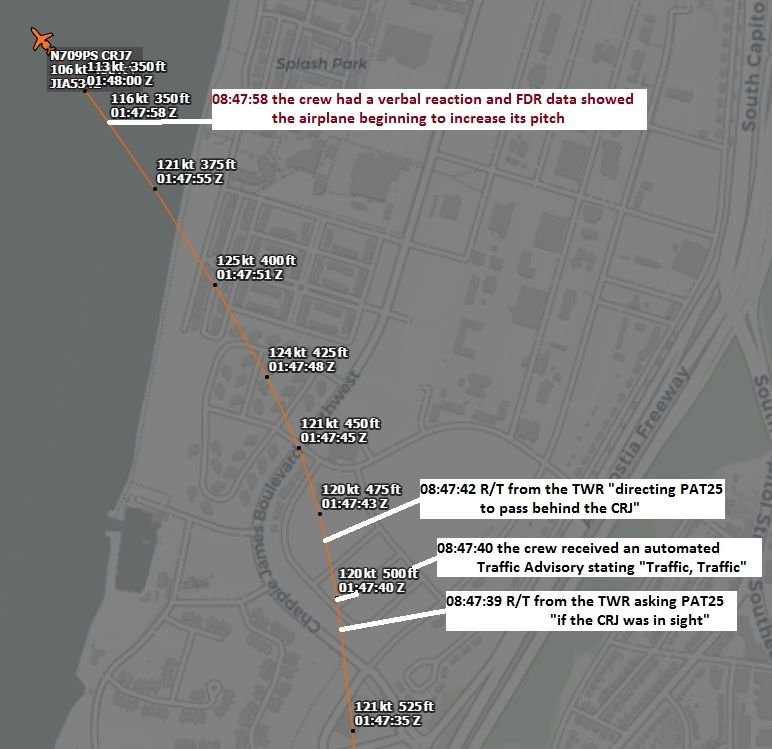
to put "all the way" into context, 18 seconds is what they had
Subjects
ADSB (All)
NTSB
TCAS (All)
Links are to this post in the relevant subject page so that this post can be seen in context.
Reply to this quoting this original post. You need to be logged in. Not available on closed threads.
February 05, 2025, 03:48:00 GMT
permalink Post: 11821881
We used this quite often when parachute jumpers crossed our approach path to the homebase (from above of course
). We could have done a 360 , but then we would have lost sight of our vertical traffic and a quick stop is more fun.
I my country we widely use a wonderful device called FLARM. It is sort of a pour man's TCAS, using a similar protocol as ADS-B but on a free to use frequency. Shows traffic of other live FLARMS and warns if a Mode-S transponders is approaching (using field strength) . It has another optional feature: a database of low strung cables, power lines and other obstructions our country is infested with. Guess what we had to do in a heli when this alarm went of? Indeed, a quick stop and then a good lookout for cables!
like they say in the industry: “you don’t know what you don’t know”
Trying to quick stop at night as a means of collision avoidance is just dumb anyway.
And fwiw: if you understand VRS training as necessary to recover from mismanaged quick stops, then you need more training.
During a quick stop, your instructor was correct to prepare you for what follows rapidly thereafter with respect to your heading and your need to be ready for some footwork, and to be aware of the torque demand that follows where the wake influences your aircraft. This isn't however vortex ring state, nor is it settling with power, it is a transient related to your wake. The R-22 has adequate but not fantastic tail rotor authority, the UH-60 has an excellent tail rotor befitting a damned fine tactical/combat helicopter.
You can get through a complete aviation career in helicopters without opening up any books beyond your training manuals. Helicopters also bite back hard if you.step out of line, so my suggestion is that you may frame Torquetalk's comment: “you don’t know what you don’t know” , and enjoy reading about your machines physics.
Subjects
ADSB (All)
Blackhawk (H-60)
TCAS (All)
Links are to this post in the relevant subject page so that this post can be seen in context.
Reply to this quoting this original post. You need to be logged in. Not available on closed threads.
February 06, 2025, 11:55:00 GMT
permalink Post: 11822926
PAT25: "PAT25 has the traffic in sight, request visual separation"
Tower: "Visual separation approved"
0:26 here:
https://youtu.be/r90Xw3tQC0I?feature=shared
Perhaps, and this is big perhaps, it's a pavlovian response to whenever PAT is advised of other traffic. I listened to the TCAS RA missed approach from the previous day, and once again the response from PAT is "request visual separation". It's highly likely that the pilot requests for visual separation is the only way that this Class B airspace can operate with the mix of IFR vs VFR, and aerodrome traffic vs transits.
I fail to understand why PAT is using UHF, surely this is another slice of cheese.
The use of RWY 33 for arrival makes it easier for the ATC and the aircrew with one less runway crossing after they have landed. To emphasis the point, the following PSA actually requests RWY 33.
Subjects
ATC
CRJ
IFR
PAT25
Separation (ALL)
TCAS (All)
TCAS RA
Traffic in Sight
VFR
Visual Separation
Links are to this post in the relevant subject page so that this post can be seen in context.
Reply to this quoting this original post. You need to be logged in. Not available on closed threads.
February 06, 2025, 13:32:00 GMT
permalink Post: 11822989
Again, not excusing things, not saying it can’t improve, but the size of the problem is huge. Ultimately, the solution is less aviation. I’ve flown all over the world, nowhere has the traffic the US has. ATL, for example has a mix of traffic unheard of in Europe. I’ve been in the bizjets, airliners, I’ve seen jet fighters parked there and a Piper Cherokee on the GA ramp. Same in LAX, DFW, LGA, BOS. We do not expect the restrictions on aviation acceptable elsewhere and we have plenty of it.
Our GA safety record is pretty awful, but at glance it’s probably 75% of the world’s total GA flying. It’s also no accident to see FAA-registered GA planes in the EU. Guess why?
Subjects
FAA
TCAS (All)
TCAS RA
Links are to this post in the relevant subject page so that this post can be seen in context.
Reply to this quoting this original post. You need to be logged in. Not available on closed threads.
February 07, 2025, 10:20:00 GMT
permalink Post: 11823511
Quite extraordinary for a supposed 'recertification' flight.
Subjects
AA5342
ADSB (All)
NTSB
PAT25
Situational Awareness
TCAS (All)
Links are to this post in the relevant subject page so that this post can be seen in context.
Reply to this quoting this original post. You need to be logged in. Not available on closed threads.
February 07, 2025, 11:01:00 GMT
permalink Post: 11823555
Quite extraordinary for a supposed 'recertification' flight.
In another midair collision report, that happened in July 2022 at NorthLas Vegas airport, NTSB put out this:
Interviews with personnel at the air traffic control tower indicated that staffing was deficient, and most staff were required to work mandatory overtime shifts, reaching an annual average of 400 to 500 hours of overtime per controller. According to the air traffic manager (ATM), the inadequate staffing had resulted in reduced training discissions, and the management team was unable to appropriately monitor employee performance. The ATM stated that everyone on the team was exhausted, and that work/life balance was non-existent. It is likely that the cumulative effects of continued deficient staffing, excessive overtime, reduced training, and inadequate recovery time between shifts took a considerable toll on the control tower workforce.
I wonder, how this situation is with DCA ATC service.
I am not trying to blame ATC either. He issued clearance to PAT25 to cross behind and asked (and got) confirmation for CRJ in sight twice. It seems quite clear that helicopter crew did not look at the same airplane that ATC was asking about.
What baffles me here is, that it was obvious a routine procedure to let helicopters cross active runway heading less than 2 miles from runway treshold, leaving practically zero margin for error. Backups, designed to catch pilots or ATC errors (TCAS and ATC alarms) cannot catch up in short time left if someone makes a mistake, so this arrangement as based on "see and avoid" concept, in the night, with many lights in the background and a fact, that other aircraft on collision course does not move relatively on the screen, but just grows bigger. Unfortunatelly, that dot on the screen that will kill you starts growing bigger only in the last few seconds.
If I would ask ATC to cross runway heading DAY VFR so close to runway treshold at my airport with incoming commercial traffic, I would be denied 100 times out of 100 attempts. (and probably called nuts).
My guess on this tragedy is, that thru the years, the system was trying to pack more and more aircraft in the same space and same infrastructure, by gradually squeezing margins and safegueards, until one day, Jenga tower collapsed.
Subjects
AA5342
ADSB (All)
ATC
Blackhawk (H-60)
CRJ
DCA
NTSB
PAT25
See and Avoid
Situational Awareness
TCAS (All)
VFR
Links are to this post in the relevant subject page so that this post can be seen in context.
Reply to this quoting this original post. You need to be logged in. Not available on closed threads.
February 07, 2025, 11:52:00 GMT
permalink Post: 11823587
Subjects
AA5342
ADSB (All)
CRJ
NTSB
PAT25
TCAS (All)
Links are to this post in the relevant subject page so that this post can be seen in context.
Reply to this quoting this original post. You need to be logged in. Not available on closed threads.
February 07, 2025, 12:37:00 GMT
permalink Post: 11823616
1.5NM is obviously not applied, look at the south flow arrivals TCAS RA the day prior. It, a PAT merged previously with a SWA 737 at TCAS TA altitudes with Collision Alert to ATC radar, before causing the later RA.
Last edited by moosepileit; 7th February 2025 at 15:53 .
Subjects
ATC
Radar
Separation (ALL)
TCAS (All)
TCAS RA
Links are to this post in the relevant subject page so that this post can be seen in context.
Reply to this quoting this original post. You need to be logged in. Not available on closed threads.
February 07, 2025, 22:36:00 GMT
permalink Post: 11823982
Quite extraordinary for a supposed 'recertification' flight.
The recertification flight might specifically need to be at night. It might even specifically require NVG. I also wonder if both pilots would be on NVG or just one of the two.
Last edited by YRP; 7th February 2025 at 22:49 . Reason: Edited to sound 10% less grumpy
Subjects
AA5342
ADSB (All)
NTSB
Night Vision Goggles (NVG)
PAT25
Situational Awareness
TCAS (All)
Links are to this post in the relevant subject page so that this post can be seen in context.
Reply to this quoting this original post. You need to be logged in. Not available on closed threads.
February 11, 2025, 09:56:00 GMT
permalink Post: 11825962
Speculation : The helicopter crews know that if they don't report traffic in sight as soon as it's called, they'll be slowed down and deprioritised by ATC and eventually held back until they either do report the traffic, or there's a substantial gap in arrivals - see the LH A380. That makes them unpopular with their passengers and/or superiors, so they are very flexible with what 'in sight' means.
ATC likewise knows that if they push helicopter crews too hard on altitude busts, report anything involving a helicopter, or hold up either kind of traffic, they might get people breathing down their neck and certainly nothing good comes of it.
Calling traffic immediately and not enforcing separation too strictly allows both parties to 'get on with their jobs' while looking more-or-less by-the-book - until an incident like this happens.
I'm hopeful I'm wrong, but given there seems to be a long history of near misses and altitude busts this seems like the obvious conclusion. No-one high-up wanted to hear about it or change anything , because no-one had died yet.
On a slightly different note, I'm curious whether anyone is familiar with the Hierarchy of Controls by NIOSH? It doesn't map 1:1 to aviation, but it codifies some things that are 'obvious' in hindsight:
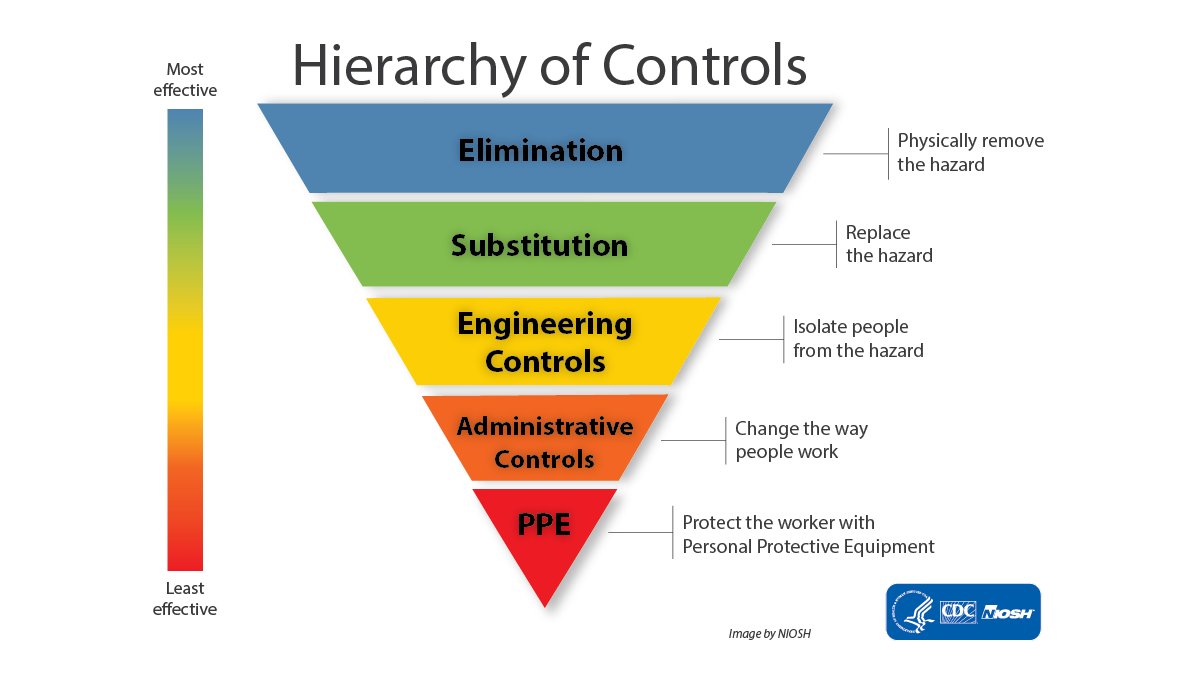
Broadly speaking, some controls are more effective than others. Wherever possible, you should attempt to use more effective controls in place of less effective ones. More effective means not just that it reduces the risk the most, but also the most reliable over time and most resistant to having rules bent, being left broken, being ignored due to alarm fatigue, or 'normalisation of deviation'. Procedures that assume everything is working perfectly and everyone is 100% competent will fail; see MCAS and a great number of other accidents.
Elimination is rarely possible but substitution (radar vs visual) and isolation (separate helicopters from other traffic) amongst other engineering controls are potentially more feasible, and much higher up the hierarchy than a glorified instruction not to crash (the very bottom of administrative). Engineering a problem out of existence is far superior to having a procedure to fix it in the QRH.
I list things like TCAS, GPWS, RSAs, and crash-proof seating as broadly being under PPE: they're nice to have and certainly worth pursuing, but unless there is no other alternative, they should never be your primary protection. Something has gone wrong if they get used.
Subjects
ATC
Close Calls
Normalization of Deviance
Radar
Separation (ALL)
TCAS (All)
Traffic in Sight
Links are to this post in the relevant subject page so that this post can be seen in context.
Reply to this quoting this original post. You need to be logged in. Not available on closed threads.
February 12, 2025, 12:15:00 GMT
permalink Post: 11826676
I am sorry you see a witch hunt in my post. It was supposed to be an idea for a future improvement, rather than a criticism of the very hard worked man who was on the job. On the flying end, there is quite a rigid procedure to follow if a TCAS RA goes off. From posts since I see, that there seems to be one for for STCA triggers too. It seems to me that the gravity of the situation is brought faster to a pilot's attention if the Conflict warning is announced on the RT.
That is just one factor in this sad affair of course. Both TCAS and STCA are last ditch saviours but only if full attention can be paid to them.
Subjects
ATC
DCA
TCAS (All)
TCAS RA
Links are to this post in the relevant subject page so that this post can be seen in context.
Reply to this quoting this original post. You need to be logged in. Not available on closed threads.