February 03, 2025, 16:13:00 GMT
permalink Post: 11820667
On the face of it, CAs seem to be a regular occurrence and the controllers don't issue separation instructions as the traffic has already reported that they will manage separation visually. There are two CAs in this video and there was also a CA in a video of the crash the following day.
Subjects
ATC
Separation (ALL)
Traffic in Sight
Links are to this post in the relevant subject page so that this post can be seen in context.
Reply to this quoting this original post. You need to be logged in. Not available on closed threads.
February 04, 2025, 21:57:00 GMT
permalink Post: 11821736
I have flown into DCA at least a hundred times and took my own go-around once even though tower said the traffic had us in sight. If I can\x92t see a TCAS target on a collision course I am going around.
Subjects
DCA
TCAS (All)
Traffic in Sight
Links are to this post in the relevant subject page so that this post can be seen in context.
Reply to this quoting this original post. You need to be logged in. Not available on closed threads.
February 04, 2025, 22:34:00 GMT
permalink Post: 11821762
"5342, helo traffic on your right 1/4 mile at 300 feet, has you in sight". The CRJ FO might just have taken a closer look out the side window with that. Or, like you, they might have opted to go around.
Subjects
ATC
CRJ
CVR
DCA
IFR
Separation (ALL)
TCAS (All)
Traffic in Sight
Visual Separation
Links are to this post in the relevant subject page so that this post can be seen in context.
Reply to this quoting this original post. You need to be logged in. Not available on closed threads.
February 05, 2025, 20:20:00 GMT
permalink Post: 11822517
Just thinking: they are coming up on the extended centerline of 33, and keep going? Were there any tower or CRJ transmits that indicated the CRJ was on short final?
Subjects
ATC
CRJ
PAT25
Separation (ALL)
Traffic in Sight
Visual Separation
Links are to this post in the relevant subject page so that this post can be seen in context.
Reply to this quoting this original post. You need to be logged in. Not available on closed threads.
February 06, 2025, 10:57:00 GMT
permalink Post: 11822897
Controller instructed very firmly: "PAT25, pass behind the CRJ"
There was no such readback, instead:
PAT25: "PAT25 has CRJ in sight, request visual separation"
Controller: "vis sep approved"
Does the "request visual separation" undo the "pass behind"?
(just trying to refresh my phraseology understanding, its long time passed, my PPL is not current a long time since)
Subjects
ATC
CRJ
PAT25
Pass Behind
Pass Behind (All)
Pass Behind (PAT25)
Phraseology (ATC)
Separation (ALL)
Traffic in Sight
Visual Separation
Links are to this post in the relevant subject page so that this post can be seen in context.
Reply to this quoting this original post. You need to be logged in. Not available on closed threads.
February 06, 2025, 11:28:00 GMT
permalink Post: 11822911
Subjects
ATC
CRJ
PAT25
Separation (ALL)
Traffic in Sight
Visual Separation
Links are to this post in the relevant subject page so that this post can be seen in context.
Reply to this quoting this original post. You need to be logged in. Not available on closed threads.
February 06, 2025, 11:35:00 GMT
permalink Post: 11822919
PAT25: "PAT25 has the traffic in sight, request visual separation"
Tower: "Visual separation approved"
0:26 here:
Subjects
CRJ
PAT25
Separation (ALL)
Traffic in Sight
Visual Separation
Links are to this post in the relevant subject page so that this post can be seen in context.
Reply to this quoting this original post. You need to be logged in. Not available on closed threads.
February 06, 2025, 11:55:00 GMT
permalink Post: 11822926
PAT25: "PAT25 has the traffic in sight, request visual separation"
Tower: "Visual separation approved"
0:26 here:
https://youtu.be/r90Xw3tQC0I?feature=shared
Perhaps, and this is big perhaps, it's a pavlovian response to whenever PAT is advised of other traffic. I listened to the TCAS RA missed approach from the previous day, and once again the response from PAT is "request visual separation". It's highly likely that the pilot requests for visual separation is the only way that this Class B airspace can operate with the mix of IFR vs VFR, and aerodrome traffic vs transits.
I fail to understand why PAT is using UHF, surely this is another slice of cheese.
The use of RWY 33 for arrival makes it easier for the ATC and the aircrew with one less runway crossing after they have landed. To emphasis the point, the following PSA actually requests RWY 33.
Subjects
ATC
CRJ
IFR
PAT25
Separation (ALL)
TCAS (All)
TCAS RA
Traffic in Sight
VFR
Visual Separation
Links are to this post in the relevant subject page so that this post can be seen in context.
Reply to this quoting this original post. You need to be logged in. Not available on closed threads.
February 06, 2025, 14:28:00 GMT
permalink Post: 11823014
The accident aircraft was making a sidestep curving manoeuvre, a late change from a straight in to 01. The only message passed about this was it was landing on 33. No comment that it was going to break off the 01 approach. No questioning that the heli crew even understood how an aircraft now approached 33, making this unusual and last-minute change, nor that it would compromise them routing along the river.
.
Subjects
CRJ
Circle to Land (Deviate to RWY 33)
PAT25
Separation (ALL)
Traffic in Sight
Visual Separation
Links are to this post in the relevant subject page so that this post can be seen in context.
Reply to this quoting this original post. You need to be logged in. Not available on closed threads.
February 06, 2025, 16:55:00 GMT
permalink Post: 11823104
Ref para 3.2.3. e. 2 here https://www.faa.gov/air_traffic/publ...l%20separation .
Subjects
ATC
Separation (ALL)
Traffic in Sight
Visual Separation
Links are to this post in the relevant subject page so that this post can be seen in context.
Reply to this quoting this original post. You need to be logged in. Not available on closed threads.
February 06, 2025, 18:20:00 GMT
permalink Post: 11823141
Ref para 3.2.3. e. 2 here https://www.faa.gov/air_traffic/publ...l%20separation .
I have watched these comments in two threads with interest. Helo routes under busy approach lanes was (and I believe, still is) the norm at Boscombe Down when I arrived there in th eearly 90s. When the civvy incumbants left and the military took over we had to learn from scratch and one of the first things was to sort out the procedure for helicopters routing from Middle Wallop, along the railway line towards Boscombe Down before making a sharp right to go under the approach path to 23 before heading of north west into the Salisbury Plain play areas. As far as I remember this was a no-RT route and was a akin to a child crossing the road (look left, look right and when safe, cross). It was not unusal to have a jet on PAR and then a little blip appear about 2 miles finals crossing at 90 degrees. I seem to think this had been going on like this for years. After that it was mandated that a call to ATC must be made, and if traffic was busy, the helos held clear of the appraoch path. I cannot remember the exact details but think there was a150ft cap as well and a conspicuity squawk. Back then Boscombe was incredibly busy.
IMHO the crew on the helo were alerted to traffic, a misident occurs and they press on, maybe relaxing their altitude accuracy as they are not aware of any other threats besides the one they can see in the distance, which they will clearly pass behind as requested. They would have no clue as to aircraft type.
A very sad incident indeed and my heart goes out to all involved.
Subjects
ATC
Pass Behind
Pass Behind (All)
Separation (ALL)
Traffic in Sight
Links are to this post in the relevant subject page so that this post can be seen in context.
Reply to this quoting this original post. You need to be logged in. Not available on closed threads.
February 06, 2025, 19:52:00 GMT
permalink Post: 11823184
Ref para 3.2.3. e. 2 here https://www.faa.gov/air_traffic/publ...l%20separation .
Subjects
ATC
Separation (ALL)
Traffic in Sight
Visual Separation
Links are to this post in the relevant subject page so that this post can be seen in context.
Reply to this quoting this original post. You need to be logged in. Not available on closed threads.
February 08, 2025, 20:56:00 GMT
permalink Post: 11824572

Subjects
IFR
Traffic in Sight
Links are to this post in the relevant subject page so that this post can be seen in context.
Reply to this quoting this original post. You need to be logged in. Not available on closed threads.
February 11, 2025, 09:56:00 GMT
permalink Post: 11825962
Speculation : The helicopter crews know that if they don't report traffic in sight as soon as it's called, they'll be slowed down and deprioritised by ATC and eventually held back until they either do report the traffic, or there's a substantial gap in arrivals - see the LH A380. That makes them unpopular with their passengers and/or superiors, so they are very flexible with what 'in sight' means.
ATC likewise knows that if they push helicopter crews too hard on altitude busts, report anything involving a helicopter, or hold up either kind of traffic, they might get people breathing down their neck and certainly nothing good comes of it.
Calling traffic immediately and not enforcing separation too strictly allows both parties to 'get on with their jobs' while looking more-or-less by-the-book - until an incident like this happens.
I'm hopeful I'm wrong, but given there seems to be a long history of near misses and altitude busts this seems like the obvious conclusion. No-one high-up wanted to hear about it or change anything , because no-one had died yet.
On a slightly different note, I'm curious whether anyone is familiar with the Hierarchy of Controls by NIOSH? It doesn't map 1:1 to aviation, but it codifies some things that are 'obvious' in hindsight:
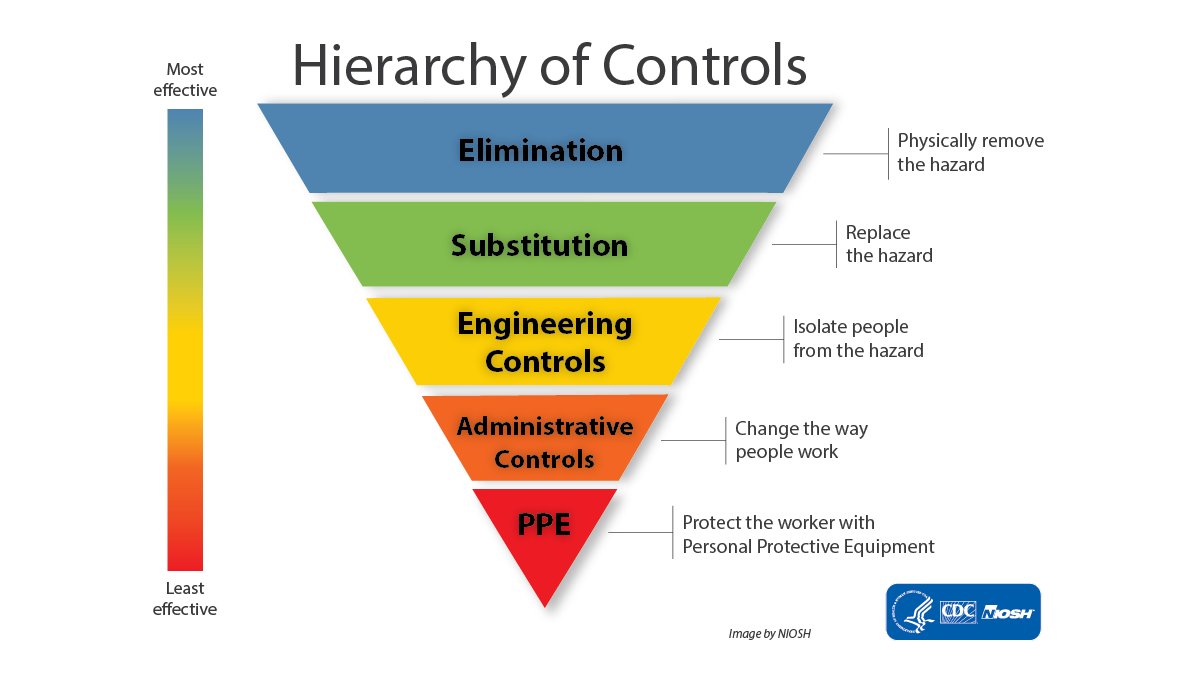
Broadly speaking, some controls are more effective than others. Wherever possible, you should attempt to use more effective controls in place of less effective ones. More effective means not just that it reduces the risk the most, but also the most reliable over time and most resistant to having rules bent, being left broken, being ignored due to alarm fatigue, or 'normalisation of deviation'. Procedures that assume everything is working perfectly and everyone is 100% competent will fail; see MCAS and a great number of other accidents.
Elimination is rarely possible but substitution (radar vs visual) and isolation (separate helicopters from other traffic) amongst other engineering controls are potentially more feasible, and much higher up the hierarchy than a glorified instruction not to crash (the very bottom of administrative). Engineering a problem out of existence is far superior to having a procedure to fix it in the QRH.
I list things like TCAS, GPWS, RSAs, and crash-proof seating as broadly being under PPE: they're nice to have and certainly worth pursuing, but unless there is no other alternative, they should never be your primary protection. Something has gone wrong if they get used.
Subjects
ATC
Close Calls
Normalization of Deviance
Radar
Separation (ALL)
TCAS (All)
Traffic in Sight
Links are to this post in the relevant subject page so that this post can be seen in context.
Reply to this quoting this original post. You need to be logged in. Not available on closed threads.
February 11, 2025, 19:12:00 GMT
permalink Post: 11826274
Subjects
ATC
DCA
Traffic in Sight
Links are to this post in the relevant subject page so that this post can be seen in context.
Reply to this quoting this original post. You need to be logged in. Not available on closed threads.
February 13, 2025, 10:16:00 GMT
permalink Post: 11827259
TCAS RA says that a collision is imminent (within the accuracy of the system, ie it probably means the system can\x92t prove the planes won\x92t hit).
Conflict alert is to notify the controller well in advance \x97 maybe a few minutes for en-route. It isn\x92t a loss of separation, it is so they can avoid a loss of separation (3 or 5 miles for radar).
The problem with conflict alerting is that in mixed-use airspace you will get a lot of warnings; I hesitate to say false as they are defined by preset parameters that may or may not be relevant to the potential conflict. Talking to controllers in the UK, they often turn this feature (STCA) off as GA traffic happily avoiding each other by visual and/or electronic means can fill the screen with so many alerts it distracts from the main job, especially if you are not in communication with either aircraft.
I would expect, given the traffic density around DCA, that CAs are so commonplace they have become unremarkable, indeed expected. Twice the controller was told that the traffic was in sight, so in their mind they are applying visual separation (no minima, just don\x92t collide). The takeaway has to be that IFR/VFR separation at night by visual means is inherently risky and so a questionable pursuit.
Subjects
ATC
DCA
Radar
Separation (ALL)
TCAS (All)
TCAS RA
Traffic in Sight
Visual Separation
Links are to this post in the relevant subject page so that this post can be seen in context.
Reply to this quoting this original post. You need to be logged in. Not available on closed threads.
February 22, 2025, 11:12:00 GMT
permalink Post: 11833584
However, from a US point of view, this is arguably the solution which was in place on the night. It's just that the means of actively keeping the traffic apart, ie visual separation, failed. I am prepared to accept that FAA-style "visual separation" is slightly more robust than "see and avoid" in that it requires ATC to confirm that the pilot has the specific traffic in sight before relaxing separation minima, but the question for the FAA is whether "slightly more robust" is good enough when airliners are involved, particularly at night given the increased potential for misidentification.
I am not sure the subsequent line of discussion over how Class B requires ATC (not pilots) to separate all traffic is a very productive one. Any separation instruction given by ATC relies upon the pilot executing it, for instance by maintaining the cleared altitude. Here, it relied on the pilot not colliding with the specific traffic he had confirmed visual contact with. So far as the FAA is concerned, that's a sufficient degree of control and differs from the "see and avoid" principle applicable to VFR/VFR in Class C, and VFR/Any in Class D. Again, the question is whether that's appropriate.
That last point gives me an opportunity to make an observation I've been pondering for a while. Many European airport control zones are Class D, where on a strict reading of ICAO, VFR traffic is not required to be separated from IFR. But how many of us know a Class D zone where the controller gives traffic information and lets VFR traffic merge with IFR under see and avoid? In practice, European and especially UK ATC exercise a greater degree of control than is strictly required by the ICAO classification. At least in my experience, US airspace is operated closer to ICAO specifications ("visual separation" nothwithstanding).
Last edited by Easy Street; 22nd February 2025 at 11:31 .
Subjects
ATC
DCA
FAA
ICAO
IFR
See and Avoid
Separation (ALL)
Traffic in Sight
VFR
Visual Separation
Links are to this post in the relevant subject page so that this post can be seen in context.
Reply to this quoting this original post. You need to be logged in. Not available on closed threads.
February 22, 2025, 18:56:00 GMT
permalink Post: 11833817
When genuine "see and avoid" applies (Class C VFR/VFR, Class D VFR/Any) the controller does not need to confirm that VFR pilots have visual contact before allowing separation to reduce, because there *are no* separation minima. At least, not according to ICAO.
As I mentioned earlier, European and especially UK ATC tends to apply more stringent separation than ICAO requires. The 'ATC duty of care' argument in the UK results in its Class D being operated in a similar way to US Class B, in my experience.
Last edited by Easy Street; 22nd February 2025 at 19:10 .
Subjects
ATC
FAA
ICAO
See and Avoid
Separation (ALL)
Traffic in Sight
VFR
Visual Separation
Links are to this post in the relevant subject page so that this post can be seen in context.
Reply to this quoting this original post. You need to be logged in. Not available on closed threads.
March 05, 2025, 11:58:00 GMT
permalink Post: 11841230
Now if the controller had said "you look to be tracking very close to the CRJ are you sure you can pass behind?" or similar, then maybe the helo crew would have got excited. A call like that might have even triggered a "holy sh1t" moment about the TCAS "Traffic". But as far as they were concerned, they knew they had the traffic in sight and could do the visual sep thing and even if they had heard "pass behind" they would have said/thought "well, obviously". Except they had the wrong aircraft. ATC had an idea they had the wrong aircraft but didn't get the message across.
As for the reference, same thing. The helo crew could have read-back "pass behind" but it wouldn't have achieved anything.
Subjects
ATC
CRJ
Pass Behind
Pass Behind (All)
Separation (ALL)
TCAS (All)
Traffic in Sight
Visual Separation
Links are to this post in the relevant subject page so that this post can be seen in context.
Reply to this quoting this original post. You need to be logged in. Not available on closed threads.
March 05, 2025, 19:00:00 GMT
permalink Post: 11841477
Now if the controller had said "you look to be tracking very close to the CRJ are you sure you can pass behind?" or similar, then maybe the helo crew would have got excited. A call like that might have even triggered a "holy sh1t" moment about the TCAS "Traffic". But as far as they were concerned, they knew they had the traffic in sight and could do the visual sep thing and even if they had heard "pass behind" they would have said/thought "well, obviously". Except they had the wrong aircraft. ATC had an idea they had the wrong aircraft but didn't get the message across.
As for the reference, same thing. The helo crew could have read-back "pass behind" but it wouldn't have achieved anything.
Subjects
ATC
CRJ
Pass Behind
Pass Behind (All)
Separation (ALL)
TCAS (All)
Traffic in Sight
Visual Separation
Links are to this post in the relevant subject page so that this post can be seen in context.
Reply to this quoting this original post. You need to be logged in. Not available on closed threads.