January 30, 2025, 12:30:00 GMT
permalink Post: 11817186
Subjects: None
8 recorded likes for this post.Reply to this quoting this original post. You need to be logged in. Not available on closed threads.
January 31, 2025, 00:34:00 GMT
permalink Post: 11817798
In the US does an agreement to make a visual approach regardless of airspace classification, cancel IFR separation requirements for the ATCO?
However, note that the airspace class at major US airports is B (rarely used elsewhere). Cancelling IFR in Class B does not relieve ATC of separation responsibility because VFR flights must still be separated from all other flights ( VFR separation standards here ). Separation responsibility only transfers to a pilot when they accept ' visual separation ' and the controller must continue giving separation instructions until that point. Aircraft can be given 'visual separation' against other aircraft, including IFR aircraft as happened here, without the other aircraft needing to have the traffic in sight. The controller must advise the other aircraft that visual separation is being applied if the flight paths are converging .
None of that is necessarily a problem.
The problem is reliance on visual separation at night. The ease with which the eye is drawn to bright lights (which may not be the lights of interest) and inability to perceive depth and distance from a point source of light (made worse by NVG) make it a high risk activity even between combat aircraft. To permit it to be relied upon for protection of airline traffic is madness.
Last edited by Easy Street; 31st January 2025 at 01:14 .
Subjects
ATC
ATCO
IFR
Night Vision Goggles (NVG)
Separation (ALL)
Traffic in Sight
VFR
Visual Separation
Links are to this post in the relevant subject page so that this post can be seen in context.
Reply to this quoting this original post. You need to be logged in. Not available on closed threads.
January 31, 2025, 16:38:00 GMT
permalink Post: 11818348
It is genuinely odd how they flew directly into this thing which must literally have been lighting up the interior of their cockpit. Also, why were they above the 200ft route ceiling?
(Still from the video referenced above by ORAC.)
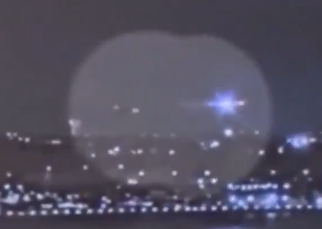
Helo on the left
Here's the more likely issue with NVG. Looking through them is often described as akin to looking through a pair of toilet roll tubes. Field of vision is radically reduced and it takes strong, conscious and fatiguing effort to conduct any kind of visual search.
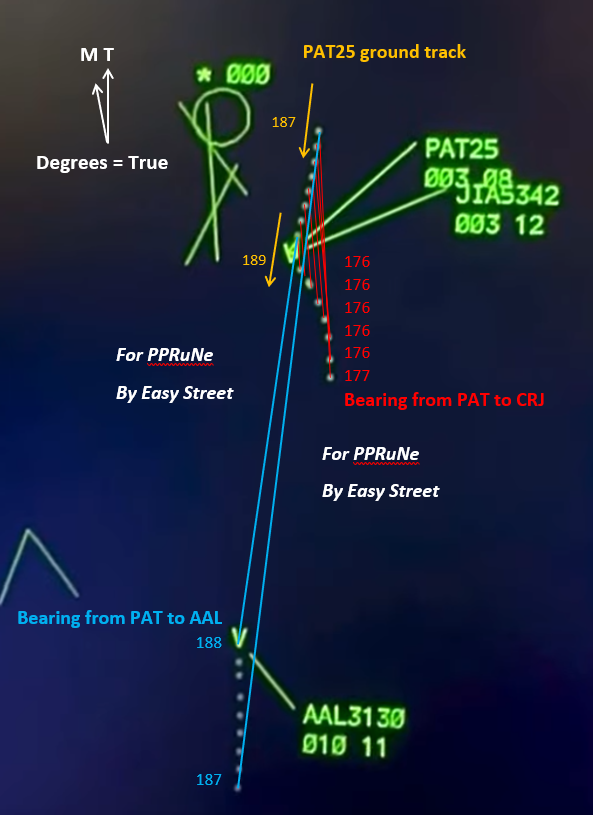
At the start of the radar recording posted to YouTube by AvHerald, AAL3130 is 10 degrees right of the CRJ from PAT25's point of view, and at a similar elevation angle. Its landing lights would be prominent in NVG and if PAT25's pilots were fixated upon it, they would not have seen the CRJ further left unless actively moving their heads to look for it. PAT25 gradually changes heading by 2 degrees right during the course of the radar clip, almost exactly following the bearing to AAL3130, and this makes it even clearer to me that PAT25 was mistakenly holding visual on it.
Last edited by Easy Street; 31st January 2025 at 16:50 .
Subjects
CRJ
Night Vision Goggles (NVG)
PAT25
Radar
Links are to this post in the relevant subject page so that this post can be seen in context.
Reply to this quoting this original post. You need to be logged in. Not available on closed threads.
January 31, 2025, 17:58:00 GMT
permalink Post: 11818419
Subjects
ATC
CRJ
IFR
Pass Behind
Pass Behind (All)
Separation (ALL)
VFR
Visual Separation
Links are to this post in the relevant subject page so that this post can be seen in context.
Reply to this quoting this original post. You need to be logged in. Not available on closed threads.
February 01, 2025, 00:29:00 GMT
permalink Post: 11818652
Bear in mind also that the helo was about 35 degrees right of the CRJ's nose during the final 20 seconds or so, well outside the typical landing light beam width of about 5 or 6 degrees semi-angle.
Last edited by Easy Street; 3rd February 2025 at 02:06 .
Subjects
Night Vision Goggles (NVG)
Links are to this post in the relevant subject page so that this post can be seen in context.
Reply to this quoting this original post. You need to be logged in. Not available on closed threads.
February 02, 2025, 02:56:00 GMT
permalink Post: 11819470
I suspect the helicopter's gradual turn to the right was a result of the pilots fixating on AAL3130 and instinctively flying to pass just behind it, without realising how far away it was.
Edit: this is the reconstruction which shows the similarity in elevation. Captain Steve and Juan Browne have put forward the same theory on their channels but without quite the same compelling graphics.
Last edited by Easy Street; 2nd February 2025 at 03:09 .
Subjects
CRJ
Night Vision Goggles (NVG)
Pass Behind
Pass Behind (All)
Radar
Links are to this post in the relevant subject page so that this post can be seen in context.
Reply to this quoting this original post. You need to be logged in. Not available on closed threads.
February 02, 2025, 10:30:00 GMT
permalink Post: 11819666
... The politics of DCA are going to drive a band-aid fix is my prediction. Visual separation won\x92t go away. FAA will get crucified over manning. DCA may lose some significant service, if we closed 33 permanently.
[I think of the Austin investigation, which did not even mention, let alone question the practice of issuing runway clearances to multiple aircraft at the same time, which IMHO is the root cause of most of the recent near misses.]
Last edited by Easy Street; 2nd February 2025 at 10:50 .
Subjects
ATC
Close Calls
DCA
FAA
Separation (ALL)
Visual Separation
Links are to this post in the relevant subject page so that this post can be seen in context.
Reply to this quoting this original post. You need to be logged in. Not available on closed threads.
February 02, 2025, 11:55:00 GMT
permalink Post: 11819724
Regrettably, I suspect we will see the NTSB take the same approach to the question of visual separation at night. It can't so much as mention the resulting risks without putting the FAA (and as you rightly infer, politicians) in the position of having to admit that safety is not always king. On the evidence of Austin, they won't do that.
Last edited by Easy Street; 2nd February 2025 at 13:05 .
Subjects
FAA
Findings
NTSB
Separation (ALL)
Visual Separation
Links are to this post in the relevant subject page so that this post can be seen in context.
Reply to this quoting this original post. You need to be logged in. Not available on closed threads.
February 02, 2025, 20:31:00 GMT
permalink Post: 11820089
Subjects
ADSB (All)
ADSB In
ADSB Out
Blackhawk (H-60)
TCAS (All)
TCAS RA
Links are to this post in the relevant subject page so that this post can be seen in context.
Reply to this quoting this original post. You need to be logged in. Not available on closed threads.
February 02, 2025, 21:03:00 GMT
permalink Post: 11820111
If the aircraft were at a close to 90-degree intersection, then the CRJ700 would have been moving across the field of vision right in front of the helicopter, thus making the collision all the more perplexing, not withstanding night vision goggles (if indeed worn) interfere with depth perception and can reduce field of view to as low as 40\xb0. Of course there also remains the reported disparity in flying height, with the UH-60 100 feet above it's flight ceiling
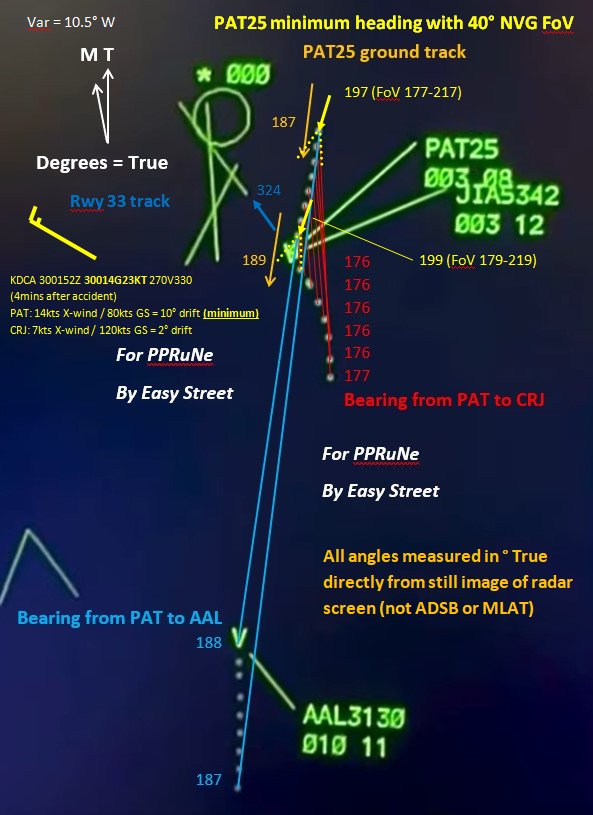
I can't access the METAR history any more, but I think it was 270V330 with gusts above 20kts. With the helo showing a groundspeed of 80kts on the radar trace, a westerly wind of just 12kts would give 9 degrees of drift and therefore a helo heading of 196, putting the CRJ just outside the 20 degree semi-angle of NVG with 40 degree field of view if the pilots were looking straight ahead.
If anyone can supply the METAR info (there was a report just 10mins after the accident), I'll update my radar diagram with the helo heading and a superimposed field of view. (Edit: done at #729 )
Last edited by Easy Street; 3rd February 2025 at 02:04 .
Subjects
Blackhawk (H-60)
CRJ
Night Vision Goggles (NVG)
Radar
Links are to this post in the relevant subject page so that this post can be seen in context.
Reply to this quoting this original post. You need to be logged in. Not available on closed threads.
February 03, 2025, 01:52:00 GMT
permalink Post: 11820222
My marked up version of the radar plot now shows the heading of PAT25 at the first and penultimate sweep, based on the ground track as measured directly from the plot and assuming that the wind is at the non-gust value from the METAR observation taken just 4 minutes later (making this a reasonable minimum drift). It also shows the 40 degree field of view of the AN/AVS-9 NVG, drawn assuming both pilots are looking directly ahead along aircraft centreline.
The take-away is that with these assumptions, the CRJ starts on the extreme left hand edge of the NVG field of view and then moves just out of it. The PAT25 pilots would only see the CRJ in NVG if they turned their heads left of aircraft centreline to search for it. Since they thought they had visual contact, presumably with AAL3130, they would have no reason to do so.
Subjects
CRJ
Night Vision Goggles (NVG)
PAT25
Radar
Links are to this post in the relevant subject page so that this post can be seen in context.
Reply to this quoting this original post. You need to be logged in. Not available on closed threads.
February 04, 2025, 11:51:00 GMT
permalink Post: 11821345
Among the many risky things I used to do as a military pilot, including diving towards the ground at 45 degrees in pitch darkness and pulling out on a range cue to miss the ground by 500 feet, one thing which always made the chain of command particularly nervous was closed pattern work on NVG. At home base, only experienced pilots were allowed to wear NVG in the pattern with another aircraft, and even then only one other: their similarly experienced formation wingman. And that was at a remote airfield with only a few military lives at stake and a tower controller monitoring both aircraft like a hawk. In Afghanistan, it was a toss-up whether the most dangerous place to fly fixed wing was over the Taliban or in the closed pattern at Kandahar, with helicopters darting around wearing covert lighting (they of course had an understandably different view of the risks). The idea of flying through the traffic pattern at a busy civilian airport using NVG to avoid airliners simply appals me.
Last edited by Easy Street; 4th February 2025 at 12:25 .
Subjects
ATC
CRJ
Night Vision Goggles (NVG)
Links are to this post in the relevant subject page so that this post can be seen in context.
Reply to this quoting this original post. You need to be logged in. Not available on closed threads.
February 04, 2025, 13:04:00 GMT
permalink Post: 11821412
The issue outside is that NVG modify and 'flatten' the visual scene markedly. Not all wavelengths are intensified equally: older generation equipment with which I'm familiar amplified red significantly, green not at all (hence green writing in HUDs and green lighting in NVG cockpits), and blue only moderately. The purpose of NVG is to see the ground, so gain control is applied to prevent bright points of light from obscuring the terrain; this means that beyond a certain brightness, all lights look the same. However a particularly bright light can create a dark halo around it, potentially obscuring dim lights nearby. It is possible to see two lights with the naked eye and only one with NVG. There is no ability to discern colour or sharpness, at least in the equipment I'm familiar with, and any twinkle is lost.
Stories abound of pilots chasing after bright stars or planets, wondering why their TACAN range to the tanker keeps increasing. It is really a thing, trust me. I distinctly remember the aviation medical officer giving the NVG introductory briefing telling us that if we were to undergo assessment of visual acuity while wearing them on a perfectly moonlit night, we would be assessed as clinically blind! That message was never lost on me.
Subjects
Night Vision Goggles (NVG)
Links are to this post in the relevant subject page so that this post can be seen in context.
Reply to this quoting this original post. You need to be logged in. Not available on closed threads.
February 05, 2025, 10:45:00 GMT
permalink Post: 11822093
Perhaps you mean that DoD would not be too happy with not being able to take visual separation, at night, using NVG? I think they might have to suck that up - especially the second and third aspects.
Subjects
IFR
Night Vision Goggles (NVG)
Separation (ALL)
VFR
Visual Separation
Links are to this post in the relevant subject page so that this post can be seen in context.
Reply to this quoting this original post. You need to be logged in. Not available on closed threads.
February 05, 2025, 12:57:00 GMT
permalink Post: 11822202
...change from Heathrow Special to Tower for the crossing itself. There's a further hold at Twin Taxiways between the runways. Altitudes are shown. Note there is usually unrestricted passage on routes H3 and H10 along the river directly under the approach...
...defined clearance limits, sensible vertical separation and, critically, coherent and specific controller voice procedure.
I agree with your underlying point that blanket application of IFR separation criteria would be inappropriate. But there are modes of separation besides the false binary of 'visual' and 'IFR' which can be applied to VFR traffic.
Last edited by Easy Street; 5th February 2025 at 14:01 .
Subjects
ATC
IFR
Radar
Separation (ALL)
VFR
Vertical Separation
Visual Separation
Links are to this post in the relevant subject page so that this post can be seen in context.
Reply to this quoting this original post. You need to be logged in. Not available on closed threads.
February 06, 2025, 11:35:00 GMT
permalink Post: 11822919
PAT25: "PAT25 has the traffic in sight, request visual separation"
Tower: "Visual separation approved"
0:26 here:
Subjects
CRJ
PAT25
Separation (ALL)
Traffic in Sight
Visual Separation
Links are to this post in the relevant subject page so that this post can be seen in context.
Reply to this quoting this original post. You need to be logged in. Not available on closed threads.
February 15, 2025, 10:24:00 GMT
permalink Post: 11828489
I sincerely hope the NTSB can avoid being distracted by the distractions of altimetry and the missing ATC words on the Blackhawk CVR.
Upthread, Luca Lion calculated the 3 degree PAPI approach path as crossing the eastern riverbank at 270ft. If that's correct, then the CRJ's 313ft radar height 2 seconds before collision puts it at least 43ft above the approach path, so the Blackhawk's radio height deviation of 78ft would have contributed only about 35ft to the erosion of any intended "procedural separation" (*) between the aircraft. Or, to put it another way, the same outcome would have resulted if the Blackhawk had been at 235ft radio and the CRJ on the glide. Height keeping of plus or minus 35ft can only be achieved by instrument flying, which is obviously not compatible with visual separation (or indeed VFR) so cannot be reasonably cited as part of a safety case for the procedure. And of course a landing aircraft could easily be below the glide. Altimetry and height keeping are not the cause of this accident.
Missing the word "circling" wouldn't have influenced the helo crew getting visual with the CRJ at the time of the trasnmission. At best, it would have given them an extra nudge that "runway 33" (which was audible) meant the CRJ would be taking an easterly flight path. Missing "pass behind" with only a few seconds to collision was irrelevant if, as seems likely, the helo crew did not see the CRJ at that point.
(*) The quotes around "procedural separation" are intended to convey a tone of disgust and sarcasm.
Last edited by Easy Street; 15th February 2025 at 10:47 .
Subjects
ATC
Altimeter (All)
Blackhawk (H-60)
CRJ
CVR
Final Report
NTSB
Pass Behind
Pass Behind (All)
Radar
Separation (ALL)
VFR
Visual Separation
Links are to this post in the relevant subject page so that this post can be seen in context.
Reply to this quoting this original post. You need to be logged in. Not available on closed threads.
February 15, 2025, 12:41:00 GMT
permalink Post: 11828596
Why did the did miss part of the message
Why was the incomplete read back missed
Why does missing a few words lead to this disaster within seconds.
Does this lead an answer like: helicopter in a very busy airspace, busy controllers (insufficient time to be fully focused on full read backs) being by default too close to (and even needing to cross) the glideslope.
Helicopters in busy airspace are not a problem if a safe system exists for separating them from airline traffic.
There is no evidence yet of the controller having made a mistake. He was undoubtedly busy, but that was not his fault. What could be done about it? The answers to that question take us another step along the causal chain:
- The FAA could have provided more controllers. We know the helicopter controller position was unoccupied, and it's likely that closer monitoring and earlier intervention could have changed the outcome (notwithstanding point 3).
- Controller workload could have been reduced by implementing effective procedural separation . If the DCA ATC rulebook allowed this segment of Route 4 to be in simultaneous use with Runway 33 landings, then procedural separation did not exist , however much anyone thought it did. At least 1.5nm or 500ft between flight paths would be needed to meet the least restrictive FAA separation standards, and this would have forced constraints to be applied to Route 4 or Runway 33 utilisation.
- Regulations allowed the helo pilots to assume responsibility for separation. This is what happened, with the consequences which flow from the inherent difficulty of identifying and separating visually at night (especially while wearing NVG).
The authorities (by which I mean FAA and DoD) have questions to answer on all three points. Why was the helicopter controller position vacant? Did the ATC rulebook or staffing requirements rely on a false assumption that procedural separation existed? How did any such assumption remain in place after previous near misses? Is visual separation between helicopters and airline traffic a reasonable thing for regulations to permit, at night and using NVG? Ultimately it seems to have routinely been used as a release valve for the pressure building in the system due to the failure to address points 1 and 2.
Hopefully the investigation will be bold enough to ask these questions, which expand the potential scope of responsibility well beyond the individual controller and pilots.
Last edited by Easy Street; 15th February 2025 at 13:36 .
Subjects
ATC
Close Calls
DCA
FAA
Night Vision Goggles (NVG)
Route 4
Separation (ALL)
Visual Separation
Links are to this post in the relevant subject page so that this post can be seen in context.
Reply to this quoting this original post. You need to be logged in. Not available on closed threads.
February 16, 2025, 09:42:00 GMT
permalink Post: 11829100
Last edited by Easy Street; 16th February 2025 at 10:32 .
Subjects
ATC
Night Vision Goggles (NVG)
Separation (ALL)
Visual Separation
Links are to this post in the relevant subject page so that this post can be seen in context.
Reply to this quoting this original post. You need to be logged in. Not available on closed threads.
February 16, 2025, 18:30:00 GMT
permalink Post: 11829380
200 feet is the maximum and they had to get permission for this route. They\x92re flying past a busy airport. On one hand you\x92re all saying this accident was bound to happen, on the other hand this in and of itself indicates pilots don\x92t fly through these zones without concerns & vigilance. It makes no sense they would play roulette with the height - most pilots would be adhering to rules & a little on edge knowing a VIP or any number of emergency protocols could happen in the capital of America.
It just doesn\x92t add up - the complacency over elevation. Between two pilots it should have been rectified. May they rest in peace & this isn\x92t a slur against their name but in support of it not being their fault and something amiss.
Systems that rely on human perfection are 100% guaranteed to fail. The only question is how often. The system in place at DCA required helo pilots to assume responsibility for visual (*not vertical*) avoidance of collisions in order to fulfil their ordered missions. Given what we know about human visual performance at night, that would eventually end badly, and sure enough it did. There is a strong element of the pilots having been set up to fail, which is why no-one here is going hard on them.
Altimetry and height keeping would be important matters for investigators if the collision had occurred due to a breakdown in vertical separation, which as a minimum would involve 500 feet (and more often 1000 feet) of planned spacing to account for instrument and height keeping errors. FAA instrument rating standards require pilots to be able to maintain altitude plus or minus 100 feet. This helicopter was being flown VFR at very low height, which means that looking outside takes primacy over monitoring instruments. I'm sure helo pilots could fly along at 175ft plus or minus 25ft if they really tried, but you can be certain they wouldn't be looking out for traffic (as is required when holding responsibility for visual separation).
However, as there was no vertical separation built into this procedure, all of this is at best a distraction. The more important questions are why procedural barriers were not in place to stop the route being used during landings on runway 33, and whether visual separation at night is an adequate barrier to collision when airliners and their human cargo are involved.
Last edited by Easy Street; 16th February 2025 at 18:57 .
Subjects
CRJ
DCA
FAA
PAT25
Separation (ALL)
VFR
Vertical Separation
Visual Separation
Links are to this post in the relevant subject page so that this post can be seen in context.
Reply to this quoting this original post. You need to be logged in. Not available on closed threads.