January 30, 2025, 03:21:00 GMT
permalink Post: 11816809
TCAS
ATC
ADS-B
See and Avoid
Filing a flight plan
Not operating in controlled airspace without a transponder
Not operating at a landing altitude for aircraft on final for a well used runway
Announcing an intention to cross a well used approach
Position lights/strobes
Landing lights
Just spitballing, but there's a non-zero chance NVGs were in use in the helicopter.
It sucks that the best part of this is the airplane was a CRJ, not a larger airliner. Most all those passengers would have survived the initial collision and been aware during the fall to the river.
I feel rage.
Subjects
ADSB (All)
ATC
CRJ
Night Vision Goggles (NVG)
See and Avoid
TCAS (All)
Links are to this post in the relevant subject page so that this post can be seen in context.
Reply to this quoting this original post. You need to be logged in. Not available on closed threads.
January 31, 2025, 15:35:00 GMT
permalink Post: 11818296
It is genuinely odd how they flew directly into this thing which must literally have been lighting up the interior of their cockpit. Also, why were they above the 200ft route ceiling?
(Still from the video referenced above by ORAC.)
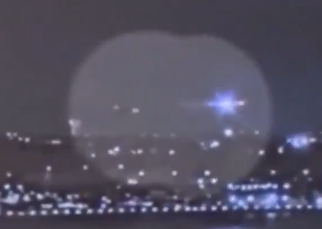
Helo on the left
The other lights should have been visible from inside the helicopter, but they were likely looking a different direction to monitor other aircraft.
Subjects
CRJ
Links are to this post in the relevant subject page so that this post can be seen in context.
Reply to this quoting this original post. You need to be logged in. Not available on closed threads.
February 04, 2025, 21:27:00 GMT
permalink Post: 11821718
Subjects: None
2 recorded likes for this post.Reply to this quoting this original post. You need to be logged in. Not available on closed threads.
February 05, 2025, 17:40:00 GMT
permalink Post: 11822386
I think "smoother" would be a poor trade-off in this circumstance.
Subjects: None
1 recorded likes for this post.Reply to this quoting this original post. You need to be logged in. Not available on closed threads.
February 14, 2025, 23:39:00 GMT
permalink Post: 11828297
Subjects
ATC
Radio Altimeter
Links are to this post in the relevant subject page so that this post can be seen in context.
Reply to this quoting this original post. You need to be logged in. Not available on closed threads.
February 17, 2025, 23:42:00 GMT
permalink Post: 11830331
I would also expect helicopter pilots would avoid doing it at all. I would not recommend testing.
Last edited by Senior Pilot; 18th February 2025 at 01:12 . Reason: Leave the US Politics out of it, thanks
Subjects
Pass Behind
Pass Behind (All)
Links are to this post in the relevant subject page so that this post can be seen in context.
Reply to this quoting this original post. You need to be logged in. Not available on closed threads.
February 19, 2025, 23:36:00 GMT
permalink Post: 11831852
Subjects
NTSB
Links are to this post in the relevant subject page so that this post can be seen in context.
Reply to this quoting this original post. You need to be logged in. Not available on closed threads.
March 26, 2025, 02:10:00 GMT
permalink Post: 11854312
The helo crew asked ATC for visual clearance and ATC agreed. It is not clear why the helo crew made the request nor how they missed that an aircraft switched from crossing their field of vision to one that became fixed in their field of vision, but it is likely the bias of certainty in their mental model of which direction they needed to look did not include towards the side.
Subjects
ATC
Links are to this post in the relevant subject page so that this post can be seen in context.
Reply to this quoting this original post. You need to be logged in. Not available on closed threads.
March 27, 2025, 18:31:00 GMT
permalink Post: 11855367
Subjects: None
No recorded likes for this post (could be before pprune supported 'likes').Reply to this quoting this original post. You need to be logged in. Not available on closed threads.
March 29, 2025, 19:57:00 GMT
permalink Post: 11856868
Instead of the unavoidable chance of getting shot down there is the continuous risk of mid-air collision.
Of the two ends of these conflicting requirements, I don't see that the DoD will want to budge, and I don't see a safe resolution that works without ADS-B and other broadcasts.
At the least, in a national emergency, there would be no need to follow the defined helicopter corridors. The Georgetown residents can file their noise complaints if they want to.
Subjects
ADSB (All)
Links are to this post in the relevant subject page so that this post can be seen in context.
Reply to this quoting this original post. You need to be logged in. Not available on closed threads.
March 30, 2025, 05:44:00 GMT
permalink Post: 11857069
I agree with the rest and don't understand** the constant foot dragging by the FAA about ADS-B.
**Disclaimer: I do understand it because the FAA is under control of the Congress and the lobbyists for the aviation industry seem to have made it clear that a mandate for ADS-B will be resisted by a bunch of people who don't want to spend money on what they feel is unnecessary. Instead they go after the ones with a weak lobby, the hobby drones, to have useless short-range position transmitters that don't improve safety, but do increase cost. I also think there is some sort of cover-up in that ADS-B doesn't have enough bandwidth for the full integration such as placing transmitters on known fixed obstacles, like radio towers, and the predicted commercial drone traffic. So the FAA is stuck. Have it as a nice extra, but if they push too much and the flaws become obvious. To fix that likely requires some give from the FCC of spectrum, but the FCC has been selling prime spectrum to private industry and have lobbyists chewing on the FCC who would not give up a slice for the common good.
Subjects
ADSB (All)
FAA
Links are to this post in the relevant subject page so that this post can be seen in context.
Reply to this quoting this original post. You need to be logged in. Not available on closed threads.
March 30, 2025, 21:50:00 GMT
permalink Post: 11857565
This is from 7 years ago:
Subjects
ADSB (All)
ADSB Out
FAA
Links are to this post in the relevant subject page so that this post can be seen in context.
Reply to this quoting this original post. You need to be logged in. Not available on closed threads.
July 31, 2025, 19:18:00 GMT
permalink Post: 11931506
For TF/TA radalt is the go-to instrument, but for coordinating multiple aircraft to maintain vertical separation, barometric altitude is more suitable. The problem being that barometric altimeters are subject to a lot of measurement and reporting errors.
I am sure that GPS-RTK could be used to fix the absolute altitude with great precision, but I am also sure that depending on an easily denied measurement source on a military aircraft is not going happen.
The correct solution for operating in a civilian airspace is to use ADS-B In/Out for all manned aircraft to provide appropriate and timely situational awareness. While ADS-B is also subject to denial, it offers far greater benefit in civilian airspace over GPS-RTK in that it tells the pilots where all the other aircraft are rather than simply being more precise about where their own aircraft is.
It is clear that the helicopter crew not knowing where the passenger jet was was the primary cause of the collision.
Arguments about the error in the altimeter readings are suitable to emphasize that depending on them in a crowded airspace is a fool's choice and should have been spotted a long time ago as insufficient to provide clearance.
Subjects
ADSB (All)
Altimeter (All)
Radio Altimeter
Separation (ALL)
Situational Awareness
Vertical Separation
Links are to this post in the relevant subject page so that this post can be seen in context.
Reply to this quoting this original post. You need to be logged in. Not available on closed threads.
July 31, 2025, 23:36:00 GMT
permalink Post: 11931584
EDIT: I also appreciate the arriving jet was on a geometric glide slope and that radalt under the glideslope could have been sufficient, but if one is expecting that vertical separation is sufficient then there needs to be certainty to that altitude and clearly that isn't possible on barometric altimeter and should never have been accepted by anyone.
Last edited by MechEngr; 1st August 2025 at 05:39 .
Subjects
AA5342
Altimeter (All)
Barometric Altimeter
Radio Altimeter
Separation (ALL)
Vertical Separation
Links are to this post in the relevant subject page so that this post can be seen in context.
Reply to this quoting this original post. You need to be logged in. Not available on closed threads.
September 29, 2025, 23:10:00 GMT
permalink Post: 11961778
The benefit of suing the airline may be to allow the airline to use that as leverage against the FAA and the Army over their losses and maybe pressure both to take steps to eliminate the possibility of happening again.
Have I just missed it or has the US Army been very quiet about this event and what changes in procedures and equipment they might make?
Last edited by MechEngr; 29th September 2025 at 23:23 .
Subjects
FAA
Links are to this post in the relevant subject page so that this post can be seen in context.
Reply to this quoting this original post. You need to be logged in. Not available on closed threads.
October 20, 2025, 14:28:00 GMT
permalink Post: 11973153
The following video is from NTSB, about 8 years ago concerning the midair collision between Cessna 150M, N3601V and Lockheed Martin F-16CM, 96-0085
From the description:
Subjects
ADSB (All)
ADSB In
ATC
NTSB
Links are to this post in the relevant subject page so that this post can be seen in context.
Reply to this quoting this original post. You need to be logged in. Not available on closed threads.
December 11, 2025, 01:44:00 GMT
permalink Post: 12003399
From https://armedservices.house.gov/uplo...to_s._1071.pdf
RULES COMMITTEE PRINT 119–16 TEXT OF HOUSE AMENDMENT TO S. 1071
While it starts out with a request that military training flights may need to have warnings to civilian aircraft, it does not require ALL military operations near DCA to do so and then says:
From Section 373
p275
9 ‘‘(b) WAIVER AUTHORITY.—The Secretary of a mili-
10 tary department, with the concurrence of the Secretary of
11 Transportation, may waive the limitation under subsection
12 (a) with respect to the operation of an aircraft if that Sec-
13 retary—
14 ‘‘(1) determines that—
15 ‘‘(A) such waiver is in the national security
16 interests of the United States; and
17 ‘‘(B) a commercial aviation compatibility
18 risk assessment has been conducted with re-
19 spect to the operation of the aircraft pursuant
20 to the waiver to mitigate the risk associated
21 with such operation; and
22 ‘‘(2) in the case of a waiver to be in effect for
23 a period exceeding 30 days, submits to appropriate
24 congressional committees notice of such waiver, in-
25 cluding a copy of the applicable commercial aviation
p276
1 compatibility risk assessment specified in paragraph
2 (1)(B)
It goes on to specify that this waiver is for DCA.
One only puts in waiver authority if there is certainty it will be used.
This also only appears to affect DCA, leaving civilian aircraft everywhere else in the USA to be blind to the military.
Subjects
DCA
Section 373 of the FY26 NDAA
Links are to this post in the relevant subject page so that this post can be seen in context.
Reply to this quoting this original post. You need to be logged in. Not available on closed threads.
December 12, 2025, 16:54:00 GMT
permalink Post: 12004266
What makes it strange is that if someone in the House is going Bad Boy Scout and saving the taxpayer, the ultimate source of the potential payout, that Congress critter would ordinarily be boasting about those savings, like the way that an Executive critter (Rubio) is boasting about going back from Calibri to Times New Roman (because the Biden administration said Calibri was a help to those with damaged eyesight). But no Congress critter is going to be able to take credit for this change if it becomes clear it results in further hurt to the surviving families of the victims of the collision. They won't say "Look at how I saved the US government from the consequences of their carelessness" on the campaign trail.
It's a rare Congress critter who does a thing which, if discovered, would bring hellfire down upon them, and for which they can never take public credit, but for which they also not being paid. If one is to sell out the good of the people, it normally requires a fat bribe. If that can of worms is opened - the DoD paying cash bribes to Congress for political favors - that will be a very difficult can to seal up again. If not the DoD, who would benefit from paying off a Rep to do this?
Subjects: None
1 recorded likes for this post.Reply to this quoting this original post. You need to be logged in. Not available on closed threads.
December 13, 2025, 02:21:00 GMT
permalink Post: 12004450
December 10, 2025
Press Release
WASHINGTON, D.C. —Congressman Troy E. Nehls (R-TX-22) released the following statement after voting “YES” to pass S.1071, the National Defense Authorization Act of Fiscal Year (FY) 2026, which included H.R. 1058, the Directing Resources for Officers Navigating Emergencies (DRONE) Act of 2025, bipartisan legislation Congressman Nehls championed with Congressman Lou Correa (D-CA-46):
"I just voted “YES” to pass the National Defense Authorization Act for Fiscal Year (FY) 2026. This legislation restores our military’s focus on lethality, meritocracy, and accountability, and gives our brave service men and women a 3.8% pay raise.
December 11, 2025
Press Release
WASHINGTON, D.C. —House Aviation Chairman Troy E. Nehls (R-TX-22) released the following statement expressing concern regarding Section 373 of the National Defense Authorization Act (NDAA) of Fiscal Year (FY) 2026:
“While I supported the overall passage of the FY26 NDAA, I have specific concerns with Section 373 of the legislation, which does little, if anything, to adequately address the safety of the overly congested National Capitol Region airspace,” said Chairman Nehls. “I made a commitment to the families of American Airlines flight 5342 and to the American people that we, as Congress, will ensure the January 29 midair crash that took 67 souls would never happen again. Section 373 of the FY26 NDAA fails to uphold that commitment and fails to seriously consider the safety of DC’s congested airspace.
Subjects
Accountability/Liability
NDAA
Section 373 of the FY26 NDAA
Links are to this post in the relevant subject page so that this post can be seen in context.
Reply to this quoting this original post. You need to be logged in. Not available on closed threads.
December 13, 2025, 05:20:00 GMT
permalink Post: 12004479
As a result of this investigation, we issued 2 urgent new recommendations. We issued recommendations to:
To the Federal Aviation Administration:
Prohibit operations on Helicopter Route 4 between Hains Point and the Wilson Bridge when runways 15 and 33 are being used for departures and arrivals, respectively, at Ronald Reagan Washington National Airport (DCA). (Urgent)
Designate an alternative helicopter route that can be used to facilitate travel between Hains Point and the Wilson Bridge when that segment of Route 4 is closed. (Urgent)
The CRJ was equipped with TCAS, which may or may not have been applicable at this low altitude as it is suppressed at 400 ft. The preliminary report does not indicate the helicopter having a TCAS or having an operating one. It did have the ability to produce ADS-B Out. Neither aircraft is reported to have had ADS-B In.
Since many operators seem to loath spending money on ADS-B In, the recommendation from the NTSB was to (1) stop simultaneous flight path use and (2) go elsewhere when the approaches were in use. The FAA agreed.
Per https://data.ntsb.gov/carol-main-pub...tails/A-25-001 the FAA did what was recommended about simultaneous use.
Per https://data.ntsb.gov/carol-main-pub...tails/A-25-002 the FAA made a satisfactory response concerning planning the alternate route(s)
This legislation is the exact opposite of that recommendation.
No doubt the anger isn't just that the NTSB has yet again been ignored, it's that the FAA agreements to safety measures are targeted for destruction in a way that recreates the circumstance of the tragic event.
I said at first, on seeing this collision a few hours after the event, that I felt rage that so many safety measures are available and yet none of them was actually used.
This section, 373, is what I consider an intentional sabotage of the safe operations around DCA.
The FAA literally had advertising videos showing the use of ADS-B In on helicopters for this exact purpose, to give situational awareness to the pilots long before there would be a need to deconflict with other traffic (see end) . No sudden swerves as TCAS attempts to make a last moment save of a terrible situation. TCAS alone cannot be the solution as TCAS gets shut off to avoid nuisance complaints about the terrain the plane is intentionally going to run into or other proximate planes waiting for takeoff.
ADS-B In is for noting where everyone else is in the neighborhood of the aircraft. Had the helicopter been equipped with ADS-B In they would have known the speed and direction of the CRJ and seen it was on a collision course.
As usual it appears there is no name attached nor meeting notes about who submitted what became Section 373. There is certainly no justification paper that will see the light of day.
If those exist, please, someone, prove me wrong.
I cannot find it on YouTube.
An actual user who avoided a mid-air using ADS-B In (Trent Palmer, if anyone wants to avoid him; not everyone is liked):
Subjects
ADSB (All)
ADSB In
ADSB Out
CRJ
DCA
FAA
NTSB
Preliminary Report
Route 4
Section 373 of the FY26 NDAA
Situational Awareness
TCAS (All)
Links are to this post in the relevant subject page so that this post can be seen in context.
Reply to this quoting this original post. You need to be logged in. Not available on closed threads.