July 30, 2025, 16:22:00 GMT
permalink Post: 11930758
Subjects
NTSB
Links are to this post in the relevant subject page so that this post can be seen in context.
Reply to this quoting this original post. You need to be logged in. Not available on closed threads.
August 02, 2025, 22:32:00 GMT
permalink Post: 11932521
Day 1
https://transcript.verbit.co/?transcriptJobId=c8273991-7823-4761-8ab1-95618f517981
Day 2
https://transcript.verbit.co/?transcriptJobId=02727bab-a1a2-4efd-95cb-de7991bdce87
Day 3
https://transcript.verbit.co/?transcriptJobId=42394932-5289-4aa9-b9ea-4a5d3ee725f6
Subjects
NTSB
Links are to this post in the relevant subject page so that this post can be seen in context.
Reply to this quoting this original post. You need to be logged in. Not available on closed threads.
August 04, 2025, 05:46:00 GMT
permalink Post: 11932987
https://www.ntsb.gov/investigations/...CA25MA108.aspx
The docket is linked at the bottom of that page.
NTSB Public Docket
https://data.ntsb.gov/Docket/?NTSBNumber=DCA25MA108
The docket contains evidence related to the investigation. Many NTSB investigations have public dockets; often they're released with the final report.
In the docket:
10-HELO-A FLIGHT DATA RECORDER - HELICOPTER - GROUP CHAIRMAN'S FACTUAL REPORT
https://data.ntsb.gov/Docket/Documen...0L_FDR-Rel.pdf
Subjects
Final Report
NTSB
NTSB Docket
Links are to this post in the relevant subject page so that this post can be seen in context.
Reply to this quoting this original post. You need to be logged in. Not available on closed threads.
August 08, 2025, 06:37:00 GMT
permalink Post: 11935035
If they would has kept wings level, maybe both wings would have narrowly escaped major damage, only MLG and belly at risk of the main rotor.
But it all doesn't matter, really. 'Fate is the hunter' and they got caught.
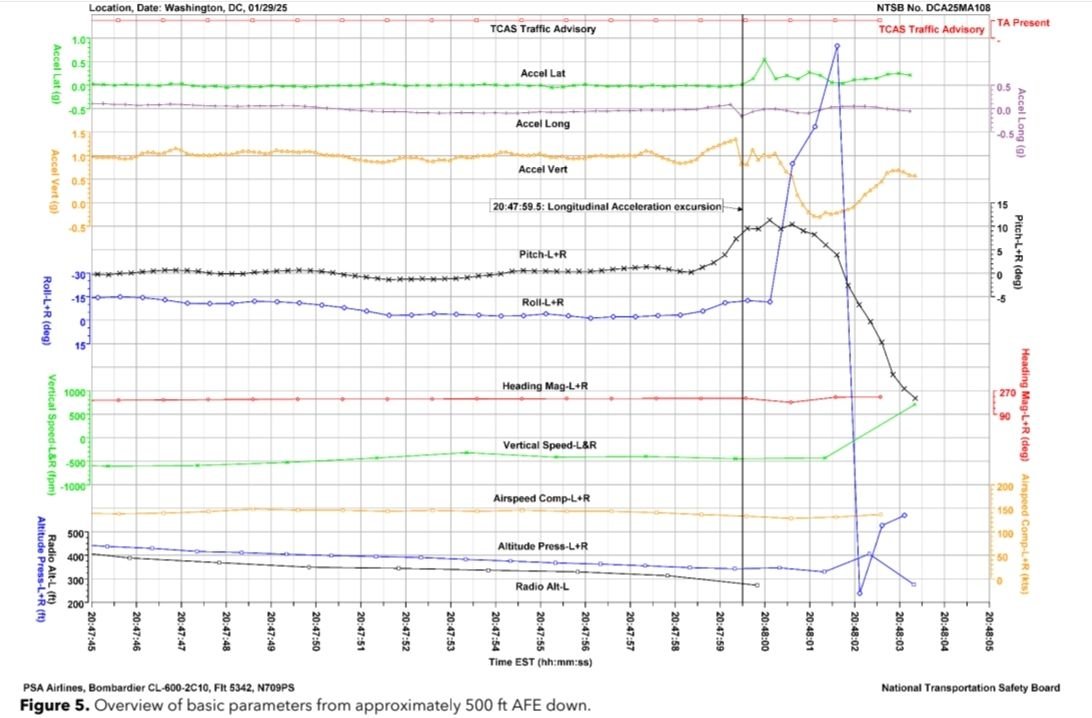
You can see that the pitch-up reduced the airspeed, and the vertical speed was mostly unaffected. This would have had a net effect of making the descent steeper (as the Radio Alt suggests).
If the CRJ crew had remained unaware, we would've learned how the downwash of a helicopter affects the wings of a jet.
The ultimate point is that a situation where a helicopter scrapes by the underside of a jet is not supposed to occur. At this point, all bets are off anyway, and rather than pondering what to do in such a situation, the focus should be on how to prevent it in the first place.
Subjects
CRJ
Links are to this post in the relevant subject page so that this post can be seen in context.
Reply to this quoting this original post. You need to be logged in. Not available on closed threads.
August 11, 2025, 09:41:00 GMT
permalink Post: 11936588
Shouldn't aircraft have 1000 ft ground/obstacle clearance in built-up areas, in general? and 500 ft. otherwise?
That route forced helicopters below 200 ft., how can that not be unsafe?
Subjects: None
No recorded likes for this post (could be before pprune supported 'likes').Reply to this quoting this original post. You need to be logged in. Not available on closed threads.
August 12, 2025, 15:40:00 GMT
permalink Post: 11937327
Here, the helicopter pilots had obviously routinely been lying to LC (and getting away with it!), so the system broke down.
Subjects
ATC
Separation (ALL)
Visual Separation
Links are to this post in the relevant subject page so that this post can be seen in context.
Reply to this quoting this original post. You need to be logged in. Not available on closed threads.
August 12, 2025, 16:04:00 GMT
permalink Post: 11937346
I wonder how many pilots on rwy 01/19 really perceived this section of the routing as unsafe (when flown correctly = hugging the shoreline at max 200ft).

I take your point that the route was legal (if unsafe).
My impression is that the 500/1000 ft clearance rule exists so when a pilot gets disoriented, or suffers a flight control problem, they don't immediately smash into things; and that they have a chance to find a suitable place to
If you don't have that altitude, you're missing a slice of cheese; and of course you won't feel it missing unless you need it, which is often the case with safety.
If the heli route had been higher up, then letting helicopters fly it on visual separation while runway 33 was in use wouldn't be "normalising deviance", it'd be normalising insanity, i.e. the illusion of "safety" that the 200 ft restriction provided would have been absent. The fact that someone at the FAA thought, "it'll be ok if we force the helicopters down to an unsafe altitude routinely" speaks of eroded safety standards to me. There are some disasters (and at least one impressive Space Shuttle fireball) that resulted from eroded safety standards, where managers convinced themselves it would still be ok--until it wasn't.
Subjects
FAA
Route 4
Separation (ALL)
Visual Separation
Links are to this post in the relevant subject page so that this post can be seen in context.
Reply to this quoting this original post. You need to be logged in. Not available on closed threads.
August 14, 2025, 08:04:00 GMT
permalink Post: 11938210
We don't know if the heli crew thought they had seen that traffic (but picked the wrong one) or not, though the CVR conveys the impression they didn't, because they didn't talk about it (like they did about other traffic earlier in the flight).
It's also difficult to judge distance if all you see is a light, in your night vision goggles.
And it's especially difficult if you fail to predict the other aircraft's maneouver. The CRJ rolled out on final only 7 seconds before the collision. Until then, from a purely visual standpoint, everything would've looked fine. It required the heli crew to be aware of where the runway 33 extended centerline was (and where they were) to avoid being where the CRJ was going.
Subjects
CRJ
CVR
Normalization of Deviance
Separation (ALL)
Traffic in Sight
Visual Separation
Links are to this post in the relevant subject page so that this post can be seen in context.
Reply to this quoting this original post. You need to be logged in. Not available on closed threads.
August 14, 2025, 14:00:00 GMT
permalink Post: 11938382
Yes but that is only the visual separation procedure .
When we talk about un safe " procedures" (plural) it is mostly the airspace design and the actions written and put in place which have to be performed to keep that design safe . That part : "conflicting paths used simultaneously with only 100 or 200ft separation " is the basic " unsafe " part of the procedures. For me at least .
"Visual separation" is the procedure that's supposed to make this safe, i.e. ensure that the actual separation is never that low.
Did DCA actually schedule conflicting flights without visual separation procedures?
Subjects
ATC
DCA
Preliminary Report
Separation (ALL)
Visual Separation
Links are to this post in the relevant subject page so that this post can be seen in context.
Reply to this quoting this original post. You need to be logged in. Not available on closed threads.
August 15, 2025, 07:31:00 GMT
permalink Post: 11938800
Subjects
ATC
CRJ
DCA
Route 4
Separation (ALL)
VFR
Links are to this post in the relevant subject page so that this post can be seen in context.
Reply to this quoting this original post. You need to be logged in. Not available on closed threads.
September 27, 2025, 17:25:00 GMT
permalink Post: 11960678
The plaintiff lawyers would have a better argument against the airline if they had deviated from the approach.
Subjects
Accident Waiting to Happen
Close Calls
Links are to this post in the relevant subject page so that this post can be seen in context.
Reply to this quoting this original post. You need to be logged in. Not available on closed threads.
September 28, 2025, 06:33:00 GMT
permalink Post: 11960869
It's more difficult to argue that the airlines should have been doing FAA's job for them.
Subjects
Accident Waiting to Happen
Close Calls
FAA
Links are to this post in the relevant subject page so that this post can be seen in context.
Reply to this quoting this original post. You need to be logged in. Not available on closed threads.
September 29, 2025, 09:41:00 GMT
permalink Post: 11961394
If the SOP requirement was instituted by the airline out of a safety concern, to reduce the workload on the pilots during that critical phase of flight, then that has a bearing on how responsibility is apportioned.
Subjects
ATC
PSA Procedures
Situational Awareness
Links are to this post in the relevant subject page so that this post can be seen in context.
Reply to this quoting this original post. You need to be logged in. Not available on closed threads.
September 29, 2025, 11:23:00 GMT
permalink Post: 11961446
Subjects
ATC
Blackhawk (H-60)
CRJ
Pass Behind
Pass Behind (All)
Links are to this post in the relevant subject page so that this post can be seen in context.
Reply to this quoting this original post. You need to be logged in. Not available on closed threads.
September 29, 2025, 15:28:00 GMT
permalink Post: 11961563
This is the problem with enthusiastic amateurs and blood-thirsty lawyers: all these peripheral issues take centre-stage and the real causes are not addressed. Easier to spear the pilots of the CRJ for not doing a unneeded briefing or missing a TCAS alerts than get the FAA and army boffins that approved that sh1tshow in the first place...
I also don't advocate for that issue taking center stage, but to taboo it and to say we can't talk about it ever doesn't seem right, either. The central issue in this accident is ATC's decision to routinely leave separation in the hands of a heli crew with night vision goggles and less than 75 feet of procedural separation. But we all know this by now if we've watched the NTSB presentation, so please excuse me for not repeating this with every post.
The central issue of the lawsuit is whether the level of safety provided by FAA rules, FAA/ATC procedures, Airline decisions and SOPs, Army decisions and SOPs, and pilot performance on the day are sufficient to legal standards. It's a complex interplay of factors, and even though it's clearly far from the deciding factor, I'm not going to say that a late approach briefing did not matter at all.
Subjects
CRJ
FAA
NTSB
Separation (ALL)
Situational Awareness
TCAS (All)
Links are to this post in the relevant subject page so that this post can be seen in context.
Reply to this quoting this original post. You need to be logged in. Not available on closed threads.
September 30, 2025, 18:35:00 GMT
permalink Post: 11962172
https://en.wikipedia.org/wiki/Air_Fr..._investigation
Subjects
Accountability/Liability
Links are to this post in the relevant subject page so that this post can be seen in context.
Reply to this quoting this original post. You need to be logged in. Not available on closed threads.
October 17, 2025, 14:59:00 GMT
permalink Post: 11971572
I suspect that this the unwritten message to the IG given they are even highlighting why they are having to order him to do it!
Maybe the IG thinks the DoD should provide that report.
We don't really know because the refusal isn't public, so we only know one side of the issue.
And I for one am reluctant to trust a politician over a (inspector) general in this.
Subjects: None
No recorded likes for this post (could be before pprune supported 'likes').Reply to this quoting this original post. You need to be logged in. Not available on closed threads.
October 21, 2025, 19:09:00 GMT
permalink Post: 11973814
Subjects
FAA
Radio Altimeter
Links are to this post in the relevant subject page so that this post can be seen in context.
Reply to this quoting this original post. You need to be logged in. Not available on closed threads.
October 21, 2025, 22:54:00 GMT
permalink Post: 11973923
I know it's legal.
But I'm reading (c) as the "standard" level of safety, and (d) as the exception.
Subjects: None
No recorded likes for this post (could be before pprune supported 'likes').Reply to this quoting this original post. You need to be logged in. Not available on closed threads.
December 12, 2025, 10:14:00 GMT
permalink Post: 12004038
Subjects
NTSB
Links are to this post in the relevant subject page so that this post can be seen in context.
Reply to this quoting this original post. You need to be logged in. Not available on closed threads.