January 30, 2025, 14:51:00 GMT
permalink Post: 11817298
How much higher at a minimum should they be over the required flightpath for the Helicopter Low Level route (at that point I see it as being 200 feet AGL or below)
But indications seem to show the Helicopter not at the required height above ground....although that number has some doubts due to various reasons.
Do standard IAP Procedures by Airlines require use of Glide Slope information even when VFR.....which would make me ask the question what height the RJ should have been at at the point it collided with t he helicopter.
Was the RJ Crew using Glide Slope information as part of their VFR Approach procedure for the designated runway? The CVR will let us know that in time probably.
The other question is at what point would the RJ Crew have benefit of visual glide slope lighting for the RWY 33?
Any of you Airline Pilots care to address that issue and assess that for us.
Here is the Airport data for Reagan International that shows the Instrument Approaches that are available. Can one derive a reasonable height above ground for the collision point....and/or a distance from the Touchdown Point of RWY33 for comparison to what seems to be the height and distance from the TD point?
https://www.airnav.com/airport/KDCA
Subjects
CVR
TCAS (All)
VFR
Links are to this post in the relevant subject page so that this post can be seen in context.
Reply to this quoting this original post. You need to be logged in. Not available on closed threads.
January 31, 2025, 15:13:00 GMT
permalink Post: 11818281
I learned that from during my Student Pilot days and it was reaffirmed till I retired from flying.
The Rule is "see and be seen"....which I read as being a two way street kind of situation.
When there is doubt...there is no doubt....remedy the situation as quickly and safely as possible.
If your aircraft is so complex and difficult to fly, or your procedures do not require or allow you to look out when appropriate, and that one of you cannot be spared to take a look out the window now and then....or if you think there is no need for you get your scan outside because you think yourself too busy inside.....there is something close to home that warrants changing.
Bottom line....nothing prevents you from doing a "missed approach" and give it a second try if it eliminates a critical risk of some kind. Even Air Line Pilots do not have to land on every approach and need to kick the mindset every second counts and remind their management that an occasional delay's expense is far cheaper than an accident. It also might make the difference between being retired and enjoying life and just being another statistic or name on a list of those killed In a crash.
This discussion about who is burdened with the responsibility for traffic separation between ATC and Pilots omits one thing.....the PIC of each aircraft is equally responsible for the safety of their own aircraft. More importantly, ATC Controllers might have to live with their mistakes but Pilots die by theirs.
Subjects
ATC
Separation (ALL)
Links are to this post in the relevant subject page so that this post can be seen in context.
Reply to this quoting this original post. You need to be logged in. Not available on closed threads.
February 01, 2025, 06:06:00 GMT
permalink Post: 11818794
The mission continues till today and shall continue as it is an essential national security concern.
https://whitehouse.gov1.info/continuity-plan/
Subjects: None
No recorded likes for this post (could be before pprune supported 'likes').Reply to this quoting this original post. You need to be logged in. Not available on closed threads.
February 01, 2025, 13:35:00 GMT
permalink Post: 11819026
The helicopter crew is said to have had NVG's but at this point no information has been provided re their use of NVG's.
The height issue is not the primary issue as the intent of the procedures and ATC instructions was to separate the two aircraft.
Had that separation effort worked there would have been no conflict thus no collision.
It is the failure of the separation and the meeting over the river the two aircraft in the same bit of air that height mattered.
No where in the standard procedure was it intended to have helicopter traffic fly below landing aircraft on RWY 33.
Poll the Pilots here folks....ask them if they would routinely fly 100-200 feet below a crossing aircraft? What do you think the answer would be?
I thank 212 Man for his input reminding me why he was the Teacher's Pet. I depend upon his ability to get into the books to keep me straight.
Now a test question for him.....were you flying the incident airplane doing a Visual Approach to RWY33....would you have tuned up the IAP for that RWY as an additional reference for your approach?
SOP's usually instruct Crews to use ILS data when doing Visual Approaches to runways with that kind of IAP so would that kind of thinking apply in this incident? Would that have been of any benefit considering the existing weather and terrain? Or, would that have been a distraction?
This was not a "Circling Approach" but it was very similar.
Subjects
ATC
Circle to Land (Deviate to RWY 33)
Night Vision Goggles (NVG)
Separation (ALL)
Links are to this post in the relevant subject page so that this post can be seen in context.
Reply to this quoting this original post. You need to be logged in. Not available on closed threads.
February 01, 2025, 15:33:00 GMT
permalink Post: 11819101
SOP's usually instruct Crews to use ILS data when doing Visual Approaches to runways with that kind of IAP so would that kind of thinking apply in this incident? Would that have been of any benefit considering the existing weather and terrain? Or, would that have been a distraction?
It really is not a difficult concept or question.
Seems easy enough to understand if the post is actually read for comprehension sakes.
Subjects: None
No recorded likes for this post (could be before pprune supported 'likes').Reply to this quoting this original post. You need to be logged in. Not available on closed threads.
February 01, 2025, 17:00:00 GMT
permalink Post: 11819169
Thank you....figured that would be the answer especially if the runway change is very close in to the Airport.
Dave,
The video Clip I saw of Hegseth he noted the Crew "had" them then stated it had not been confirmed they were "using" them.
That was last night sometime I saw that on the Re-Run Stream channel I had on that draws from multiple sources.
Also....the NTSB guy said much the same thing saying the Investigation in time would try to determine that.
I trust the video and my lip reading ability over the media anymore.
I just did a google search and found this video clip that has Hegseth talking about the Mid-Air Collision and he clearly states the case as I described it.
About one minute into the video Hegseth addresses NVG's.
Last edited by SASless; 1st February 2025 at 17:28 .
Subjects
NTSB
Night Vision Goggles (NVG)
Links are to this post in the relevant subject page so that this post can be seen in context.
Reply to this quoting this original post. You need to be logged in. Not available on closed threads.
February 06, 2025, 12:34:00 GMT
permalink Post: 11822952
https://www.city-journal.org/article...control?skip=1
Subjects
ATC
DEI
Links are to this post in the relevant subject page so that this post can be seen in context.
Reply to this quoting this original post. You need to be logged in. Not available on closed threads.
February 06, 2025, 13:36:00 GMT
permalink Post: 11822991
What an enlightened approach to discussing aviation safety you have.
You attack the source and ignore the content.
Others have already made note of their perception that the UK and EU have better ATC systems than does the United States..
That is raised in the article.
What say you discuss issues rather than sources as that might allow you to be seen in a far better light than you are with the quality of your post.
People that have flown the London and Paris helicopter lanes as well as the DC routes see the DC method lacking in the level of safety the other two provide.
Efforts to change the US ATC system to similar to that of the UK and the EU have been tried and failed....the article get that wrong?
Why not just discuss the issues raised in the article and prove your comment has some basis in fact.
Subjects
ATC
Links are to this post in the relevant subject page so that this post can be seen in context.
Reply to this quoting this original post. You need to be logged in. Not available on closed threads.
February 06, 2025, 14:36:00 GMT
permalink Post: 11823021
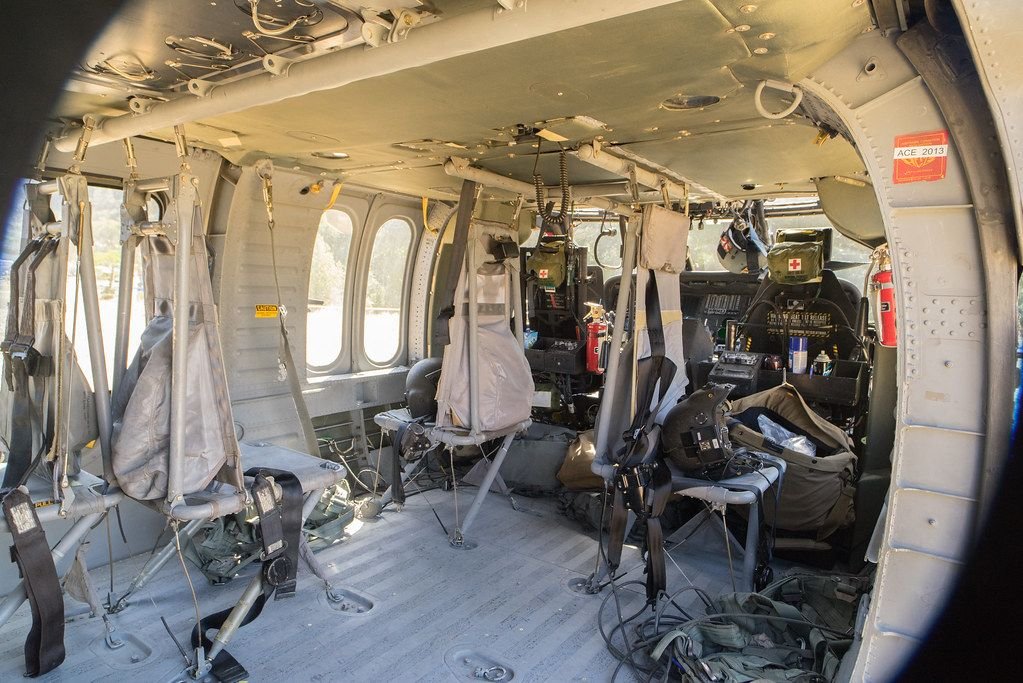
Owing to the vision limitations caused by use of NVG's it is not out of the realm of consideration Army policy would require for two crew members in the rear of the aircraft to enhance conflict resolution.
We routinely flew Chinooks with three crew in the rear with two designated to watch for traffic on either side of the aircraft. The third crew member was the Flight Engineer who controlled activities in the rear and performed safety checks. That simple concept saved my Bacon more than a few times.
Subjects
Blackhawk (H-60)
CRJ
Night Vision Goggles (NVG)
Links are to this post in the relevant subject page so that this post can be seen in context.
Reply to this quoting this original post. You need to be logged in. Not available on closed threads.