January 30, 2025, 06:24:00 GMT
permalink Post: 11816912
And the chopper crew simply had the next airplane in sequence of landing in sight and not the one they collided with?
RIP
Visual management of traffic isn't really acceptable, especially at night against a backdrop.
Can I argue this is the 'fatal runway incursion' everyone has been warning the US is going to have?
Last edited by Someone Somewhere; 30th January 2025 at 06:29 . Reason: Reply to 2nd post.
Subjects
President Donald Trump
Links are to this post in the relevant subject page so that this post can be seen in context.
Reply to this quoting this original post. You need to be logged in. Not available on closed threads.
January 30, 2025, 07:27:00 GMT
permalink Post: 11816947
This accident was certainly "setup" in the procedures defined in this area, heavily relying on Humans not making (altitude (settings)) mistakes and Humans detection opportunities, for which we all know, the human is not really that well-designed for from scratch.
For this case, the helicopter corridor was designed to be below the approach path, though when the human makes even a small mistake and/or the weather makes the approach path a bit lower, things can go haywire quite easily.
RVSM is 1000ft at higher altitudes; even if things had gone 100% to plan, this would have only provided, what, <300ft vertical separation? Is wake turbulence a threat to helicopters?
Subjects
CRJ
See and Avoid
Separation (ALL)
Vertical Separation
Visual Separation
Links are to this post in the relevant subject page so that this post can be seen in context.
Reply to this quoting this original post. You need to be logged in. Not available on closed threads.
January 30, 2025, 08:19:00 GMT
permalink Post: 11816986
Subjects
CRJ
Links are to this post in the relevant subject page so that this post can be seen in context.
Reply to this quoting this original post. You need to be logged in. Not available on closed threads.
February 04, 2025, 07:49:00 GMT
permalink Post: 11821166
The end result of all of this, perhaps the better part of a century down the track, is probably going to be closer to positive train control and atlantic tracks: these are the blocks of airspace and time that are reserved for your aircraft, plus a buffer in each direction including time. Conflicting movements cannot be authorised (though unlike rail, you can have clearances that forbid you stopping, and therefore give a plane 'advance clearance' through a section of space that the plane(s) in front haven't yet transited, as long as the times each aircraft is allowed to be in that space are non-overlapping). At any time, an aircraft would expect to have forward clearances for 2-3 routes - normal path, plus pre-clearances for some combination of missed approach, engine failure drift-down, emergency descent, ETOPS divert, perhaps a even pre-authorised radio failure track. As you clear each section or a future clearance becomes unnecessary, you release it behind you but collect new clearances for alternate routes.
That's a long way away given even CPDLC is in fairly limited use.
I'm sure there's a few cases of stalls during go-around, terrain avoidance, or TCAS activation. There's never such a thing as 'no threat'. I do agree that it's pretty minimal, though, and the Airbus procedure of 'pull the stick full back and pray' simplifies/de-risks it even further.
Last edited by Someone Somewhere; 4th February 2025 at 08:09 .
Subjects
TCAS (All)
TCAS RA
Links are to this post in the relevant subject page so that this post can be seen in context.
Reply to this quoting this original post. You need to be logged in. Not available on closed threads.
February 04, 2025, 10:52:00 GMT
permalink Post: 11821295
Radar orders also need to be given and actions taken sooner than if the crews are doing it of their own initiative. So a radar CA needs to be visible say 15 second pre-collision so ATC can wait for the radio to be clear then order pilots to manoeuvre. Pilots can aim to cross visually at more like 5 seconds.
I'm not saying that this is overall a good idea, but the fundamental reason you fit more planes in with visual separation is that you can put them closer together with (given good visibility) not too dissimilar safety.
[Edit: too late... Fullwings got this.]
TCAS 8 is getting closer and sooner after this horrific accident.
Subjects
ATC
Blackhawk (H-60)
CRJ
DCA
Radar
Separation (ALL)
TCAS (All)
TCAS RA
Visual Separation
Links are to this post in the relevant subject page so that this post can be seen in context.
Reply to this quoting this original post. You need to be logged in. Not available on closed threads.
February 06, 2025, 03:55:00 GMT
permalink Post: 11822721
I wouldn't be surprised if the same applied to helos flying above the 200' ceiling, but that's more of an incidental factor. It would still have been unacceptably close had they been at the correct altitude, and could have been a collision if the CRJ was a little low on approach.
Subjects
CRJ
Close Calls
Normalization of Deviance
Links are to this post in the relevant subject page so that this post can be seen in context.
Reply to this quoting this original post. You need to be logged in. Not available on closed threads.
February 07, 2025, 12:05:00 GMT
permalink Post: 11823605
Regarding to the Pavlovian - if PAL25 wouldnt have requested 'visual separation', what "punishment" would they expect from the Tower? Orbit(s)? Vectors? Or somethin wild, considering 200/300' altitude limits along the river and buildings/infrastructure left and right (what diameter would an orbit cost with a Blackhawk, is it feasible over black water at 200')? Therefore I am asking - would a non-request of a 'visual separation' mean major complications to such a helicopter at night? That as well would then be a significant flaw in the design.
Waiting for the tower to have no aircraft below ~700ft in the approach area, if we're assuming a 1.5Nm separation, could be quite a while.
Subjects
AA5342
Blackhawk (H-60)
CRJ
Separation (ALL)
VFR
Visual Separation
Links are to this post in the relevant subject page so that this post can be seen in context.
Reply to this quoting this original post. You need to be logged in. Not available on closed threads.
February 07, 2025, 14:59:00 GMT
permalink Post: 11823702
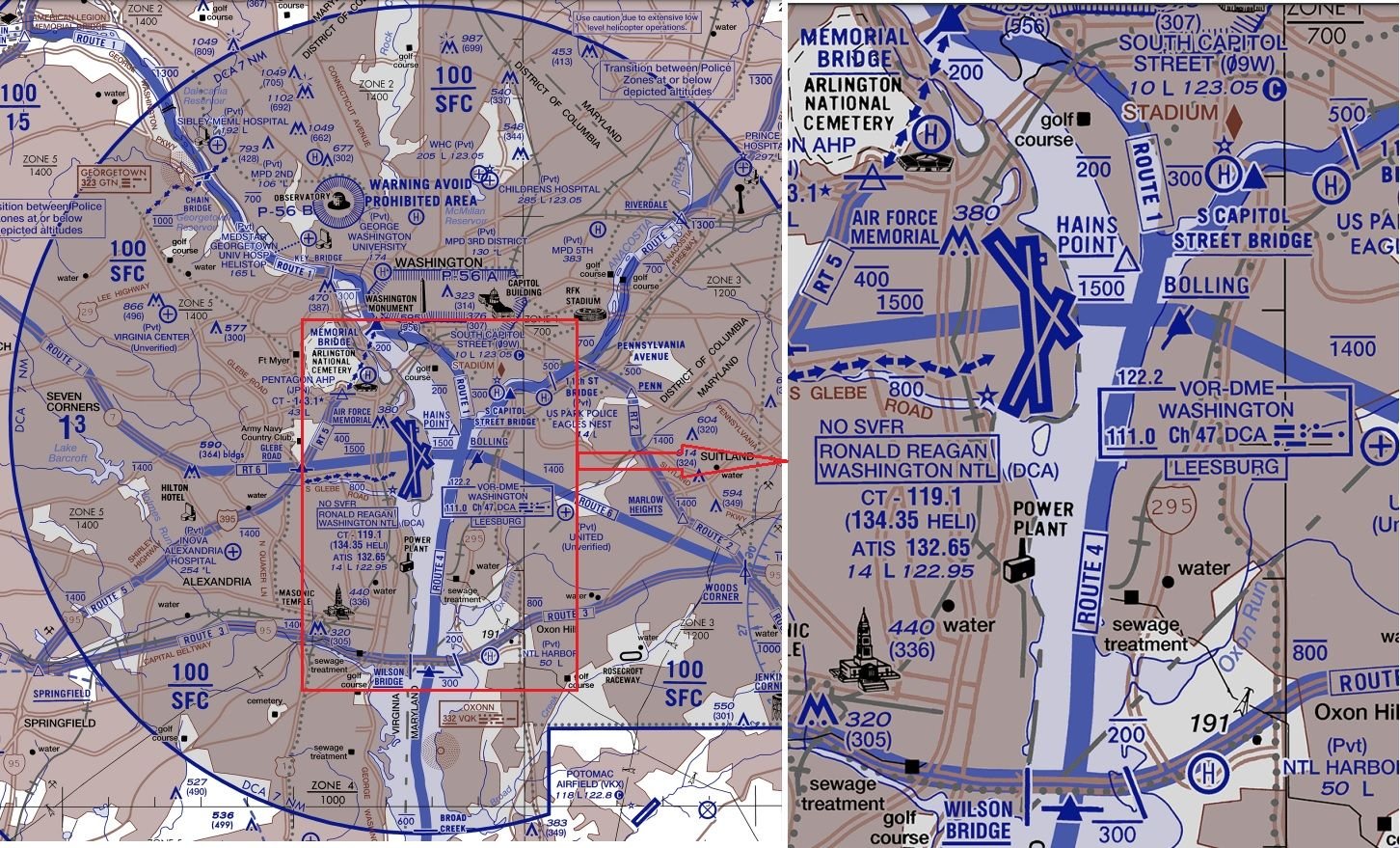
Anything approaching Rwy 1 should be below ~700ft anywhere north of the sewage treatment marker; use the Wilson Bridge for a bit of headroom because not all aircraft are going to be perfectly on glideslope.
The river is far narrower than 1.5Nm so clearly a southbound helicopter on Route 4 can never cross a northbound aircraft approaching runway 1 north of the Wilson Bridge.
You'd have to hold a southbound helicopter north of either the Memorial or Capitol St Bridges until previous traffic had landed. Then have a sufficiently large gap with no arrivals (or departures until south of the runways) for the helicopter to reach the Wilson St Bridge before the next arrival crosses that bridge.
That's the preceding aircraft covering ~3Nm at 140kt (~80s), followed by the helicopter covering ~6Nm at ~100kt (another 3.5min), and accurately timing the next arrival so it doesn't cross the Wilson bridge until after the helicopter, or it needs to do a go-around.
Subjects
Route 4
Route 5
Separation (ALL)
Links are to this post in the relevant subject page so that this post can be seen in context.
Reply to this quoting this original post. You need to be logged in. Not available on closed threads.
February 07, 2025, 17:07:00 GMT
permalink Post: 11823784
I don't suggest a hard 1.5NM, but anywhere standard fixed wing ops cannot assure 500' vertical separation, Rotary wing traffic must be gated and controlled.
If rotary wing mission dictates, then fixed wing traffic will have to wait/go missed/discontinue approach. Visual Sep, ATC and a Pavlovian environment killed an airliner.
I'm still going to argue that a helicopter on Route 4 from DCA to the Wilson Bridge or across Route 6 is unacceptable while there's an approaching aircraft below 700ft.
Subjects
ATC
DCA
Route 4
Separation (ALL)
Vertical Separation
Links are to this post in the relevant subject page so that this post can be seen in context.
Reply to this quoting this original post. You need to be logged in. Not available on closed threads.
February 07, 2025, 17:49:00 GMT
permalink Post: 11823812
Subjects: None
No recorded likes for this post (could be before pprune supported 'likes').Reply to this quoting this original post. You need to be logged in. Not available on closed threads.
February 07, 2025, 18:15:00 GMT
permalink Post: 11823828
This page, section "Separation minima based on ATS surveillance systems" quotes ICAO as saying that even in terminal space with good radar, separation should not go below 1,000ft vertically or 3Nm (2.5Nm if established on the same final approach in sequence within 10Nm of the runway). We're already blithely discussing half those standards as being impossible to meet.
Subjects
ADSB (All)
ICAO
Radar
Separation (ALL)
Links are to this post in the relevant subject page so that this post can be seen in context.
Reply to this quoting this original post. You need to be logged in. Not available on closed threads.
February 07, 2025, 18:43:00 GMT
permalink Post: 11823850
Subjects: None
No recorded likes for this post (could be before pprune supported 'likes').Reply to this quoting this original post. You need to be logged in. Not available on closed threads.
February 07, 2025, 21:37:00 GMT
permalink Post: 11823944
This is following on from #960-964, discussing what would happen if the PAT flight(s) refused visual separation. It seems like it would throw a spanner in ATC's arrivals and they would probably get a response similar to that Lufthansa A380: Buzz off somewhere else.
Subjects
ATC
FAA
Radar
Separation (ALL)
Visual Separation
Links are to this post in the relevant subject page so that this post can be seen in context.
Reply to this quoting this original post. You need to be logged in. Not available on closed threads.
February 07, 2025, 21:48:00 GMT
permalink Post: 11823958
Subjects
Route 4
Links are to this post in the relevant subject page so that this post can be seen in context.
Reply to this quoting this original post. You need to be logged in. Not available on closed threads.
February 08, 2025, 05:59:00 GMT
permalink Post: 11824111
Subjects: None
No recorded likes for this post (could be before pprune supported 'likes').Reply to this quoting this original post. You need to be logged in. Not available on closed threads.
February 08, 2025, 07:14:00 GMT
permalink Post: 11824135
If you approach/reach the point and ATC doesn't clear you further, are you then automatically required to hold there?
Subjects
ATC
Links are to this post in the relevant subject page so that this post can be seen in context.
Reply to this quoting this original post. You need to be logged in. Not available on closed threads.
February 11, 2025, 09:56:00 GMT
permalink Post: 11825962
Speculation : The helicopter crews know that if they don't report traffic in sight as soon as it's called, they'll be slowed down and deprioritised by ATC and eventually held back until they either do report the traffic, or there's a substantial gap in arrivals - see the LH A380. That makes them unpopular with their passengers and/or superiors, so they are very flexible with what 'in sight' means.
ATC likewise knows that if they push helicopter crews too hard on altitude busts, report anything involving a helicopter, or hold up either kind of traffic, they might get people breathing down their neck and certainly nothing good comes of it.
Calling traffic immediately and not enforcing separation too strictly allows both parties to 'get on with their jobs' while looking more-or-less by-the-book - until an incident like this happens.
I'm hopeful I'm wrong, but given there seems to be a long history of near misses and altitude busts this seems like the obvious conclusion. No-one high-up wanted to hear about it or change anything , because no-one had died yet.
On a slightly different note, I'm curious whether anyone is familiar with the Hierarchy of Controls by NIOSH? It doesn't map 1:1 to aviation, but it codifies some things that are 'obvious' in hindsight:
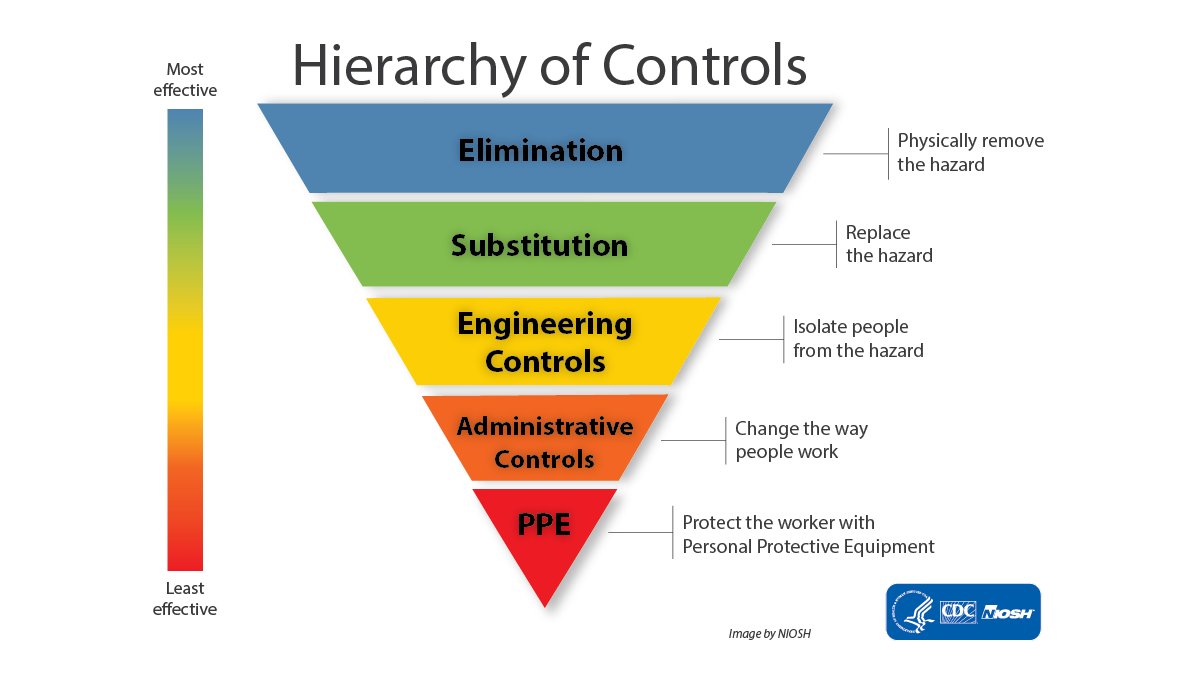
Broadly speaking, some controls are more effective than others. Wherever possible, you should attempt to use more effective controls in place of less effective ones. More effective means not just that it reduces the risk the most, but also the most reliable over time and most resistant to having rules bent, being left broken, being ignored due to alarm fatigue, or 'normalisation of deviation'. Procedures that assume everything is working perfectly and everyone is 100% competent will fail; see MCAS and a great number of other accidents.
Elimination is rarely possible but substitution (radar vs visual) and isolation (separate helicopters from other traffic) amongst other engineering controls are potentially more feasible, and much higher up the hierarchy than a glorified instruction not to crash (the very bottom of administrative). Engineering a problem out of existence is far superior to having a procedure to fix it in the QRH.
I list things like TCAS, GPWS, RSAs, and crash-proof seating as broadly being under PPE: they're nice to have and certainly worth pursuing, but unless there is no other alternative, they should never be your primary protection. Something has gone wrong if they get used.
Subjects
ATC
Close Calls
Normalization of Deviance
Radar
Separation (ALL)
TCAS (All)
Traffic in Sight
Links are to this post in the relevant subject page so that this post can be seen in context.
Reply to this quoting this original post. You need to be logged in. Not available on closed threads.
February 15, 2025, 10:07:00 GMT
permalink Post: 11828476
Subjects
CRJ
Links are to this post in the relevant subject page so that this post can be seen in context.
Reply to this quoting this original post. You need to be logged in. Not available on closed threads.
February 17, 2025, 06:24:00 GMT
permalink Post: 11829650
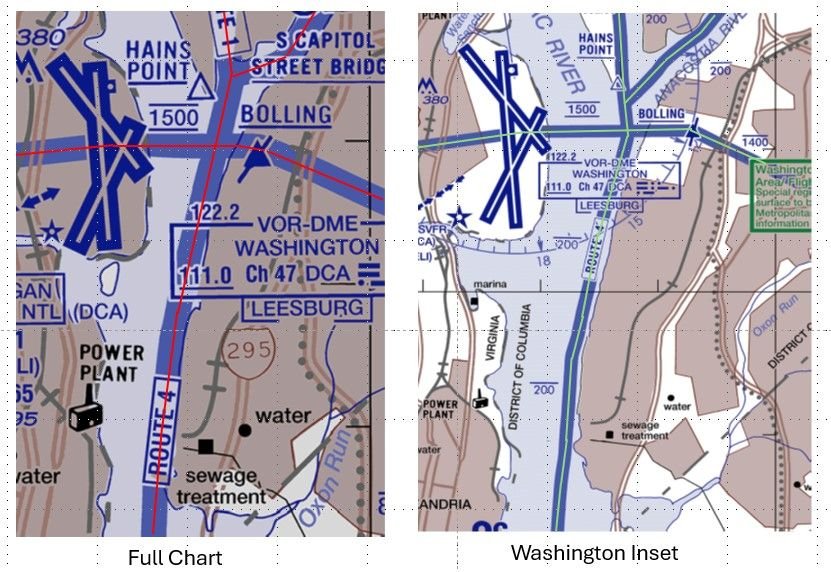
You could reasonably define the bank as the water's edge, and therefore expect crews to fly along an infinitesimally narrow path. Or as the space between the water's edge and the [edge of the flood plain | first flat area | something else], which would imply that the western boundary changes with the water level. Both imply the route is substantially above land.
Neither are useful for precise navigation, but the map and the description are probably 'close enough' if they are only needed for general route guidance and knowing that structures on the east bank need to be NOTAMed for helicopters, but probably not the west bank.
A good reminder that measurements/specifications without tolerance are often worse than useless.
If it quacks like a duck... this kind of "It can't be an X because we can't do it, so we'll call it a Y" leads to a culture that gets used to massaging the truth for convenience. Did we hear more on the Alaska door plug that was an 'opening' not a 'removal'?
Subjects
ATC
CRJ
DCA
FAA
KDCA
NTSB
Night Vision Goggles (NVG)
Pass Behind
Pass Behind (All)
Separation (ALL)
Links are to this post in the relevant subject page so that this post can be seen in context.
Reply to this quoting this original post. You need to be logged in. Not available on closed threads.
March 06, 2025, 08:54:00 GMT
permalink Post: 11841781
Because without that information, they could IMHO quite happily look at the A319 approaching runway 1, intend to pass behind it to head south down-river until the A319 was no longer over the river, and loiter around the runway 33 approach until that happens.
Shift the times by ten seconds and the same accident could have still occurred.
Visual simply doesn't work at the required level of safety if there are multiple aircraft to be visual with.
Subjects
Pass Behind
Pass Behind (All)
Links are to this post in the relevant subject page so that this post can be seen in context.
Reply to this quoting this original post. You need to be logged in. Not available on closed threads.