February 02, 2025, 19:56:00 GMT
permalink Post: 11820055
This seems to me to be a big charting oversight, because these charts would be stage centre as any crew conducted their approach briefing and then made reference to them while they flew the actual approach. There\x92s simply nothing on there to suggest risk of mid-air collision might be a factor, where the hotspots are, or extra vigilance required etc.
Subjects
KDCA
VFR
Links are to this post in the relevant subject page so that this post can be seen in context.
Reply to this quoting this original post. You need to be logged in. Not available on closed threads.
February 06, 2025, 16:55:00 GMT
permalink Post: 11823104
Ref para 3.2.3. e. 2 here https://www.faa.gov/air_traffic/publ...l%20separation .
Subjects
ATC
Separation (ALL)
Traffic in Sight
Visual Separation
Links are to this post in the relevant subject page so that this post can be seen in context.
Reply to this quoting this original post. You need to be logged in. Not available on closed threads.
February 07, 2025, 21:23:00 GMT
permalink Post: 11823937
https://www.faa.gov/documentLibrary/...5-24_READY.pdf
As mentioned upthread, if not visually separated then either 500ft or 1.5mi applies.
Correct if this is all wrong, but in the accident sequence if the helo had responded ‘not visual yet, looking’ or words to that effect, then presumably a controller could allow the two to get a bit closer and then advise the conflicting traffic info to the helo again, say at 2.5mi. If helo visual, great —maintain visual separation, responsibly passes to helo.
This is what happened, although the very busy controller failed to re-state the position of the CRJ to direct the eyes of the helo crew onto the CRJ in order that they could actually see and avoid it.
However if not visual at say 2.5mi, well it’s a bit late, but the controller does still retain responsibility for separation and must apply the 500ft/1.5mi standard. Presumably instant vectors away while simultaneously climb to min vectoring altitude. Or the CRJ has to go around. Can of worms in busy airspace— helos and /or jets being dispersed all over the sky.
Much better to do a rules based system and mutually exclude intersecting IFR app/deps and Helo Visual Routes.
Last edited by Stagformation; 7th February 2025 at 22:06 .
Subjects
ATC
CRJ
FAA
IFR
See and Avoid
Separation (ALL)
Visual Separation
Links are to this post in the relevant subject page so that this post can be seen in context.
Reply to this quoting this original post. You need to be logged in. Not available on closed threads.
February 08, 2025, 11:52:00 GMT
permalink Post: 11824286
In this case though the aircraft lights were rapidly converging, the radar repeater was flashing \x91CA\x92 but the helo has already requested and been given responsibility for collision responsibility. Crazy tragic situation.
Subjects
ATC
Radar
Separation (ALL)
Visual Separation
Links are to this post in the relevant subject page so that this post can be seen in context.
Reply to this quoting this original post. You need to be logged in. Not available on closed threads.
February 08, 2025, 16:34:00 GMT
permalink Post: 11824442
I would love to see it tried - obviously it would have to be over the desert in aircraft with no pax aboard! How would it work - do you just yell " Bloggs, left a bit " over the RT if all looks a bit close?
It happens all day long at airfields. Controller sees and gives clearances, eg remain dead side, go around, hold short of the active, expedite etc.
Subjects
ATC
Radar
Links are to this post in the relevant subject page so that this post can be seen in context.
Reply to this quoting this original post. You need to be logged in. Not available on closed threads.
February 10, 2025, 23:06:00 GMT
permalink Post: 11825761
Likewise ATC controllers ought to be a bit more sceptical whether they really believe a pilot who calls visual with traffic in amongst a whole bunch of other lights 7miles away at night!
Subjects
ATC
Links are to this post in the relevant subject page so that this post can be seen in context.
Reply to this quoting this original post. You need to be logged in. Not available on closed threads.
February 14, 2025, 23:34:00 GMT
permalink Post: 11828293
 ) if there had been any discussion in the black hawk cockpit about the CRJ (where it was, whether the PF did see it or not) when PM requested visual separation
Subjects
Altimeter (All)
Blackhawk (H-60)
CRJ
NTSB
Separation (ALL)
Situational Awareness
Visual Separation
Links are to this post in the relevant subject page so that this post can be seen in context.
Reply to this quoting this original post. You need to be logged in. Not available on closed threads.
February 15, 2025, 21:35:00 GMT
permalink Post: 11828846
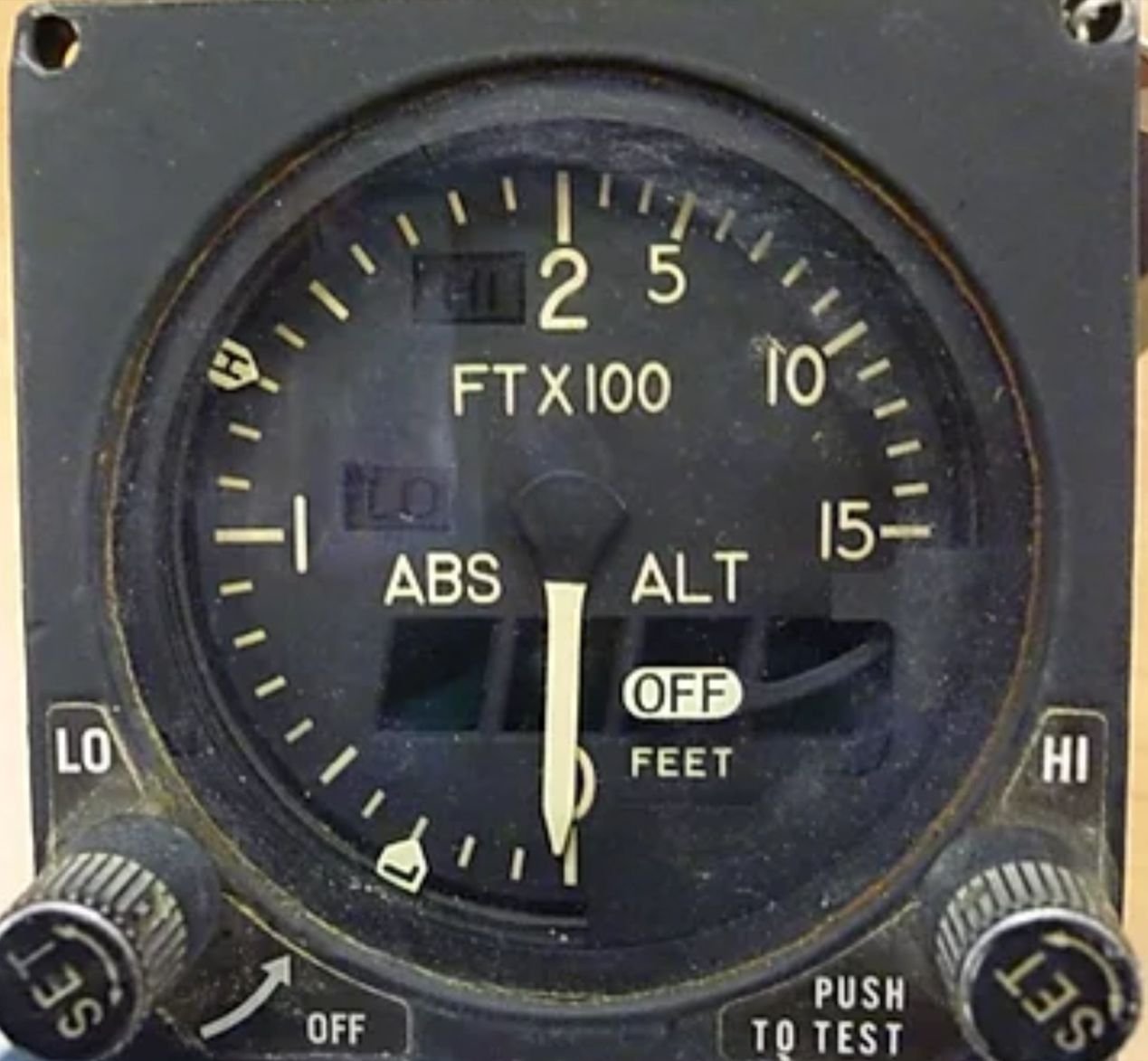
Disconcerting that the PAT 25 crew, about to descend and fly less than 200 feet AGL , would not have investigate the discrepancy of 100 feet between their respective altimeters...
Details of instrumentation here:
https://apps.dtic.mil/sti/tr/pdf/ADA409934.pdf
Not completely obvious in the photo is the digital display of radar altitude just underneath the annotation ABS ALT. The technical manual also mentions a three digit radar altitude displayed on the HUD.
Last edited by Stagformation; 15th February 2025 at 23:01 .
Subjects
Altimeter (All)
HUD
Radar
Links are to this post in the relevant subject page so that this post can be seen in context.
Reply to this quoting this original post. You need to be logged in. Not available on closed threads.
February 16, 2025, 23:07:00 GMT
permalink Post: 11829527
So maybe the handling pilot misread 300ft radio and set an indicated 210ft on her baro-altimeter, while the pilot monitoring correctly set 300ft on his baro-altimeter, but without a crosscheck being performed. Subsequently if they adjusted flightpath to fly 200ft on the handling pilots baro alt then that would explain quite a lot\x85.
eg The helicopter flying at 290ft radio (actually 278ft at impact); the pilot monitoring\x92s nudge to the pilot handling to descend a bit; the transponder mode C reporting 300ft from the pressure altitude capsule in the handling pilots baro altimeter (which we\x92ve seen on the various ATC traffic videos).
Subjects
ATC
Altimeter (All)
Radio Altimeter
Links are to this post in the relevant subject page so that this post can be seen in context.
Reply to this quoting this original post. You need to be logged in. Not available on closed threads.
February 16, 2025, 23:49:00 GMT
permalink Post: 11829548

Subjects: None
No recorded likes for this post (could be before pprune supported 'likes').Reply to this quoting this original post. You need to be logged in. Not available on closed threads.
February 26, 2025, 16:29:00 GMT
permalink Post: 11836475
eg. If you don’t catch all of a radio call meant for you, just reply with what you think the controller wants to hear you say and then comply with that — not, ‘Say again…’ and confirm your clearance. Also (implicitly while discussing LED lights) confirmed that the helicopter crew would not have been able to visually identify the correct conflicting traffic, yet made the habitual call, ‘Traffic’s visual, request visual separation’ and ok to proceed, with ATC complicit in the arrangement. Also don’t beat yourself up too much if you bust your altitude restriction right under where your route intersects with landing jets, while confirming this as the most safety critical part of the route.
Last edited by Stagformation; 26th February 2025 at 22:13 .
Subjects
ATC
Blackhawk (H-60)
Normalization of Deviance
Links are to this post in the relevant subject page so that this post can be seen in context.
Reply to this quoting this original post. You need to be logged in. Not available on closed threads.
February 26, 2025, 16:42:00 GMT
permalink Post: 11836483
Subjects: None
No recorded likes for this post (could be before pprune supported 'likes').Reply to this quoting this original post. You need to be logged in. Not available on closed threads.
February 26, 2025, 17:29:00 GMT
permalink Post: 11836513
Subjects: None
No recorded likes for this post (could be before pprune supported 'likes').Reply to this quoting this original post. You need to be logged in. Not available on closed threads.
February 26, 2025, 19:10:00 GMT
permalink Post: 11836579
At 8:47:42 the helicopter pilot stepped on the latter part of ATC’s transmission to the Blackhawk which was an instruction to ‘…pass behind the…’ The helicopter crew could not possibly have heard that instruction because they stepped on it themselves. Read back is required to an en-route clearance. Afterwards there was an intercom discussion between the helicopter pilots about whether they were to move further east.
Seems that two consecutive radio calls to the helicopter got corrupted which led to a breakdown in SA onboard the helicopter. Probably they had no idea that they needed to look left over the city lights to see the CRJ and were convinced their traffic was in the line up of jets on 01 extended centreline and therefore no factor.
Subjects
ATC
Blackhawk (H-60)
CRJ
CVR
Situational Awareness
Links are to this post in the relevant subject page so that this post can be seen in context.
Reply to this quoting this original post. You need to be logged in. Not available on closed threads.
February 28, 2025, 19:36:00 GMT
permalink Post: 11838025
Subjects
Blackhawk (H-60)
Links are to this post in the relevant subject page so that this post can be seen in context.
Reply to this quoting this original post. You need to be logged in. Not available on closed threads.
March 01, 2025, 09:36:00 GMT
permalink Post: 11838415
I think the LC saw what was unfolding and said that because he had concerns that the chopper didn't actually have the CRJ. He was right.
PAT25 says (for the second time), “Traffic visual, request visual separation”,
which is not true, evidently they were not visual at all because they crashed into the CRJ.
LC responds, “Visual separation approved, [pass behind the] CRJ,”
which clearance was issued on the false premise that PAT25 was visual. But PAT 25 only hears, “Visual separation approved…[pause]…CRJ,” because they briefly stepped on the LC’s transmission themselves. No read back is forthcoming; the LC should be expecting one but he fails to chase it up, because he’s too busy.
If PAT 25 realised he’s stepped on the middle part of the LC’s transmission to himself (which likely could have included an instruction) then he ought to be professional enough to say, “Stepped on, say again,” etc and make absolutely sure he knows what the clearance may have been. That was standard practice a long time ago, but no longer, it seems.
My original point was that in the Mover/Gonky video (post #1228) it was suggested that it’s perfectly OK to second guess what ATC might have said to you, reply to that, and then if no correction is forthcoming you can comply with your guess. As others have pointed out implicitly, that works if there’s only one error involved, but here there were three: an untrue statement, leading to a wrongly issued clearance, and a missing read back.
System broken.
Last edited by Stagformation; 2nd March 2025 at 23:42 .
Subjects
ATC
CRJ
PAT25
Pass Behind
Pass Behind (All)
Separation (ALL)
Links are to this post in the relevant subject page so that this post can be seen in context.
Reply to this quoting this original post. You need to be logged in. Not available on closed threads.
March 05, 2025, 10:44:00 GMT
permalink Post: 11841182
https://www.faa.gov/air_traffic/publ...section_4.html
Para 2-4-3 note 2 says it all really.
Last edited by Stagformation; 5th March 2025 at 11:55 .
Subjects
ATC
Links are to this post in the relevant subject page so that this post can be seen in context.
Reply to this quoting this original post. You need to be logged in. Not available on closed threads.
March 05, 2025, 19:00:00 GMT
permalink Post: 11841477
Now if the controller had said "you look to be tracking very close to the CRJ are you sure you can pass behind?" or similar, then maybe the helo crew would have got excited. A call like that might have even triggered a "holy sh1t" moment about the TCAS "Traffic". But as far as they were concerned, they knew they had the traffic in sight and could do the visual sep thing and even if they had heard "pass behind" they would have said/thought "well, obviously". Except they had the wrong aircraft. ATC had an idea they had the wrong aircraft but didn't get the message across.
As for the reference, same thing. The helo crew could have read-back "pass behind" but it wouldn't have achieved anything.
Subjects
ATC
CRJ
Pass Behind
Pass Behind (All)
Separation (ALL)
TCAS (All)
Traffic in Sight
Visual Separation
Links are to this post in the relevant subject page so that this post can be seen in context.
Reply to this quoting this original post. You need to be logged in. Not available on closed threads.
March 11, 2025, 23:10:00 GMT
permalink Post: 11845750
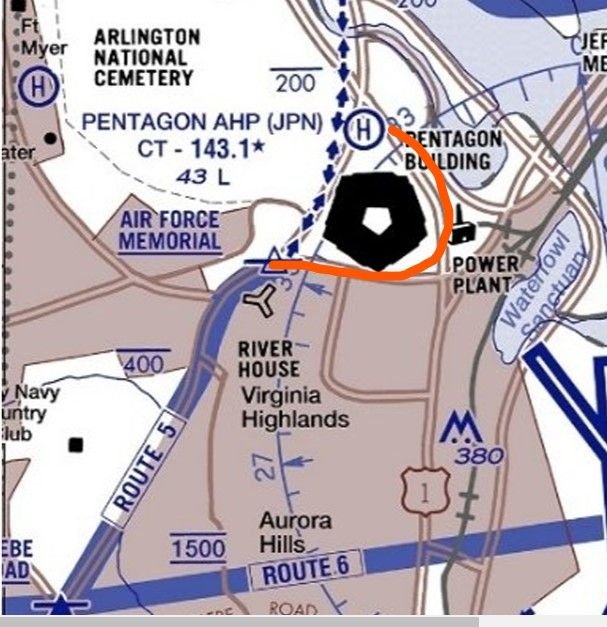
The chart shows the dotted routes connecting 1 and 5 to the Pentagon helipad. But much of the time, the PAT helos would fly the red line - as I observed earlier, over a raised highway with light poles, and cutting under the RW15 approach at about half the distance to the runway end.
I just base this on what I can see locally. I walk almost daily parallel to the rail line and it was no big deal to see the PATs following 395 around the east side of the building - but that's not where the chart says Route 5 is.
By the way a midair over 395 would put debris into a heavily used outdoor sports complex.
PS Observed two more go-arounds from RW18 this afternoon!
https://www.airnav.com/airport/KJPN
FAA Information for KJPN, effective 20 Feb 2025, has amongst Additional Remarks:\x97
CAUTION - TFC PAT - KJPN EAST/WEST OPS. SPECIAL PRO TFC PAT. WHEN LDG W ALL ARR ACFT MAKE LEFT TFC CIRCLING THE PENTAGON AT OR BLW 200 FT. WHEN DEP E ALL ACFT MAKE RIGHT TFC CIRCLING THE PENTAGON AT OR BLW 200 FTSubjects
Route 5
Links are to this post in the relevant subject page so that this post can be seen in context.
Reply to this quoting this original post. You need to be logged in. Not available on closed threads.
March 12, 2025, 10:40:00 GMT
permalink Post: 11846018
One would hope traffic arriving/departing the Pentagon is coordinated tower to tower with DCA if traffic is approaching 15 and departing 33….
Last edited by Stagformation; 12th March 2025 at 10:51 .
Subjects
DCA
Route 5
VFR
Links are to this post in the relevant subject page so that this post can be seen in context.
Reply to this quoting this original post. You need to be logged in. Not available on closed threads.