Standards for altimeter accuracy apply only to the altimeter itself, i.e. the part that's installed in the instrument panel. They don't include source error, such as the error introduced by airflow over the static ports.
SubjectsAltimeter (All)
Links are to this post in the relevant subject page so that this post can be seen in context.
No recorded likes for this post (could be before pprune supported 'likes').
There have been a number of references above to the woefully inadequate vertical separation provided between helicopter Route 4 and the approach to Runway 33. Given altimeter errors (expected and maybe not so expected) in the helicopter, a helicopter flying high (and possibly offset sideways towards the end of Runway 33) and an aircraft maybe low on approach, there really wasn\x92t any guaranteed separation.
I strikes me that, from my layman\x92s point of view, that this is the primary and gaping hole (among numerous others) in the Swiss cheese here.
At the same time, I get the sense that no controller was ever going to allow a helicopter to pass directly under an approaching aircraft and challenge that limited clearance.
My question is, should this have been (or was it?) formalized as an ATC procedure? Because if this had been proceduralized, I find it hard to believe that just nighttime VFR separation would have been found acceptable in that environment. Rather I would think that lateral separation should have been actively managed by ATC.
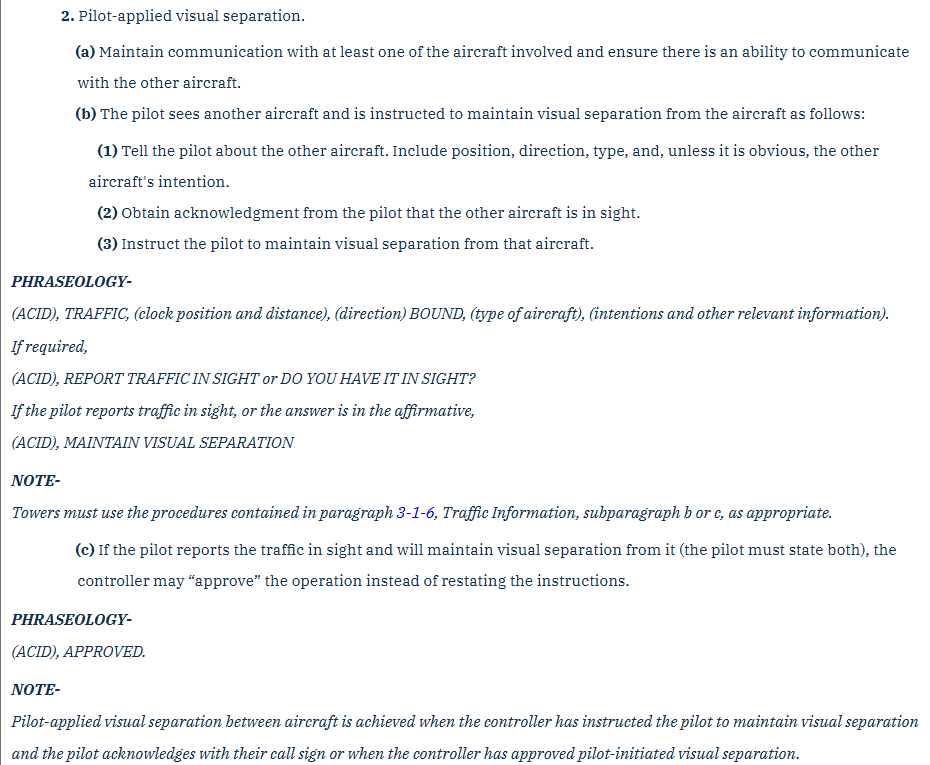
It's simple; the altitude restriction was never intended to be the sole method of separation. At most, it was an additional layer of protection. The controller wouldn't have cleared the Blackhawk to continue if they hadn't said they had the traffic in sight. But they did say that, whether it was true or not. ATC is a service provided to pilots, not an authority. Pilot-applied visual separation essentially overrides any procedure used by ATC. When you say "Traffic in sight," you are saying "I don't need your help maintaining separation, I have it under control and I take full responsibility."
Originally Posted by
andihce
For one thing, with the CRJ (or whatever aircraft) pilots making a late switch to 33, turning to line up with the runway, etc., they may not have had the bandwidth to scan for a possibly conflicting helicopter, if they could even have seen it from their cockpit. (IIRC from the inquiry, the NTSB will be investigating that last point.)
The IFR aircraft wouldn't be required to have the traffic in sight.
Are you sure about that? My understanding of Class B airspace is that all aircraft proceed only on the basis of an ATC clearance. So to re-parse your statement\x85When a pilot says \x93Traffic in sight\x94 it just means he can see it, nothing more. It\x92s when he then says, \x93Request visual separation\x94 that he\x92s suggesting to the Local Controller he doesn\x92t need help with separation. And then it\x92s only when the Local Controller says, \x93Visual separation approved\x94 that the pilot takes on the responsibility for separation.
No, they're exactly the same. If you say "traffic in sight" then the controller will immediately say "Maintain visual separation."
Absolutely, it was a non-standard discourse. But however you look at what was said, PAT 25
requested
the change to visual separation. Meaning PAT25 correctly believed he was under standard 1.5nm/500ft separation at the time and that he needed LC approval for Visual separation to be applied. The change in the separation standard being applied did not happen until the LC accepted PAT 25’s traffic visual report and
authorised
the change. It’s not an automatic change made just on the pilot’s say so, ie by reporting visual, which I think is what you may be implying (happy if you correct me). Both pilot and LC are necessary (and both made errors here).
I may be mistaken, but my understanding is that the controller doesn't really have the option to deny visual separation. The regulations don't mention any response except 'approved.' The word 'approved' does seem to imply that it could also be denied, but there's no mention of how, when, or why that would be done. Even if they do have the option to deny, as far as I can tell there's no guidance on how to make that decision. Obviously there's no way for a controller to know whether a pilot truly has the correct aircraft in sight.
Only the PSA CRJ was scheduled. The PAT flight was an ad hoc VFR Class B transition.
Note that the apparently informal procedure of holding helicopters at Hains Pt or golf balls was an effective method of deconflicting Route 4 and 15/33 traffic. However it appears that the use of this \x93procedure\x94 was left to the discretion of the individual controller.
It's not the controller's discretion, it's the pilot's discretion. If the pilot calls "traffic in sight" then the pilot is taking on the responsibility of ensuring separation. If the pilot hadn't done that in this case, then I'm sure the controller would've directed them to hold.
One of the Army pilots at the NTSB hearing said he'd always been instructed to hold when there was traffic on approach to 33. I'd be willing to bet that he never called "traffic in sight" in those instances. That's the crucial difference.
The 78 feet deviation by the Mil Heli is not the cause of this accident . I hope the lawyers during the trial do not focus on that and minimize the rest .
Bit of historical background : when designing this route decades ago they must have followed basic ICAO/ FAA principles . separation IFR-VFR is 500 feet . allowed deviation then was 100 ft either way , so even if one a/c is 100ft above and the other 100ft too low , there would still be 300 ft separation preventing a collision ,
Agreed.
Originally Posted by
ATC Watcher
When that was introduced decades ago I bet you a bottle of (real) Champagne that the procedure was use of that route 4 was restricted during RWY 33 arrivals and RWY 15 departures. It was one or the other but not both simultaneously .
How , when and why , over time , did it degraded to the point that this restriction could be disregarded would be interested to investigate and unveil .
If the helicopter hadn't called "traffic in sight," they would've been instructed to hold until the CRJ was clear. In general, a VFR aircraft saying "traffic in sight" is effectively exempt from such procedures.
I'vd argued before that any route that does not achieve 500ft above terrain is unsafe by the FAA's own standards, for much the same reasons.
(b) Over congested areas \x96 Over any congested area of a city, town, or settlement, or over any open-air assembly of persons, an altitude of 1,000 feet above the highest obstacle within a horizontal radius of 2,000 feet of the aircraft.
(c) Over other than congested areas \x96 An altitude of 500 feet above the surface except over open water or sparsely populated areas. In that case, the aircraft may not be operated closer than 500 feet to any person, vessel, vehicle, or structure.
(d) Helicopters \x96
Helicopters may be operated at less than the minimums prescribed In paragraph (b) or (c) of this section
if the operation is conducted without hazard to persons or property on the surface. In addition,
each person operating a helicopter shall comply with routes or altitudes specifically prescribed for helicopters by the Administrator.
Which safety assessment was made and validated ( and by who) which allowed visual separation for an helicopter at 200ft to pass below the approach path of an aircraft at 3 or 400 feet ?, resulting in a 100-200ft separation ?
None. That would obviously be unsafe, so the helicopter would be expected to use lateral separation. (e.g. "Pass behind the CRJ.")
The 200 ft altitude restriction seems to have given some the impression that helicopters were routinely passing directly below the approach traffic, but that's not the case. And even if it was, it wouldn't really be relevant to this accident. The Blackhawk pilots weren't trying to duck underneath the plane, they never even saw it.
You mean no SA was made because this scenario was not even considered ? That makes things worse for the FAA if this local "visual " procedure was written down somewhere or even just tolerated , because as I understood, it was standard practice .I am not sure if you know how safety assessments are made , but you must consider every possible scenario when designing procedures.
Visual Flight Rules aren't a local procedure.
Originally Posted by
ATC Watcher
From a European / EASA perspective :
Re the "Lateral separation" you mention : in that scenario so close to the Runway threshold it would mean only a left turn is possible, i.e. away from the thresholds of both runways , it would mean flying over build up areas , and doing so at 200ft above buildings with possible antennas on top , etc.. ,not really safe , and definitively not at night . As to \x93pass behind\x94 , the standard wake turbulence separation criteria would not be met , especially passing behind/below and I would not even try that at 200ft under a large jet..
I agree. The prudent thing to do would be to not call traffic in sight and let the controller give you a hold. But first you'd have to know the plane is there.
Originally Posted by
ATC Watcher
During the interviews, one Heli pilot from that same group ,mentioned that asking for visual separation was a routine request , even if you did not see the traffic at time of the request . That fact alone, if really proven to be systematically the case , would also add to the normalization of deviance case and put full responsibility on the regulator, not the pilots
If that was/is happening, that's a huge problem. But I don't understand how the FAA would be responsible. Visual separation is initiated by the pilot, when they say "traffic in sight." Controllers sometimes prompt it (e.g. "Do you have that traffic in sight?"), but that didn't happen in this case. A pilot should never call traffic in sight unless they truly have it in sight and are completely confident that they can maintain safe separation. I do get the impression that the Blackhawk pilots may not have fully understood that. Both from the NTSB hearings and the ATC recordings (the way they don't even wait for the controller to finish speaking before shouting "traffic in sight request visual separation!")