February 24, 2025, 15:23:00 GMT
permalink Post: 11834944
Subjects: None
No recorded likes for this post (could be before pprune supported 'likes').Reply to this quoting this original post. You need to be logged in. Not available on closed threads.
February 26, 2025, 01:45:00 GMT
permalink Post: 11836058
Thinking about the helicopter route, and the possible errors in the helicopter-borne equipment, the Static ports could be subject to some biases, and could be variable as a function go helicopter airspeed, vertical velocity, side slip.
Add to that a possible error or change in local baro (In-Hg) as one transits from their departure point into another area, the two cockpit baro altimeters' displayed altitudes can contribute to errors, but the altitude reporting to the tower is based on 29.92, so any error in setting AAU-31 or AAU-32 In-Hg applies only to the cockpit displays; the Tower receives Alt value referenced to 29.92 inches and corrects it locally for their displays and conflict alerting algorithms.
For the approach without benefit of a Glide Slope, the VASI or PAPI is visual and thus "probably" more challenging to maintain nominal approach angle to the runway. There should have been some documented analysis, backed up by data that helps to define the worst-case vertical departure from nominal approach angle on the PAPI/VASI approach; that needs to be part of a worst-case combined analysis, and I think needs to be better than "10 to the minus nine". Need to have data from both low-hour and high-hour pilots on a non-coupled approach.
Next quasi- related thought::: when the CVR recorded a verbal disparity of 100 feet between pilot and examiner, shouldn't that have raised questions of "Why"- especially when at low altitudes MSL? As I understand it, there would be 3 or 4 places where Baro Alt was displayed; the two mechanical bar alt indicators, AND the altitude display(s) on the pilot(s) NVG HUDS. If the pilot under evaluation was fully on the ANVIS HUD, and if that pilot failed to set the Bar Alt "correction" in terms go In-Hg, then the pilot could readily be seeing inaccurate Bar Alt digits on the HUD.
I believe there procedurally had to be a separate action to set In-Hg ( or to sync the HUD to the AAU-31 and AAU-32 values). It would not take much of an error in ANVIS HUD In-Hg setting to cause a substantial error in the Altitude digits displayed on the HUD.
Add/multiply these error sources up, and then see if the defined helicopter route met the 10 to the minus nine value.
This is the same deal - anytime a landing airplane is below 1,000 feet (at least!) and doesn't own the airspace from them on down to the surface, you already lost the game right there. Someone will be down there at some point a bit too high and someone at some point will be a bit too low or too close or whatever. It is a narrow 2 lane road in the country with a 150 MPH speed limit. There will be crashes.
Subjects
CVR
HUD
Night Vision Goggles (NVG)
Links are to this post in the relevant subject page so that this post can be seen in context.
Reply to this quoting this original post. You need to be logged in. Not available on closed threads.
February 27, 2025, 00:32:00 GMT
permalink Post: 11836735
The chart for route 4 shows a single line above 200 ft indicating its the maximum permissible altitude. Also the wording on the chart is "at or below". IF, as the video suggests, 200 ft was the only recommended altitude then I would expect it to have a line above and below it with the appropriate wording "at" only. Route 6 has a 1500 ft altitude with a line above and below and with "at" only in the wording.
From the FAA chart I believe altitudes below 200 ft are permissable and expected along route 4.
Army: Do not go below 200 feet.
Flying at 200 feet is the only way not to have one of the two annoyed with you

Subjects
FAA
Route 4
Links are to this post in the relevant subject page so that this post can be seen in context.
Reply to this quoting this original post. You need to be logged in. Not available on closed threads.
February 28, 2025, 13:11:00 GMT
permalink Post: 11837785
Subjects
ADSB (All)
Links are to this post in the relevant subject page so that this post can be seen in context.
Reply to this quoting this original post. You need to be logged in. Not available on closed threads.
February 28, 2025, 20:18:00 GMT
permalink Post: 11838072

Subjects
Blackhawk (H-60)
Links are to this post in the relevant subject page so that this post can be seen in context.
Reply to this quoting this original post. You need to be logged in. Not available on closed threads.
April 09, 2025, 00:10:00 GMT
permalink Post: 11863047
From your perspective then, could you clarify :
Controlled Airspace, See and Avoid re same, duty of care re ATCre controlled Airspace, specifically short finals, etc?
May as well add split or proportional liability??
I am trying to get even a basic understanding of how a large helicopter flew in visual flight rules into a jetliner on short final, which was on an IMC approach, on slope. Both were \x93legal\x94. The helicopter busted altitude by 125 feet vertically, and just exactly enough horizontally. Que?
The airplane was not in IMC, it was a clear night. They were on a visual approach to 33 and got hit by a helicopter. The helicopter said they had the traffic in sight and obviously didn't. That is the short version.
Subjects
Accountability/Liability
See and Avoid
Traffic in Sight
Links are to this post in the relevant subject page so that this post can be seen in context.
Reply to this quoting this original post. You need to be logged in. Not available on closed threads.
April 20, 2025, 17:29:00 GMT
permalink Post: 11870631
Regrets: in my post trying to comment on Sailvi767's observation regarding the RJ crew having the best situational awareness, in retrospect I should have emphasized and explained what I meant by using the the word "imminent". The thread previously did clearly reference factors such as the inhibition of TAs and RAs at specified heights, and the TA alert. What seemed different in the post about the RJ crew's SA was what I, as only SLF/attorney, understood as the suggestion that a different crew with different mindset might have realized before the last second prior to impact that "erring on the side of caution" was the correct action to take. Please note - this is not an effort to put words into Sailvi767's post whatsoever.
Perhaps it was already pretty clear to others, but I had thought - for the reasons your post H&H talks about - that naming the airline as a defendant in the lawsuits would be just for form's sake at best, and to draw in its insurance coverages. Every law student (in the U.S. that is, I don't know about other systems) is taught that a shorthand for negligence is whether the alleged negligent party "knew or should have known" about the risk of harm the party was creating. The observation that I think the post about the RJ crew's SA justifies is certainly not that they "knew". But it does suggest that although it is highly unlikely they "should have known", there either are some facts supporting the assertion that they "could have known", or at least enough facts to warrant making the airline a defendant.
About prior safety-related reports and whether any risk assessments were done and what those assessments showed, it appears very likely if not certain that some answers to "who knows" will be found through the discovery process particularly, although not only, if the airline is named as defendant.
(Lastly, I apologize for convoluting the thread.)
WR 6-3
In real life the pilots were on short final and paying attention to airspeed and glideslope lights. Traffic that said they had them in sight and would fly behind them would not be a priority. Even if there was no tower at all, they owned that last 500 feet, random crossing traffic would not have right of way.
Subjects
Situational Awareness
TCAS RA
Traffic in Sight
Links are to this post in the relevant subject page so that this post can be seen in context.
Reply to this quoting this original post. You need to be logged in. Not available on closed threads.
August 01, 2025, 03:53:00 GMT
permalink Post: 11931630
Was it her that later said she'd use baro since the route was MSL not AGL?
Again need to recheck against the transcript. my memory may be fuzzy. I was doing 3 different things at the time.
I have several things I want to revisit from the 2 days so far.

Subjects
KDCA
Links are to this post in the relevant subject page so that this post can be seen in context.
Reply to this quoting this original post. You need to be logged in. Not available on closed threads.
October 18, 2025, 03:44:00 GMT
permalink Post: 11971880
Every pax jet is separated by SIDs and STARs, with either lateral and/or vertical separation. That is what is required here with the choppers. Playing TCAS dodgem-cars below 1000ft when you're trying to land is not the way to go.
Point 3 is the only one that makes any real sense. The rest sound good only to the great-unwashed.
Subjects
ADSB (All)
ADSB In
ATC
Separation (ALL)
TCAS (All)
Vertical Separation
Links are to this post in the relevant subject page so that this post can be seen in context.
Reply to this quoting this original post. You need to be logged in. Not available on closed threads.
October 18, 2025, 03:46:00 GMT
permalink Post: 11971882
Subjects: None
1 recorded likes for this post.Reply to this quoting this original post. You need to be logged in. Not available on closed threads.
October 18, 2025, 12:38:00 GMT
permalink Post: 11972056
It would not have changed much for the AA CRJ either , the TA would have been more precise and maybe a second or two earlier , but he had already 2 TAs and most certainly so short from landing the PF was focusing on the PAPI not his TA display
It might have changed something if the Heli was equipped with a CDTI ( ADS-B in display) as it is a powerful tool to help identify traffic visually. But not separate yourself from another aircraft . One thing people in offices making such statements forget is that to provide separations maneuvers ATC needs a stable radar picture , with antennas firmly on the ground facing North . Inside an aircraft constantly moving the picture moves with it , (as you can see on your TCAS display ) Extremely complex to separate yourself using that kind of picture when both you and the target are moving. AWACS operators are trained to do this , but not your average pilot .
So I think this ADS-B on the Military Helis is a red herring made by politicians wanting to appear to “do something “ and perhaps distract the public from the FAA and regulator failures on both the design of the airspace / routes and the lack of action after numerous previous serious incidents reports ,
Can I add some sympathy for the AA crew - A night over water runway change on final combined with dodging traffic is a LOT to ask of anyone. I can't say for sure what they would have done with ADS-B on the chopper, they said they would miss us, not by how much and we are 30 seconds from landing. The benefit here is the helo crew realizing they are dodging the wrong airplane.
* full disclosure, I have had a close call with the helo traffic there more than once, back in the day they did some crazy stuff. I would have LOVED to have seen them coming on a screen if such a thing had existed.
Last edited by island_airphoto; 18th October 2025 at 13:00 .
Subjects
ADSB (All)
ADSB In
ATC
CRJ
Close Calls
FAA
Radar
TCAS (All)
Links are to this post in the relevant subject page so that this post can be seen in context.
Reply to this quoting this original post. You need to be logged in. Not available on closed threads.
October 20, 2025, 01:09:00 GMT
permalink Post: 11972783

Subjects
ADSB (All)
ADSB In
ADSB Out
ATC
Links are to this post in the relevant subject page so that this post can be seen in context.
Reply to this quoting this original post. You need to be logged in. Not available on closed threads.
October 20, 2025, 23:41:00 GMT
permalink Post: 11973406
(the same thing happens with boat transponders, once you get close enough to throw a beer at the other boat they can be on the opposite side of you as the traffic display shows)
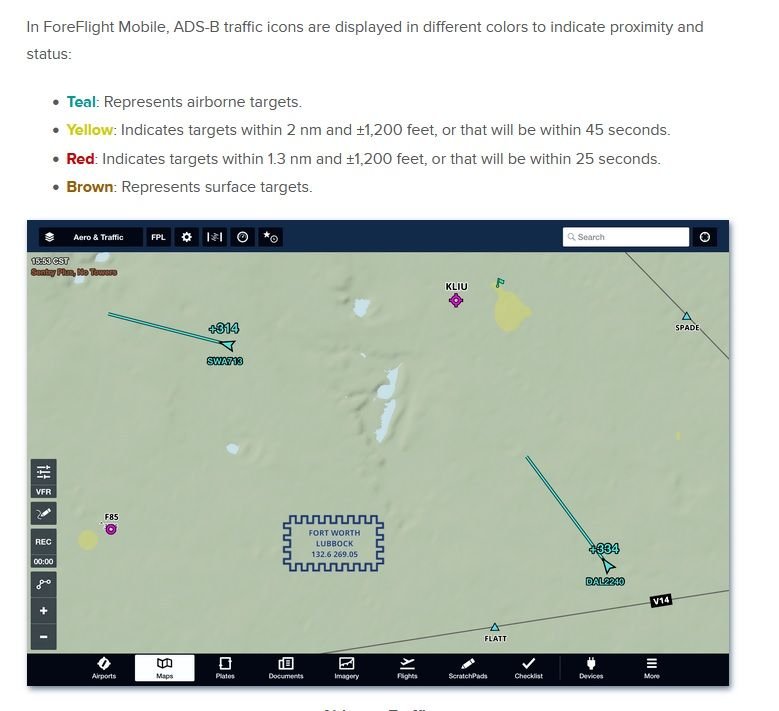
For myself, I get to look at the pretty colors. If I was the AA plane the helo would have been red, but it was close enough to be red even if it was going behind me.
Last edited by island_airphoto; 20th October 2025 at 23:54 .
Subjects
ADSB (All)
ADSB Out
Radar
Separation (ALL)
TCAS (All)
Links are to this post in the relevant subject page so that this post can be seen in context.
Reply to this quoting this original post. You need to be logged in. Not available on closed threads.
February 19, 2026, 04:18:00 GMT
permalink Post: 12039465
Subjects
Altimeter (All)
Separation (ALL)
Visual Separation
Links are to this post in the relevant subject page so that this post can be seen in context.
Reply to this quoting this original post. You need to be logged in. Not available on closed threads.
February 19, 2026, 04:20:00 GMT
permalink Post: 12039466
We don't know of any gestures, if any pilot pointed at lights, but there is nothing in the CVR transcript that indicates the PF was aware of the traffic, or that the PIC pointed the traffic out to her; the PF certainly did not factor in the decision to request visual separation.
So when the PIC transmitted,
or did the PF know that neither of them could identify the traffic, but accepted it as normal?
Subjects
CVR
Night Vision Goggles (NVG)
Normalization of Deviance
Separation (ALL)
Traffic in Sight
Visual Separation
Links are to this post in the relevant subject page so that this post can be seen in context.
Reply to this quoting this original post. You need to be logged in. Not available on closed threads.
February 20, 2026, 03:43:00 GMT
permalink Post: 12039997
Subjects
DCA
Links are to this post in the relevant subject page so that this post can be seen in context.
Reply to this quoting this original post. You need to be logged in. Not available on closed threads.