January 30, 2025, 09:01:00 GMT
permalink Post: 11817018
At 300 ft doglegging onto a different runway in an airliner (whaaat??? Who the digamma thought that one up! No wonder Lufthansa refused it!) there's zero lookout for traffic going on.
Having spent much helo time over cities at night even at 800ft (the lowest I ever operated) you don't have too much attention left to scan the skies for traffic, and if something was on a collison course its lights are on a constant bearing ie stationary against the background lighting and would be very difficult indeed to spot. Additionally you would naturally not be looking for traffic against the city lights but above it. Even strobes would easily be misconstrued as some of the numerous flashing lights seen in cities at night. And if the helo was on a training flight both pilots' attention on surroundings is likely to be less than might be expected otherwise.
Compared to the stringent control of the London Helilanes and rigid procedures especially closer to Heathrow this entire airspace setup looks simply beyond belief from a European point of view.
Last edited by meleagertoo; 30th January 2025 at 10:35 .
Subjects
Circle to Land (Deviate to RWY 33)
Night Vision Goggles (NVG)
Links are to this post in the relevant subject page so that this post can be seen in context.
Reply to this quoting this original post. You need to be logged in. Not available on closed threads.
January 31, 2025, 10:42:00 GMT
permalink Post: 11818095
6. Effective radio comms depend on the people communicating speaking clearly and precisely, so that what they say is understood by all parties involved. That includes waiting for read-backs and acknowledgements.
7. This man was having to speak so fast in order to do his job that it seems strikingly obvious that the volume of traffic he was having to deal with was far too high.
My take is, in order.
5) No, I don't think he was overwhelmed. He was shot through with adrenaline and shocked as anyone would be having just witnessed two aircraft he was talking to seconds before vanish in a fireball, realising his career, reputation, life and future sanity was irrevocably blown to pieces no matter the cause.
No, no and thrice no. Assuming the tapes are in real time there are considerable gaps between transmissions so he most certainly did not 'have' to speak so quickly. He had plenty of time to speak clearly and coherently instead of spouting those eruptions of incoherent, almost incomprehensible babble.
Sadly - reprehensibly, this style of unnecessarily theatrical auctioneer-style unpunctuated babble seems all too frequent in the States. Tower frequencies are usually if not almost invariably much less time-pressurised as they handle fewer aircraft in a well spaced sequence than in a termnal control area.
6) Concur 100%. And they failed miserably to achieve this. I've been flying for several decades and struggle to hear one word in three (and only assume much of the rest because I know what to expect - a human factors disaster) of that controller's outbursts, and the shoddy partial readbacks are shocking to European ears.
7) Once again, NO! Even if super-busy (and I'd argue especially if super busy) it is essential to keep r/t steady, clear and comprehensible; gabbling that fast might save half a second on an exchange, but no frequency is so busy it requires that, least of all a Tower. He only had three or four aircraft to deal with for simple go-arounds, all well spaced out on approach. He pretty much had time to recite half the Lord's Prayer to each.
This crazy r/t seems to be a cultural thing and needs to be changed, as do some fundamental procedures like having helo lanes crossing final approach tracks at essentially the same height instead of with decent vertical separation. Why wasn't the helilane at 800ft or 1000ft as a Heathrow? No aircraft is up there one mile out from finals while every single one is at 300ft. Madness. Just madness. It's like a figure 8 banger race dodging cars at the intersection. If there was a flyover - vertical separation too accidents would be all but eliminated.
And this buisness of "...pass behind the CRJ on finals" when no none can determine whether the lights in sight are a CRJ, a Cessna or the Space Shuttle or in what sequence they are landing. It might work in daylight but imho it assumes unreasonable levels of instant almost head-on aircraft recognition - a disastrous human factors trap quite aside from the additional one of assumption.
I'm not having a go at the poor controller who imho is compleely blameless, he did his job as well as the flawed system that indoctrinated him allowed.
As for 'stopping' helicopters in a free- air hover. This is (in my experience) never ever requested, done or attempted as a traffic avoidance method. I can only assume people suggesting this have absolutely zero knowlege of flying helos and the litany of pitfalls and hazards it would generate, helos simply do not 'stop' in midair unless they have to for SAR, load-lfting ot maybe surveillance. If necessary, as in holding at 'dual taxiways' between the Heathrow runways at 1000ft you'd slow to a sensible speed, maybe 50-60Kts in a tight orbit and even that is 'interesting' in 40Kts of wind. "Are you visual with landing traffic 2 mile final" identifies the traffic far, far better than "the CRJ on finals" when there might be three in a row, not to mention assuming superhuman powers of head-on distant aircraft recognition even in daylight - and impossible at night!!! Crossing clearance is then "cross over the threshold after the landing traffic" where no aeroplane ever is at 1000ft. (bar a g/a when there is enough time to skedaddle and avoid) With any significant wind a hover would have to be into wind, ie more or less tail -on to the conflicting traffic, an utterly absurd concept. Bin this one people, please.
As for the appalling behaviour of the 'president' to instantly apportion blame with no understanding of either the situation or accident investigation in general whatsoever - which anyway is not his job and none of his business, thereby prejudicing any enquiry (what pressure does this put on the investigators and report writers, federal employees, when they are all but directed by their deranged and vindictive boss what they are expected to report? This is a very, very dangerous precedent that smacks more of a shonky third world dictatorship than a western democracy.
Last edited by meleagertoo; 31st January 2025 at 11:55 .
Subjects
ATC
CRJ
DCA
Hover
Pass Behind
Pass Behind (All)
President Donald Trump
Separation (ALL)
Vertical Separation
Links are to this post in the relevant subject page so that this post can be seen in context.
Reply to this quoting this original post. You need to be logged in. Not available on closed threads.
February 01, 2025, 10:05:00 GMT
permalink Post: 11818884
The accident appears, almost certainly, to have been directly caused by the misidentification of conflicting traffic by the helo.
Fundamentally though the accident was entirely set up and enabled by critical faults in airspace usage and procedures, viz no vertical separation betwen the helo lane and glideslope at their point of intersection (to my mind simply incredible) and to a lesser extent perhaps the (again to my mind) extraordinary split frequency system. The first provides only one slice of swiss cheese - substantial vertical separation would add a second slice while the frequency thing is no cheese at all.
Despite what some commentators here and elsewhere seem to think there is never intended to be a situation when a helo passes under an aircraft on finals at 200ft. Helo traffic is held, or holds itself following a conditional clearance short of runway track before proceeding visually behind landing traffic or ahead of traffic on longer finals, exactly as is done at Heathrow. The difference is that in the event of an error at LHR there is 1000ft of vertical separation to add guartanteed separation if a helo wanders off track. Here there is next to none, it is very like a road intersection where cars on a minor road cross a big highway with conditional (orange flashing) traffic lights. Elsewhere in aviation this is just never done, there is always vertical separation too as a most basic safety precaution - ie like an overpass. The 1000ft also has the advantage that helo traffic is clearly visible on radar which is not the case when its grubbing along at 200ft.
Equally, the London helilanes too carry both mil and civ traffic, but critically both are on the same frequency (or if not the system re-broadcasts everything so it sounds as if they are) so everyone is playing the same ball. As every mil helo (surely?) has VHF nowadays why the digamma aren't procedures requiring its use when interracting in close/very close proximity with civ traffic?
Contributory factors include grossly sloppy r/t which employs open questions instead of closed ones - "do you see the CRJ on finals" when there are two unidentifiable aircraft visible on finals instead of "do you see the aircraft on 2 mile finals".
Doubtless there may be other consideration such as insufficient controllers and excessive workload too but that is not for me to say.
Bottom line is this appears to be a classic human factors accident induced by badly designed airspace, voice and control procedures.
+++++++++++
Why was the helo high? Not that I've ever done it but 200 ft or below at night over a big black hole of a river surrounded by bright city lights (800ft is my lowest) sounds pretty adventurous to me, it's very low indeed, and when a threator distraction is introduced at such low level in a helo one's instinct, even reflex is often to just squeeze back a little on the cyclic to give you a bit more space while your attention is drawn elsewhere. 100ft extra comes in a very short time and with less than 100ft of vertical separation from mis-identified traffic, that's it.
Subjects
CRJ
Radar
Separation (ALL)
Vertical Separation
Links are to this post in the relevant subject page so that this post can be seen in context.
Reply to this quoting this original post. You need to be logged in. Not available on closed threads.
February 02, 2025, 10:36:00 GMT
permalink Post: 11819671
Not just from a collision perspective, but a wake turbulance issue.
And maybe more importantly, what should have been the horizontal separation? Surely it should have been at least 500 feet after the passing CRJ (not based on air law, just common sense). Clearly there was no horizontal or vertical separation in the end, but just how far off minimums was the helicopter? Seems nearly impossible to be that far off the expected flight path.
Can all these non-aviation pundits here please get it into their heads that just because the helilane has a cieling of 200ft and the glideslope is 325 or whatever it does not imply that helos can, would or might EVER be allowed to pass 125 ft under an aircraft on finals nor would any sane helo pilot (there are some!) do so. That would be insane, as surely this common sense you speak of should tell you? What's a lateral 500ft got to do with air law or anything else, ever? You're muddling completely unconnected and irrelevant matters. Have you not read/heard the ATC transcripts? Helos are not given clearance to and cannot cross until landing traffic is clear (as this helo one was told) - ie until it has passed unless the incoming is sufficiently far away for there to be no possible confliction.
How far off minimums (actually a maximum)? - you've already answered that question yourself. 125ft.
The insanity of this routing procedure is that in the event of an accidental horizontal incursion into the track of an inboud as happened here there is in theory only 125 ft of vertical clearance to prevent a disaster which is nowhere near enough of a safety margin. That route should have been, imho, at least 5-800ft or more above two dots up on the glideslope.
Once again, helicopters never, never ever come to a free air hover for separation purposes - this is a ridiculous concept for numerous reasons that are too long to go into here, and would be downright dangerous at night over a black hole at 200ft. They slow and orbit if they have to, maybe slow right down if wind direction and speed allows, but never hover.
I know not everyone here is experienced on helos but if so could they please refrain from speculating on operating procedures? All this guff about altimeter accuracy is completely irrelevant and has created a huge amount of unnecessaty noise. The aircraft was flying a visual sight-picture approach where an altimeter barely features at all and helos at low level, especially at night and over water do not use the baro altimeter. They exclusively refer to rad-alt.
Finally, all those who think a visual self-positioning clearance as employed in this case behind crossing traffic is somehow hazardous are completely incorrect. Once again, at Heathrow the helilane crosses 27 L and R thresholds at (iirc)1000ft. The only clearances given as you approach the boundary is to the effect of 'cross NOW (directly) over the threshold', 'hold (at a VRP clear N/S of the threshold)' or, having confirmed and read back landing traffic visual and identified the formula is repeated, 'after the landing traffic 2 miles cross behind'. It's perfectly safe as as it isn't done at the same height as the airliner but with a large vertcal clearance too.
btw, does Marine One fly this route?
Last edited by meleagertoo; 2nd February 2025 at 11:41 .
Subjects
ATC
Altimeter (All)
CRJ
Hover
Radio Altimeter
Separation (ALL)
Vertical Separation
Links are to this post in the relevant subject page so that this post can be seen in context.
Reply to this quoting this original post. You need to be logged in. Not available on closed threads.
February 05, 2025, 10:32:00 GMT
permalink Post: 11822080
Additionally, any helicopters flying in such congested airspace should have a display showing other traffic so they know where to look outside.
You cannot actively vector a helo at 200ft over the black hole of a river in the middle of an urban environment or anywhere else. You'd kill helos every month doing that. If the helo were at 100ft or so there would be no need for vectors (you never get them in London, just holding, ie orbits if necessary).
Visual acknowlewgement from the aeroplane is totally unnecessary as he is on finals to land which give total priority over all other traffic. It is up to the give-way traffic to identify and acknowlege.
500ft vertical I agree with, in which case 1,5 miles is totally unnecessary and ridiculously excessive.
This discussion is being considerably bogged down by a really surprising (to me) absence of understanding of helos and helo ops by people who clearly only fly f/w IFR and seem to have no concept of how the rest of the aviation world works. Strangely, there are other ways of aviating safely without staring exclusively at an instrument panel, following a magenta line and doing only what someone miles away in an office tells you. You simply cannot try to apply IFR airline type procedures and mindset to low level VFR traffic. It's like a train driver trying to dictate railway rules to a motorcyclist and being unaware that motorcycles just don't operate like trains... imaginingthat helos can or would come to a free air hover for separation is another example of unrealistic imagnation over reality.
Please, if you don't know anything about helicopter ops, please don't try to apply procedural IFR or Hollywood mindsets/misapprehensions to them as if there is no other waay of flying.
Last edited by meleagertoo; 5th February 2025 at 10:54 .
Subjects
ATC
CRJ
Hover
IFR
Separation (ALL)
VFR
Visual Separation
Links are to this post in the relevant subject page so that this post can be seen in context.
Reply to this quoting this original post. You need to be logged in. Not available on closed threads.
February 05, 2025, 11:21:00 GMT
permalink Post: 11822123
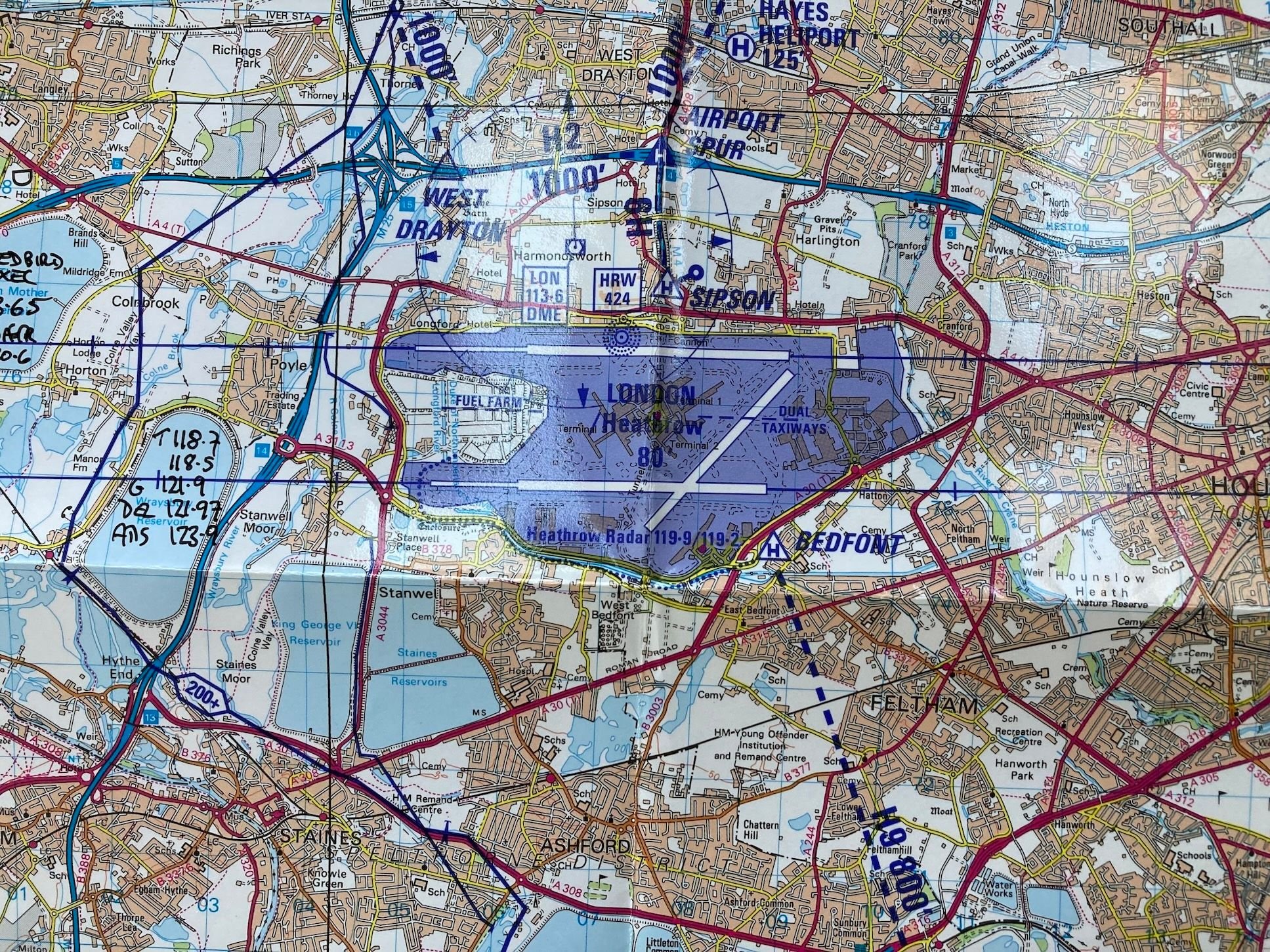
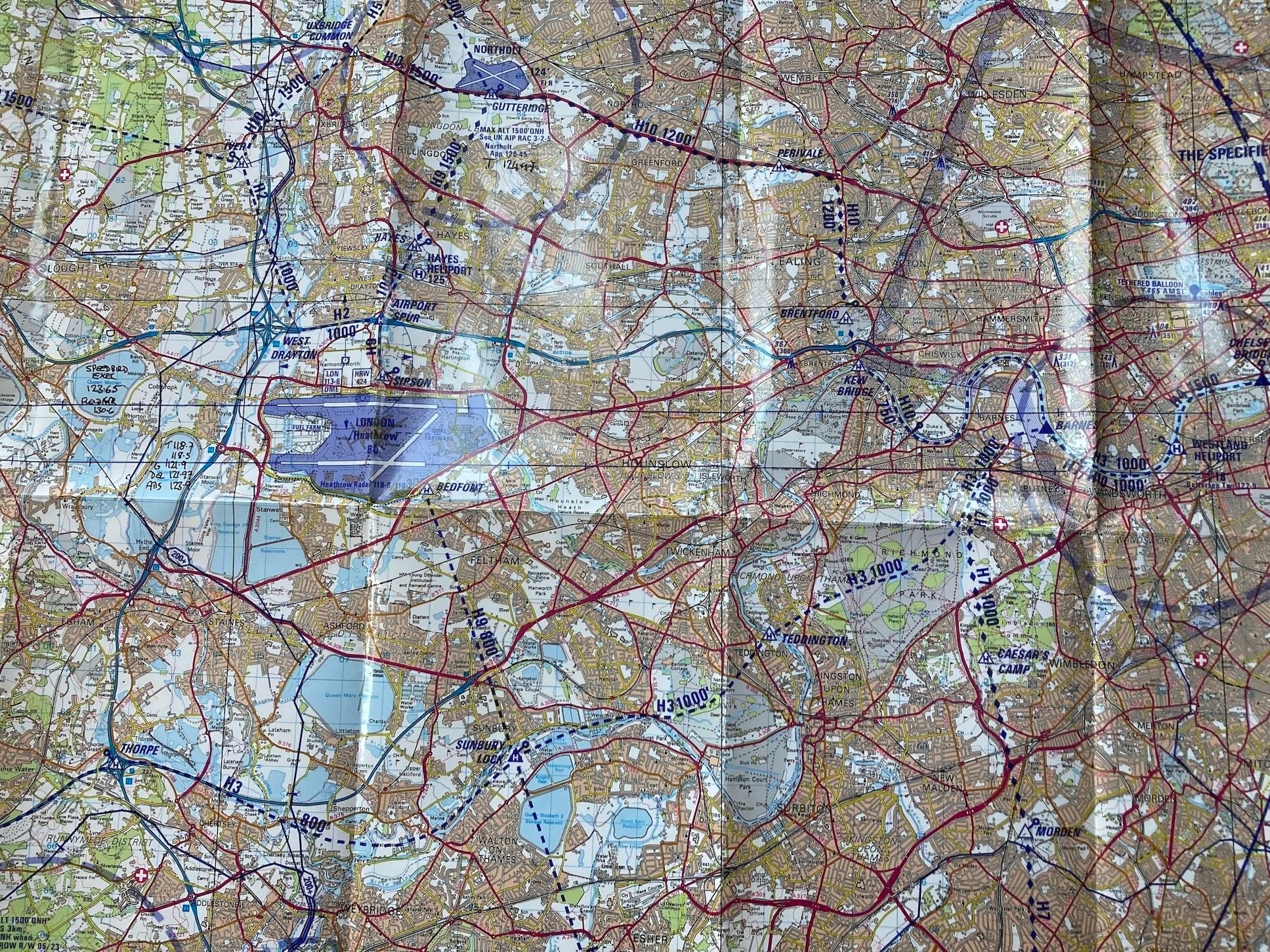
Usually, only if crossing LHR you'd be cleared to enter via requested route with limit Bedfont/Sipson, sometimes Airport Spur to hold (orbit) and change from Heathrow Special to Tower for the crossing itself. There's a further hold at Twin Taxiways between the runways. Altitudes are shown. Note there is usually unrestricted passage on routes H3 and H10 along the river directly under the approach. This system works seamlessly and with - to date - total safety.
Accepted the aairport we are discussing has more varied runway directions than Heathrow so the situation would be a bit more complex but I can't see why a similar system couldn't be devised - with defined clearance limits, sensible vertical separation and, critically, coherent and specific controller voice procedure.
There's no reason not to make landing traffic aware of helos holding close in if appropriate and indeed that happens, but no way is their visual contact required.
The entire system operates on visual 'separation'. Helos cross visually behind traffic as cleared, but with vertical separation. It's as safe as the system can be made. How else could it work? It requires no controller vectoring and the time and space margins that would be required if radar separation was used would render the slick, efficient visual system cumbrous, unacceptably high end unnecessary workload and probably unworkable.
Please, once again let's stop applying this insular f/w procedural IFR mindset to VFR helo traffic. There seems to be a procedural IFR mental blockage that can't see that 'visual separation' occurs in three dimensions, not just two. Helos are perfectly capable of ensuring visual separation as long as the traffic has been correctly identified and with vertical separation as here even if a mistake is made there is 800ft clear vertically. Also, VFR does NOT mean, as many seem to imagine, blundering about randomly at will, it is often every bit as disciplined and controlled as IFR as Shackman reiterates below, these routes are rigidly enforced to within a hundred metres or so and woe betide the transgressor.
The elephant in the room here is a combintion of a ridiculously hazardous two-dimensional crossing procedure combined with culpably sloppy & imprecise r/t which offers no second slice of cheese, not matters of visual separation. I'm well aware that our transatlantic cousins are sensitive to criticism of their relaxed, easygoing and informal ways in the air but in this case they self-evidently were the direct cause of 70 odd deaths. While they may regard European style as excessively pedantic there's no doubt whatsoever that had European standards applied here this event would have resulted in nothing more serious than a MOR and an Airmiss report.
For those unfamiliar the light grid squares are 1Km so the Sipson and Bedfont reporting/holding points is ony about 500m from the runways.
Last edited by meleagertoo; 5th February 2025 at 12:23 .
Subjects
ATC
IFR
Radar
Separation (ALL)
VFR
Vertical Separation
Visual Separation
Links are to this post in the relevant subject page so that this post can be seen in context.
Reply to this quoting this original post. You need to be logged in. Not available on closed threads.
February 07, 2025, 08:11:00 GMT
permalink Post: 11823433
Subjects
Radio Altimeter
Links are to this post in the relevant subject page so that this post can be seen in context.
Reply to this quoting this original post. You need to be logged in. Not available on closed threads.
February 17, 2025, 09:15:00 GMT
permalink Post: 11829728
Re the height deviation. When flying a helo at 200ft at night over a black hole (the river) you are very conscious indeed of your extremely low height. If told of conflicting traffic that you have to search for over/amongst city lights your attention is considerably diverted from pure flying and the natural tendency would be to squeeze back a little on the cyclic. I imagine that would be even more the case if NVGs were in use, tho I've no experience with them. That is a likely cause of the otherwise surprising altitude deviation tho we'll never know.
Subjects
Night Vision Goggles (NVG)
Route 4
Links are to this post in the relevant subject page so that this post can be seen in context.
Reply to this quoting this original post. You need to be logged in. Not available on closed threads.
February 20, 2025, 08:54:00 GMT
permalink Post: 11832026
A published glideslope (usually nowadays defined by ILS or GPS) is predicated on HEIGHT above the touchdown point , ie it is a physically fixed plane referenced to the ground. How the altimeter is set is completely irrelevant to an aircraft on the glideslope from that point of view. But this aeroplane was on a visual aproach so altimetry is also irrelevant as it is not constrained by a rigidly defined instrumented glideslope.
While the helilane limit is, technically, predicated on an altitude that's really just semantics in this case as it is over water that is at sea level and as any PPL should know that gives height above sea level with QNH set. Thus to all practical intents and purposes the heli routes are flown at heights, and as the rad alt is an order of magnitide more accutate than a bar-alt pilots will likely set its bug at 200ft and and such a low level as this where bar-alt inaccuracy is very significant will (or should) fly that, despite having set QNH because that's the requirement. That way both aircraft are on the same plane of reference, ie vs. the ground = height.
The graphic above is surprising illustration of how a lateral error of just 200m puts a helo firmly into the acceptable glideslope parameters and surely demonstrates more clearly than anything else we've seen the insanity, even irresponsibility of the design of this piece of airspace. Mind, get 200m off track in the vicinity of Heathrow, let alone crossing it and you'll be ordered out of the system the way you came in with a telephone number to call...
Still no word on why this route couldn't have been designed with a sensible vertical separation above the f/w flightpath, someone must know.
Subjects
Altimeter (All)
QNH
Radio Altimeter
Separation (ALL)
Vertical Separation
Links are to this post in the relevant subject page so that this post can be seen in context.
Reply to this quoting this original post. You need to be logged in. Not available on closed threads.