January 30, 2025, 08:19:00 GMT
permalink Post: 11816984
Subjects
VFR
Links are to this post in the relevant subject page so that this post can be seen in context.
Reply to this quoting this original post. You need to be logged in. Not available on closed threads.
January 30, 2025, 10:22:00 GMT
permalink Post: 11817092
Or could the circling approach from 01 to 33 also be a factor with the helo misinterpreting the CRJ flight path and somehow losing sight ? The track of both aircraft is interesting\x85 helo seems to initially be parallel to the river bank and turns 40 right. Why ? Was their destination the same airport or was that manoeuvre related to traffic avoidance or loss of visual ?
All guesswork I know\x85 putting Special VFR traffic so close to final approach traffic at night clearly a problem. Tragic.
Subjects
CRJ
Circle to Land (Deviate to RWY 33)
Traffic in Sight
VFR
Links are to this post in the relevant subject page so that this post can be seen in context.
Reply to this quoting this original post. You need to be logged in. Not available on closed threads.
January 30, 2025, 11:23:00 GMT
permalink Post: 11817135
Airliners cockpits are not designed for see and avoid.. not on daylight , so much worse at night where distance of lights is almost impossible to determine
Subjects
See and Avoid
Separation (ALL)
VFR
Visual Separation
Links are to this post in the relevant subject page so that this post can be seen in context.
Reply to this quoting this original post. You need to be logged in. Not available on closed threads.
January 30, 2025, 11:24:00 GMT
permalink Post: 11817136
Special VFR (and I bet it is done frequently at DCA).
This is the equivalent of Class G airspace I believe. My goodness.
Subjects
DCA
VFR
Links are to this post in the relevant subject page so that this post can be seen in context.
Reply to this quoting this original post. You need to be logged in. Not available on closed threads.
January 30, 2025, 11:39:00 GMT
permalink Post: 11817145
The majority of people inside the system don\x92t realise how bad it is because it\x92s all they\x92ve ever known. We have American contributors here who routinely tell us it\x92s ok to switch to TA only to avoid \x93nuisance\x94 RA\x92s, who will not follow an RA as they have the traffic in sight, who will accept visual separation at night (day is bad enough) or very late visual switches, who think LAHSO is a good idea. USA ATC think it\x92s acceptable to \x93slam dunk\x94 a heavy jet, get shirty when foreign operators refuse a questionable clearance, literally forget about an aircraft once it has accepted visual separation. The system allows uncontrolled VFR traffic within 500ft of commercial operations which is madness.
I operated the 747-400 around the planet for over a decade, the USA was one of the most threat laden environments we went to. Lovely people, just insane procedures. In that time I experienced a TCAS RA on vectors to JFK, was sent around and put in the hold as punishment on short final in Miami for refusing LAHSO, had multiple super high workload approaches to SFO combined with the crazy policy of pairing aircraft on approach. I witnessed a Singapore aircraft being refused a diversion to Boston from JFK fifteen minutes after they stated what time they would be leaving the hold and where they would be going resulting in a fuel mayday and an unplanned diversion to a regional airport. I lost count of the times I was chastised for refusing a visual approach and visual separation in congested airspace or a very late visual switch.
On most of the planet the human is the last line of defence in a multi layered safety environment. In the USA the human is often the only line of defence, while the environment they are in is super high workload significantly reducing their capacity to trap safety issues.
Unless there is a marked attitude shift in all parties involved in aviation in the USA this will happen again, potentially quite soon.
Stay safe out there
LD
Subjects
ATC
Close Calls
Land and Hold Short
Separation (ALL)
TCAS (All)
TCAS RA
Traffic in Sight
VFR
Visual Separation
Links are to this post in the relevant subject page so that this post can be seen in context.
Reply to this quoting this original post. You need to be logged in. Not available on closed threads.
January 30, 2025, 13:16:00 GMT
permalink Post: 11817227
The majority of people inside the system don\x92t realise how bad it is because it\x92s all they\x92ve ever known. We have American contributors here who routinely tell us it\x92s ok to switch to TA only to avoid \x93nuisance\x94 RA\x92s, who will not follow an RA as they have the traffic in sight, who will accept visual separation at night (day is bad enough) or very late visual switches, who think LAHSO is a good idea. USA ATC think it\x92s acceptable to \x93slam dunk\x94 a heavy jet, get shirty when foreign operators refuse a questionable clearance, literally forget about an aircraft once it has accepted visual separation. The system allows uncontrolled VFR traffic within 500ft of commercial operations which is madness.
I operated the 747-400 around the planet for over a decade, the USA was one of the most threat laden environments we went to. Lovely people, just insane procedures. In that time I experienced a TCAS RA on vectors to JFK, was sent around and put in the hold as punishment on short final in Miami for refusing LAHSO, had multiple super high workload approaches to SFO combined with the crazy policy of pairing aircraft on approach. I witnessed a Singapore aircraft being refused a diversion to Boston from JFK fifteen minutes after they stated what time they would be leaving the hold and where they would be going resulting in a fuel mayday and an unplanned diversion to a regional airport. I lost count of the times I was chastised for refusing a visual approach and visual separation in congested airspace or a very late visual switch.
On most of the planet the human is the last line of defence in a multi layered safety environment. In the USA the human is often the only line of defence, while the environment they are in is super high workload significantly reducing their capacity to trap safety issues.
Unless there is a marked attitude shift in all parties involved in aviation in the USA this will happen again, potentially quite soon.
Stay safe out there
LD
Subjects
ATC
Close Calls
Land and Hold Short
Separation (ALL)
TCAS (All)
TCAS RA
Traffic in Sight
VFR
Visual Separation
Links are to this post in the relevant subject page so that this post can be seen in context.
Reply to this quoting this original post. You need to be logged in. Not available on closed threads.
January 30, 2025, 13:20:00 GMT
permalink Post: 11817228
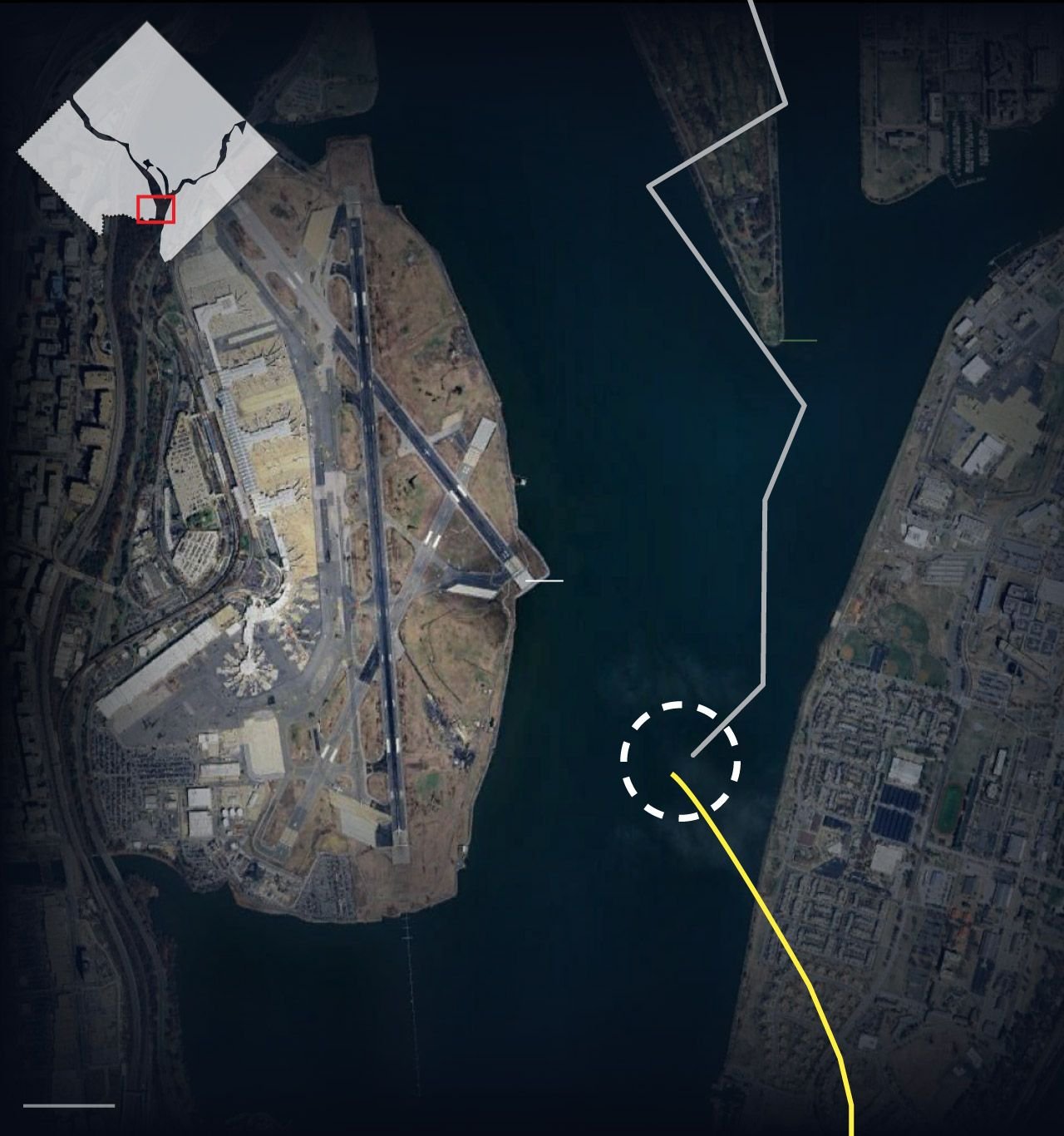
Or could the circling approach from 01 to 33 also be a factor with the helo misinterpreting the CRJ flight path and somehow losing sight ? The track of both aircraft is interesting… helo seems to initially be parallel to the river bank and turns 40 right. Why ? Was their destination the same airport or was that manoeuvre related to traffic avoidance or loss of visual ?
All guesswork I know… putting Special VFR traffic so close to final approach traffic at night clearly a problem. Tragic.
The golf course is on a peninsula in the river, so the helicopter was flying over water before and after it made the two turns.
Subjects
CRJ
Circle to Land (Deviate to RWY 33)
VFR
Links are to this post in the relevant subject page so that this post can be seen in context.
Reply to this quoting this original post. You need to be logged in. Not available on closed threads.
January 30, 2025, 13:23:00 GMT
permalink Post: 11817231
I would expect the airliner not to have to take any avoiding action, as it\x92d be IFR on a standard arrival for RW33. I would expect ATC to inform them of the helicopter traffic below them on the east side of the river.
I would expect the helicopter traffic to ultimately be responsible for avoidance, and they\x92d I guess be flying \x91Special VFR\x92*. But as they\x92re in controlled airspace then they should have been warned (which apparently they were) about the arriving civil traffic.
If the helicopter was, indeed, following Route 4 then what led to the discrepancy in position & height is conjecture. Also why they confirmed traffic in sight yet still collided is conjecture (& It\x92s possible they had their own emergency)
*) does \x91Special VFR\x92 exist/ apply for \x91night VMC\x92 ops in US controlled airspace ? it\x92s a long time since my FAA/US flying days\x85\x85
Subjects
ATC
DCA
IFR
Route 4
Traffic in Sight
VFR
Links are to this post in the relevant subject page so that this post can be seen in context.
Reply to this quoting this original post. You need to be logged in. Not available on closed threads.
January 30, 2025, 13:45:00 GMT
permalink Post: 11817256
Subjects
ATC
VFR
Links are to this post in the relevant subject page so that this post can be seen in context.
Reply to this quoting this original post. You need to be logged in. Not available on closed threads.
January 30, 2025, 13:55:00 GMT
permalink Post: 11817263
Approach traffic seems to be approx 400-500ft at this point.
Which turnip decided it would be OK to allow vertical separation of 300ft on a busy approach path? And allow it VFR at night?
This accident was baked in. Bound to happen at some point.
Subjects
Route 4
Separation (ALL)
VFR
Vertical Separation
Links are to this post in the relevant subject page so that this post can be seen in context.
Reply to this quoting this original post. You need to be logged in. Not available on closed threads.
January 30, 2025, 14:14:00 GMT
permalink Post: 11817273
Subjects
IFR
See and Avoid
VFR
Links are to this post in the relevant subject page so that this post can be seen in context.
Reply to this quoting this original post. You need to be logged in. Not available on closed threads.
January 30, 2025, 14:37:00 GMT
permalink Post: 11817285
my earlier point related to responsibility for separation\x85. and that the helo would be VFR (if following the low-level transit Route 4) and the airliner IFR. I was unsure if there was a special category for VFR at night\x85
apologies for sowing any confusion\x85\x85
Subjects
ATC
IFR
Route 4
VFR
Links are to this post in the relevant subject page so that this post can be seen in context.
Reply to this quoting this original post. You need to be logged in. Not available on closed threads.
January 30, 2025, 14:51:00 GMT
permalink Post: 11817298
How much higher at a minimum should they be over the required flightpath for the Helicopter Low Level route (at that point I see it as being 200 feet AGL or below)
But indications seem to show the Helicopter not at the required height above ground....although that number has some doubts due to various reasons.
Do standard IAP Procedures by Airlines require use of Glide Slope information even when VFR.....which would make me ask the question what height the RJ should have been at at the point it collided with t he helicopter.
Was the RJ Crew using Glide Slope information as part of their VFR Approach procedure for the designated runway? The CVR will let us know that in time probably.
The other question is at what point would the RJ Crew have benefit of visual glide slope lighting for the RWY 33?
Any of you Airline Pilots care to address that issue and assess that for us.
Here is the Airport data for Reagan International that shows the Instrument Approaches that are available. Can one derive a reasonable height above ground for the collision point....and/or a distance from the Touchdown Point of RWY33 for comparison to what seems to be the height and distance from the TD point?
https://www.airnav.com/airport/KDCA
Subjects
CVR
TCAS (All)
VFR
Links are to this post in the relevant subject page so that this post can be seen in context.
Reply to this quoting this original post. You need to be logged in. Not available on closed threads.
January 30, 2025, 15:12:00 GMT
permalink Post: 11817313
The majority of people inside the system don\x92t realise how bad it is because it\x92s all they\x92ve ever known. We have American contributors here who routinely tell us it\x92s ok to switch to TA only to avoid \x93nuisance\x94 RA\x92s, who will not follow an RA as they have the traffic in sight, who will accept visual separation at night (day is bad enough) or very late visual switches, who think LAHSO is a good idea. USA ATC think it\x92s acceptable to \x93slam dunk\x94 a heavy jet, get shirty when foreign operators refuse a questionable clearance, literally forget about an aircraft once it has accepted visual separation. The system allows uncontrolled VFR traffic within 500ft of commercial operations which is madness.
I operated the 747-400 around the planet for over a decade, the USA was one of the most threat laden environments we went to. Lovely people, just insane procedures. In that time I experienced a TCAS RA on vectors to JFK, was sent around and put in the hold as punishment on short final in Miami for refusing LAHSO, had multiple super high workload approaches to SFO combined with the crazy policy of pairing aircraft on approach. I witnessed a Singapore aircraft being refused a diversion to Boston from JFK fifteen minutes after they stated what time they would be leaving the hold and where they would be going resulting in a fuel mayday and an unplanned diversion to a regional airport. I lost count of the times I was chastised for refusing a visual approach and visual separation in congested airspace or a very late visual switch.
On most of the planet the human is the last line of defence in a multi layered safety environment. In the USA the human is often the only line of defence, while the environment they are in is super high workload significantly reducing their capacity to trap safety issues.
Unless there is a marked attitude shift in all parties involved in aviation in the USA this will happen again, potentially quite soon.
Stay safe out there
LD
Couldn\x92t agree more with everything you say. I\x92m sure we have probably shared a flightdeck in years gone by judging by your experiences. It\x92s this kind of chaos that I have to say I miss very little!!
Subjects
ATC
Close Calls
Land and Hold Short
Separation (ALL)
TCAS (All)
TCAS RA
Traffic in Sight
VFR
Visual Separation
Links are to this post in the relevant subject page so that this post can be seen in context.
Reply to this quoting this original post. You need to be logged in. Not available on closed threads.
January 30, 2025, 15:23:00 GMT
permalink Post: 11817324
Approach traffic seems to be approx 400-500ft at this point.
Which turnip decided it would be OK to allow vertical separation of 300ft on a busy approach path? And allow it VFR at night?
This accident was baked in. Bound to happen at some point.
In this case, the aircraft was flying an approach to one runway with a circle-to-land on RW-33. Ask any pilot; a circle to land in itself ups the work load. The margin for error of any kind at DCA is small and the 5200 foot runway isn't all that long. Even on a simple landing where none of these considerations are an issue, at some point the pilots reduce their "see and avoid" efforts and concentrate their efforts on achieving the proper line up and glide slope, rate of descent, aircraft configuration, flap setting, etc. etc. etc. In other words, the complicated routine required to safely land an airliner these days is already close to task overload even when things are going well. Add in the fact that it's night time at a very busy airport and looking out the window gets shoved pretty far down the "to do" list. But generally speaking, the system works because big busy airports pretty much operate using IFR rules and nearly all the aircraft are under close control. I other words, even on a crystal clear day under VFR flight conditions, someone is keeping a very close eye on the airliners coming and going from major airports. If a pilot makes a mistake and levels off at the wrong altitude, for example, there is a very good chance a controller will catch that error immediately even on a sunny VFR day. And that's a good thing because truth-be-told, when an airliner is seconds from touch down these days, there isn't much "see and avoid" going on. That's just the way it is.
But apparently DCA routinely has all sorts of helo traffic buzzing around under modified VFR flight rules. The pilots are talking to a controller but without being under the same sort of close control which is usually associated with how airliners operate. And they do that night and day, trusting the helo pilots to not make a mistake. But it looks like someone DID make a mistake last night and nobody caught it in time.
Subjects
ATC
Circle to Land (Deviate to RWY 33)
DCA
FAA
IFR
Route 4
See and Avoid
Separation (ALL)
VFR
Vertical Separation
Links are to this post in the relevant subject page so that this post can be seen in context.
Reply to this quoting this original post. You need to be logged in. Not available on closed threads.
January 30, 2025, 15:41:00 GMT
permalink Post: 11817334
It seems to be a US speciality that ATC can delegate the separation to aircrews (visually) and this at night! And how the hell can ATC separate vertically near the ground when mode S transponders report pressure altitude in steps of 100 feet only?
I dont know the rules of vertical separation by heart but its certainly not less than 500 feet for crossing paths. Is one last digit more or less a separation? This heli crew should have been told by ATC to hold until the aircraft(s) on final have safely passed. It's one of the benefits of a helicopter that it can hover.
Subjects
ATC
DCA
Hover
IFR
Separation (ALL)
VFR
Vertical Separation
Links are to this post in the relevant subject page so that this post can be seen in context.
Reply to this quoting this original post. You need to be logged in. Not available on closed threads.
January 30, 2025, 17:10:00 GMT
permalink Post: 11817417
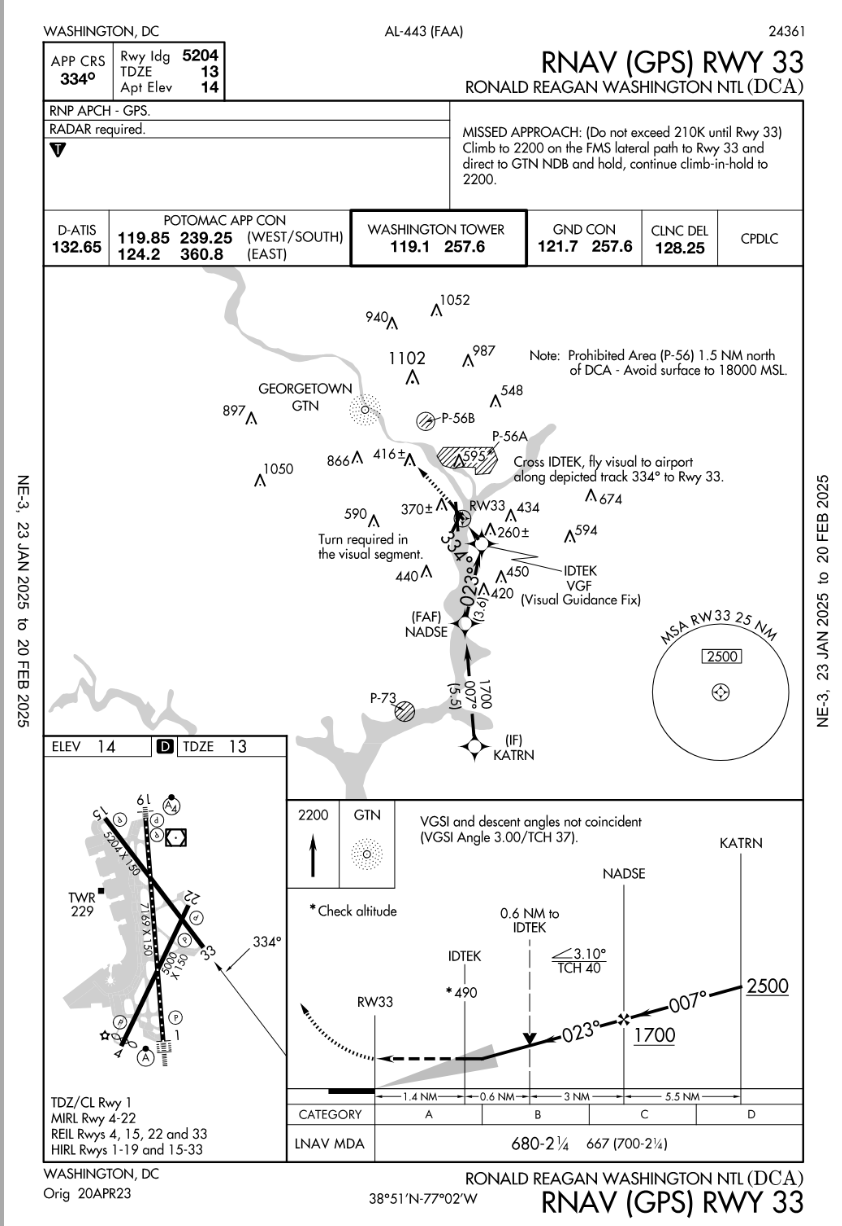
I couldn't find any NOTAM that would have signaled a non-functioning PAPI and, in a clear night, any trained pilot would follow the PAPI indication out of force of habit.
starting at the Visual Guidance Fix (VGF) IDTEK which is overhead of the motorway I-295 (if I am not mistaken).
I think that it is reasonable to assume that the pilot would have aimed at passing overhead IDTEK at 490 feet MSL as specified in the RNAV procedure.
IDTEK is about at 1.4 nm or 8500 ft from the threshold or about 9600 ft from the TDZ.
With a published PAPI glideslope of 3.00\xb0, the glideslope path is at about 500 ft MSL at IDTEK
And the distance TDZ - threshold is about 330 m for this runway.
With some trigonometric calculation, you end up with a height between 229 and 263 feet above runway TDZ, under the assumption that the plane was spot on the glide.
Subjects
CRJ
Circle to Land (Deviate to RWY 33)
Radar
VFR
Links are to this post in the relevant subject page so that this post can be seen in context.
Reply to this quoting this original post. You need to be logged in. Not available on closed threads.
January 30, 2025, 17:54:00 GMT
permalink Post: 11817466
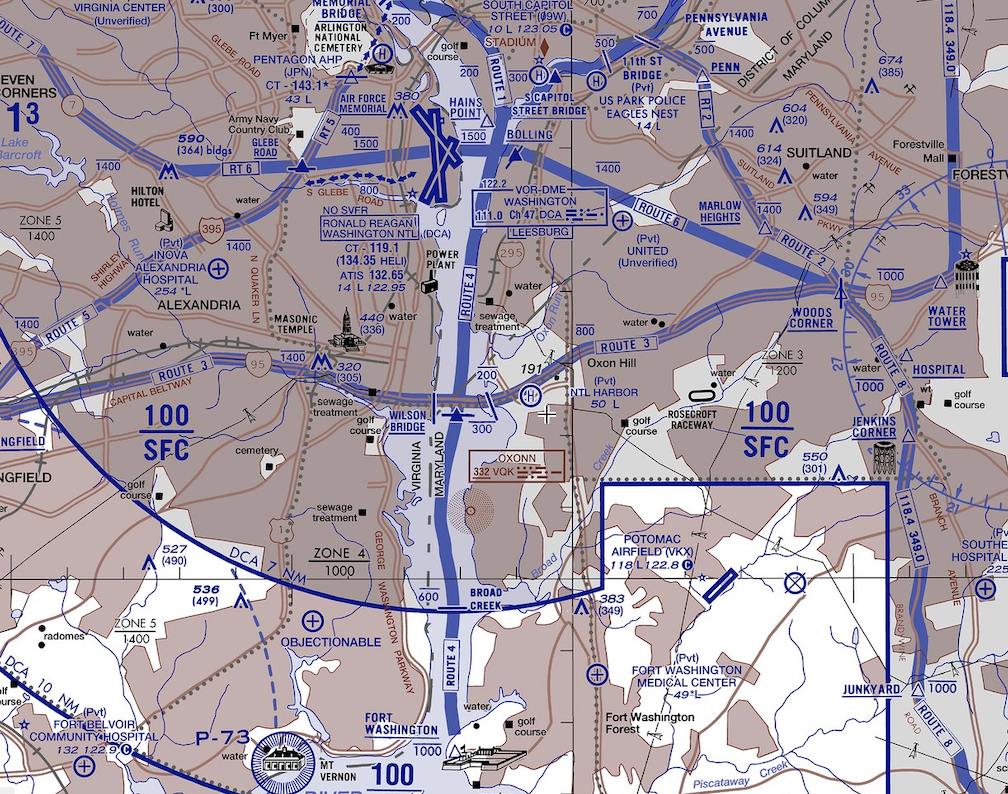
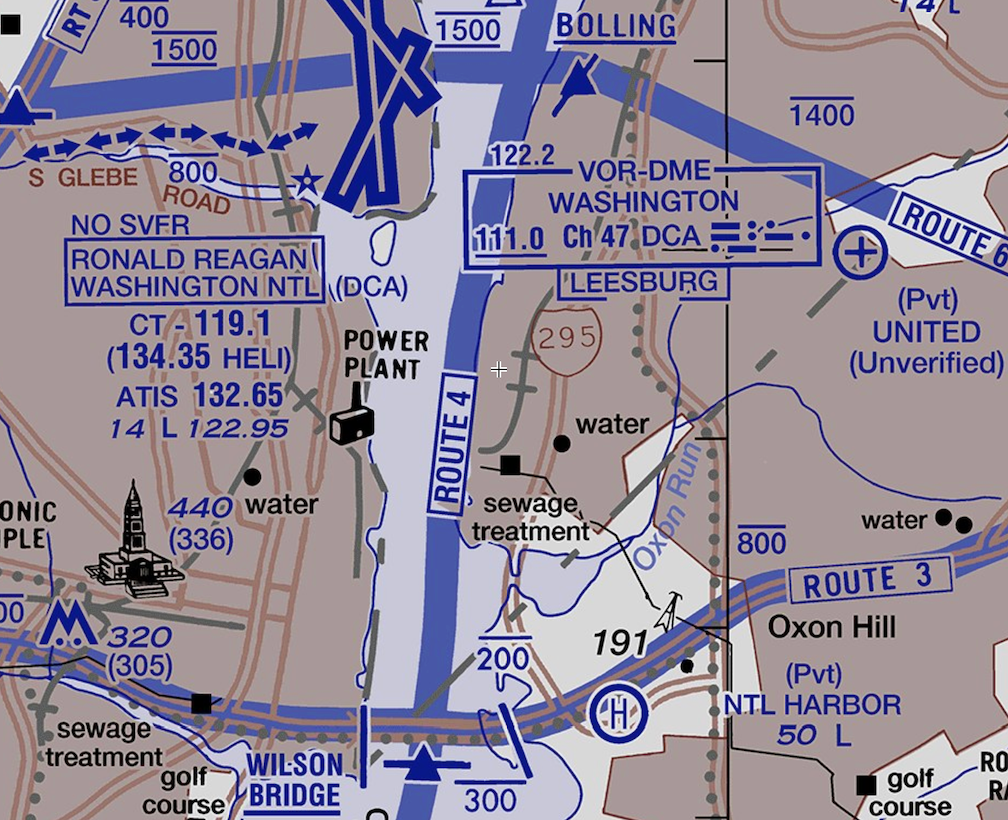
Hanging the ATCO on duty will not bring back the dead, and was not the cause of the problem. Having a civil aircraft flight path immediately overhead a LL RW VFR transit lane that guarantees that there is a loss of separation standards is what set this off, and that has been the case for decades. The crews, pax, ATC officers and families just happened to be the ones that got caught out by the insanity that permitted this track and procedure to exist.
Will Mr T go after the ATC guy? probably, the ATC officer doesn't own a kingdom, a corporation, in fact he is highly unlikely to have a DUI, and certainly won't be a convicted felon. So, I would rate the ATC guy as the convenient fall guy for the US Govt, the FAA who should not have permitted the operation of civil aircraft proximate to military LL traffic, and the US DOD, who will have signed off on the practice of disregarding minimum separation per \xa791.111. As far as right of way, the CRJ was landing, \xa791.113(g) applies, notwithstanding 91.113(d). The CRJ had every reasonable expectation of not sharing a cockpit on short finals to a short runway with crossing helo traffic.
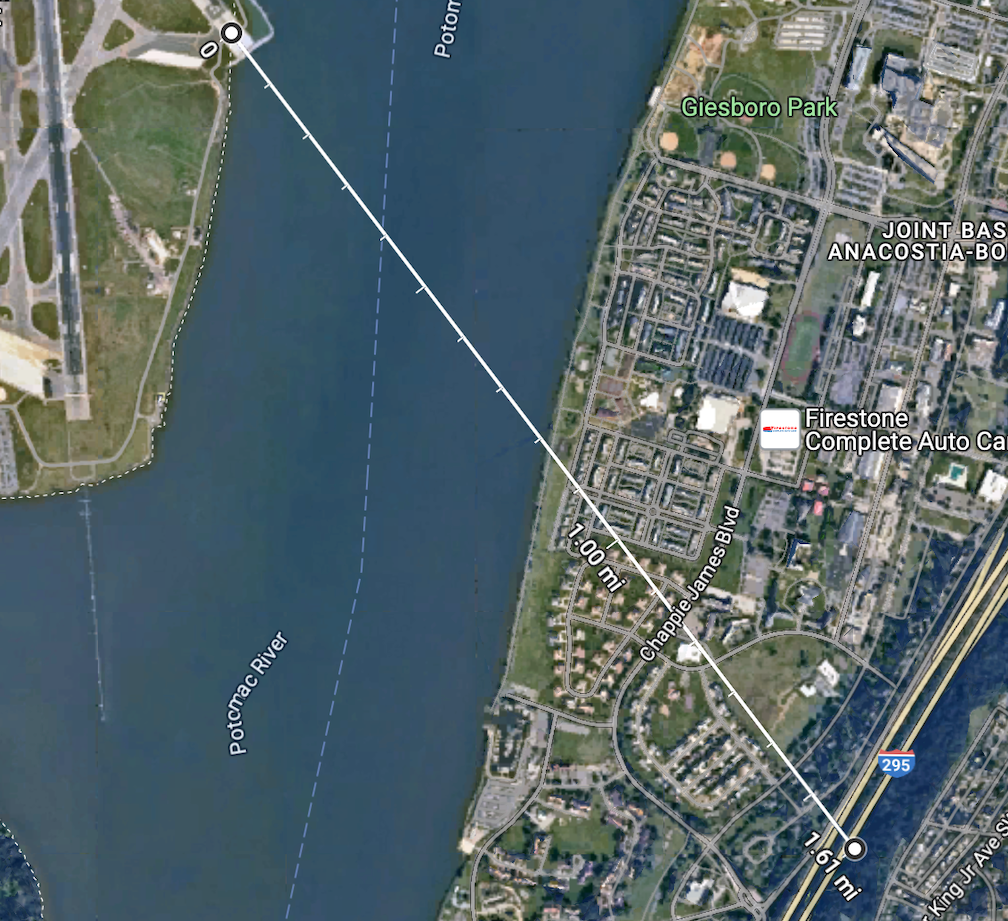
- IDTEK is 1.4nm from touchdown, 490' PA
- the east bank of the river is half way to the runway, ~0.7nm, -> 245'+40' = 285'PA
- the collision occurred around mid river, ~0.3-0.4nm from T/D, or 125+40=165'
What is particularly annoying is that the generals and other command staff, and Secretaries of Transport, Defence etc are quite happy to cashier the F-18 pilots who do a slow flypast of an arena, or the T-38 instructors who do the same over some other game, and yet, what is the chance that any general takes responsibility for their part in this sorry state of affairs. responsibility like other stuff, only goes downwards,
Its pretty easy for the guy in charge to defame the ATCO.
Glass houses.

Subjects
ATC
ATCO
CRJ
FAA
Normalization of Deviance
President Donald Trump
Separation (ALL)
VFR
Links are to this post in the relevant subject page so that this post can be seen in context.
Reply to this quoting this original post. You need to be logged in. Not available on closed threads.
January 30, 2025, 18:09:00 GMT
permalink Post: 11817487
it is easy to become disorientated at night particularly when making turns.
.the circling approach to r/w 33 seems demanding and pitot lookout would be focused on the runway not peripheral traffic - turns prevent all round lookout protection .
. The helo pilots could have sighted other traffic or moving lights on the ground - things happen very fast.
as stated earlier this was an accident waiting to happen - allowing VFR traffic to pass that close to traffic on short finals is crazy
with reliable engines,modern glass cockpits and brilliant nav aids flying has become a whole lot safer - mid air collisions in VFR / VMC remain high risk especially at low level if TCAS is unreliable and when weather is marginal.
the human eyeball has it\x92s limitations
PS are ATC urgent instructions ever misunderstood or not received because of comm faffs or language / regional accent misunderstandings ?
Subjects
ATC
Accident Waiting to Happen
Circle to Land (Deviate to RWY 33)
TCAS (All)
VFR
Links are to this post in the relevant subject page so that this post can be seen in context.
Reply to this quoting this original post. You need to be logged in. Not available on closed threads.
January 30, 2025, 20:09:00 GMT
permalink Post: 11817610
Subjects
ATC
DCA
Separation (ALL)
VFR
Links are to this post in the relevant subject page so that this post can be seen in context.
Reply to this quoting this original post. You need to be logged in. Not available on closed threads.