January 30, 2025, 07:27:00 GMT
permalink Post: 11816947
This accident was certainly "setup" in the procedures defined in this area, heavily relying on Humans not making (altitude (settings)) mistakes and Humans detection opportunities, for which we all know, the human is not really that well-designed for from scratch.
For this case, the helicopter corridor was designed to be below the approach path, though when the human makes even a small mistake and/or the weather makes the approach path a bit lower, things can go haywire quite easily.
RVSM is 1000ft at higher altitudes; even if things had gone 100% to plan, this would have only provided, what, <300ft vertical separation? Is wake turbulence a threat to helicopters?
Subjects
CRJ
See and Avoid
Separation (ALL)
Vertical Separation
Visual Separation
Links are to this post in the relevant subject page so that this post can be seen in context.
Reply to this quoting this original post. You need to be logged in. Not available on closed threads.
January 30, 2025, 13:55:00 GMT
permalink Post: 11817263
Approach traffic seems to be approx 400-500ft at this point.
Which turnip decided it would be OK to allow vertical separation of 300ft on a busy approach path? And allow it VFR at night?
This accident was baked in. Bound to happen at some point.
Subjects
Route 4
Separation (ALL)
VFR
Vertical Separation
Links are to this post in the relevant subject page so that this post can be seen in context.
Reply to this quoting this original post. You need to be logged in. Not available on closed threads.
January 30, 2025, 15:23:00 GMT
permalink Post: 11817324
Approach traffic seems to be approx 400-500ft at this point.
Which turnip decided it would be OK to allow vertical separation of 300ft on a busy approach path? And allow it VFR at night?
This accident was baked in. Bound to happen at some point.
In this case, the aircraft was flying an approach to one runway with a circle-to-land on RW-33. Ask any pilot; a circle to land in itself ups the work load. The margin for error of any kind at DCA is small and the 5200 foot runway isn't all that long. Even on a simple landing where none of these considerations are an issue, at some point the pilots reduce their "see and avoid" efforts and concentrate their efforts on achieving the proper line up and glide slope, rate of descent, aircraft configuration, flap setting, etc. etc. etc. In other words, the complicated routine required to safely land an airliner these days is already close to task overload even when things are going well. Add in the fact that it's night time at a very busy airport and looking out the window gets shoved pretty far down the "to do" list. But generally speaking, the system works because big busy airports pretty much operate using IFR rules and nearly all the aircraft are under close control. I other words, even on a crystal clear day under VFR flight conditions, someone is keeping a very close eye on the airliners coming and going from major airports. If a pilot makes a mistake and levels off at the wrong altitude, for example, there is a very good chance a controller will catch that error immediately even on a sunny VFR day. And that's a good thing because truth-be-told, when an airliner is seconds from touch down these days, there isn't much "see and avoid" going on. That's just the way it is.
But apparently DCA routinely has all sorts of helo traffic buzzing around under modified VFR flight rules. The pilots are talking to a controller but without being under the same sort of close control which is usually associated with how airliners operate. And they do that night and day, trusting the helo pilots to not make a mistake. But it looks like someone DID make a mistake last night and nobody caught it in time.
Subjects
ATC
Circle to Land (Deviate to RWY 33)
DCA
FAA
IFR
Route 4
See and Avoid
Separation (ALL)
VFR
Vertical Separation
Links are to this post in the relevant subject page so that this post can be seen in context.
Reply to this quoting this original post. You need to be logged in. Not available on closed threads.
January 30, 2025, 15:41:00 GMT
permalink Post: 11817334
It seems to be a US speciality that ATC can delegate the separation to aircrews (visually) and this at night! And how the hell can ATC separate vertically near the ground when mode S transponders report pressure altitude in steps of 100 feet only?
I dont know the rules of vertical separation by heart but its certainly not less than 500 feet for crossing paths. Is one last digit more or less a separation? This heli crew should have been told by ATC to hold until the aircraft(s) on final have safely passed. It's one of the benefits of a helicopter that it can hover.
Subjects
ATC
DCA
Hover
IFR
Separation (ALL)
VFR
Vertical Separation
Links are to this post in the relevant subject page so that this post can be seen in context.
Reply to this quoting this original post. You need to be logged in. Not available on closed threads.
January 30, 2025, 18:16:00 GMT
permalink Post: 11817497
To answer an earlier question , Yes they have CISM , NATCA is good at this , they will take care of the controllers.
@ fdr : our posts crossed each other , fully agree with you .
Subjects
Accident Waiting to Happen
CRJ
IFR
Route 4
Separation (ALL)
Vertical Separation
Links are to this post in the relevant subject page so that this post can be seen in context.
Reply to this quoting this original post. You need to be logged in. Not available on closed threads.
January 30, 2025, 22:16:00 GMT
permalink Post: 11817700
There have been countless similar cases of near misses. Near airports, crossing traffic, especially helicopters is a real issue, as is the totally inappropriate see and avoid principle with commercial traffic. In my view we need a complete rule change and rethink around lack of radar separation between IFR and VFR traffic.
All too frequently ATC allow IFR and VFR far too close on approach and are permitted to just inform the VFR traffic to visually manoeuvre themselves all too close to IFR traffic. The book 'The Naked Pilot' years ago established that see and avoid does not work, simple as that.
Class D airspace whilst not necessarily involved here often causes such issues. Pilot's wrongly believe ATC separates IFR and VFR. Frequently ATC allow conflicts to develop on the basis of law, rather than duty of care. We need to get back to common sense, and that is ATC must stop VFR traffic getting anywhere near airliners on final approach or from crossing the go around track. Either lateral or vertical separation needs to be enforced or repeats of this type of accident will definitely repeat.
Lessons have not been learned previous to this accident. I fear we will see a repeat, and low level near airport ATC separation needs to improve.
We need the industry to wake up and realise, see and avoid is unreliable, and air law does not protect IFR traffic from VFR traffic enough.
Subjects
ATC
Close Calls
IFR
Radar
See and Avoid
Separation (ALL)
VFR
Vertical Separation
Links are to this post in the relevant subject page so that this post can be seen in context.
Reply to this quoting this original post. You need to be logged in. Not available on closed threads.
January 31, 2025, 10:42:00 GMT
permalink Post: 11818095
6. Effective radio comms depend on the people communicating speaking clearly and precisely, so that what they say is understood by all parties involved. That includes waiting for read-backs and acknowledgements.
7. This man was having to speak so fast in order to do his job that it seems strikingly obvious that the volume of traffic he was having to deal with was far too high.
My take is, in order.
5) No, I don't think he was overwhelmed. He was shot through with adrenaline and shocked as anyone would be having just witnessed two aircraft he was talking to seconds before vanish in a fireball, realising his career, reputation, life and future sanity was irrevocably blown to pieces no matter the cause.
No, no and thrice no. Assuming the tapes are in real time there are considerable gaps between transmissions so he most certainly did not 'have' to speak so quickly. He had plenty of time to speak clearly and coherently instead of spouting those eruptions of incoherent, almost incomprehensible babble.
Sadly - reprehensibly, this style of unnecessarily theatrical auctioneer-style unpunctuated babble seems all too frequent in the States. Tower frequencies are usually if not almost invariably much less time-pressurised as they handle fewer aircraft in a well spaced sequence than in a termnal control area.
6) Concur 100%. And they failed miserably to achieve this. I've been flying for several decades and struggle to hear one word in three (and only assume much of the rest because I know what to expect - a human factors disaster) of that controller's outbursts, and the shoddy partial readbacks are shocking to European ears.
7) Once again, NO! Even if super-busy (and I'd argue especially if super busy) it is essential to keep r/t steady, clear and comprehensible; gabbling that fast might save half a second on an exchange, but no frequency is so busy it requires that, least of all a Tower. He only had three or four aircraft to deal with for simple go-arounds, all well spaced out on approach. He pretty much had time to recite half the Lord's Prayer to each.
This crazy r/t seems to be a cultural thing and needs to be changed, as do some fundamental procedures like having helo lanes crossing final approach tracks at essentially the same height instead of with decent vertical separation. Why wasn't the helilane at 800ft or 1000ft as a Heathrow? No aircraft is up there one mile out from finals while every single one is at 300ft. Madness. Just madness. It's like a figure 8 banger race dodging cars at the intersection. If there was a flyover - vertical separation too accidents would be all but eliminated.
And this buisness of "...pass behind the CRJ on finals" when no none can determine whether the lights in sight are a CRJ, a Cessna or the Space Shuttle or in what sequence they are landing. It might work in daylight but imho it assumes unreasonable levels of instant almost head-on aircraft recognition - a disastrous human factors trap quite aside from the additional one of assumption.
I'm not having a go at the poor controller who imho is compleely blameless, he did his job as well as the flawed system that indoctrinated him allowed.
As for 'stopping' helicopters in a free- air hover. This is (in my experience) never ever requested, done or attempted as a traffic avoidance method. I can only assume people suggesting this have absolutely zero knowlege of flying helos and the litany of pitfalls and hazards it would generate, helos simply do not 'stop' in midair unless they have to for SAR, load-lfting ot maybe surveillance. If necessary, as in holding at 'dual taxiways' between the Heathrow runways at 1000ft you'd slow to a sensible speed, maybe 50-60Kts in a tight orbit and even that is 'interesting' in 40Kts of wind. "Are you visual with landing traffic 2 mile final" identifies the traffic far, far better than "the CRJ on finals" when there might be three in a row, not to mention assuming superhuman powers of head-on distant aircraft recognition even in daylight - and impossible at night!!! Crossing clearance is then "cross over the threshold after the landing traffic" where no aeroplane ever is at 1000ft. (bar a g/a when there is enough time to skedaddle and avoid) With any significant wind a hover would have to be into wind, ie more or less tail -on to the conflicting traffic, an utterly absurd concept. Bin this one people, please.
As for the appalling behaviour of the 'president' to instantly apportion blame with no understanding of either the situation or accident investigation in general whatsoever - which anyway is not his job and none of his business, thereby prejudicing any enquiry (what pressure does this put on the investigators and report writers, federal employees, when they are all but directed by their deranged and vindictive boss what they are expected to report? This is a very, very dangerous precedent that smacks more of a shonky third world dictatorship than a western democracy.
Last edited by meleagertoo; 31st January 2025 at 11:55 .
Subjects
ATC
CRJ
DCA
Hover
Pass Behind
Pass Behind (All)
President Donald Trump
Separation (ALL)
Vertical Separation
Links are to this post in the relevant subject page so that this post can be seen in context.
Reply to this quoting this original post. You need to be logged in. Not available on closed threads.
January 31, 2025, 12:43:00 GMT
permalink Post: 11818172
Subjects
ATC
Separation (ALL)
Vertical Separation
Links are to this post in the relevant subject page so that this post can be seen in context.
Reply to this quoting this original post. You need to be logged in. Not available on closed threads.
January 31, 2025, 13:07:00 GMT
permalink Post: 11818186
Subjects
Separation (ALL)
Vertical Separation
Links are to this post in the relevant subject page so that this post can be seen in context.
Reply to this quoting this original post. You need to be logged in. Not available on closed threads.
January 31, 2025, 13:41:00 GMT
permalink Post: 11818215
Subjects
Blackhawk (H-60)
DCA
Separation (ALL)
Vertical Separation
Links are to this post in the relevant subject page so that this post can be seen in context.
Reply to this quoting this original post. You need to be logged in. Not available on closed threads.
January 31, 2025, 14:48:00 GMT
permalink Post: 11818264
30 seconds before the collision, when LC asked if they have traffic in sight, HELO was on track about 200\xb0, because of wind (320/25) HDG was somerhing like 215\xb0. Bearing to CRJ was 10 o’clock and to A319 about 11 o’clock. At this moment CRJ was flying track to North, base for rwy 33, and was not at all conflicting traffic from HELO’s point of view. Few seconds later HELO turned to the South, perhaps to avoid A319, soon after noticed that A319 will pass far ahead and turned back to right… so sad.
Subjects
CRJ
Separation (ALL)
Traffic in Sight
Vertical Separation
Links are to this post in the relevant subject page so that this post can be seen in context.
Reply to this quoting this original post. You need to be logged in. Not available on closed threads.
January 31, 2025, 22:11:00 GMT
permalink Post: 11818566
Comments appreciated of course. Indeed, I was referring to the second LC comms with the helo (coinciding with CA alerts). Class B mandates ATC to ensure separation , no matter VFR (indeed twice requested and twice accepted) or IFR (on the question whether AA by/when accepting 33 canceled IFR or not). This IMO implies much more on ATC than re-requesting whether A/C in sight, in particular in case of CA alert, less than one good/bad minute apart.
VFR aircraft must be separated from VFR/IFR aircraft/ helicopter/rotorcraft that weigh more than 19,000 pounds and turbojets by no less than:
- 1 \xbd miles separation, or
- 500 feet vertical separation, or
- Visual separation, as specified in paragraph 7-2-1 , Visual Separation, paragraph 7-4-2 , Vectors for Visual Approach, and paragraph 7-6-7 , Sequencing.
The rules for pilot-applied visual separation state:
- If the aircraft are on converging courses, inform the other aircraft of the traffic and that visual separation is being applied.
- Advise the pilots if the radar targets appear likely to merge.
Subjects
ATC
IFR
Radar
Separation (ALL)
VFR
Vertical Separation
Visual Separation
Links are to this post in the relevant subject page so that this post can be seen in context.
Reply to this quoting this original post. You need to be logged in. Not available on closed threads.
January 31, 2025, 23:31:00 GMT
permalink Post: 11818616
VFR aircraft must be separated from VFR/IFR aircraft/ helicopter/rotorcraft that weigh more than 19,000 pounds and turbojets by no less than:
- 1 \xbd miles separation, or
- 500 feet vertical separation, or
- Visual separation, as specified in paragraph 7-2-1 , Visual Separation, paragraph 7-4-2 , Vectors for Visual Approach, and paragraph 7-6-7 , Sequencing.
The rules for pilot-applied visual separation state:
- If the aircraft are on converging courses, inform the other aircraft of the traffic and that visual separation is being applied.
- Advise the pilots if the radar targets appear likely to merge.
- If aircraft are on converging courses, inform the other aircraft of the traffic and that visual separation is being applied.
(ACID), TRAFFIC, (clock position and distance), (direction) BOUND, (type of aircraft), HAS YOU IN SIGHT AND WILL MAINTAIN VISUAL SEPARATION.
- Advise the pilots if the targets appear likely to merge.
Issue this advisory in conjunction with the instruction to maintain visual separation, the advisory to the other aircraft of the converging course, or thereafter if the controller subsequently becomes aware that the targets are merging.\x94
Subjects
ATC
CRJ
Radar
Separation (ALL)
VFR
Vertical Separation
Visual Separation
Links are to this post in the relevant subject page so that this post can be seen in context.
Reply to this quoting this original post. You need to be logged in. Not available on closed threads.
February 01, 2025, 00:03:00 GMT
permalink Post: 11818637
Note I say \x91through\x92 and not \x91under\x92.
I\x92m sure it is done at many airports around the World and we have a similar procedure at a large international airport in East Asia.
HOWEVER, the idea that the 200ft ceiling on the heli route is designed to provide vertical separation from the approach is ludicrous.
I suspect that limit is imposed to allow clearance from the Take-off climb surface if using the opposite direction runways. That would indeed be possible from a flight procedure design point of view (TERPS or PANS-OPS).
The only safe way is to cross behind traffic on final laterally . In some ways it would be better for the heli to be at a higher altitude if on 33 but for simplicity of procedure they may have just made it a blanket 200ft regardless.
Our procedure has laterally separated holding points either side of final which is the clearance limit where the heli can orbit or delay as necessary until confirming the aircraft to pass behind is in sight. The heli is also advised where the next aircraft in the sequence is to further verify the correct aircraft is in sight and what margin they need to leave behind the one crossing behind. Again, being higher is better as they can avoid wake turbulence by remaining well an above the glide path and pass closer behind, well ahead of the following.
There is no doubt night time makes this a far more critical operation and requires full attention. In our operation the heli is also on the same frequency as the approach aircraft, so having separate positions to control fixed wing and helis wouldn\x92t have any benefit.
This controller was hugely busy however, handling departures as well. I can\x92t believe the speed of his transmissions - even as a controller for over 30 years I have trouble with all the abbreviated phrases- of course local pilots would be used to it and expecting clipped frequencies etc\x85
The trouble with a lot of these types of procedures is a lot is carried out as a box ticking exercise - heli calls requesting to cross the final ✅, LC provides the position of the aircraft to pass behind ✅, heli reports sighting and requests own visual separation ✅, approved ✅.
LC is no doubt expected to monitor compliance visually although hugely busy with other traffic on the runway. It does sound like he was doing so, especially when the CA goes off in the background audio and puts doubt in his mind the heli is passing clear of the CRJ. He asks again immediately.
The heli confirms, so difficult to further challenge the pilot.
In my view a poorly designed procedure which was guaranteed to place the 2 aircraft in the same position if an error was made.
Subjects
ATC
CRJ
Pass Behind
Pass Behind (All)
Separation (ALL)
Vertical Separation
Visual Separation
Links are to this post in the relevant subject page so that this post can be seen in context.
Reply to this quoting this original post. You need to be logged in. Not available on closed threads.
February 01, 2025, 10:05:00 GMT
permalink Post: 11818884
The accident appears, almost certainly, to have been directly caused by the misidentification of conflicting traffic by the helo.
Fundamentally though the accident was entirely set up and enabled by critical faults in airspace usage and procedures, viz no vertical separation betwen the helo lane and glideslope at their point of intersection (to my mind simply incredible) and to a lesser extent perhaps the (again to my mind) extraordinary split frequency system. The first provides only one slice of swiss cheese - substantial vertical separation would add a second slice while the frequency thing is no cheese at all.
Despite what some commentators here and elsewhere seem to think there is never intended to be a situation when a helo passes under an aircraft on finals at 200ft. Helo traffic is held, or holds itself following a conditional clearance short of runway track before proceeding visually behind landing traffic or ahead of traffic on longer finals, exactly as is done at Heathrow. The difference is that in the event of an error at LHR there is 1000ft of vertical separation to add guartanteed separation if a helo wanders off track. Here there is next to none, it is very like a road intersection where cars on a minor road cross a big highway with conditional (orange flashing) traffic lights. Elsewhere in aviation this is just never done, there is always vertical separation too as a most basic safety precaution - ie like an overpass. The 1000ft also has the advantage that helo traffic is clearly visible on radar which is not the case when its grubbing along at 200ft.
Equally, the London helilanes too carry both mil and civ traffic, but critically both are on the same frequency (or if not the system re-broadcasts everything so it sounds as if they are) so everyone is playing the same ball. As every mil helo (surely?) has VHF nowadays why the digamma aren't procedures requiring its use when interracting in close/very close proximity with civ traffic?
Contributory factors include grossly sloppy r/t which employs open questions instead of closed ones - "do you see the CRJ on finals" when there are two unidentifiable aircraft visible on finals instead of "do you see the aircraft on 2 mile finals".
Doubtless there may be other consideration such as insufficient controllers and excessive workload too but that is not for me to say.
Bottom line is this appears to be a classic human factors accident induced by badly designed airspace, voice and control procedures.
+++++++++++
Why was the helo high? Not that I've ever done it but 200 ft or below at night over a big black hole of a river surrounded by bright city lights (800ft is my lowest) sounds pretty adventurous to me, it's very low indeed, and when a threator distraction is introduced at such low level in a helo one's instinct, even reflex is often to just squeeze back a little on the cyclic to give you a bit more space while your attention is drawn elsewhere. 100ft extra comes in a very short time and with less than 100ft of vertical separation from mis-identified traffic, that's it.
Subjects
CRJ
Radar
Separation (ALL)
Vertical Separation
Links are to this post in the relevant subject page so that this post can be seen in context.
Reply to this quoting this original post. You need to be logged in. Not available on closed threads.
February 01, 2025, 11:49:00 GMT
permalink Post: 11818962
"Why was the helo high? Not that I've ever done it but 200 ft or below at night over a big black hole of a river surrounded by bright city lights (800ft is my lowest) sounds pretty adventurous to me, it's very low indeed, and when a threator distraction is introduced at such low level in a helo one's instinct, even reflex is often to just squeeze back a little on the cyclic to give you a bit more space while your attention is drawn elsewhere. 100ft extra comes in a very short time and with less than 100ft of vertical separation from mis-identified traffic, that's it."
Can't help but wonder about the sudden supposed change in height. I can't imagine that the heli pilot didn't see the jet in the final moments......reaction is "avoid"....turn right? ....in front of it? No, Go down into the blackness below, No, Turn left towards it? No,
So only way is up, another 100ft and we'd not all be writing this.Tragic beyond words.
Subjects
Separation (ALL)
Vertical Separation
Links are to this post in the relevant subject page so that this post can be seen in context.
Reply to this quoting this original post. You need to be logged in. Not available on closed threads.
February 01, 2025, 14:34:00 GMT
permalink Post: 11819060
Subjects
IFR
Separation (ALL)
Vertical Separation
Links are to this post in the relevant subject page so that this post can be seen in context.
Reply to this quoting this original post. You need to be logged in. Not available on closed threads.
February 01, 2025, 16:56:00 GMT
permalink Post: 11819164
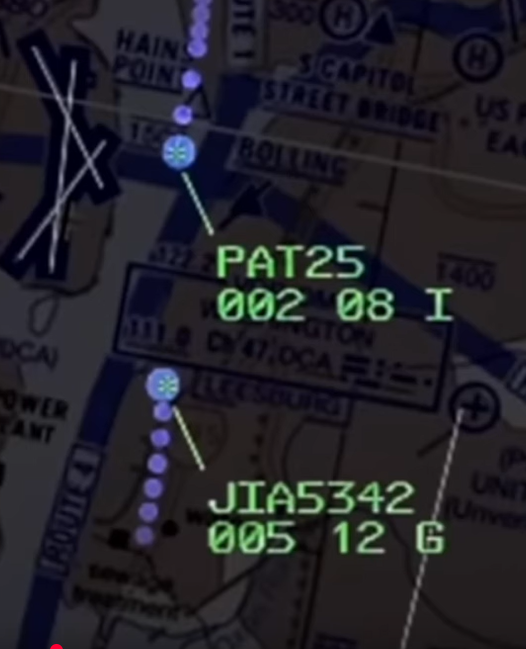
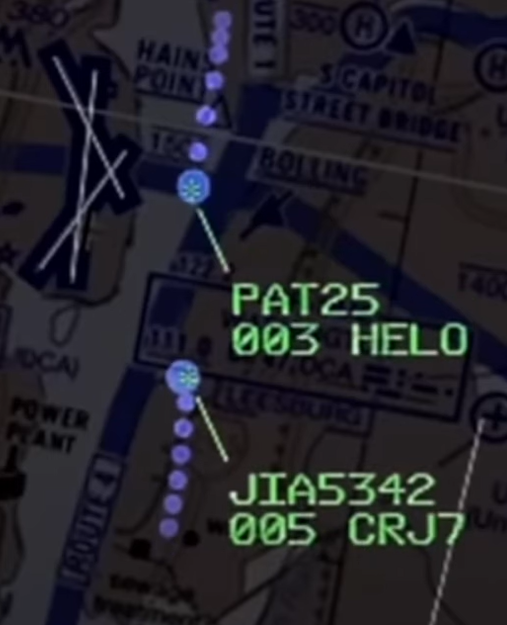
Subjects
ATC
Radar
Separation (ALL)
Vertical Separation
Links are to this post in the relevant subject page so that this post can be seen in context.
Reply to this quoting this original post. You need to be logged in. Not available on closed threads.
February 01, 2025, 22:34:00 GMT
permalink Post: 11819350
Urgent information needs salience in displays and suitable attention-getters, but in that regard, proximate traffic near an airport could be given greater prominence, then to be lost in learned noise. TCAS is not the answer to this collision. I’m increasingly reminded of the term, ‘defensive controlling’. Yes, you expect to have vertical separation if the climber stops at its cleared level, but why not give it a five degree heading change, not to achieve any kind of separation, but just to make sure they don’t hit if it busts….
The transfer of responsibility to the helo crew here was entirely legitimate, but also created the single point of failure which led to a collision, and that was foreseeable.
Subjects
Separation (ALL)
TCAS (All)
Vertical Separation
Links are to this post in the relevant subject page so that this post can be seen in context.
Reply to this quoting this original post. You need to be logged in. Not available on closed threads.
February 02, 2025, 00:07:00 GMT
permalink Post: 11819397
Not just from a collision perspective, but a wake turbulance issue.
And maybe more importantly, what should have been the horizontal separation? Surely it should have been at least 500 feet after the passing CRJ (not based on air law, just common sense). Clearly there was no horizontal or vertical separation in the end, but just how far off minimums was the helicopter? Seems nearly impossible to be that far off the expected flight path.
Subjects
CRJ
Separation (ALL)
Vertical Separation
Links are to this post in the relevant subject page so that this post can be seen in context.
Reply to this quoting this original post. You need to be logged in. Not available on closed threads.