February 02, 2025, 00:21:00 GMT
permalink Post: 11819407
Assuming the CRJ was at an expected/typical altitude at that point in it's approach, if the helicopter was at 200 feet, or lets say for their benefit 175 feet, then they would have avoided collision by a mere 150 feet of vertical separation if everything else about the position of the two aircraft remained the same.
Is 125 feet of vertical separation (with no horizontal separation) considered acceptable?
If the CRJ movement is controlled by ATC, and the helicopter is responsible for avoiding all other aircraft, then there is no question the helicopter was at fault here as the primary cause, and ATC as the secondary.
Given the collision course these aircraft were clearly on, why wouldn't ATC have diverted one of them prior to impact? Does ATC have any reason to believe that the helicopter sees everything with the same degree of detail and accuracy as ATC? This is not a sarcastic question. I'm genuinely curious. Would ATC, hearing the helicopter twice affirming visual separation, have had any plausible reason to doubt that the helicopter was unaware of the impending collision?
What's the point of having Air Traffic "Control"...if they're not actually in control?
Subjects
ATC
CRJ
NTSB
Separation (ALL)
Vertical Separation
Visual Separation
Links are to this post in the relevant subject page so that this post can be seen in context.
Reply to this quoting this original post. You need to be logged in. Not available on closed threads.
February 02, 2025, 00:48:00 GMT
permalink Post: 11819416
Assuming the CRJ was at an expected/typical altitude at that point in it's approach, if the helicopter was at 200 feet, or lets say for their benefit 175 feet, then they would have avoided collision by a mere 150 feet of vertical separation if everything else about the position of the two aircraft remained the same.
Is 125 feet of vertical separation (with no horizontal separation) considered acceptable?
If the CRJ movement is controlled by ATC, and the helicopter is responsible for avoiding all other aircraft, then there is no question the helicopter was at fault here as the primary cause, and ATC as the secondary.
Given the collision course these aircraft were clearly on, why wouldn't ATC have diverted one of them prior to impact? Does ATC have any reason to believe that the helicopter sees everything with the same degree of detail and accuracy as ATC? This is not a sarcastic question. I'm genuinely curious. Would ATC, hearing the helicopter twice affirming visual separation, have had any plausible reason to doubt that the helicopter was unaware of the impending collision?
What's the point of having Air Traffic "Control"...if they're not actually in control?
The helo should have been told to hold some half mile away and wait for crossing traffic to clear.
The NTSB is going to have a field day with the FAA on this.
Subjects
ATC
CRJ
FAA
NTSB
Separation (ALL)
Vertical Separation
Visual Separation
Links are to this post in the relevant subject page so that this post can be seen in context.
Reply to this quoting this original post. You need to be logged in. Not available on closed threads.
February 02, 2025, 01:32:00 GMT
permalink Post: 11819434
Is 125 feet of vertical separation (with no horizontal separation) considered acceptable?
If two aircraft passed that close in some other part of controlled airspace, and they'd seen each other, would one or both have filed an air miss report?
Subjects
CRJ
Separation (ALL)
Vertical Separation
Links are to this post in the relevant subject page so that this post can be seen in context.
Reply to this quoting this original post. You need to be logged in. Not available on closed threads.
February 02, 2025, 01:50:00 GMT
permalink Post: 11819439
That is insane.
The CRJ likely wasn\x92t flying VNAV vertical guidance as it\x92s an LNAV only MDA for 33 and they were coming out of a left base to final turn flying visually on a 3 degree PAPI.
Which means they\x92re hand flying and no one can guarantee they won\x92t be slightly slow to slightly fast or slightly high or slightly low.
\x93Three red on the PAPI correcting\x94
0.01 on the altimeter is 25\x92, that\x92s already 10%
Plus inherent altimeter inaccuracy,
For a shorter taxi or one departure.
Its madness.
Subjects
Altimeter (All)
CRJ
Separation (ALL)
Vertical Separation
Links are to this post in the relevant subject page so that this post can be seen in context.
Reply to this quoting this original post. You need to be logged in. Not available on closed threads.
February 02, 2025, 03:18:00 GMT
permalink Post: 11819485
FAA Order JO 7110.65AA - Air Traffic Control
7.9.4 SEPARATIONa. Standard IFR services to IFR aircraft.
b. VFR aircraft must be separated from VFR/IFR aircraft/ helicopter/rotorcraft that weigh more than 19,000 pounds and turbojets by no less than:
1. 1 \xbd miles separation, or
2. 500 feet vertical separation, or
3. Visual separation, as specified in paragraph 7-2-1 , Visual Separation, paragraph 7-4-2 , Vectors for Visual Approach, and paragraph 7-6-7 , Sequencing.
7.2.1 VISUAL SEPARATION
a.2. Pilot-applied visual separation.
(a) Maintain communication with at least one of the aircraft involved and ensure there is an ability to communicate with the other aircraft.
(b) The pilot sees another aircraft and is instructed to maintain visual separation from the aircraft as follows
(1) Tell the pilot about the other aircraft. Include position, direction, type, and, unless it is obvious, the other aircraft's intention.
(2) Obtain acknowledgment from the pilot that the other aircraft is in sight.
(3) Instruct the pilot to maintain visual separation from that aircraft.
Subjects
FAA
IFR
Separation (ALL)
VFR
Vertical Separation
Visual Separation
Links are to this post in the relevant subject page so that this post can be seen in context.
Reply to this quoting this original post. You need to be logged in. Not available on closed threads.
February 02, 2025, 06:15:00 GMT
permalink Post: 11819534
As a system ' - at night - I think it's crazy. But that's the system.
Subjects
ATC
Blackhawk (H-60)
Pass Behind
Pass Behind (All)
Separation (ALL)
Vertical Separation
Links are to this post in the relevant subject page so that this post can be seen in context.
Reply to this quoting this original post. You need to be logged in. Not available on closed threads.
February 02, 2025, 07:39:00 GMT
permalink Post: 11819561
As a system ' - at night - I think it's crazy. But that's the system.
Subjects
ATC
Blackhawk (H-60)
Pass Behind
Pass Behind (All)
Separation (ALL)
Vertical Separation
Links are to this post in the relevant subject page so that this post can be seen in context.
Reply to this quoting this original post. You need to be logged in. Not available on closed threads.
February 02, 2025, 10:36:00 GMT
permalink Post: 11819671
Not just from a collision perspective, but a wake turbulance issue.
And maybe more importantly, what should have been the horizontal separation? Surely it should have been at least 500 feet after the passing CRJ (not based on air law, just common sense). Clearly there was no horizontal or vertical separation in the end, but just how far off minimums was the helicopter? Seems nearly impossible to be that far off the expected flight path.
Can all these non-aviation pundits here please get it into their heads that just because the helilane has a cieling of 200ft and the glideslope is 325 or whatever it does not imply that helos can, would or might EVER be allowed to pass 125 ft under an aircraft on finals nor would any sane helo pilot (there are some!) do so. That would be insane, as surely this common sense you speak of should tell you? What's a lateral 500ft got to do with air law or anything else, ever? You're muddling completely unconnected and irrelevant matters. Have you not read/heard the ATC transcripts? Helos are not given clearance to and cannot cross until landing traffic is clear (as this helo one was told) - ie until it has passed unless the incoming is sufficiently far away for there to be no possible confliction.
How far off minimums (actually a maximum)? - you've already answered that question yourself. 125ft.
The insanity of this routing procedure is that in the event of an accidental horizontal incursion into the track of an inboud as happened here there is in theory only 125 ft of vertical clearance to prevent a disaster which is nowhere near enough of a safety margin. That route should have been, imho, at least 5-800ft or more above two dots up on the glideslope.
Once again, helicopters never, never ever come to a free air hover for separation purposes - this is a ridiculous concept for numerous reasons that are too long to go into here, and would be downright dangerous at night over a black hole at 200ft. They slow and orbit if they have to, maybe slow right down if wind direction and speed allows, but never hover.
I know not everyone here is experienced on helos but if so could they please refrain from speculating on operating procedures? All this guff about altimeter accuracy is completely irrelevant and has created a huge amount of unnecessaty noise. The aircraft was flying a visual sight-picture approach where an altimeter barely features at all and helos at low level, especially at night and over water do not use the baro altimeter. They exclusively refer to rad-alt.
Finally, all those who think a visual self-positioning clearance as employed in this case behind crossing traffic is somehow hazardous are completely incorrect. Once again, at Heathrow the helilane crosses 27 L and R thresholds at (iirc)1000ft. The only clearances given as you approach the boundary is to the effect of 'cross NOW (directly) over the threshold', 'hold (at a VRP clear N/S of the threshold)' or, having confirmed and read back landing traffic visual and identified the formula is repeated, 'after the landing traffic 2 miles cross behind'. It's perfectly safe as as it isn't done at the same height as the airliner but with a large vertcal clearance too.
btw, does Marine One fly this route?
Last edited by meleagertoo; 2nd February 2025 at 11:41 .
Subjects
ATC
Altimeter (All)
CRJ
Hover
Radio Altimeter
Separation (ALL)
Vertical Separation
Links are to this post in the relevant subject page so that this post can be seen in context.
Reply to this quoting this original post. You need to be logged in. Not available on closed threads.
February 02, 2025, 16:21:00 GMT
permalink Post: 11819897
Subjects
ATC
Blackhawk (H-60)
Pass Behind
Pass Behind (All)
Separation (ALL)
Vertical Separation
Links are to this post in the relevant subject page so that this post can be seen in context.
Reply to this quoting this original post. You need to be logged in. Not available on closed threads.
February 02, 2025, 23:05:00 GMT
permalink Post: 11820185
1. In an effort to maximize commercial air traffic in and out of DCA, the FAA has created the “deviate to RWY 33 procedure” for air traffic in-bound to RWY 01. This requires a right-hand turn from the RWY 01 approach followed by an immediate hard left-hand turn to line up on RWY 33. FAA criteria for a stabilized approach states that you have to be stable at 500 feet AGL on final in VMC or perform an immediate go-around. But on this particular approach, you will be at or below 400 feet AGL as you come out of the left turn to final. So the FAA has granted an exception to the “stabilized requirements” at DCA to allow for this maneuver. This allows ATC to shorten the distance between arriving and departing aircraft that are utilizing conflicting RWYs. The FAA in essence violates its own safety standards on stabilized approaches for the sake of expediency.
2. The FAA creates the Route 1/4 helicopter route through the DCA airspace as a VFR route with constantly changing altitude requirements. The lowest limit is at 200 ft MSL through the area east of DCA. Any pilot will tell you that flying that low over water at night is a best a tense experience. Try not to break that limit flying at night while also trying to communicate with ATC and simultaneously searching for possible conflicting aircraft.
3. The United States Army Aviation Branch deems it acceptable to allow training missions for Army Reserve pilots with limited flying experience to fly these helicopter routes through this complex and extremely active airspace. Compounding this, training flights at night using night-vision goggles are deemed “safe” in spite of the fact that using said goggles severely limits peripheral vision and makes it difficult if not impossible to perceive any color other than green and white. Picking out particular lights against the background of urban lighting is challenging, as is depth perception. Scanning key cockpit instruments is also made more difficult, making it challenging to accurately maintain altitude. Add to that workload the need to be in constant communication with ATC as well as monitoring all other comms traffic not directed to you but necessary in order to maintain good situational awareness. Given the density of commercial air traffic on this route, common sense would dictate that this route be flown by only the most experienced pilots and only when absolutely necessary. Reasonable logic would understand that conducting training missions should not be using final approach areas with heavy commercial traffic.
4. The Army crew on PAT25 are flying a mission they have been ordered to fly, at night and using night vision goggles. Although they may feel it is difficult and may be anxious about it, their command structure has determined that it is an appropriate training procedure and as such must meet minimum safety requirements. They do not have the authority to question the mission or the orders to fly it.
5. JIA342 is on approach for RWY 01, but is asked at the last minute by ATC to deviate to RWY 33, requiring the “circle to land” maneuver. Therefore, they are now on approach different from what they briefed for.
6. Any aircraft following the “circle to land” approach to RWY 33 will most likely have both pilots focused on RWY 33 as they come out of the left turn to final, especially if it was a last-minute request by ATC. In this case they will be looking to make sure that AA1630, which has just been given clearance to depart from RWY 01, is clear of the intersection with RWY 33 as they complete their final approach, and be ready for a go-around if it is not. In addition, this left bank makes it extremely difficult for the first officer to see any conflicting traffic coming towards them from the 1 to 2 o’clock position, as that traffic will probably be below the right window level. For the pilot, who is on the left side of the cockpit, visibility of such conflicting traffic will be nearly impossible.
7. For whatever reason, ATC is working with “split frequencies while controlling this airspace, so that although the controller hears both the aircraft on approach and the helo traffic south-bound on “Route 1”, the pilots of those respective aircraft only hear information directed at them. Thus they are not aware of all that is going on around them, and as such their situational awareness is limited by factors outside of their control.
8. ATC informs PAT25 of the conflicting aircraft on approach for RWY 33 at 1200 feet MSL, but at the time, PAT25 is heading almost due east towards the Jefferson Memorial on Helo Route 4 while JIA342 (the CRJ) is executing its right turn departing from the RWY 01 approach and is now heading in a northeast direction as it prepares to make a hard left onto the RWY 33 short final approach. From their respective positions, PAT25 in all likelihood sees the landing lights of AA3130 which is trailing JIA342 and whose landing lights are pointed almost directly in his direction, and mistakenly identifies it as the aircraft approaching RWY 33. At no time does it appear that ATC notifies JIA342 of the conflicting helo traffic. They are most likely focused on their approach to RWY 33, which was just handed to them.
9. As JIA342 rolls out of its left hand turn to final on RWY 33, completing the deviation they were just handed and had not briefed for, it is now approaching the 9-11 o’clock position of PAT25. Since the pilot of PAT25 is on the right-hand side of the Blackhawk, visibility of the CRJ may be limited. Both pilots of PAT25 are now most likely visibly fixated on passing to the rear of AA3130, which is in their 1-3 O’clock position, and which is the conflicting aircraft they perceive as the one ATC initially warned them about.
10. ATC, now receiving a conflicting aircraft warning, asks PAT25 if they have JIA342 in sight. In the absence of any obvious difference from the first mid-identification of the conflicting traffic, confirmation bias raises its ugly head. The voice response from the training pilot is calm and confident in stating that they do have it in sight and claim visual separation, probably proving once again that he mistakenly has AA3130 in sight slightly to his right directly in front of him and more than a mile away. Both pilots are totally unaware of JIA342 which is now arriving in front of them from their left.
11. The collision occurs.
In my humble opinion, the crews of both aircraft involved were set up by both the FAA and the Army Department of Aviation through a series of poorly based decisions which focused on expediency and departed from any appropriate utilization of a rational use of risk assessment. Consider the following:
1. Approval of the circling to RWY 33 maneuver which violates normal stabilized approach standards.
2. The establishment of a series of complex VFR helicopter track complex and heavily restricted air space as well as through final approach paths.
3. A 200 foot maximum altitude requirement over water and required even at night, which may result in a less than 200 foot vertical separation between aircraft on approach to RWY 33 and those traveling on Helo Route 1/4.
4. The decision to conduct military training missions in this complex and busy airspace with an abundance of commercial passenger traffic either arriving to or departing from DCA.
5. The use of split frequencies by the FAA which negatively impacts the situational awareness of all of the pilots in the airspace.
6. The use of night vision goggles to place even more limitations on the pilots.
Granted, all pilots involved may not have had the thousands of hours senior commercial and military pilot possess. But even the most senior individuals when placed in the task saturated environments these two crews faced would have at the very least felt their “pucker factor” increase through this. And there is probably an equal chance that the lack of common sense and appropriate safety design exhibited by the controlling entities would have resulted in a similar outcome. The odds were significantly stacked against these two flight crews, and unfortunately, against the passengers and flight attendants as well. If ever there were an example of an accident waiting to happen, this is it.
Subjects
ATC
Accident Waiting to Happen
Blackhawk (H-60)
CRJ
DCA
FAA
NTSB
PAT25
Route 4
Separation (ALL)
Situational Awareness
VFR
Vertical Separation
Visual Separation
Links are to this post in the relevant subject page so that this post can be seen in context.
Reply to this quoting this original post. You need to be logged in. Not available on closed threads.
February 03, 2025, 22:06:00 GMT
permalink Post: 11820948
I assume the altitude reading that the Altimeter in the aircraft displays in the cockpit is identical to the Transponded signal that ATC shows on it's screen? Is there a chance
that the Helicopter would have a different altimeter setting set? A new ATIS came out recently, or a pressure front was moving in?
Although the route / approach crossed the main plan was surely to never let two aircraft on different courses /stages get even 10 times that close in passing . . which takes us back to the real issue
Subjects
ATC
Altimeter (All)
DCA
Separation (ALL)
Vertical Separation
Links are to this post in the relevant subject page so that this post can be seen in context.
Reply to this quoting this original post. You need to be logged in. Not available on closed threads.
February 04, 2025, 19:20:00 GMT
permalink Post: 11821649
Now here we are having a public debate about whether the helicopter was at 200 or 300 feet. My question is at what point would you consider the CRJ to be impermissibly low at that point? At the point of impact they were less than 5000 feet from the aiming point and, I presume, the PAPI. That's less than 4000 feet from the numbers. It's a short runway, 3 degrees to the numbers is 208 feet, to the aiming point 260 feet. So how low can they be at this point without violating some FAR or other rule? Keep in mind it is a visual approach at this point.
Subjects
CRJ
Separation (ALL)
Vertical Separation
Links are to this post in the relevant subject page so that this post can be seen in context.
Reply to this quoting this original post. You need to be logged in. Not available on closed threads.
February 04, 2025, 21:02:00 GMT
permalink Post: 11821702
Subjects
ATC
PAT25
Separation (ALL)
Vertical Separation
Visual Separation
Links are to this post in the relevant subject page so that this post can be seen in context.
Reply to this quoting this original post. You need to be logged in. Not available on closed threads.
February 05, 2025, 11:21:00 GMT
permalink Post: 11822123
Usually, only if crossing LHR you'd be cleared to enter via requested route with limit Bedfont/Sipson, sometimes Airport Spur to hold (orbit) and change from Heathrow Special to Tower for the crossing itself. There's a further hold at Twin Taxiways between the runways. Altitudes are shown. Note there is usually unrestricted passage on routes H3 and H10 along the river directly under the approach. This system works seamlessly and with - to date - total safety.
Accepted the aairport we are discussing has more varied runway directions than Heathrow so the situation would be a bit more complex but I can't see why a similar system couldn't be devised - with defined clearance limits, sensible vertical separation and, critically, coherent and specific controller voice procedure.
There's no reason not to make landing traffic aware of helos holding close in if appropriate and indeed that happens, but no way is their visual contact required.
The entire system operates on visual 'separation'. Helos cross visually behind traffic as cleared, but with vertical separation. It's as safe as the system can be made. How else could it work? It requires no controller vectoring and the time and space margins that would be required if radar separation was used would render the slick, efficient visual system cumbrous, unacceptably high end unnecessary workload and probably unworkable.
Please, once again let's stop applying this insular f/w procedural IFR mindset to VFR helo traffic. There seems to be a procedural IFR mental blockage that can't see that 'visual separation' occurs in three dimensions, not just two. Helos are perfectly capable of ensuring visual separation as long as the traffic has been correctly identified and with vertical separation as here even if a mistake is made there is 800ft clear vertically. Also, VFR does NOT mean, as many seem to imagine, blundering about randomly at will, it is often every bit as disciplined and controlled as IFR as Shackman reiterates below, these routes are rigidly enforced to within a hundred metres or so and woe betide the transgressor.
The elephant in the room here is a combintion of a ridiculously hazardous two-dimensional crossing procedure combined with culpably sloppy & imprecise r/t which offers no second slice of cheese, not matters of visual separation. I'm well aware that our transatlantic cousins are sensitive to criticism of their relaxed, easygoing and informal ways in the air but in this case they self-evidently were the direct cause of 70 odd deaths. While they may regard European style as excessively pedantic there's no doubt whatsoever that had European standards applied here this event would have resulted in nothing more serious than a MOR and an Airmiss report.
For those unfamiliar the light grid squares are 1Km so the Sipson and Bedfont reporting/holding points is ony about 500m from the runways.
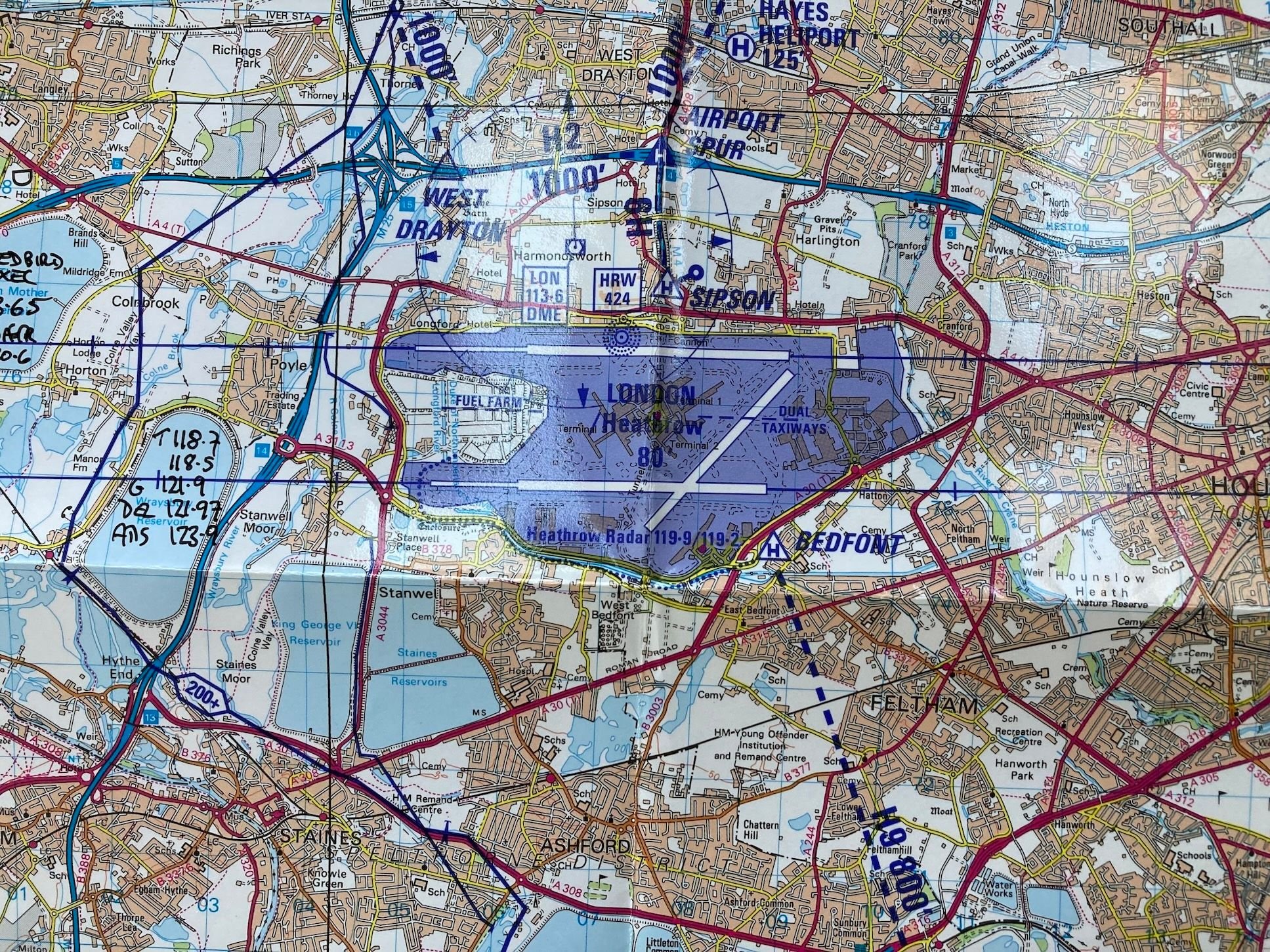
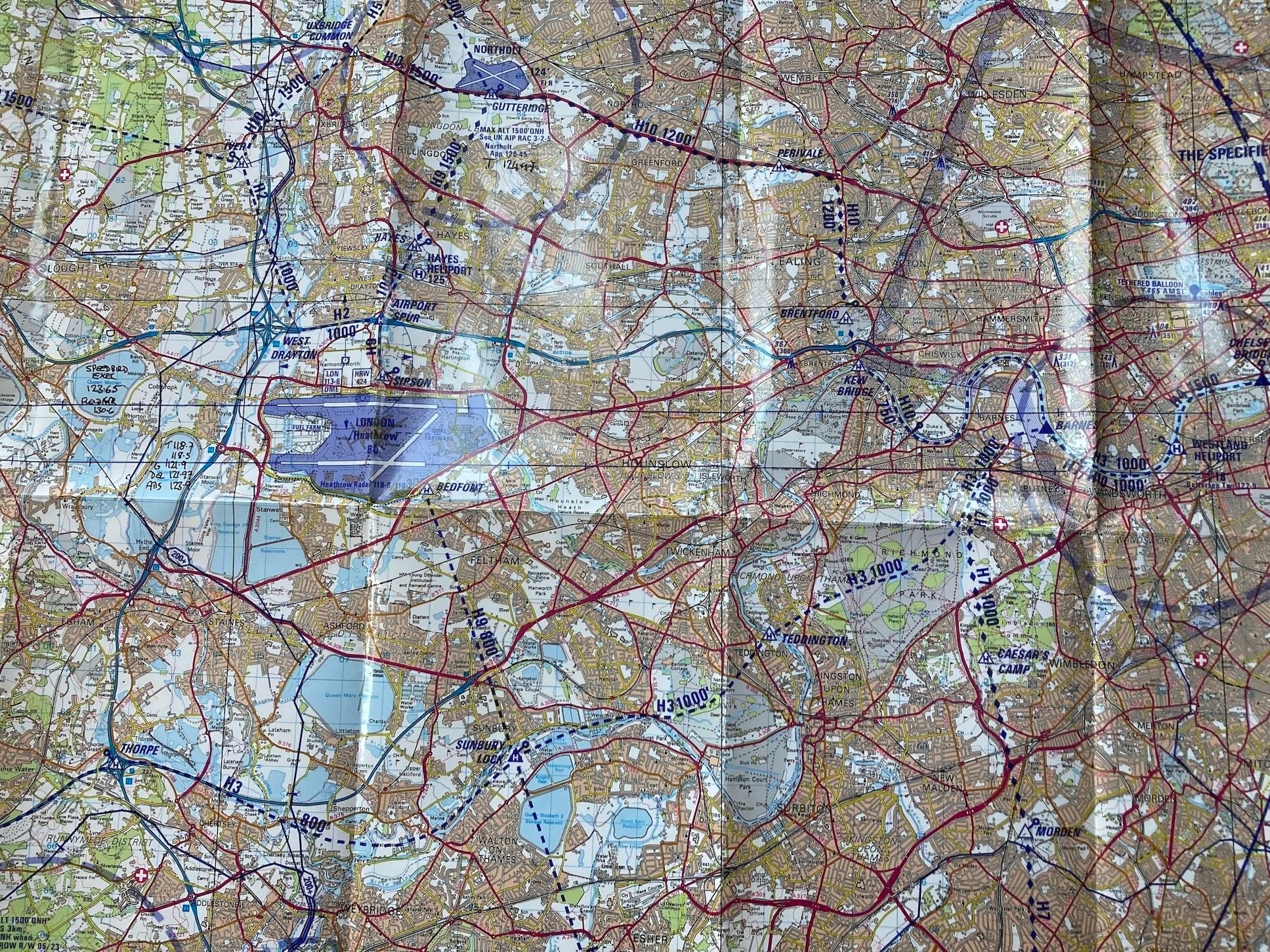
Last edited by meleagertoo; 5th February 2025 at 12:23 .
Subjects
ATC
IFR
Radar
Separation (ALL)
VFR
Vertical Separation
Visual Separation
Links are to this post in the relevant subject page so that this post can be seen in context.
Reply to this quoting this original post. You need to be logged in. Not available on closed threads.
February 05, 2025, 12:57:00 GMT
permalink Post: 11822202
...change from Heathrow Special to Tower for the crossing itself. There's a further hold at Twin Taxiways between the runways. Altitudes are shown. Note there is usually unrestricted passage on routes H3 and H10 along the river directly under the approach...
...defined clearance limits, sensible vertical separation and, critically, coherent and specific controller voice procedure.
I agree with your underlying point that blanket application of IFR separation criteria would be inappropriate. But there are modes of separation besides the false binary of 'visual' and 'IFR' which can be applied to VFR traffic.
Last edited by Easy Street; 5th February 2025 at 14:01 .
Subjects
ATC
IFR
Radar
Separation (ALL)
VFR
Vertical Separation
Visual Separation
Links are to this post in the relevant subject page so that this post can be seen in context.
Reply to this quoting this original post. You need to be logged in. Not available on closed threads.
February 05, 2025, 13:39:00 GMT
permalink Post: 11822224
I can imagine a scenario where a helicopter crew, who are regular on this route, report the airliner in sight on first call, knowing that by doing so, they avoid an orbit and subsequent delay.
With regard to other posts asking why the tower controller didn\x92t pass traffic information to the CRJ crew. Bear in mind that this guy was working flat out, working two positions with pretty constant RT. There may well have been additional tasks such as phone coordination going on in the background which we are not aware of. Again I see a scenario of tower using the absolute minimum RT in an attempt to keep on top of the workload. In his mind, the helicopter has reported the inbound in sight and has stated responsibility to pass behind\x85\x85.job done, onto the next task.
I\x92m sure that the investigation will be focusing on why the sectors were combined under these traffic conditions. In my 30+ years of ATC, I have investigated numerous incidents where a significant factor was an overworked controller working combined positions. This can be caused by staff shortages, late reactions to rapidly changing traffic conditions, unit culture or simply a \x93macho\x94 controller who thinks that they can handle everything\x85.until subsequently they find that they cannot!
Subjects
ATC
CRJ
DCA
Separation (ALL)
Vertical Separation
Links are to this post in the relevant subject page so that this post can be seen in context.
Reply to this quoting this original post. You need to be logged in. Not available on closed threads.
February 05, 2025, 19:26:00 GMT
permalink Post: 11822473
Subjects
CRJ
NTSB
Radio Altimeter
Separation (ALL)
Vertical Separation
Links are to this post in the relevant subject page so that this post can be seen in context.
Reply to this quoting this original post. You need to be logged in. Not available on closed threads.
February 07, 2025, 03:43:00 GMT
permalink Post: 11823374

The CRJ was given the right of way by ATC, who did not control the conflict. All lateral issues, because the vertical does not matter until more than 500' separation can be maintained. Even at 200', the helo was in the CRJ's airspace in all 4 dimensions.
Subjects
ATC
CRJ
Separation (ALL)
Vertical Separation
Links are to this post in the relevant subject page so that this post can be seen in context.
Reply to this quoting this original post. You need to be logged in. Not available on closed threads.
February 07, 2025, 15:40:00 GMT
permalink Post: 11823717
OTOH, the CRJ is not flying a BARO ALT, it is descending on a visual glide slope that would approximate something near 3 degree, 5.2%, from whatever aiming point they had chosen, +/- the vertical error from that ideal glide slope. They stuck each other with the UH60 striking from below. John D and LW50 can suggest the static system error that is in the -1 for the UH60L, I don't have the FM for that type. The static pressure ports are on the 2 pitot static heads that are above the cockpit area, just behind the rear edge on the pilots doors. For the UH60A,
...so for the A model, the drivers get raw static for their ALT displays. Later models with EFIS systems would take the same data and process that from analog to digital, and that would normally be done by an ADC system, which can remove the errors that arise from direct static sources with some rat cunning. For our jets, the ADC data does not correct all static errors, that is why we generally see a negative transient of altitude and VS rate at rotate, the flow conditions around the static ports are changing. The helicopter has the static ports in the wake of the rotor, which alters with CT, and with J so pretty much is a mess for getting nice n' tidy accurate pressure altitude displayed. The RADALT is better, it is subject to errors as well due to attitude changes but they are generally tolerable by the choice of the fan shape of the transmitter. Bottom line is, assuming that the aircraft should have missed by a hair vertically given the wide range of errors that would apply to the helicopter instruments is immaterial to the fact that they were otherwise going to be in a grossly unacceptable vertical separation in any circumstance. That they arrived at the same place in space and time is a consequence of a very straight forward error of identification of a single target when confronted with multiple targets, which we have known to be an issue for about a century. Hard to blame the PF in getting caught out doing a practice that is known to be hazardous but which is institutionally tolerated as "business as usual".
Last edited by fdr; 7th February 2025 at 15:55 .
Subjects
CRJ
Radio Altimeter
Separation (ALL)
Vertical Separation
Links are to this post in the relevant subject page so that this post can be seen in context.
Reply to this quoting this original post. You need to be logged in. Not available on closed threads.
February 07, 2025, 15:59:00 GMT
permalink Post: 11823731
Anything approaching Rwy 1 should be below ~700ft anywhere north of the sewage treatment marker; use the Wilson Bridge for a bit of headroom because not all aircraft are going to be perfectly on glideslope.
The river is far narrower than 1.5Nm so clearly a southbound helicopter on Route 4 can never cross a northbound aircraft approaching runway 1 north of the Wilson Bridge.
You'd have to hold a southbound helicopter north of either the Memorial or Capitol St Bridges until previous traffic had landed. Then have a sufficiently large gap with no arrivals (or departures until south of the runways) for the helicopter to reach the Wilson St Bridge before the next arrival crosses that bridge.
That's the preceding aircraft covering ~3Nm at 140kt (~80s), followed by the helicopter covering ~6Nm at ~100kt (another 3.5min), and accurately timing the next arrival so it doesn't cross the Wilson bridge until after the helicopter, or it needs to do a go-around.
Hence the issue requiring metering the helicopters on the numbered Routes.
I don't suggest a hard 1.5NM, but anywhere standard fixed wing ops cannot assure 500' vertical separation, Rotary wing traffic must be gated and controlled.
If rotary wing mission dictates, then fixed wing traffic will have to wait/go missed/discontinue approach. Visual Sep, ATC and a Pavlovian environment killed an airliner.
Subjects
ATC
Route 4
Route 5
Separation (ALL)
Vertical Separation
Links are to this post in the relevant subject page so that this post can be seen in context.
Reply to this quoting this original post. You need to be logged in. Not available on closed threads.