March 30, 2025, 01:42:00 GMT
permalink Post: 11857026
<snip>
It is known that ADSB-Out is not active on the Army and other certain missions in the relevant airspace. Is there also a pattern or practice of operating with a mindset that FAA ATC is a necessary nuisance, to be indulged but not focused upon as closely as other airspace users? If any reader asserts this question accuses the Army pilots or any one of them in the helicopter on January 29 of negligence - that would be incorrect. The way in which the airspace had been designed, managed and operated handed those pilots a pre-determined normalization of complacency - so it appears, does it not?. They operated their flight within the system they had been given, which does not constitute negligence. The designers, managers, and operators of that system . . . well, it will be for the courts to sort out whether the exception to the removal of federal immunity to tort claims applies to those systemic level actions, or not. If it were not for the existence of the discretionary function exception, I personally believe the race to the courthouse would already have been a feeding frenzy worthy of the most biting negative stereotypes about lawyers.
<snip>
There were other holes in the cheese, so the pilot was working in a compromised environment.
I'm just an SLF, so no domain expertise at all.
Last edited by artee; 30th March 2025 at 04:00 . Reason: Typo
Subjects
ATC
DCA
FAA
Normalization of Deviance
Separation (ALL)
Visual Separation
Links are to this post in the relevant subject page so that this post can be seen in context.
Reply to this quoting this original post. You need to be logged in. Not available on closed threads.
March 30, 2025, 03:12:00 GMT
permalink Post: 11857048
There were other holes in the cheese, so the pilot was working in a compromised environment.
I'm just an SLF, so no domain expertice at all.
This is not a reason either to dismiss, or to claim decisivenesss of, any particular legal reasoning here. It is instead recognition that reasoning which points to the request for visual separation and then the failure to maintain it as the basic cause of the accident will produce a very unpleasant legal case. Think of the Army units assigned to this sort of duty, how they are trained to treat "continuity of governement" and transport of highly important (presumably) officials as a kind of higher calling - at least that's the impression given by several statements or articles. And one set of their fellow servicemembers are put in the position of being blamed, and not present even to try to explain what happened. And that's in addition to usual strident reluctance to assign responsibility to aviators in situations where things go wrong.
Over the past several days, it has become clearer that the airspace environment was indeed so compromised that, as SLF/attorney without technical expertise or even knowledge about airspace design, management and operation, it would be best to stop trying to refine an understanding of the causes and effects and instead leave the puzzle-solving aside until the NTSB report is completed and released. That said, the way Sen. Cruz pressed witnesses last week suggests that waiting for the report will be a difficult task.
I appreciate any and every acknowledgement of efforts to make positive contributions to this forum - thank you for your post!
As other posts have admitted I am biased against assigning responsibility in situations such as this one to any aviator. There additionally may be a somewhat unique factor in this case too (involving some personal history about Army aviation maintenance training circa 1975, enlistment as an alternative to dead-end mindless jobs, and studying German in high school and for a couple of semesters in college so that if I ever went to Germany in the Army . . . ).
Subjects
Accountability/Liability
NTSB
Separation (ALL)
Visual Separation
Links are to this post in the relevant subject page so that this post can be seen in context.
Reply to this quoting this original post. You need to be logged in. Not available on closed threads.
March 31, 2025, 00:41:00 GMT
permalink Post: 11857626
To say so-and-so got it wrong is often obvious ........ but why did they get it wrong? That's often very complex and can involve a lot more people and a raft of other factors and that's where the really valuable lessons are to be found. That's the real reason behind any "bias" - it's so we don't simply stop at that first person (or persons) who got something wrong, but look at what led to them doing what they did and what other factors contributed to the end result . That is the real way Safety is improved. You can then look at appropriate mitigation to try and prevent that same scenario from setting up another crew to fail in the same way at a later date.
So, for example, based on the difficulty in picking out the correct aircraft from the inbound stream, one of the many questions I've been asking myself is "Why were the PAT25 crew so willing to say they had the CRJ in sight (twice they said that) in that environment?". Had that become "normalised" on the Sqdn, or were the risks of miss-IDing a/c not being adequately highlighted in Local Orders, particularly given the geometry of that specific set-up? There may be several reasons - that's for the NTSB to dig out. I used to do a lot of visual separation stuff Commercially and I was nervous as hell - and that was in wayyyyyyyy simpler scenarios in way better conditions usually involving just one other aircraft. ATC were the same - they were very pointed in making sure I'd really seen the a/c in question. Any doubts in my mind or the ATCs mind and it was either an orbit till traffic was well clear or, if busier, it was "Contact Approach ....... lets chat again when they hand you back to me on the ILS.". OK, the ILS bit is not applicable to PAT25 but you get my drift!
There is no one reason why this accident happened - there will be quite a list with each one contributing to the final outcome. Any one of those things, had they been different decisions by those involved on the night, or, for example, by those who designed and approved Route 4 way back when, would have saved the day. So correct not just the 1st issue you find, find out and correct ALL the issues! That's what we really need to do to stop similar things happening again, not just at DCA, but anywhere.
Anyway, hope the above helps with the context of the word "bias". It was not that long ago it was "Hang the crew! Erm, oh no! Someone else has done it now! Hang them too!" Rinse & repeat! Thankfully, we are much better at digging out all the issues these days. But we have to constantly remind ourselves to "Look for everything, not just the 1st thing you find!". Cheers, H 'n' H
Last edited by Hot 'n' High; 31st March 2025 at 00:55 .
Subjects
ATC
CRJ
DCA
NTSB
Night Vision Goggles (NVG)
PAT25
Route 4
See and Avoid
Separation (ALL)
Visual Separation
Links are to this post in the relevant subject page so that this post can be seen in context.
Reply to this quoting this original post. You need to be logged in. Not available on closed threads.
March 31, 2025, 06:45:00 GMT
permalink Post: 11857734
So, for example, based on the difficulty in picking out the correct aircraft from the inbound stream, one of the many questions I've been asking myself is "Why were the PAT25 crew so willing to say they had the CRJ in sight (twice they said that) in that environment?". Had that become "normalised" on the Sqdn, or were the risks of miss-IDing a/c not being adequately highlighted in Local Orders, particularly given the geometry of that specific set-up? ...
...
Subjects
ATC
CRJ
PAT25
Separation (ALL)
Visual Separation
Links are to this post in the relevant subject page so that this post can be seen in context.
Reply to this quoting this original post. You need to be logged in. Not available on closed threads.
March 31, 2025, 08:54:00 GMT
permalink Post: 11857799
Anyway, just some thoughts! You know, I can be a right cynic at times but, having a background in Safety Engineering in a previous life, that's par for the course!!!
 Cheers,
H 'n' H
Cheers,
H 'n' H
Subjects
ATC
Separation (ALL)
Visual Separation
Links are to this post in the relevant subject page so that this post can be seen in context.
Reply to this quoting this original post. You need to be logged in. Not available on closed threads.
March 31, 2025, 09:30:00 GMT
permalink Post: 11857820
Anyway, after 72 pages it seems fairly clear that separating IFR from VFR at night by visual means inside the circuit pattern of a major airport is not a great plan. This could happen anywhere in the US and it would be an interesting exercise for the NTSB/FAA to see how many separation losses there were at other airports, as they have the software to do that. It is easy to fixate on this accident and the immediate environment when similar setups exist all over the place. It\x92s not just about helicopters and the military - civil and fixed wing on that kind of clearance could be just as risk-bearing.
Subjects
DCA
IFR
Separation (ALL)
VFR
Visual Separation
Links are to this post in the relevant subject page so that this post can be seen in context.
Reply to this quoting this original post. You need to be logged in. Not available on closed threads.
March 31, 2025, 14:27:00 GMT
permalink Post: 11858000
Bit academic anyway as there was no AA ban and the AA flight accepted it when offered it and the next AA asked for it on initial contact ..... not realising what had just happened! That's why I had a $ sign in my earlier post! The cynic that I am........
Last edited by Hot 'n' High; 31st March 2025 at 14:38 .
Subjects
Circle to Land (Deviate to RWY 33)
DCA
Separation (ALL)
TCAS (All)
Visual Separation
Links are to this post in the relevant subject page so that this post can be seen in context.
Reply to this quoting this original post. You need to be logged in. Not available on closed threads.
April 09, 2025, 03:30:00 GMT
permalink Post: 11863094
From your perspective then, could you clarify :
Controlled Airspace, See and Avoid re same, duty of care re ATCre controlled Airspace, specifically short finals, etc?
May as well add split or proportional liability??
I am trying to get even a basic understanding of how a large helicopter flew in visual flight rules into a jetliner on short final, which was on an IMC approach, on slope. Both were \x93legal\x94. The helicopter busted altitude by 125 feet vertically, and just exactly enough horizontally. Que?
There are unknowns at this point about what information the Army PAT25 crew had in front of them about the altitude at which they were operating. There also are unknowns about the Army crew's visual scan (which, as a non-aviator, sounds to me like a complex subset of facts; I do work on maintaining strong visual scan plying limited access highways and even local streets and roads in my car but the instrument panel of my vehicle is, shall we say, somewhat limited in comparison). Add in the relatively fixed attributes of the physical environment, the background lights of the city and surrounding areas, the river, and so forth. Plus, NVGs, plus experience using same by the particular crew.
Then with all those factual matters still subject to fairly significant unknowns (at least as I am able to follow the developments), your question(s) turn to the acts or omissions of ATC. I am fairly strongly inclined to "stay in my lane" - meaning, there is a lot more about how ATC functions are performed that I don't know, compared to what I might actually have picked up from forum threads and other sources. It stands to reason that the visual separation set-up is subject to formal written rules and procedures, but I don't know to what extent these presumed rules and procedures reach down to very specific operational details. Beyond that, the signal-to-noise ratio of what more I might say would not be too especially good.
I'm reminded of the old saw that some one or another fairly well-versed individual has already forgotten more about a given subject than some smart-aleck will ever be able to master about such subject. I don't want to trip over that . . . altitude restriction.
One other perhaps non-trivial item I can add is that the attorney whose office has filed the preliminary claim (as required pursuant to the federal statute) is very accomplished in this field. I've met him at professional (Aviation Law) conferences. I have enough respect for other members of the bar who have amassed vastly larger public records of accomplishment - even those records which prompt lawyer-bashers to decry the profession and all who practice in it - not to try to pass off forum talk as the equivalent, or even merely reflective of, the serious legal thinking going on in that attorney's conference room. And many other law firm conference rooms. The issues in this matter aren't going to be simple, neat, or pleasant. Perhaps the air has been deflated out of the emotional shock-balloon the midair collision visited upon many folks; it is still my view that this was a catastrophe, wrenching in many respects the NAS all the way back to the skies over New York City in 1960 and the midair which ultimately gave rise to the formation of PATCO. And the strike, which led to, with respect to controller staffing . . . . .
Subjects
ATC
Accountability/Liability
Night Vision Goggles (NVG)
PAT25
See and Avoid
Separation (ALL)
Visual Separation
Links are to this post in the relevant subject page so that this post can be seen in context.
Reply to this quoting this original post. You need to be logged in. Not available on closed threads.
April 28, 2025, 09:48:00 GMT
permalink Post: 11874753
Subjects
ADSB (All)
DCA
Separation (ALL)
Situational Awareness
Traffic in Sight
Visual Separation
Links are to this post in the relevant subject page so that this post can be seen in context.
Reply to this quoting this original post. You need to be logged in. Not available on closed threads.
August 01, 2025, 22:40:00 GMT
permalink Post: 11932083
And they acknowledged it, although in a very short reply (understandable to keep R/T's as short as possible).
But replying with " traffic circling 33 in sight " just might have improved their own SA, helping to build the mental picture that mentioned traffic was going to move slightly to their left and was at some point going to cross their route from left to right. And if they didn't have that mental picture of what "circling 33" meant for their routing, then a lot was wrong long before the impact.
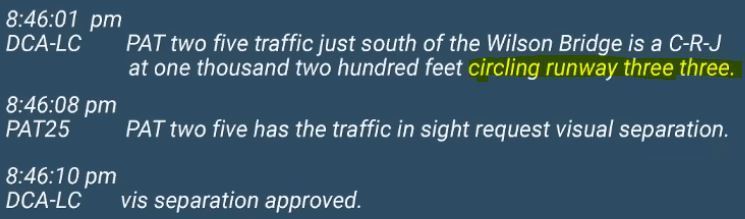
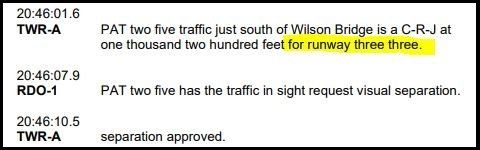
And what strikes me over and over again, is this mutual 'pavlovian' "request visual separation"-"approved" thing, as if proclaiming these words, absolves all involved from any rules/restriction that might hinder the smooth flow of things (which it does - kind of).
Even at the last chance of averting disaster by the controller (by clearly indicating the target), the pavlovian reaction was there again (totally meaningless as it was already requested and approved 96 second earlier)...
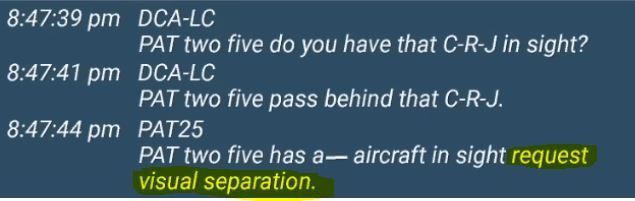
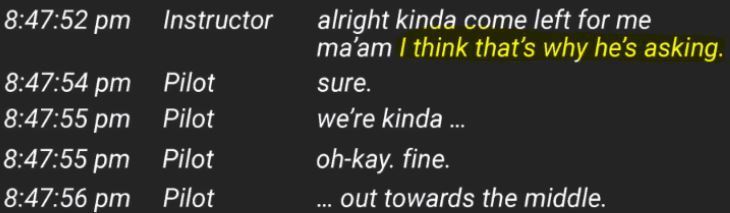
Last edited by DIBO; 2nd August 2025 at 22:03 . Reason: add extract from UH60 CVR transcript (not available/included in NTSB debrief animation)
Subjects
ATC
CVR
Night Vision Goggles (NVG)
Separation (ALL)
Situational Awareness
Visual Separation
Links are to this post in the relevant subject page so that this post can be seen in context.
Reply to this quoting this original post. You need to be logged in. Not available on closed threads.
August 01, 2025, 23:15:00 GMT
permalink Post: 11932095
Normalisation of deviance doesn\x92t even come close.
- Airspace design. The heli route stepping down to 200ft max lead some army pilots to believe it gave clearance from DCA traffic. Spoiler. It did not.
- Controller workload \x93Just make it work\x94 was a common attitude at DCA
- FAA not actively tracking TCAS RA \x93incidents\x94 as it could skew data.. maybe it was correctly applied visual separation etc. Need to look at the background etc. Yeah. But it generated an RA 🤬
- FAA refusing requests for traffic \x93hot spots\x94 on low level VFR charts as \x93hot spots\x94 are on ground charts only.
- PAT25 wanted visual separation from the CRJ. ATC was required to inform the CRJ crew another aircraft was applying visual separation to them. They didn\x92t.
Honestly from a European perspective. It\x92s quite bone chilling.
I feel this was a systemic failure. Airspace design and Risk Normalisation.
And my heartfelt condolences for the pilots, of both aircraft, and everyone else involved including the ATCOs. Not that there weren\x92t issues\x85 but in the Swiss cheese model, the FAA bought the cheese, drilled holes in it, and invited everyone to take a look inside.
Slightly surprised by some NTSB comments as well\x85 they were presented that the heli was straight ahead on the CRJ TCAS simulation presentation. But in actual fact the CRJ was circling in a left turn for runway 33. It was stable at 500ft but in a left turn to line up with the runway\x85 wings level at 300ft. It was challenged by the airline/ALPA but I would hope the NTSB would have picked up on that.
Low point of the whole hearing was Jennifer Homendy halting proceedings and moving witnesses to different seats, as one of the FAA managers elbowed a colleague while she was giving testimony - at which point she went quiet. Infernce being she was being reminded to stop talking.
Subjects
ATC
CRJ
DCA
FAA
NTSB
NTSB Chair Jennifer Homendy
Normalization of Deviance
PAT25
Separation (ALL)
TCAS (All)
TCAS RA
VFR
Visual Separation
Links are to this post in the relevant subject page so that this post can be seen in context.
Reply to this quoting this original post. You need to be logged in. Not available on closed threads.
August 06, 2025, 15:09:00 GMT
permalink Post: 11934187
Subjects
ATC
Route 4
Separation (ALL)
Visual Separation
Links are to this post in the relevant subject page so that this post can be seen in context.
Reply to this quoting this original post. You need to be logged in. Not available on closed threads.
August 06, 2025, 18:07:00 GMT
permalink Post: 11934290
https://data.ntsb.gov/Docket/Documen...dacted-Rel.pdf
Last edited by Stagformation; 7th August 2025 at 08:57 .
Subjects
ATC
Route 4
Separation (ALL)
Visual Separation
Links are to this post in the relevant subject page so that this post can be seen in context.
Reply to this quoting this original post. You need to be logged in. Not available on closed threads.
August 06, 2025, 18:42:00 GMT
permalink Post: 11934308
Subjects
PAT25
Separation (ALL)
Traffic in Sight
Visual Separation
Links are to this post in the relevant subject page so that this post can be seen in context.
Reply to this quoting this original post. You need to be logged in. Not available on closed threads.
August 06, 2025, 19:35:00 GMT
permalink Post: 11934332
Subjects
ATC
Normalization of Deviance
Separation (ALL)
Traffic in Sight
Visual Separation
Links are to this post in the relevant subject page so that this post can be seen in context.
Reply to this quoting this original post. You need to be logged in. Not available on closed threads.
August 08, 2025, 10:02:00 GMT
permalink Post: 11935129
What I learned:
Interestingly the Local controller involved was also a CPL pilot
Pressure to use 33 for landing during high departure rates was there to avoid the queue blocking the taxi ways for arriving aircraft : ( my comment : when you get to that situation traffic should be reduced by departure slots , that what we do in Europe with the Network manager CTOTs..)
No reaction to Conflict alert because visual acquisition was prioritized , i.e if you saw the helicopter passing behind you disregarded the CA. and this was almost always the case so CA with helicopters became disregarded
Advanced training was poor or non existent ( e.g Threat/Error management training).
On the PAT pilots interviews the most flagrant normalization of deviance is requesting visual separation with an aircraft you do not see ( yet) I realize that was declared by pilots other that the one operating that flight , but gives a good indication of the local " best practices " in that area.
Finally on the TCAS issue, one of the screenshots shows other traffic, and we can see that there were 2 TAs one in front -2 and one behind +6 , that could ( emphasis on could) have been one of the reason the CRJ crew missed the urgency of the -2 , but also probably were more focusing on the PAPI so both looking outside instead of at the display .
And to reply to a question earlier by DIBO on the discussion about ADS-B out not avail on the RAT, and its relevance for TCAS, well it would have influenced the degree of accuracy of the Tau calculation ( with Alt returns every 25 ft instead of 100 feet) and could ( again emphasis on could) have changed the alert logic/timing of the TA. Non installation of ADS-B and flying 70 ft too high are probably one of the points the lawyers are going to get into to prove negligence from the military to get more money for their clients , possibly shadowing the real causes. ; which for me are still the design of the procedure and routes, and the failure of the Regulator to act on the alerts. . Love to hear Willow-Run 6-3 comment on this .
.
Subjects
ADSB (All)
ADSB Out
ATC
CRJ
DCA
Normalization of Deviance
Separation (ALL)
TCAS (All)
Visual Separation
Links are to this post in the relevant subject page so that this post can be seen in context.
Reply to this quoting this original post. You need to be logged in. Not available on closed threads.
August 08, 2025, 10:54:00 GMT
permalink Post: 11935166
Subjects
ATC
Normalization of Deviance
Separation (ALL)
Visual Separation
Links are to this post in the relevant subject page so that this post can be seen in context.
Reply to this quoting this original post. You need to be logged in. Not available on closed threads.
August 08, 2025, 16:19:00 GMT
permalink Post: 11935293
And to reply to a question earlier by DIBO on the discussion about ADS-B out not avail on the [P]AT, and its relevance for TCAS, well it would have influenced the degree of accuracy of the Tau calculation ( with Alt returns every 25 ft instead of 100 feet) and could ( again emphasis on could) have changed the alert logic/timing of the TA. Non installation of ADS-B and flying 70 ft too high are probably one of the points the lawyers are going to get into to prove negligence from the military to get more money for their clients , possibly shadowing the real causes. ; which for me are still the design of the procedure and routes, and the failure of the Regulator to act on the alerts. . Love to hear Willow-Run 6-3 comment on this .
.
As for the airline, to fault the pilots when they were on short finals and expected to concentrate on flying - as others have expressed here numerous times - seems very ill-founded. Whether the airline company could be alleged to have responsibility for not having spoken up more effectively to cause the airspace design and procedure to be redone also strikes me as far too oblivious to the actual operation of the NAS, and the FAA and Congressional processes, to have any validity as an approach to liability. The airline and even Sikorski could still be named as defendants but, to reiterate, this would be just for leverage and not because there is any real pathway to liability for either one.
That having been set as background, the first context ignores the existence of sovereign immunity issues and looks just at what happened and who was responsible. As a rubric for this, "normalization of deviance" seems very accurate. This includes the fact that over time, ignoring Conflict Alerts came to be routine. It includes the practice of confirming "traffic in sight" or related proper terminology, for visual separation even though no traffic had been sighted yet - because it had become routine that the traffic would come into view and be properly identified as the traffic ATC had called out. The testimony about "just make it work", as I heard it, similarly was very concerning; iirc an overall very credible FAA witness acknowledged that the "just make it work" attitude also resulted in decreased safety margins. As did the medical helicopter operator who also had Army helicopter service background. Add in the lack of advanced training, and though I have not practiced law as legal counsel for accident victims' families, the liability theories here appear strong.
Then factor in the use of 3-3 to allievate congestion from high departure rates, rather than slowing or reducing departure slots. Part of the pressure to use 3-3 (as I understood the testimony) was that the Potomac Tracon wanted to increase in-trail separation but DCA instead increased use of 3-3. This was consistent with the attitude, "just make it work".
As to ADS-B on the helicopters, my understanding is that given the roles and missions of the helicopter operations, ADS-B is not equippage the military and its civilian control (in the sense of oversight) could have approved consistent with those roles and missions generally, and especially the continuing-of-government function.
Putting all the causal factors together into a "theory of the case" is perhaps better left to advocates for the accident victims' families (just as defense theories better left to defense counsel in this matter). But since you've impliedly asked, I would not - in this first context - parse out three of the four factors you noted, the lack of ADS-B being the one left out. That leaves the helicopter operating approximately 70 feet too high, the airspace design and procedures including the helicopter routes, and the inaction following the several safety alerts in databases and other reporting functions prior to the occurence of the accident. And including the forced enlistment of DCA for handling more traffic than the widely accepted airspace utilization and safe operation rules and procedures would allow - but they "just made it work." In other words, all of these three factors combine into the most likely theory of liability.
There is a second context, however. Federal government defendants are protected, despite the broad removal (waiver) of sovereign immunity by federal statute, from liability if the alleged negligence resulted from the exercise of discretion. If the actions or omissions being challenged resulted from decisions in which the federal entity weighed economic, social, political and other factors against each other in a form of "policy" decision-making, sovereign immunity remains in place. You can see where this is leading, of course. At what point does the over-use of DCA move out of the protection of "discretionary functions and decision-making" and into the realm of ... just plain negiligence which needs to be addressed in a court action. And likewise, at what point does the Army's set of decisions about how the routes are flown, and how visual separation and traffic sightings are handled, move out of the protection given by discretionary decisions and into the realm of significant negligence not deserving of such protection? Same question for FAA - surely the presence of safety concerns in databases and reporting systems - as unorganized as they may be and as lacking in systematic review as they may be - are matters within the FAA's discretionary functions and decision-making . . . until they're not. (And not equipping PAT helicopters or other D.C.-based Very Important air transport operations by helicopter with ADS-B would have no chance of being ruled not resulting from a discretionary function and decision - it's not even arguable imo.)
I almost included with this (already lengthy) post the "syllabus" of the U.S. Supreme Court's decision in the United States v. Varig Airlines case, which I think is the most pertinent aviation case in which the discretionary function rule is fundamentally involved....but this isn't a legal forum. Still, the U.S. S. Ct. opinion (467 U.S. 797 1984) gives me uncertainty about how any court of competent jurisdiction will draw the line between what would in a case against a not-federal defendant definitely appear to be negligence, and the actions and omissions of the federal defendants here. (My personal view is that the federal defendants acted with such severe negligence that the discretionary function protection has been lost - but that is a gut reaction to the "this accident never should have happened" idea and not legal analysis.)
Finally and last for a reason, I am not commenting about the motives of legal counsel who are representing or advising clients involved in this matter. I have not practiced law a single day, or a single billable hour, or otherwise, on behalf of the families or representatives of aviation accident victims, or the defendants in such matters. As a result, in participation as a guest on this forum I think it's much wiser to let the members of the bar who do have clients and who do practice in this area let their conduct in their professional capacities speak for itself.
Subjects
ADSB (All)
ADSB Out
ATC
Accountability/Liability
DCA
FAA
Normalization of Deviance
Separation (ALL)
TCAS (All)
Traffic in Sight
Visual Separation
Links are to this post in the relevant subject page so that this post can be seen in context.
Reply to this quoting this original post. You need to be logged in. Not available on closed threads.
August 10, 2025, 06:48:00 GMT
permalink Post: 11936029
I strikes me that, from my layman\x92s point of view, that this is the primary and gaping hole (among numerous others) in the Swiss cheese here.
At the same time, I get the sense that no controller was ever going to allow a helicopter to pass directly under an approaching aircraft and challenge that limited clearance.
My question is, should this have been (or was it?) formalized as an ATC procedure? Because if this had been proceduralized, I find it hard to believe that just nighttime VFR separation would have been found acceptable in that environment. Rather I would think that lateral separation should have been actively managed by ATC.
Subjects
ATC
Altimeter (All)
Blackhawk (H-60)
CRJ
IFR
NTSB
Route 4
Separation (ALL)
Traffic in Sight
VFR
Vertical Separation
Visual Separation
Links are to this post in the relevant subject page so that this post can be seen in context.
Reply to this quoting this original post. You need to be logged in. Not available on closed threads.
August 10, 2025, 07:27:00 GMT
permalink Post: 11936037
Yet was not the controller required to inform the CRJ of the helicopter, which (as the inquiry noted) he failed to do? Thus a possible cross-check was lost.
Last edited by andihce; 10th August 2025 at 07:28 . Reason: Fixed quoting
Subjects
ATC
Blackhawk (H-60)
CRJ
IFR
Separation (ALL)
Traffic in Sight
Visual Separation
Links are to this post in the relevant subject page so that this post can be seen in context.
Reply to this quoting this original post. You need to be logged in. Not available on closed threads.