August 10, 2025, 09:11:00 GMT
permalink Post: 11936070
Are you sure about that? My understanding of Class B airspace is that all aircraft proceed only on the basis of an ATC clearance. So to re-parse your statement\x85When a pilot says \x93Traffic in sight\x94 it just means he can see it, nothing more. It\x92s when he then says, \x93Request visual separation\x94 that he\x92s suggesting to the Local Controller he doesn\x92t need help with separation. And then it\x92s only when the Local Controller says, \x93Visual separation approved\x94 that the pilot takes on the responsibility for separation.
Subjects
ATC
Separation (ALL)
Traffic in Sight
Visual Separation
Links are to this post in the relevant subject page so that this post can be seen in context.
Reply to this quoting this original post. You need to be logged in. Not available on closed threads.
August 10, 2025, 18:08:00 GMT
permalink Post: 11936308
"Request visual separation" is non-standard.
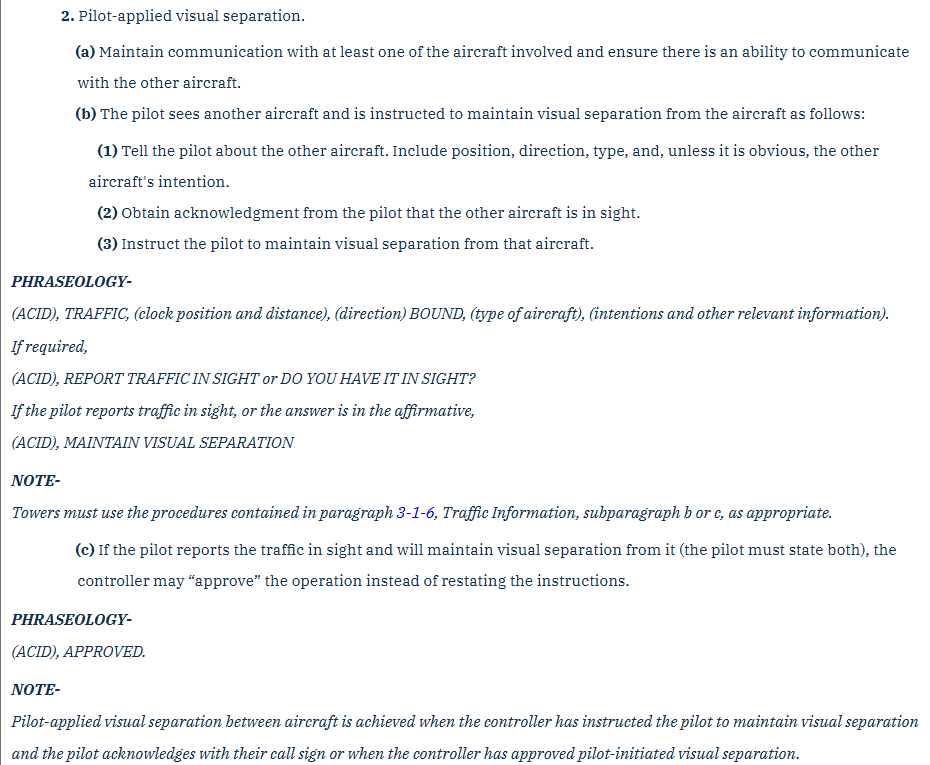
https://www.faa.gov/air_traffic/publ...section_2.html
Subjects
ATC
Separation (ALL)
Traffic in Sight
Visual Separation
Links are to this post in the relevant subject page so that this post can be seen in context.
Reply to this quoting this original post. You need to be logged in. Not available on closed threads.
August 10, 2025, 22:26:00 GMT
permalink Post: 11936398
Two interesting events noted on the recordings:
At about 20:00L, PCT calls helicopter traffic to PAT25. I count at least 12 statements between the two pilots regarding the called traffic in addition to radio transmissions to PCT regarding the traffic. Contrast this to the CRJ called traffic which generates zero discussion between the PAT25 flight crew.
At about 20:37L, there’s a traffic interaction between MUSL13 and BLJK1 (two helicopters) that generates a conflict alert. The DCA LC provides multiple traffic alerts to both aircraft, including direction, range, and altitude of the conflicting aircraft, even after visual separation is approved for BLJK1. Contrast this with the accident sequence where PAT25 is provided with a single traffic alert and the CRJ gets bupkis.
Subjects
ATC
CRJ
DCA
PAT25
Route 4
Separation (ALL)
Visual Separation
Links are to this post in the relevant subject page so that this post can be seen in context.
Reply to this quoting this original post. You need to be logged in. Not available on closed threads.
August 10, 2025, 22:36:00 GMT
permalink Post: 11936403
In class B , controllers will provide separation between IFR and VFR however they can delegate separation to an aircrfat visually following a strict procedure and phraseology .and issuing an ATC Instruction : " maintain visual separation "
Subjects
ATC
CRJ
IFR
NTSB
NTSB Docket
Phraseology (ATC)
Separation (ALL)
TCAS (All)
VFR
Visual Separation
Links are to this post in the relevant subject page so that this post can be seen in context.
Reply to this quoting this original post. You need to be logged in. Not available on closed threads.
August 11, 2025, 11:39:00 GMT
permalink Post: 11936649
Subjects
IFR
Separation (ALL)
Visual Separation
Links are to this post in the relevant subject page so that this post can be seen in context.
Reply to this quoting this original post. You need to be logged in. Not available on closed threads.
August 12, 2025, 00:21:00 GMT
permalink Post: 11936996
"Request visual separation" is non-standard.
https://www.faa.gov/air_traffic/publ...section_2.html
Absolutely, it was a non-standard discourse. But however you look at what was said, PAT 25 requested the change to visual separation. Meaning PAT25 correctly believed he was under standard 1.5nm/500ft separation at the time and that he needed LC approval for Visual separation to be applied. The change in the separation standard being applied did not happen until the LC accepted PAT 25\x92s traffic visual report and authorised the change. It\x92s not an automatic change made just on the pilot\x92s say so, ie by reporting visual, which I think is what you may be implying (happy if you correct me). Both pilot and LC are necessary (and both made errors here).
Subjects
ATC
PAT25
Separation (ALL)
Traffic in Sight
Visual Separation
Links are to this post in the relevant subject page so that this post can be seen in context.
Reply to this quoting this original post. You need to be logged in. Not available on closed threads.
August 12, 2025, 01:18:00 GMT
permalink Post: 11937016
Subjects
ATC
PAT25
Separation (ALL)
Visual Separation
Links are to this post in the relevant subject page so that this post can be seen in context.
Reply to this quoting this original post. You need to be logged in. Not available on closed threads.
August 12, 2025, 10:13:00 GMT
permalink Post: 11937144
 . I'd often get from Twr on joining the circuit at my various destinations, and having confirmed I'd got traffic XYZ in sight, a clearance "Roger, C/S, keeping that traffic in sight, report Final XX. You are No 2 to the XYZ.". From that point on, my positioning was determined by me based on visual separation with the other traffic - so not totally identical to the DCA accident but the principle was the same - I was responsible for remaining clear of XYZ and positioning appropriately behind them (including accounting for wake/runway occupancy effects etc). Occasionally I'd then get "C/S, new clearance - report
ready
for L/R base." usually with a reason if there was time - often it was App not leaving TWR a big enough gap to sneak me in between 2 IFR arrivals.
. I'd often get from Twr on joining the circuit at my various destinations, and having confirmed I'd got traffic XYZ in sight, a clearance "Roger, C/S, keeping that traffic in sight, report Final XX. You are No 2 to the XYZ.". From that point on, my positioning was determined by me based on visual separation with the other traffic - so not totally identical to the DCA accident but the principle was the same - I was responsible for remaining clear of XYZ and positioning appropriately behind them (including accounting for wake/runway occupancy effects etc). Occasionally I'd then get "C/S, new clearance - report
ready
for L/R base." usually with a reason if there was time - often it was App not leaving TWR a big enough gap to sneak me in between 2 IFR arrivals.
In other words, Twr would delegate separation to me with the initial clearance but, if for whatever reason, they became unhappy - I got issued with a revised, more restrictive, clearance. Similarly, if I lost sight of the traffic at any point after the initial "Report Final" clearance, it was my responsibility to advise ATC that I was no longer visual with XYZ (ie I could no longer comply with the clearance ATC had given me) and ATC would then update my clearance on that basis - "..... report ready for base" or similar until they could visually assure themselves of separation. Indeed, on those occasions, it was not unknown for ATC to say "C/S, I have you both in sight - that traffic is well ahead of you, report Final XX, No 2". I was thus relieved of my responsibility to self-position.
What ATC giveth away in their airspace ATC can taketh back again in their airspace!
Now, "normalised deviation" may skew such a way of working such as PAT routinely expecting to get what they ask for and ATC routinely giving them what they want......... Not saying that happened at DCA but............ Also, I've lost track in the Thread if PAT were visual but with another a/c or the intended one but simply "lost it" at some point........... And whether visual separation at night in such busy airspace was wise ............
Last edited by Hot 'n' High; 12th August 2025 at 10:23 .
Subjects
ATC
DCA
IFR
Separation (ALL)
Traffic in Sight
Visual Separation
Links are to this post in the relevant subject page so that this post can be seen in context.
Reply to this quoting this original post. You need to be logged in. Not available on closed threads.
August 12, 2025, 15:40:00 GMT
permalink Post: 11937327
Here, the helicopter pilots had obviously routinely been lying to LC (and getting away with it!), so the system broke down.
Subjects
ATC
Separation (ALL)
Visual Separation
Links are to this post in the relevant subject page so that this post can be seen in context.
Reply to this quoting this original post. You need to be logged in. Not available on closed threads.
August 12, 2025, 16:04:00 GMT
permalink Post: 11937346
I wonder how many pilots on rwy 01/19 really perceived this section of the routing as unsafe (when flown correctly = hugging the shoreline at max 200ft).

I take your point that the route was legal (if unsafe).
My impression is that the 500/1000 ft clearance rule exists so when a pilot gets disoriented, or suffers a flight control problem, they don't immediately smash into things; and that they have a chance to find a suitable place to
If you don't have that altitude, you're missing a slice of cheese; and of course you won't feel it missing unless you need it, which is often the case with safety.
If the heli route had been higher up, then letting helicopters fly it on visual separation while runway 33 was in use wouldn't be "normalising deviance", it'd be normalising insanity, i.e. the illusion of "safety" that the 200 ft restriction provided would have been absent. The fact that someone at the FAA thought, "it'll be ok if we force the helicopters down to an unsafe altitude routinely" speaks of eroded safety standards to me. There are some disasters (and at least one impressive Space Shuttle fireball) that resulted from eroded safety standards, where managers convinced themselves it would still be ok--until it wasn't.
Subjects
FAA
Route 4
Separation (ALL)
Visual Separation
Links are to this post in the relevant subject page so that this post can be seen in context.
Reply to this quoting this original post. You need to be logged in. Not available on closed threads.
August 13, 2025, 22:32:00 GMT
permalink Post: 11938086
If Yes, no normalisation of deviance. The procedures themselves were/are flawed, not the execution of them.
If No, then there's normalisation of deviance. The users are not following the procedures and if those procedures have been in place for some time, the users have been "getting away with it" ie NoD until now.
Each time someone gets away with a close call, the "normalization" sweeps the issue under the rug, instead of the procedure being questioned. The longer the procedure is in use, the more confidence there may be that it is acceptable, when in fact it may just be a matter of time until some unlikely and disastrous event occurs "by chance".
Having worked in a non-aviation area that became heavily proceduralized after all too many mistakes had been made, I have seen more than a few flawed procedures that continued to be employed despite warning signs, typically because of time, management, cost, etc. pressures. Modifying and reviewing a procedure can be a time consuming process as many individuals and management structures can be involved in a complicated system.
In the present case (without knowing exactly what procedures were in effect), I could argue that permitting visual separation at night in this particular environment was a key procedural flaw. But it was accepted as there had been no accidents as a result, even as perhaps traffic density, etc. increased risk over time.
Last edited by andihce; 13th August 2025 at 23:53 . Reason: addition
Subjects
Close Calls
Normalization of Deviance
Separation (ALL)
Visual Separation
Links are to this post in the relevant subject page so that this post can be seen in context.
Reply to this quoting this original post. You need to be logged in. Not available on closed threads.
August 14, 2025, 08:04:00 GMT
permalink Post: 11938210
We don't know if the heli crew thought they had seen that traffic (but picked the wrong one) or not, though the CVR conveys the impression they didn't, because they didn't talk about it (like they did about other traffic earlier in the flight).
It's also difficult to judge distance if all you see is a light, in your night vision goggles.
And it's especially difficult if you fail to predict the other aircraft's maneouver. The CRJ rolled out on final only 7 seconds before the collision. Until then, from a purely visual standpoint, everything would've looked fine. It required the heli crew to be aware of where the runway 33 extended centerline was (and where they were) to avoid being where the CRJ was going.
Subjects
CRJ
CVR
Normalization of Deviance
Separation (ALL)
Traffic in Sight
Visual Separation
Links are to this post in the relevant subject page so that this post can be seen in context.
Reply to this quoting this original post. You need to be logged in. Not available on closed threads.
August 14, 2025, 10:40:00 GMT
permalink Post: 11938285
When we talk about un safe " procedures" (plural) it is mostly the airspace design and the actions written and put in place which have to be performed to keep that design safe . That part : "conflicting paths used simultaneously with only 100 or 200ft separation " is the basic " unsafe " part of the procedures. For me at least .
Subjects
Separation (ALL)
Traffic in Sight
Visual Separation
Links are to this post in the relevant subject page so that this post can be seen in context.
Reply to this quoting this original post. You need to be logged in. Not available on closed threads.
August 14, 2025, 14:00:00 GMT
permalink Post: 11938382
Yes but that is only the visual separation procedure .
When we talk about un safe " procedures" (plural) it is mostly the airspace design and the actions written and put in place which have to be performed to keep that design safe . That part : "conflicting paths used simultaneously with only 100 or 200ft separation " is the basic " unsafe " part of the procedures. For me at least .
"Visual separation" is the procedure that's supposed to make this safe, i.e. ensure that the actual separation is never that low.
Did DCA actually schedule conflicting flights without visual separation procedures?
Subjects
ATC
DCA
Preliminary Report
Separation (ALL)
Visual Separation
Links are to this post in the relevant subject page so that this post can be seen in context.
Reply to this quoting this original post. You need to be logged in. Not available on closed threads.
August 14, 2025, 14:53:00 GMT
permalink Post: 11938401
"Visual separation" is the procedure that's supposed to make this safe, i.e. ensure that the actual separation is never that low.
Did DCA actually schedule conflicting flights without visual separation procedures?
I don't know how to answer your question. FAA said that there was no "procedural separation" plan in place. Army stated that when 33/15 was in use, the protocol/procedure was for Army to automatically hold at one of two points (depending on direction of travel) to await clearance past the extended runway center-line, or to request clearance past the same. So the 75-foot topic in theory maybe is relevant if considering wake/rotor-related turbulence, but not for physical separation of aircraft.
I cannot imagine that airlines take military helo flights into account while scheduling flights. What is important is the maximum commercial operations/flight density that can be accommodated (e.g. per hour). So when FAA allows commercial traffic to really get dense, this makes conflicts with random helo traffic more likely.
Subjects
DCA
FAA
Preliminary Report
Separation (ALL)
Visual Separation
Links are to this post in the relevant subject page so that this post can be seen in context.
Reply to this quoting this original post. You need to be logged in. Not available on closed threads.
August 14, 2025, 16:25:00 GMT
permalink Post: 11938451
Note that the apparently informal procedure of holding helicopters at Hains Pt or golf balls was an effective method of deconflicting Route 4 and 15/33 traffic. However it appears that the use of this \x93procedure\x94 was left to the discretion of the individual controller.
Subjects
ATC
CRJ
DCA
Route 4
Separation (ALL)
VFR
Visual Separation
Links are to this post in the relevant subject page so that this post can be seen in context.
Reply to this quoting this original post. You need to be logged in. Not available on closed threads.
August 15, 2025, 06:37:00 GMT
permalink Post: 11938789
Taking a road procedure similarity : . at a crossroad you can have a stop sign or a triangle giving priority , or nothing
The written procedures are : at a stop sign you must stop even if there is no traffic.
:Transposing this to DCA route 4 map l the procedure should have been in Europe at least ;
1) hold ay golf balls until you get a clearance to proceed . (so that in case of loss of comms , blocked freq, etc.. you can't proceed ).
2) pilot or controller can request visual separation if all t he following conditions re met : typically VMC, and in daylight and traffic is in sight and maintained in sight and both aircrfat pilots are informed. of each other position
3) lateral deviations by the helicopters to fly over built up areas of the city at 200ft will; not be permitted.
Big differences .
Now a pilot can request visual separation at any time but Controller can refuse at any time to .. To my knowledge requesting visual a night using NVG is not covered in the definition of " visual acquisition " in ICAO, so legally it could be challenged I guess . Same as when a pilot reports "visual" on his TCAS display . It is not valid , and for good reasons .
But KDCA is not in Europe, and ICAO SARPs do not apply to military aircrfat , so the outcome of all this is quite uncertain .In fact i would not be surprised if nothing dramatic changes as far as procedures are concerned, Route 4 will be permanently removed I guess, but other than that ? business a usual with visual separations at night ? .
Subjects
ATC
DCA
ICAO
KDCA
Night Vision Goggles (NVG)
Route 4
Separation (ALL)
TCAS (All)
Traffic in Sight
Visual Separation
Links are to this post in the relevant subject page so that this post can be seen in context.
Reply to this quoting this original post. You need to be logged in. Not available on closed threads.
October 19, 2025, 21:05:00 GMT
permalink Post: 11972680
I continue to doubt the discretionary exception will be important to this case. In my view the helicopter crew was clearly negligent (in ways that are not covered by the discretionary exception) and that is all that is needed to make the government liable. There is no need (and it would probably be inadvisable) for the plaintiffs to bring in anything that might be covered by the discretionary exception.
If I were the government I would be trying to settle these cases. I expect there are plenty of plaintiffs (and even some plaintiff's lawyers) who would rather have a certain $x now instead of an uncertain $3x in 5 years.
Without an assessment of potential liability and damages, no defense counsel I have ever known would recommend settlement negotiations to start. What you say about some plaintiffs and their counsel potentially wanting to buy certainty of recovery in exchange for waiving possibly larger recovery later on certainly can happen in litigation. However in this case, the attorneys who filed the Complaint are, to state it (or to try to state it) neutrally, about the biggest guns in the business of litigating claims on behalf of air crash victimns' families. Sure, they might take the earlier, lower dollar route, and/or recommend such a choice to clients, but their reputations - and track records - suggest this will be the least likely course, and only much futher down the timeline. On the other hand, I have no role in the case and do not know whether the two firms (one in NYC the other Chicago) actually represent all the passengers on the American Eagle flight. (And do the estates and survivors of the deceased airline pilots have representation? Or the estates and survivors of the decesased soldiers? I don't know - and not getting into why they might have representation in this case or in general. Or whether an organization on behalf of ATCOs, in the U.S., or more globally, might seek to intervene in light of the facts being asserted against one or more controllers.)
Further, the government attorneys as well as the airline attorneys on the defense would be (imo) pretty far outside practice norms to recommend settlement negotiations without joining issue on anything yet. Perhaps one or more defendants will not file their (respective) Answer to the Complaint before broaching settlement, but doubtful this will happen (insurers' counsel lurking off-stage probably would insist upon an Answer being filed). And, the defense applying sovereign immunity through the discretionary function exception to the FTCA waiver is most likely an "affirmative defense" which, under the Federal Rules of Civil Procedure, probably must be included in a defendant's Answer to the Complaint. Even if your continued doubts about its applicability prove correct, it strikes me as quite inconsistent with the current Department of Justice approach to things to skip the pleading stage and jump to settlement. Especially when the opposing attorneys are among the biggest guns in this part of the trial bar, and especially with the political overtones of the litigation looming (as in, funding by Congress of the new ATC system, and legislation which may be lurching ahead of NTSB findings, as in recent posts about 'the ROTOR Act').
As to the discretionary function exception on the merits:
On the current state of the public record, it is pretty straightforward to say that the helicopter crew deviated from the applicable duty of care (i.e., negligence) - as noted, though, I can't imagine the Army component of the Defendant-USA just declining to contest liability at this stage. It must be noted that plenty of acts and/or failures to act by the FAA component of the Defendant-USA also appear to have departed substantially from the applicable duty of care. Maybe it's too cyncial to have this view, but I think FAA is more deeply entrenched in trying to prevent a litigated result that it had mismanaged the DCA airspace - more deeply entrenched than the Army because, as the airline company attorney reportedly said, the helicopter flew into the airliner, pretty simple. I cannot quite verbalize how the FAA would try to shift major responsibility to the Army and off itself, but the discretionary judgments FAA might argue drove its methods and processes for operating the DCA airspace could be the way FAA tries to do so. Of course, ultimately that still leaves Defendant-USA fully liable - just a politically different outcome.
But recall that the defense of sovereign immunity through the discretiionary function exception to the FTCA waiver is an Affirmative Defense. The defendant can rasie it even when the plaintiff has not sought to plead anything which would, by itself, invoke the issue. And in federal court (unless things have drastically changed since I last stepped up to the lectern in a courtroom with the Big Eagle on the wall behind the bench) the standard for pleading is "notice pleading" not "fact pleading". The Complaint just has to give sufficient notice of what the claims are about and what they're based on, and not all the facts necessary to state a particular claim under the specific substantive law. (Certain State courts still follow "fact pleading" though....been a minute.)
I think the point you were making is that nothing the Complaint has alleged factually, and nothing else about the accident that is in the public record at this time, suggests that a defense based on the discretionary function exception would work, or in fact would be worth trying. My view is that the government will take a very close look at trying to assert it. For example, the way the Army operated the proficiency flights in general and in DCA airspace in partiucular, including but not limited to use of NVGs, draws upon (it would be argued) policy judgments about the critical importance of "continuity of government" operations, and even the more routine VIP transport. Will that be enough to overcome the assertedly "clear negiigence" of the helicopter crew in their visual scan for visual separation, and altitude adherence (and possibly other related operational factors)? Maybe not, but I have no clear idea what process the Army went through to devise the rules by which those proficiency flights are conducted, evaluated, and so on. (And which a proper Army Inspector General inquiry and review would delineate, and with clarity.)
And for the FAA, how many times on this forum have posters pointed out that FAA's operating principle has been to move traffic in volume, and not to focus on what FAA eviderntly considers minor details of proper ATC methods and procedures? Sloppy discretion, maybe, but Congress recently expanded the slots at DCA (iirc) and so in a sense the United States did indeed exercise discretion.
I have posted several times that I do not believe the defense should be successful here. But what some non-pilot SLF and attorney writes (hoping not to overstay my guest-on-the-forum status) here might be many levels of altitude below what will actually happen in the litigation and in the courtroom.
Subjects
ATC
Accountability/Liability
DCA
FAA
Findings
NTSB
Night Vision Goggles (NVG)
Separation (ALL)
Visual Separation
Links are to this post in the relevant subject page so that this post can be seen in context.
Reply to this quoting this original post. You need to be logged in. Not available on closed threads.
October 21, 2025, 14:54:00 GMT
permalink Post: 11973706
Also, as an aside the term "altitude" is typically used in aviation.
 (Yes, I know that DH for a precision approach is "decision height"...and HAT is shown on approach plates (Height Above Touchdown).
Why do I think the IFR ACS might be relevant? Because it specifies the accuracy the FAA requires of skilled pilots when separation is to be achieved by procedural means. The fact that the "designed" separation between the 33 approach slope and the top of Route 4 was less than the allowable error for skilled pilots could be used to rebut an allegation of negligent flying as the cause of the accident. The Army no doubt has its own standards document, but I'd be surprised if it was radically different. Building the argument off the FAA's own document forces the focus onto its route design and visual separation procedures.
As to why this might be relevant to VFR flying - is it your opinion that parameters should be flown more accurately in VFR than in IFR? In any case, I have now dug further into the ACS and the same tolerance is prescribed for commercial VFR helicopter operations (see CH.VII.A.S8).
Last edited by Easy Street; 21st October 2025 at 15:16 .
Subjects
FAA
IFR
Radio Altimeter
Route 4
Separation (ALL)
VFR
Visual Separation
Links are to this post in the relevant subject page so that this post can be seen in context.
Reply to this quoting this original post. You need to be logged in. Not available on closed threads.
October 22, 2025, 09:30:00 GMT
permalink Post: 11974130
@ IgnorantAndroid :
Which safety assessment was made and validated ( and by who) which allowed visual separation for an helicopter at 200ft to pass below the approach path of an aircrfat at 3 or 400 feet ?, resulting in a 100-200ft separation ?
That is the question I would be asking first.
How about which actions were taken after the previous incidents , and possibly acting on the normalization of deviance , would be the next .
Subjects
CRJ
Normalization of Deviance
Separation (ALL)
Traffic in Sight
VFR
Visual Separation
Links are to this post in the relevant subject page so that this post can be seen in context.
Reply to this quoting this original post. You need to be logged in. Not available on closed threads.