February 09, 2025, 17:11:00 GMT
permalink Post: 11825027
Let's discuss the procedures and visual separation delegation at night in busy airports instead on focusing on what the controller should have done , implying indirectly some form of responsibility in this accident..
Subjects
ATC
Separation (ALL)
Visual Separation
Links are to this post in the relevant subject page so that this post can be seen in context.
Reply to this quoting this original post. You need to be logged in. Not available on closed threads.
February 09, 2025, 18:15:00 GMT
permalink Post: 11825063
To discuss what he could or should have done is just playing " Captain hindsight "
The procedure was wrong , the safety case botched , and as I understand, the " book " allowing all this was followed by both the controller and the helicopter pilot .
Let's discuss the procedures and visual separation delegation at night in busy airports instead on focusing on what the controller should have done , implying indirectly some form of responsibility in this accident..
cf FAA Order JO 7110.65AA 7.2.1.a.2 Pilot-applied visual separation
(e)Advise the pilots if the radar targets appear likely to merge.
Last edited by deltafox44; 9th February 2025 at 19:04 . Reason: adding source
Subjects
ATC
FAA
Pass Behind
Pass Behind (All)
Radar
Separation (ALL)
Visual Separation
Links are to this post in the relevant subject page so that this post can be seen in context.
Reply to this quoting this original post. You need to be logged in. Not available on closed threads.
February 09, 2025, 19:15:00 GMT
permalink Post: 11825080
To discuss what he could or should have done is just playing " Captain hindsight "
The procedure was wrong , the safety case botched , and as I understand, the " book " allowing all this was followed by both the controller and the helicopter pilot .
Let's discuss the procedures and visual separation delegation at night in busy airports instead on focusing on what the controller should have done , implying indirectly some form of responsibility in this accident..
The specific one only applies to DCA, so unless you fly there for your job or want to fill out 1001 forms to get your own airplane in there, no worries, no one else does crazy stuff like that with helos.
The general one for me so far is how easy it is to see the wrong traffic at night and the next "do you see X" I get at night I am going to be triple-redundant sure and then some before saying I do.
Subjects
ATC
DCA
Pass Behind
Pass Behind (All)
Radar
Separation (ALL)
Visual Separation
Links are to this post in the relevant subject page so that this post can be seen in context.
Reply to this quoting this original post. You need to be logged in. Not available on closed threads.
February 09, 2025, 20:32:00 GMT
permalink Post: 11825106
To discuss what he could or should have done is just playing " Captain hindsight "
The procedure was wrong , the safety case botched , and as I understand, the " book " allowing all this was followed by both the controller and the helicopter pilot .
Let's discuss the procedures and visual separation delegation at night in busy airports instead on focusing on what the controller should have done , implying indirectly some form of responsibility in this accident..
A second controller -might- have had more time to observe the conflict. They -might- have twigged and second guessed the helo's separation. But they very well might not have. The spacing might have been close enough to the every day occurances that the controller might not have been able to tell.
Having the helicopters on a separate frequency from the fixed wing would certainly not have helped anyone's situational awareness.
Subjects
ATC
Pass Behind
Pass Behind (All)
Radar
Separation (ALL)
Situational Awareness
Visual Separation
Links are to this post in the relevant subject page so that this post can be seen in context.
Reply to this quoting this original post. You need to be logged in. Not available on closed threads.
February 09, 2025, 21:03:00 GMT
permalink Post: 11825124
cf FAA Order JO 7110.65AA 7.2.1.a.2 Pilot-applied visual separation
Subjects
ATC
FAA
Separation (ALL)
Situational Awareness
Visual Separation
Links are to this post in the relevant subject page so that this post can be seen in context.
Reply to this quoting this original post. You need to be logged in. Not available on closed threads.
February 10, 2025, 18:56:00 GMT
permalink Post: 11825666
I think many pilots would have made a mistake indentifying : seen from the helo, there are 3 aircraft in final, plus 1 on take-off, at the same bearing, how can you tell for sure which is the one "just south of Wilson Bridge" ?
They could only later identify the correct light spot by following its trajectory according to their mental image of the approach to 33.

At the same time the accident aircraft peels off to the right to swing around and line up to 33, thus taking his (smaller) lights out of the helicopter's direct line of vision and leaving 3130's (brighter) lights still heading to 01 to decoy the pilot. The reflexive nature of the helicopter's responses suggest to me that the full implication of 'circling to 33' in the tower's first call was missed, and also sort of implies that the helicopter could not conceive that following (nearly) the published heliroute could lead him into conflict with an aircraft on final. Me neither.
Last edited by Senior Pilot; 10th February 2025 at 21:22 . Reason: Quote
Subjects
Blackhawk (H-60)
CRJ
DCA
New York Times
PAT25
Separation (ALL)
Visual Separation
Links are to this post in the relevant subject page so that this post can be seen in context.
Reply to this quoting this original post. You need to be logged in. Not available on closed threads.
February 10, 2025, 20:51:00 GMT
permalink Post: 11825711
I'm more familiar with the London Heliroutes (see earlier posts on this thread) where the only time you'd be asked to accept visual separation is from opposite direction helicopter traffic also on the routes. You simply wouldn't get a clearance to start on any route unless all helicopters involved had already accepted visual separation. A helicopter would never need or ask for visual separation from fixed wing traffic, because the routes are designed and operated to achieve procedural separation.
Subjects
Separation (ALL)
Visual Separation
Links are to this post in the relevant subject page so that this post can be seen in context.
Reply to this quoting this original post. You need to be logged in. Not available on closed threads.
February 11, 2025, 13:27:00 GMT
permalink Post: 11826087
Subjects
Separation (ALL)
Vertical Separation
Visual Separation
Links are to this post in the relevant subject page so that this post can be seen in context.
Reply to this quoting this original post. You need to be logged in. Not available on closed threads.
February 11, 2025, 19:28:00 GMT
permalink Post: 11826281
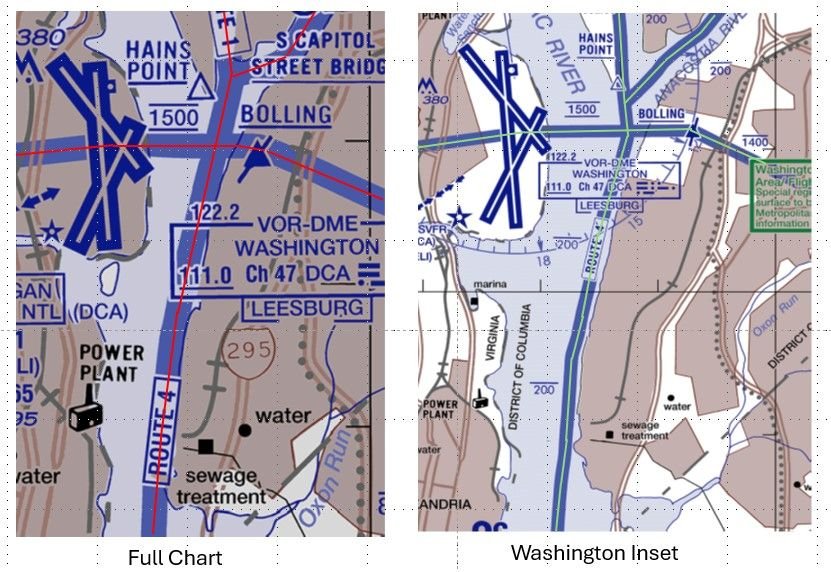
DCA Helicopter Routes
Given these chart differences, I wonder how far a helicopter can stray from the various depictions of a route before it is considered a pilot deviation? Perhaps the NTSB will give us some insight with their accident report.
Last edited by airplanecrazy; 14th February 2025 at 23:53 . Reason: Emphasize the route "appear"
Subjects
DCA
FAA
NTSB
PAT25
Route 4
Separation (ALL)
Visual Separation
Links are to this post in the relevant subject page so that this post can be seen in context.
Reply to this quoting this original post. You need to be logged in. Not available on closed threads.
February 12, 2025, 16:42:00 GMT
permalink Post: 11826805
I am sorry you see a witch hunt in my post. It was supposed to be an idea for a future improvement, rather than a criticism of the very hard worked man who was on the job. On the flying end, there is quite a rigid procedure to follow if a TCAS RA goes off. From posts since I see, that there seems to be one for for STCA triggers too. It seems to me that the gravity of the situation is brought faster to a pilot's attention if the Conflict warning is announced on the RT.
That is just one factor in this sad affair of course. Both TCAS and STCA are last ditch saviours but only if full attention can be paid to them.
Now on the Conflict alert on the BRITE display . I have no first hand info on the SOPs in DCA on how a TWR controller uses the BRITE and if STCA are even displayed . `, but if they are, seen the charts and the routes , I guess STCA alerts are very common .especially when you delegate separation and you then play with a couple of hundred feet, vertical separation Too many unnecessary alerts equals normalization of deviance, . Look at the Haneda preliminary report , same ..
Finally since you mention TCAS RAs , there is a major difference with STCA , it is not the same as a TCAS RA . With an RA , as a pilot you have to react and follow , it is mandatory , for a controller a STCA is just an alert , just like a TCAS TA , if in your judgement it will pass you will not do anything , and if you have already issued a correcting instruction ( heading, level , etc,,) or here delegate visual separation , the STCA just becomes a nuisance. .
I sincerely hope the DC Controller will not be made the scapegoat of this accident . Not so sure it will not.
Subjects
ATC
DCA
FAA
NTSB
Normalization of Deviance
Preliminary Report
Separation (ALL)
TCAS (All)
TCAS RA
Vertical Separation
Visual Separation
Links are to this post in the relevant subject page so that this post can be seen in context.
Reply to this quoting this original post. You need to be logged in. Not available on closed threads.
February 12, 2025, 19:46:00 GMT
permalink Post: 11826918
Now on the Conflict alert on the BRITE display . I have no first hand info on the SOPs in DCA on how a TWR controller uses the BRITE and if STCA are even displayed . `, but if they are, seen the charts and the routes , I guess STCA alerts are very common .especially when you delegate separation and you then play with a couple of hundred feet, vertical separation Too many unnecessary alerts equals normalization of deviance, . Look at the Haneda preliminary report , same ..
Finally since you mention TCAS RAs , there is a major difference with STCA , it is not the same as a TCAS RA . With an RA , as a pilot you have to react and follow , it is mandatory , for a controller a STCA is just an alert , just like a TCAS TA , if in your judgement it will pass you will not do anything , and if you have already issued a correcting instruction ( heading, level , etc,,) or here delegate visual separation , the STCA just becomes a nuisance. .
I sincerely hope the DC Controller will not be made the scapegoat of this accident . Not so sure it will not.
Rarely does the "bad apple" theory of accident causation survive the scrutiny of a robust, honest investigation.
Last edited by Senior Pilot; 12th February 2025 at 23:14 . Reason: Quote was unreadable
Subjects
ATC
DCA
FAA
NTSB
Normalization of Deviance
Preliminary Report
Separation (ALL)
TCAS (All)
TCAS RA
Vertical Separation
Visual Separation
Links are to this post in the relevant subject page so that this post can be seen in context.
Reply to this quoting this original post. You need to be logged in. Not available on closed threads.
February 13, 2025, 10:16:00 GMT
permalink Post: 11827259
TCAS RA says that a collision is imminent (within the accuracy of the system, ie it probably means the system can\x92t prove the planes won\x92t hit).
Conflict alert is to notify the controller well in advance \x97 maybe a few minutes for en-route. It isn\x92t a loss of separation, it is so they can avoid a loss of separation (3 or 5 miles for radar).
The problem with conflict alerting is that in mixed-use airspace you will get a lot of warnings; I hesitate to say false as they are defined by preset parameters that may or may not be relevant to the potential conflict. Talking to controllers in the UK, they often turn this feature (STCA) off as GA traffic happily avoiding each other by visual and/or electronic means can fill the screen with so many alerts it distracts from the main job, especially if you are not in communication with either aircraft.
I would expect, given the traffic density around DCA, that CAs are so commonplace they have become unremarkable, indeed expected. Twice the controller was told that the traffic was in sight, so in their mind they are applying visual separation (no minima, just don\x92t collide). The takeaway has to be that IFR/VFR separation at night by visual means is inherently risky and so a questionable pursuit.
Subjects
ATC
DCA
Radar
Separation (ALL)
TCAS (All)
TCAS RA
Traffic in Sight
Visual Separation
Links are to this post in the relevant subject page so that this post can be seen in context.
Reply to this quoting this original post. You need to be logged in. Not available on closed threads.
February 13, 2025, 22:16:00 GMT
permalink Post: 11827672
ATC do a fantastic job of managing the flow, basically by issuing helicopter traffic clearance limits based on the VRPs - usually based on Thames bridges. The Eastbound clearance limit is usually the Isle of Dogs\x85. Before London City Tower take over to manage traffic closer to the airport. At the Western end the heli routes go nowhere near the LHR approaches due or traffic density.
ATC will not in my experience clear any helicopter traffic to visually proceed behind airline traffic based on the helicopters visual perception. Day or night. They do a great job of keeping both airline and rotary traffic advised about each other, and prioritise air ambulance and police helicopters as required. But, they keep control over the overall traffic flow and it works.
I just fail to see why the FAA couldn\x92t employ a similar system, where helicopter traffic is issued a clearance limit - pending a gap in traffic - either a natural one or an ATC created gap. Before being cleared to continue.
I have also been in the situation having started engines at London City and police helicopter then was tasked to something going on off the departure end of the runway. All departures and arrivals suspend. Indefinite delays. It\x92s part of the bigger picture. CAVOK day but no possibility of visual separation. So the London system gives priority to helicopters where appropriate. But seems infinitely safer for both airline and helicopter traffic.
Subjects
ATC
FAA
Separation (ALL)
Visual Separation
Links are to this post in the relevant subject page so that this post can be seen in context.
Reply to this quoting this original post. You need to be logged in. Not available on closed threads.
February 14, 2025, 22:44:00 GMT
permalink Post: 11828270
Seems to me like a reaction to seeing the Blackhawk right before impact and a reflex/reaction with intent to avoid.
The subtext for me is that the Blackhawk crew never saw them...but there's more for the NTSB to sort out, as the lady was VERY CLEAR about.
 ) if there had been any discussion in the black hawk cockpit about the CRJ (where it was, whether the PF did see it or not) when PM requested visual separation
Last edited by deltafox44; 14th February 2025 at 23:19 .
Subjects
Blackhawk (H-60)
CRJ
NTSB
Pass Behind
Pass Behind (All)
Separation (ALL)
Visual Separation
Links are to this post in the relevant subject page so that this post can be seen in context.
Reply to this quoting this original post. You need to be logged in. Not available on closed threads.
February 14, 2025, 23:34:00 GMT
permalink Post: 11828293
Subjects
Altimeter (All)
Blackhawk (H-60)
CRJ
NTSB
Separation (ALL)
Situational Awareness
Visual Separation
Links are to this post in the relevant subject page so that this post can be seen in context.
Reply to this quoting this original post. You need to be logged in. Not available on closed threads.
February 15, 2025, 05:36:00 GMT
permalink Post: 11828365
Last edited by Commando Cody; 15th February 2025 at 07:45 . Reason: precision
Subjects
ATC
CRJ
CVR
PAT25
Pass Behind
Pass Behind (All)
Separation (ALL)
Visual Separation
Links are to this post in the relevant subject page so that this post can be seen in context.
Reply to this quoting this original post. You need to be logged in. Not available on closed threads.
February 15, 2025, 10:24:00 GMT
permalink Post: 11828489
I sincerely hope the NTSB can avoid being distracted by the distractions of altimetry and the missing ATC words on the Blackhawk CVR.
Upthread, Luca Lion calculated the 3 degree PAPI approach path as crossing the eastern riverbank at 270ft. If that's correct, then the CRJ's 313ft radar height 2 seconds before collision puts it at least 43ft above the approach path, so the Blackhawk's radio height deviation of 78ft would have contributed only about 35ft to the erosion of any intended "procedural separation" (*) between the aircraft. Or, to put it another way, the same outcome would have resulted if the Blackhawk had been at 235ft radio and the CRJ on the glide. Height keeping of plus or minus 35ft can only be achieved by instrument flying, which is obviously not compatible with visual separation (or indeed VFR) so cannot be reasonably cited as part of a safety case for the procedure. And of course a landing aircraft could easily be below the glide. Altimetry and height keeping are not the cause of this accident.
Missing the word "circling" wouldn't have influenced the helo crew getting visual with the CRJ at the time of the trasnmission. At best, it would have given them an extra nudge that "runway 33" (which was audible) meant the CRJ would be taking an easterly flight path. Missing "pass behind" with only a few seconds to collision was irrelevant if, as seems likely, the helo crew did not see the CRJ at that point.
(*) The quotes around "procedural separation" are intended to convey a tone of disgust and sarcasm.
Last edited by Easy Street; 15th February 2025 at 10:47 .
Subjects
ATC
Altimeter (All)
Blackhawk (H-60)
CRJ
CVR
Final Report
NTSB
Pass Behind
Pass Behind (All)
Radar
Separation (ALL)
VFR
Visual Separation
Links are to this post in the relevant subject page so that this post can be seen in context.
Reply to this quoting this original post. You need to be logged in. Not available on closed threads.
February 15, 2025, 10:55:00 GMT
permalink Post: 11828510
I sincerely hope the NTSB can avoid being distracted by the distractions of altimetry and the missing ATC words on the Blackhawk CVR.
Upthread, Luca Lion calculated the 3 degree PAPI approach path as crossing the eastern riverbank at 270ft. If that's correct, then the CRJ's 313ft radar height 2 seconds before collision puts it at least 43ft above the approach path, so the Blackhawk's radio height deviation of 78ft would have contributed only about 35ft to the erosion of any intended "procedural separation" (*) between the aircraft. Or, to put it another way, the same outcome would have resulted if the Blackhawk had been at 235ft radio and the CRJ on the glide. Height keeping of plus or minus 35ft can only be achieved by instrument flying, which is obviously not compatible with visual separation (or indeed VFR) so cannot be reasonably cited as part of a safety case for the procedure. And of course a landing aircraft could easily be below the glide. Altimetry and height keeping are not the cause of this accident.
Missing the word "circling" wouldn't have influenced the helo crew getting visual with the CRJ at the time of the trasnmission. At best, it would have given them an extra nudge that "runway 33" (which was audible) meant the CRJ would be taking an easterly flight path. Missing "pass behind" with only a few seconds to collision was irrelevant if, as seems likely, the helo crew did not see the CRJ at that point.
(*) The quotes around "procedural separation" are intended to convey a tone of disgust and sarcasm.
Following "5*why", keep asking...
Why did the did miss part of the message
Why was the incomplete read back missed
Why does missing a few words lead to this disaster within seconds.
Does this lead an answer like: helicopter in a very busy airspace, busy controllers (insufficient time to be fully focused on full read backs) being by default too close to (and even needing to cross) the glideslope.
Subjects
ATC
Blackhawk (H-60)
CRJ
CVR
NTSB
Pass Behind
Pass Behind (All)
Radar
Separation (ALL)
VFR
Visual Separation
Links are to this post in the relevant subject page so that this post can be seen in context.
Reply to this quoting this original post. You need to be logged in. Not available on closed threads.
February 15, 2025, 12:41:00 GMT
permalink Post: 11828596
Why did the did miss part of the message
Why was the incomplete read back missed
Why does missing a few words lead to this disaster within seconds.
Does this lead an answer like: helicopter in a very busy airspace, busy controllers (insufficient time to be fully focused on full read backs) being by default too close to (and even needing to cross) the glideslope.
Helicopters in busy airspace are not a problem if a safe system exists for separating them from airline traffic.
There is no evidence yet of the controller having made a mistake. He was undoubtedly busy, but that was not his fault. What could be done about it? The answers to that question take us another step along the causal chain:
- The FAA could have provided more controllers. We know the helicopter controller position was unoccupied, and it's likely that closer monitoring and earlier intervention could have changed the outcome (notwithstanding point 3).
- Controller workload could have been reduced by implementing effective procedural separation . If the DCA ATC rulebook allowed this segment of Route 4 to be in simultaneous use with Runway 33 landings, then procedural separation did not exist , however much anyone thought it did. At least 1.5nm or 500ft between flight paths would be needed to meet the least restrictive FAA separation standards, and this would have forced constraints to be applied to Route 4 or Runway 33 utilisation.
- Regulations allowed the helo pilots to assume responsibility for separation. This is what happened, with the consequences which flow from the inherent difficulty of identifying and separating visually at night (especially while wearing NVG).
The authorities (by which I mean FAA and DoD) have questions to answer on all three points. Why was the helicopter controller position vacant? Did the ATC rulebook or staffing requirements rely on a false assumption that procedural separation existed? How did any such assumption remain in place after previous near misses? Is visual separation between helicopters and airline traffic a reasonable thing for regulations to permit, at night and using NVG? Ultimately it seems to have routinely been used as a release valve for the pressure building in the system due to the failure to address points 1 and 2.
Hopefully the investigation will be bold enough to ask these questions, which expand the potential scope of responsibility well beyond the individual controller and pilots.
Last edited by Easy Street; 15th February 2025 at 13:36 .
Subjects
ATC
Close Calls
DCA
FAA
Night Vision Goggles (NVG)
Route 4
Separation (ALL)
Visual Separation
Links are to this post in the relevant subject page so that this post can be seen in context.
Reply to this quoting this original post. You need to be logged in. Not available on closed threads.
February 15, 2025, 18:34:00 GMT
permalink Post: 11828759
It was doomed to fail, eventually, but sadly someone [other than those directly impacted] never saw it coming. THEY are the culprits.
MPN11, former Mil ATCO
Subjects
ATC
ATCO
Route 4
Separation (ALL)
Visual Separation
Links are to this post in the relevant subject page so that this post can be seen in context.
Reply to this quoting this original post. You need to be logged in. Not available on closed threads.