June 12, 2025, 21:44:00 GMT
permalink Post: 11899716
A link to the report Zoot0 referred to:
https://ad.easa.europa.eu/blob/AIR-2..._AIR-22-09R1_1
Excerpt in the spoiler
{there is more, this is just a taste, see the whole report for details}.
Would any of our 787 qualified pilots care to comment on this as it relates, or doesn't relate, to the aircraft's brief flight shown on the CCTV video?
Subjects
CCTV
Dual Engine Failure
Engine Failure (All)
TOGA
Links are to this post in the relevant subject page so that this post can be seen in context.
The thread is closed so there are no user likes are available and no reply is possible.
June 19, 2025, 10:30:00 GMT
permalink Post: 11905864
https://ad.easa.europa.eu/blob/NM-18...SIB_NM-18-33_1
Last edited by Senior Pilot; 19th June 2025 at 12:13 . Reason: Image
Subjects
FAA
Switch Guards
Links are to this post in the relevant subject page so that this post can be seen in context.
The thread is closed so there are no user likes are available and no reply is possible.
June 19, 2025, 11:13:00 GMT
permalink Post: 11905888
Subjects: None
The thread is closed so there are no user likes are available and no reply is possible.
June 19, 2025, 17:12:00 GMT
permalink Post: 11906161
That's a TL series switch with 4 poles (the "4" in "4TL"), a "type D" lock (meaning locked out of centre position per the Honeywell data sheet - the "D" in "3D." This is a photo of one:

You can find the manufacturer's datasheet here: https://octopart.com/datasheet/4tl83...ywell-25749542
Problems with critical switches aren't new on 787-8s. For instance, in addition to the SAIB above, there's this AD: https://www.federalregister.gov/docu...pany-airplanes
Looking at the photo above, it isn't just wear that's potentially an issue, but foreign object impingement. There don't appear to be gaitors fitted to these switches in the 788, so the locking mechanisms are potentially susceptible to a build-up of material if not kept clean. There are a range of other failure modes possible, whilst the SAIB specifically describes found-in-the-field problems with these switches.
Yes, they're chunky, and very positive when new. That doesn't mean they shouldn't be discussed.
Subjects
Air Worthiness Directives
Honeywell
Special Airworthiness Information Bulletin
Links are to this post in the relevant subject page so that this post can be seen in context.
The thread is closed so there are no user likes are available and no reply is possible.
June 19, 2025, 21:52:00 GMT
permalink Post: 11906364
That's a TL series switch with 4 poles (the "4" in "4TL"), a "type D" lock (meaning locked out of centre position per the Honeywell data sheet - the "D" in "3D." This is a photo of one:
You can find the manufacturer's datasheet here: https://octopart.com/datasheet/4tl83...ywell-25749542
Problems with critical switches aren't new on 787-8s. For instance, in addition to the SAIB above, there's this AD: https://www.federalregister.gov/docu...pany-airplanes
Looking at the photo above, it isn't just wear that's potentially an issue, but foreign object impingement. There don't appear to be gaitors fitted to these switches in the 788, so the locking mechanisms are potentially susceptible to a build-up of material if not kept clean. There are a range of other failure modes possible, whilst the SAIB specifically describes found-in-the-field problems with these switches.
Yes, they're chunky, and very positive when new. That doesn't mean they shouldn't be discussed.
Subjects
Air Worthiness Directives
Honeywell
Special Airworthiness Information Bulletin
Links are to this post in the relevant subject page so that this post can be seen in context.
The thread is closed so there are no user likes are available and no reply is possible.
July 11, 2025, 23:17:00 GMT
permalink Post: 11919895
The Boeing Company (Boeing) received reports from operators of Model 737 airplanes that the fuel control switches were installed with the locking feature disengaged. The fuel control switches (or engine start switches) are installed on the control stand in the flight deck and used by the pilot to supply or cutoff fuel to the engines. The fuel control switch has a locking feature to prevent inadvertent operation that could result in unintended switch movement between the fuel supply and fuel cutoff positions. In order to move the switch from one position to the other under the condition where the locking feature is engaged, it is necessary for the pilot to lift the switch up while transitioning the switch position. If the locking feature is disengaged, the switch can be moved between the two positions without lifting the switch during transition, and the switch would be exposed to the potential of inadvertent operation. Inadvertent operation of the switch could result in an unintended consequence, such as an in-flight engine shutdown.
...The table below identifies the affected airplane models and related part numbers (P/Ns) of the fuel control switch, which is manufactured by Honeywell.
...787-8, -9, and -10
Last edited by 13 others; 12th July 2025 at 02:40 . Reason: Bold emphasis mine, fixed link
Subjects
Engine Failure (All)
Engine Shutdown
Fuel (All)
Fuel Cutoff
Fuel Cutoff Switches
Honeywell
SAIB NM-18-33
Special Airworthiness Information Bulletin
Links are to this post in the relevant subject page so that this post can be seen in context.
Reply to this quoting this original post. You need to be logged in. Not available on closed threads.
July 12, 2025, 02:55:00 GMT
permalink Post: 11920088
https://ad.easa.europa.eu/blob/NM-18...SIB_NM-18-33_1
Last edited by 13 others; 12th July 2025 at 03:46 . Reason: spelling
Subjects
Air Worthiness Directives
Fuel (All)
Fuel Cutoff Switches
Fuel Cutoff Switches (detent)
Preliminary Report
Links are to this post in the relevant subject page so that this post can be seen in context.
Reply to this quoting this original post. You need to be logged in. Not available on closed threads.
July 12, 2025, 03:02:00 GMT
permalink Post: 11920092
https://ad.easa.europa.eu/blob/NM-18...SIB_NM-18-33_1
Subjects
Air Worthiness Directives
Fuel (All)
Fuel Cutoff Switches
Fuel Cutoff Switches (detent)
Preliminary Report
Links are to this post in the relevant subject page so that this post can be seen in context.
Reply to this quoting this original post. You need to be logged in. Not available on closed threads.
July 12, 2025, 10:33:00 GMT
permalink Post: 11920418
And while I was painfully crawling the thread, I noticed the following picture about an "undesirable condition":
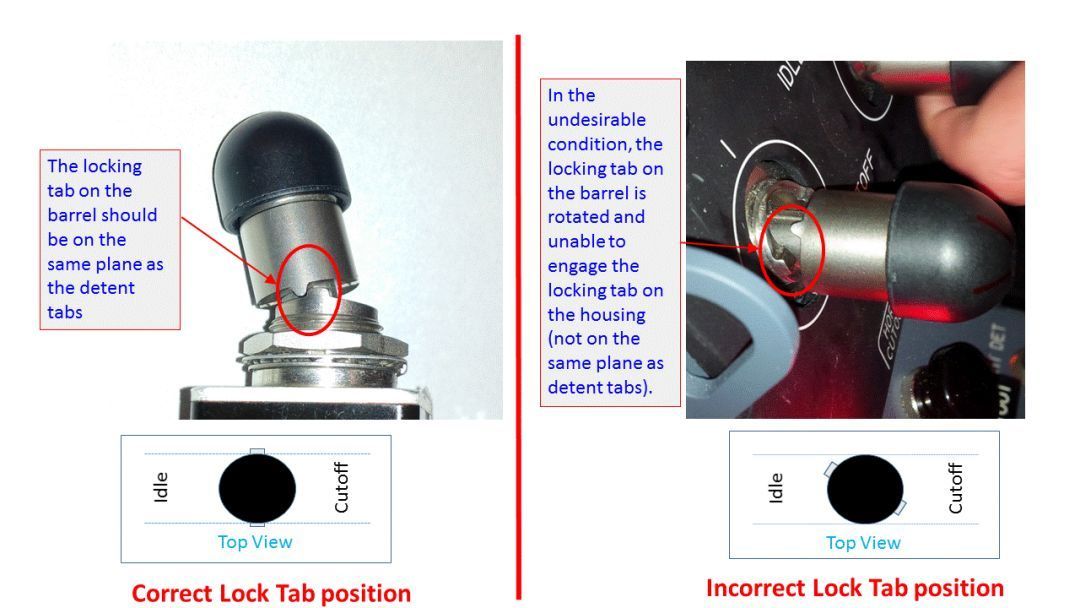
Incorrect lock tab position on fuel cut-off switch
If this incorrect mounting is actually possible, it would possibly remain unnoticed from the pilots (normal "pull-up then move" action is unaffected), but it would cancel the protective function of the so-called "locking tab", and even limit the travel of the switch handle in both directions, making it more vulnerable to an undesired change of state.
The photos above seem convincing enough, but I'd be very grateful for an informed opinion on this assembly mistake. Even if this is possible, the probability of both switches being unexpectedly snapped seems very remote to say the least, but not as remote as previously estimated.
Subjects
Fuel (All)
Fuel Cutoff
Fuel Cutoff Switches
SAIB NM-18-33
Special Airworthiness Information Bulletin
Links are to this post in the relevant subject page so that this post can be seen in context.
Reply to this quoting this original post. You need to be logged in. Not available on closed threads.
July 12, 2025, 11:26:00 GMT
permalink Post: 11920464
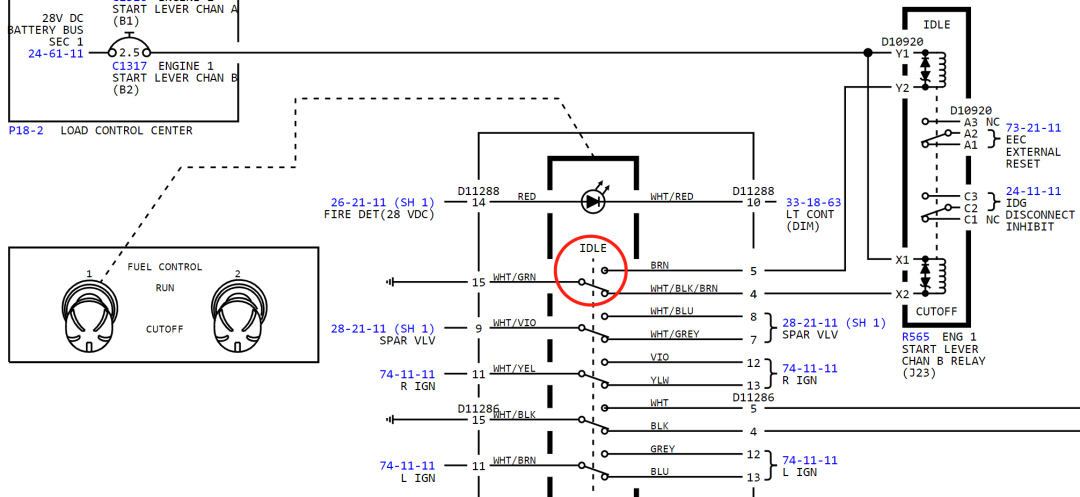
I could hardly figure what the "disengaged" word meant in this context, so I did a Google search for the switch part numbers (especially "766AT614-3D") to figure the difference between them, and a page from this chinese web site was part of the results.
And while I was painfully crawling the thread, I noticed the following picture about an "undesirable condition":
Incorrect lock tab position on fuel cut-off switch
If this incorrect mounting is actually possible, it would possibly remain unnoticed from the pilots (normal "pull-up then move" action is unaffected), but it would cancel the protective function of the so-called "locking tab", and even limit the travel of the switch handle in both directions, making it more vulnerable to an undesired change of state.
The photos above seem convincing enough, but I'd be very grateful for an informed opinion on this assembly mistake. Even if this is possible, the probability of both switches being unexpectedly snapped seems very remote to say the least, but not as remote as previously estimated.
One other useful thing from that web site is a partial schematic which shows the connection of the 4 poles in the switch. I believe this is from a 737NG but it should be the same idea.
Subjects
Fuel (All)
Fuel Cutoff
Fuel Cutoff Switches
Honeywell
SAIB NM-18-33
Special Airworthiness Information Bulletin
Links are to this post in the relevant subject page so that this post can be seen in context.
Reply to this quoting this original post. You need to be logged in. Not available on closed threads.
July 12, 2025, 11:43:00 GMT
permalink Post: 11920472
One other useful thing from that web site is a partial schematic which shows the connection of the 4 poles in the switch. I believe this is from a 737NG but it should be the same idea.
If any of that were true why would it happen after Vr and why would one pilot ask: \x93why did you go to cutoff\x94. That is an observed deliberate action. Cmon folks enough with the nonsense!
Why are people shying around the truth!?
Subjects
Honeywell
SAIB NM-18-33
Special Airworthiness Information Bulletin
Links are to this post in the relevant subject page so that this post can be seen in context.
Reply to this quoting this original post. You need to be logged in. Not available on closed threads.
July 12, 2025, 21:04:00 GMT
permalink Post: 11920795
One other useful thing from that web site is a partial schematic which shows the connection of the 4 poles in the switch. I believe this is from a 737NG but it should be the same idea.
b79edb16af_5b3bb7a57d07fbf3c85529ab3f52308b609d82a3.png.webp
Last edited by RomeoTangoFoxtrotMike; 12th July 2025 at 21:28 .
Subjects
Honeywell
SAIB NM-18-33
Special Airworthiness Information Bulletin
Links are to this post in the relevant subject page so that this post can be seen in context.
Reply to this quoting this original post. You need to be logged in. Not available on closed threads.
July 13, 2025, 22:34:00 GMT
permalink Post: 11921685
My Interpretation/reading:
Some 737 Operators reported incorrect/broken locking features on cutoff switches - PN 766AT613-3D
If you have PN 766AT61 3 -3D installed - Replace it with 766AT61 4 -3D, which includes an improved locking feature.
The other Aircraft listed - have switches with similar design. In the case of the B787, switch PN 4TL837-3D. Check those AC to ensure locking is OK, and if you do happen to find something odd, let us (the FAA) know.
No-one, has ever found anything wrong with any of those other switches, or there would be AD's.
Thus there is not a problem with 787 Fuel Switch locking features.
Subjects
FAA
Fuel (All)
Fuel Cutoff Switches
SAIB NM-18-33
Special Airworthiness Information Bulletin
Links are to this post in the relevant subject page so that this post can be seen in context.
Reply to this quoting this original post. You need to be logged in. Not available on closed threads.
July 16, 2025, 19:23:00 GMT
permalink Post: 11923905
on various Boeing airplane models. The table below identifies the affected airplane models and
related part numbers (P/Ns) of the fuel control switch
https://ad.easa.europa.eu/blob/NM-18...SIB_NM-18-33_1
Last edited by Ant T; 16th July 2025 at 19:36 .
Subjects
FAA
Special Airworthiness Information Bulletin
Links are to this post in the relevant subject page so that this post can be seen in context.
Reply to this quoting this original post. You need to be logged in. Not available on closed threads.
July 16, 2025, 19:31:00 GMT
permalink Post: 11923916
It goes on to list models including 787-8, -9 and -10
https://ad.easa.europa.eu/blob/NM-18...SIB_NM-18-33_1
Subjects
Special Airworthiness Information Bulletin
Links are to this post in the relevant subject page so that this post can be seen in context.
Reply to this quoting this original post. You need to be logged in. Not available on closed threads.
July 16, 2025, 19:39:00 GMT
permalink Post: 11923921
It goes on to list models including 787-8, -9 and -10
https://ad.easa.europa.eu/blob/NM-18...SIB_NM-18-33_1
These same switches are used on about 7,000 aircraft. A new part (766AT614-3D) with a new locking mechanism that could not be installed incorrectly was made for the 737.
The 787 uses an entirely different part number (4TL837‑3D). 1,200 787s with 30 million flight hours and 5 million departures. Not one instance of one, let alone two switches not working as designed.
- GY
Subjects
FAA
RUN/CUTOFF
Special Airworthiness Information Bulletin
Links are to this post in the relevant subject page so that this post can be seen in context.
Reply to this quoting this original post. You need to be logged in. Not available on closed threads.