June 12, 2025, 13:34:00 GMT
permalink Post: 11899162
Perhaps the gear was down because they knew they were going to force land due to lack of thrust.
(Only a 738 driver), but the electric pumps to drive the hydraulics is much slower than the engine driven pumps and so flap selection / re-selection could be not as expected.
RIP to all involved.
The 787 has 2x Enhanced Airborne Flight Recorders (EAFR), which each record both cockpit voice and flight data.
Hopefully flight data is not going to be an issue for this investigation.
It's also maybe visible in a few stills (e.g. post 64).
Last edited by Someone Somewhere; 14th June 2025 at 07:01 .
Subjects
APU
CVR
DFDR
EAFR
Engine Failure (All)
Engine Shutdown
FDR
Generators/Alternators
NTSB
RAT (All)
RAT (Deployment)
TOGA
Links are to this post in the relevant subject page so that this post can be seen in context.
The thread is closed so there are no user likes are available and no reply is possible.
June 18, 2025, 14:08:00 GMT
permalink Post: 11905228
I have been told elsewhere that this is not the case. A read of the draft FCOM available online for the 777 & 787 makes no mention of a FADEC generator, but then neither does the 737 manuals. Is this simply a case of "Boeing thinks you don't need to know"?
It has been proposed that the primary source of power for the FADECs is actually the flight control PMGs, mounted on the engine gearbox, but that this power goes to the avionics bay, has failover switching gear, and comes back to the EEC.
Can anyone shed concrete light on this (e.g. a source that clearly states there is both an EEC alternator and a flight control PMG on the accessory gearbox)?
Alternator and generator seem to be used interchangeably in this context.
I don't think you'll find an actual wire list for it (or it won't be useful) as apparently most/all of the data is via an ARINC bus.
I attempted to PM this but your inbox is full.
[SLF with an electrical background and some exposure to ground-side critical facilities power]
Last edited by Someone Somewhere; 18th June 2025 at 14:32 .
Subjects
ARINC
FADEC
FCOM
FDR
Fuel (All)
Fuel Cutoff Switches
GEnx (ALL)
Generators/Alternators
Parameters
Links are to this post in the relevant subject page so that this post can be seen in context.
The thread is closed so there are no user likes are available and no reply is possible.
June 18, 2025, 14:22:00 GMT
permalink Post: 11905242
I have been told elsewhere that this is not the case. A read of the draft FCOM available online for the 777 & 787 makes no mention of a FADEC generator, but then neither does the 737 manuals. Is this simply a case of "Boeing thinks you don't need to know"?
It has been proposed that the primary source of power for the FADECs is actually the flight control PMGs, mounted on the engine gearbox, but that this power goes to the avionics bay, has failover switching gear, and comes back to the EEC.
Can anyone shed concrete light on this (e.g. a source that clearly states there is both an EEC alternator and a flight control PMG on the accessory gearbox)?
Alternator and generator seem to be used interchangeably in this context.
It's not quite that, but there is a list of received channels for a GEnx 787 in the FDR report into one of the original battery fires .
I don't think you'll find an actual wire list for it (or it won't be useful) as apparently most/all of the data is via an ARINC bus.
I attempted to PM this but your inbox is full.
[SLF with an electrical background and some exposure to ground-side critical facilities power]
(1) The Engine Control System must be designed so that the loss or interruption of electrical power supplied from the aircraft to the Engine Control System will not -
(i) Result in a Hazardous Engine Effect,
(ii) Cause the unacceptable transmission of erroneous data.
The effect of the loss or interruption of aircraft supplied electrical power must be taken into account in complying with CS-E 50(c)(1).
Subjects
ARINC
FADEC
FCOM
FDR
GEnx (ALL)
Generators/Alternators
Links are to this post in the relevant subject page so that this post can be seen in context.
The thread is closed so there are no user likes are available and no reply is possible.
June 22, 2025, 17:37:00 GMT
permalink Post: 11908670
Regarding the recording feature, there's three types of microphone commonly used nowadays: Condenser and Ribbon type are somewhat fragile and require power to record audio while Dynamic type is basically a reverse speaker and is considered rugged. There's an off chance that a Piezzo microphone would be used here as they are basically indestructible but usually reserved for recording while in contact with a large sound transducer. My guess based on that is that we're looking at a dynamic microphone with a run of the mill preamp.
Depending on the actual electric setup this would yield a handful of different possible installations:
1) The "Cockpit Area Microphone" (hereby christened CAM because I like abbreviations) is a self contained unit consisting of a Microphone, a preamp and AD converter. This would mean while provided power the digital recording could be passed to either EAFR.
2) The CAM is a self contained unit consisting of a Microphone and a preamp. This would mean while provided power it could send an analog audio signal to the forward EAFR no problem, but would potentially struggle generating enough of a signal to be picked up by the rear EAFR.
3) The CAM is just a Microphone. This would mean it requires either no or very little power (even Condenser Mics usually require only Milliwatts) but the signal would be very hard to send over long distances and would require the EAFR to have a preamp.
In general it is audio engineering 101 to place a preamp as close to the source as possible to avoid noise. Thus I would rule out 3. It has both ups and downs to convert the analog signal to a digital signal, and there is a possibility they'd do both. In either case I am confused from an audio engineering standpoint why the rear EAFR would not pickup audio from the CAM if the forward EAFR does. Unless the rear EAFR is fed (audio) data only via BUS, which would be an interesting choice.
Also keep in mind that historically the CVR was also located in the tail section and very much received an analog signal over the entire distance. There's really no technical reason this wouldn't be possible, I routinely use far longer cables when running audio signals at concerts and those can't use compression because it would dumpster sound quality.
So, yeah, I don't understand why there would be a mismatch between the recordings of either EAFR, unless there was something else preventing all signal transmission towards the rear EAFR. The CVR in the rear has been a thing for 80 years now.
Regards,
Justus
My understanding is that, as you say, the CAM has a preamp. That preamp can be powered by the RIPS that accompanies the forward EAFR.
In addition, I believe there is a single analogue connection from the CAM+preamp to the aft EAFR in addition to the analogue connection from the CAM+preamp to the forward EAFR. I believe, but am not sure,that the other flight-deck audio (headsets) is carried digitally over the fibre-optic network to the aft EAFR. The network may or may not be in operation in the event of an electrical failure: I simply don't know.
The publicly available information I can find is not stunningly clear about this.
AEROSAFETY WORLD, January 2008 - https://flightsafety.org/asw/jan08/a...47-48.pdf?dl=1
https://data.ntsb.gov/Docket/Documen...ort-Master.PDF
What I have been unable to determine is whether the right and/or left 28 V DC buses are powered from the main battery in case of failure of the AC power supply. To my untrained eye, it looks like the Captain's flight displays are powered from the main battery in extremis (28 V DC - C1), but that there are various circuit breakers, that could be automated, that may or may not allow or prevent other loads (such as the F/O's flight displays (28 V DC - C2), or the aft EAFR, being supplied by the main battery, (See link to diagram). There could well be very drastic automated load shedding.
https://kb.skyhightex.com/wp-content...l-1024x640.png
If the right 28 V DC bus was unpowered for any period, it follows that the aft EAFR was not recording for that period. This would make the forward EAFR important in case of a power failure that prevented the right 28 V DC bus from providing power.
All the information that is unclear to me will be transparently clear to the crash investigators. But it seems to me that the aft EAFR will not hold data for any period that the right 28 V DC bus is not operating. Whether that applies to this incident is an open question.
Subjects
Air Worthiness Directives
CVR
Cockpit Area Audio
EAFR
Electrical Failure
NTSB
RIPS
Thread Moderation
Links are to this post in the relevant subject page so that this post can be seen in context.
The thread is closed so there are no user likes are available and no reply is possible.
June 22, 2025, 18:50:00 GMT
permalink Post: 11908714
My understanding is that, as you say, the CAM has a preamp. That preamp can be powered by the RIPS that accompanies the forward EAFR.
In addition, I believe there is a single analogue connection from the CAM+preamp to the aft EAFR in addition to the analogue connection from the CAM+preamp to the forward EAFR. I believe, but am not sure,that the other flight-deck audio (headsets) is carried digitally over the fibre-optic network to the aft EAFR. The network may or may not be in operation in the event of an electrical failure: I simply don't know.
The publicly available information I can find is not stunningly clear about this.
AEROSAFETY WORLD, January 2008 - https://flightsafety.org/asw/jan08/a...47-48.pdf?dl=1
GE Aviation: Consolidate and increase recording power with the 3254F EAFR. - https://www.geaerospace.com/sites/de...rder-3254F.pdf
As for power, this NTSB document describes the power set-up for the EAFRs
https://data.ntsb.gov/Docket/Documen...ort-Master.PDF
So the forward EAFR is powered from the left 28V DC bus with the possibility of being powered by the RIPS, and the aft EAFR is powered from the right 28 V DC bus.
What I have been unable to determine is whether the right and/or left 28 V DC buses are powered from the main battery in case of failure of the AC power supply. To my untrained eye, it looks like the Captain's flight displays are powered from the main battery in extremis (28 V DC - C1), but that there are various circuit breakers, that could be automated, that may or may not allow or prevent other loads (such as the F/O's flight displays (28 V DC - C2), or the aft EAFR, being supplied by the main battery, (See link to diagram). There could well be very drastic automated load shedding.
https://kb.skyhightex.com/wp-content...l-1024x640.png
If the right 28 V DC bus was unpowered for any period, it follows that the aft EAFR was not recording for that period. This would make the forward EAFR important in case of a power failure that prevented the right 28 V DC bus from providing power.
All the information that is unclear to me will be transparently clear to the crash investigators. But it seems to me that the aft EAFR will not hold data for any period that the right 28 V DC bus is not operating. Whether that applies to this incident is an open question.
Having two combined recorders is already more backup than what had previously been the norm, in addition theres the independently powered area mic going analog to the front recorder.
The common models I have checked the sheets for also provides a digital output (which is probably sent to the aft recorder via normal busses.
Having a seperate analog line going to the aft recorder would be several Kg of extra weight, and probably a substantial amount of loom design and paperwork for what is then a backup to an already redundant system.
Hence, imho why this signal only goes to the forward recorder. It is already a \xabbonus\xbb.
The power for microphone and preamp is in the >1watt range range, completely insignificant.
I am still interested in reliable information as to what is expected to be on the recorder of an aircraft which has lost the generators, what about the battery powered prinary instruments? Does some systems and the aft recorder come online with the RAT or would everything be down to the one cockpit mic? Surely not?
Subjects
EAFR
Electrical Failure
Generators/Alternators
NTSB
RAT (All)
RIPS
Thread Moderation
Links are to this post in the relevant subject page so that this post can be seen in context.
The thread is closed so there are no user likes are available and no reply is possible.
June 28, 2025, 06:47:00 GMT
permalink Post: 11912344
The B787 was one of the first aircraft to receive a new type of FDR/CVR, known as an Enhanced Airborne Flight Recorder (EAFR). Some detail of the time may be found here:
https://www.flightglobal.com/boeing-.../67970.article
https://www.militaryaerospace.com/po...for-boeing-787
I don't believe it's absolutely confirmed yet but earlier posts (thank you V1... Ooops et al ) indicated that the unit in question may be a GE Aviation Model 3254F, the document here gives some good detail, along with another doc from Skybrary that has some relevant information.
And this one discusses more on the 'new' ARINC-767 protocol in use with these later units.
Some broader background into ARINC's role in determining the standards applicable to aviation can be seen in this video. While it doesn't specifically cover ARINC-767 (used by the B787 EAFR) the history and associated detail is interesting and may give a little useful background:
In terms of actual data recovery I had a look around but couldn't find any video that showed this from an EAFR, however this NTSB YT link gives insight into how data was recovered from an earlier FDR unit (mounted in a Bombardier CRJ700 ). While it's different to that installed in the 787 the nature of the work and how it's carefully carried out may give some insight.
Finally, this is a link to a short report re data recovered from an EAFR in a B787-9:
https://data.ntsb.gov/Docket/Documen...ort-Master.PDF
I claim no specific knowledge here, just providing references to detail I read while trying to learn more about these newer units.
FP.
Subjects
CVR
DFDR
EAFR
FDR
NTSB
V1
Links are to this post in the relevant subject page so that this post can be seen in context.
The thread is closed so there are no user likes are available and no reply is possible.
June 28, 2025, 09:26:00 GMT
permalink Post: 11912392
Given the wealth of data and the 10 minutes RIPS supply for the forward EFAR the investigation body should by now have a good idea how the events unfold.
Subjects
RIPS
Links are to this post in the relevant subject page so that this post can be seen in context.
The thread is closed so there are no user likes are available and no reply is possible.
June 28, 2025, 20:12:00 GMT
permalink Post: 11912634
Auxiliary Power Unit Battery Fire Japan Airlines Boeing 787-8, JA829J Boston, Massachusetts January 7, 2013
Subjects
EAFR
FDR
NTSB
Parameters
RIPS
Links are to this post in the relevant subject page so that this post can be seen in context.
The thread is closed so there are no user likes are available and no reply is possible.
June 30, 2025, 07:50:00 GMT
permalink Post: 11913386
https://data.ntsb.gov/Docket/Documen...man-Master.PDF
Eng1_Fuel_cutoff
Eng2_Fuel_cutoff
You get a good impression about the overwhelming wealth of parameters.
Subjects
Parameters
Links are to this post in the relevant subject page so that this post can be seen in context.
The thread is closed so there are no user likes are available and no reply is possible.
July 14, 2025, 23:27:00 GMT
permalink Post: 11922550
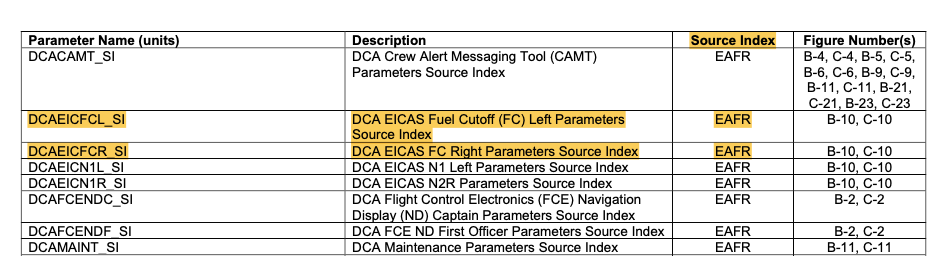
I cant speak for how long it would take to connect the dots though.
https://data.ntsb.gov/Docket/Documen...man-Master.PDF )

Last edited by D Bru; 14th July 2025 at 23:39 .
Subjects
EAFR
EICAS
Fuel (All)
Fuel Cutoff
Fuel Cutoff Switches
RAT (All)
RAT (Deployment)
Links are to this post in the relevant subject page so that this post can be seen in context.
Reply to this quoting this original post. You need to be logged in. Not available on closed threads.
July 17, 2025, 21:10:00 GMT
permalink Post: 11924629
Both dementia and profound stress can produce mental fog behaviors such that over-stressed people can be forgetful and make the kinds of mistakes seen in people with early-onset dementia. To interview friends and family about behaviors in the months before the crash could reveal dementia-type symptoms, but this would not be conclusive.
To your point, it should be expected that, if remains are available for study, there's a small chance that autopsy findings could reveal dementia-associated changes in the brain. For example, the final accident report on a 2023 Nevada medevac crash reports a 3cm intracranial tumor found on autopsy (not dementia-related, but they looked to some extent).
Subjects: None
1 recorded likes for this post.Reply to this quoting this original post. You need to be logged in. Not available on closed threads.
November 29, 2025, 21:28:00 GMT
permalink Post: 11997946
And just to note on a comment about US airport ownership, outside of most military airports and 2 civilian airports in the DC area, all other airports are owned at the state or local levels, with a number considered private entities. For example, the Louisville airport (SDF) is owned and operated by a public corporation formed under state law which is common for most large hub airports in the US.
Subjects
AAIB (All)
AAIB (India)
NTSB
Links are to this post in the relevant subject page so that this post can be seen in context.
Reply to this quoting this original post. You need to be logged in. Not available on closed threads.