June 14, 2025, 23:54:00 GMT
permalink Post: 11901926
On a flap 5 takeoff the FMS could be programmed to select climb power at flaps 1 which would seem like an apparent loss of thrust. Same as for F15 to F5 or further.
I`m not sure if they would have cycled the FCS switches or not. But the airplane certainly would have experienced a loss of lift would the flaps been inadvertently retracted. As well as perceived loss of thrust.
OTOH any castastophic failure which left the gear down would have essentially left the flaps where they were. They are hydraulically activated with electrical backup but it`s wayyyyy slow.

I believe this is the right wing, (the registration marking appears on the right wing in online photographs of the aircraft). These flaps look down (extended) to me. I believe the structure bottom left, aft of the markings is the right aileron. The flap structure is extended rearward past the aileron structure. You can just make out the rear edge of the LE slat, top right. It is deployed, not retracted.
I understand things “move” in an accident sequence. Verifying all this will be straightforward by examining the screw-jacks and of course, the flight data.
Subjects
Fuel (All)
Fuel Cutoff Switches
Links are to this post in the relevant subject page so that this post can be seen in context.
The thread is closed so there are no user likes are available and no reply is possible.
June 15, 2025, 03:40:00 GMT
permalink Post: 11902061

APU door open in the inflight position
Last edited by aeo; 15th June 2025 at 03:43 . Reason: Remove duplication
Subjects
APU
Links are to this post in the relevant subject page so that this post can be seen in context.
The thread is closed so there are no user likes are available and no reply is possible.
June 15, 2025, 05:53:00 GMT
permalink Post: 11902102
It uses a variable displacement pump to maintain 5000PSI constant pressure. The swashplate angle is varied to adjust pump output flow: more devices consuming fluid, more flow to keep the pressure up. If the pumps cannot deliver enough fluid, the swashplate reaches the full flow position and the output pressure decreases until flow consumed equals flow produced. Very much like a constant-current constant-voltage power supply.
Running in that area of maximum flow is 100% expected under some conditions, especially if an engine or EDP fails and the electric demand pump is supplying a whole hydraulic system sized for the larger EDP (although I think this would be less of an issue on the 787 as the L/R systems don't do much, but the same variable-displacement pump design has been around for a LONG time including on the 737).
And again, there's a VFD between the aircraft electrical bus and the pump motor, because the pump is 400Hz and the aircraft is wild-frequency. VFDs are very very good at isolating faults unless you are actually looking at a sustained overload on one of four generators .
No bus is essential on a modern aircraft.
Boeing treats everything electric as a black box but the A380 has this beautifully overkill drawing - given both have 4x generators, 2x APU generators, and a RAT, it should not be entirely dissimilar levels of redundancy:

Note that the reason for some links having two contactors in series (e.g. BTC5/6 or BTC7) is because this is spread across two separate units, so that a fire and total loss of one leaves ~half the aircraft powered and totally flyable.
Power-open power-close is very common in commercial/situations where you don't want to be wasting energy 24/7 and don't have a defined position for the valve/damper in case of power loss. Done a bunch of them in ductwork and electrically operated windows - your car likely has them, for example.
Last edited by Someone Somewhere; 15th June 2025 at 06:08 .
Subjects
APU
FADEC
Fuel (All)
Fuel Cutoff
Fuel Cutoff Switches
Generators/Alternators
Hydraulic Failure (All)
RAT (All)
Links are to this post in the relevant subject page so that this post can be seen in context.
The thread is closed so there are no user likes are available and no reply is possible.
June 15, 2025, 07:38:00 GMT
permalink Post: 11902150
If people are saying that they can't see anything that looks like a RAT, that may very well be true, depending on which version they're watching.
I don't have the ability to post direct links, but I did take a frame from the highest quality version of the video, and what I see is a RAT-sized, RAT-shaped object protruding from the fuselage in the exact position where you would expect the RAT to be.The image in question has only been cropped and enlarged by a factor of 2. No other editing, processing, sharpening or AI enhancement has been done. If someone else wants to replicate it, the timecode is 00:08.05.
imgur. com/a/YE2q1e3
If someone with link-posting privileges wants to upload the image here, that'd be great.

Subjects
RAT (All)
Links are to this post in the relevant subject page so that this post can be seen in context.
The thread is closed so there are no user likes are available and no reply is possible.
June 15, 2025, 10:10:00 GMT
permalink Post: 11902268
I posited a potential TCMA sequence in a post timed 1804Z - speculative of course. Agree with others, it is difficult to contemplate and seems staggeringly unlikely.

Any thoughts?
Subjects
APU
Weight on Wheels
Links are to this post in the relevant subject page so that this post can be seen in context.
The thread is closed so there are no user likes are available and no reply is possible.
June 15, 2025, 11:44:00 GMT
permalink Post: 11902343

Subjects: None
The thread is closed so there are no user likes are available and no reply is possible.
June 15, 2025, 13:11:00 GMT
permalink Post: 11902417
I believe this is the right wing, (the registration marking appears on the right wing in online photographs of the aircraft). These flaps look down (extended) to me. I believe the structure bottom left, aft of the markings is the right aileron. The flap structure is extended rearward past the aileron structure. You can just make out the rear edge of the LE slat, top right. It is deployed, not retracted.
I understand things \x93move\x94 in an accident sequence. Verifying all this will be straightforward by examining the screw-jacks and of course, the flight data.
Subjects: None
The thread is closed so there are no user likes are available and no reply is possible.
June 15, 2025, 16:05:00 GMT
permalink Post: 11902536


Subjects
ADSB
FlightRadar24
Links are to this post in the relevant subject page so that this post can be seen in context.
The thread is closed so there are no user likes are available and no reply is possible.
June 15, 2025, 20:14:00 GMT
permalink Post: 11902738
Exact location of the house where the Video was taken (Spiral staircase on street view ) . Might help deduce the Speeds and even altitude .
A Straight line between runway end and crash location

Exact location of house, Approx distance of 1.5 km from end of runway to crash site .
Subjects: None
The thread is closed so there are no user likes are available and no reply is possible.
June 15, 2025, 20:15:00 GMT
permalink Post: 11902740


Subjects
APU
Dual Engine Failure
Engine Failure (All)
RAT (All)
RAT (Deployment)
Links are to this post in the relevant subject page so that this post can be seen in context.
The thread is closed so there are no user likes are available and no reply is possible.
June 16, 2025, 00:30:00 GMT
permalink Post: 11902961
The upgrade to 777 between then and now is within reason.
Beyond that.

With that lighthearted diversion completed, back to the bickering.
Subjects: None
The thread is closed so there are no user likes are available and no reply is possible.
June 16, 2025, 06:22:00 GMT
permalink Post: 11903102
There are various reasons why the signatures we obtained are not that likely to be from a motorbike, but to answer briefly - and pictures being 1000 words 'n all that - here's a quick comparative [visual] analysis. At the top is a motorbike passing by away from the observer, the other is AI 171 doing the same thing:

I expect the difference will be clear. That said one could level a number of criticisms at the method I've used to show this, the sources obtained etc (eg. this is motorbike, not a moped as I couldn't find one in the time available), and if you really wanted to fake it one could, but I doubt that's occurred here.
Would say more but I'm short of time and think this is sufficient clear for now.
FP.
Subjects: None
The thread is closed so there are no user likes are available and no reply is possible.
June 16, 2025, 09:23:00 GMT
permalink Post: 11903243
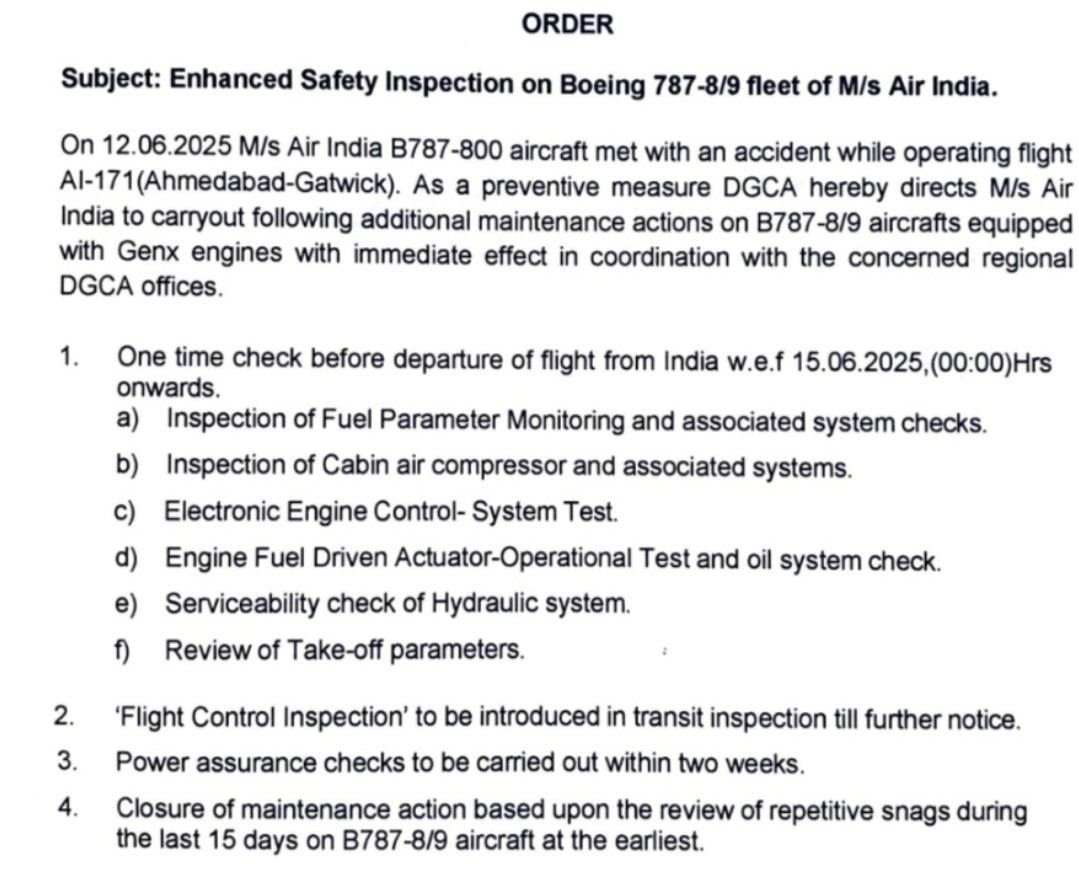
This gives us an insight of what, on Saturday morning, the Indian CAA were focused on - and many of them focus on fuel delivery.
The previous 787 groundings were battery related fires. That was solved by a temporary fix. Is that still in place?
Subjects: None
The thread is closed so there are no user likes are available and no reply is possible.
June 16, 2025, 10:48:00 GMT
permalink Post: 11903335

One thing we haven't discussed as a characteristic is how the AI recording moves from indirect sound with a shorter ambience, to direct sound, to a very much more ambient distant character in the same amount of time as the large aircraft moving overhead.
The moped/motorcycle in the sample, keeps about the same small street ambience throughout.
Notice how the harmonics are in different places with different spacing and with different relative intensity, the emphasis on the internal combustion engine is lower in frequency than the open Rat, but with added exhaust noise.
Thank you.

I also enclose a doppler distance
Subjects: None
The thread is closed so there are no user likes are available and no reply is possible.
June 14, 2025, 10:18:00 GMT
permalink Post: 11903675
A very simple audio analysis give me this:
The 3 segments horisontally, are of different videos of B787s passing overhead/landing. The vertical drop you see is the doppler effect.
In other words, these are spectrograms over time which makes these distinctions easier than a simple static spectrogram.
1. B787 landing with RAT extended.
2.Air india crash
3. B787 landing without RAT
It's a 5 minute laptop job, and it would look much prettier and clearer if I spent some time with it, (Gain to color match, and spectrally match to compensate for microphone placement and type),
but it is 85% conclusive even when done as simple as this IMO.
(I do have legal forensic audio experience)
The RAT was out judging from the audio evidence. You can see the the equally spaced overtones of the propelller match when passing overhead resulting in the Doppler effect, the difference in length of the doppler is caused by distance and the slightly varying frequencies shown in the starting point is caused by a difference in speed. But the harmonic content match.
In the 3rd segment you see none of these overtones at all.

Subjects
RAT (All)
RAT (Deployment)
Links are to this post in the relevant subject page so that this post can be seen in context.
The thread is closed so there are no user likes are available and no reply is possible.
June 15, 2025, 11:44:00 GMT
permalink Post: 11903680
Subjects: None
The thread is closed so there are no user likes are available and no reply is possible.
June 16, 2025, 10:48:00 GMT
permalink Post: 11903685
One thing we haven't discussed as a characteristic is how the AI recording moves from indirect sound with a shorter ambience, to direct sound, to a very much more ambient distant character in the same amount of time as the large aircraft moving overhead.
The moped/motorcycle in the sample, keeps about the same small street ambience throughout.
Notice how the harmonics are in different places with different spacing and with different relative intensity, the emphasis on the internal combustion engine is lower in frequency than the open Rat, but with added exhaust noise.
Thank you.
I also enclose a doppler distance
Subjects: None
The thread is closed so there are no user likes are available and no reply is possible.
June 14, 2025, 00:59:00 GMT
permalink Post: 11903715
Unlikely, but possible.
This does add more credance to the complete power loss scenario.
Subjects
APU
Links are to this post in the relevant subject page so that this post can be seen in context.
The thread is closed so there are no user likes are available and no reply is possible.
June 14, 2025, 09:43:00 GMT
permalink Post: 11903718
I’m not a 787 driver so for fear of looking dumb in front of those that are this still confuses me. Even IF they’ve mis-selected the flap setting (I still don’t think it’s been cemented on here that there is in fact a FMS/flap setting disagreement warning but i believe there is), had the wrong de-rated take off settings, selected flaps instead of gear up the 787 with massive high bypass engines, FBW and full envelope protections surely cannot let itself be put in such a low energy/high alpha regime as we saw in the videos IF it has both fans functioning normally, surely?
the pilots may have messed up royally and numerous times so those holes lined up but the plane is the final block in the chain and a 21st century all digital entirely clean sheet design was sold as being immune to such catastrophic outcomes from a few minor (consequential yes) and fairly common errors- aren’t all the protections and our procedures designed after decades of mistakes?
im having a hard time squaring how a fully functioning modern bird like this could allow for this outcome and almost whatever the pilots did outside of unbelievable inputs and the pilots are are a bit of a red herring IMO

Dale Winsley
@Winsleydale
No. The LE slats are deployed therefore the flaps are as well. This is an automatic linkage. The flaps are set at Take-Off. Hard to see from the angle but they are...if slats are out (easy to see) then flaps are set. Looks like Flaps 5. Also, the 787 has the highest Thrust-to-Weight ratio of any airliner on Earth. The change in Alpha and lift is a trifling matter for it, at these settings (1-5). It will fly out of it easily, even at that density altitude. The attitude change is - in the circumstances I describe, consistent with a massive power loss (both sides). I believe based on probability that simultaneous mechanical failure is not the cause. Fuel contamination or starvation is likewise unlikely based on the 787 fuel system. The common element is the FADEC/Autothrottle/TOGO. However, each engine FADEC is dual redundant two channels. So any such common failure must happen further upstream. From a design perspective, that would be unthinkable. But this is Boeing. Given what I can see with my own eyes, I believe the flap issue is a non-starter. Also, re the landing gear: Clearly the Positive Rate challenge would be met based on normal rotation and fly-off at V2. But since we know the flaps were set correctly, that rules out an "oopsie" moment. Just as likely there was at the challenge moment an indication that something was amiss, and the Gear Up call was not made. They see both N1s unwinding and it takes a second to get past the WFT factor. They cross-check and see the airspeed also unwinding. Then they unload the Alpha and pitch to gear down Vy. And they had another 6 seconds. Whatever it was, it was not a flap, mechanical or fuel issue. We will know soon enough. But this is Boeing. My gut says "software". All 787s worldwide need to be grounded, now.
6:10 AM \xb7 Jun 14, 2025
\xb7
53.8K
Views
Subjects
FADEC
FBW
Fuel (All)
V2
Links are to this post in the relevant subject page so that this post can be seen in context.
The thread is closed so there are no user likes are available and no reply is possible.
June 14, 2025, 10:18:00 GMT
permalink Post: 11903720
A very simple audio analysis give me this:
The 3 segments horisontally, are of different videos of B787s passing overhead/landing. The vertical drop you see is the doppler effect.
In other words, these are spectrograms over time which makes these distinctions easier than a simple static spectrogram.
1. B787 landing with RAT extended.
2.Air india crash
3. B787 landing without RAT
It's a 5 minute laptop job, and it would look much prettier and clearer if I spent some time with it, (Gain to color match, and spectrally match to compensate for microphone placement and type),
but it is 85% conclusive even when done as simple as this IMO.
(I do have legal forensic audio experience)
The RAT was out judging from the audio evidence. You can see the the equally spaced overtones of the propelller match when passing overhead resulting in the Doppler effect, the difference in length of the doppler is caused by distance and the slightly varying frequencies shown in the starting point is caused by a difference in speed. But the harmonic content match.
In the 3rd segment you see none of these overtones at all.
Subjects
RAT (All)
RAT (Deployment)
Links are to this post in the relevant subject page so that this post can be seen in context.
The thread is closed so there are no user likes are available and no reply is possible.