June 14, 2025, 10:19:00 GMT
permalink Post: 11903721
I am very mindful of just how awful a tragedy this is, and have significant misgivings about disproportionate interest in others misfortune where it carries no purpose, but also recognise that for some people knowing and learning what happened ASAP could be very important, particularly given the present circumstances.
Thus while I sincerely hope that early detail from investigators will give some clarity, in an effort to reduce needless speculation regarding RAT deployment I have taken:
(1) an audio sample from the video of AI171 passing by in which people claim to hear a RAT
(2) an audio sample from a 787 video with RAT deployed on test by Boeing
(3) an audio sample from a JAL 787 video with RAT deployed
And passed these through a FFT in order to gain a more quantitative view of the noise spectra from each event.
A spectrogram of the results is presented below. I hesitate to make any conclusions per se, but observe that there are similarities as well as divergences between them. In all three samples there is a relatively consistent signal roughly centered in the range 113-146Hz that could be what gives the characteristic 'buzz' sound of (apparently) a RAT in operation.
JAL ~141Hz
Test ~146Hz
AI171 ~113-134Hz (prob doppler variation here)

Spectral comparison AI171, B787 with RAT, JAL 787 with RAT

Spectral comparison #2 AI171, B787 with RAT, JAL 787 with RAT
These frequencies seem consistent(ish) with what I got from this video [[url]https://www.youtube.com/watch?v=O1r3CuRwjPc] in which a 787 RAT is being tested - albeit in this case the blades are hydraulically powered and not driven as a turbine. This test showed a fundamental frequency of 135Hz with relevant harmonics above (the second harmonic at 270Hz is higher SPL, no weighting):

It's important to note that the initial recordings are necessarily different; these are not controlled conditions, the recording equipment is probably quite diverse and almost certainly not ideal, and the environmental conditions will also be different. Moreover all of these audio samples have come from video files referenced here, one has no way of determining the provenance or veracity of these sources and, crucially, I have no prior experience of analysing/extracting RAT acoustic fingerprints (nor have I sampled 'control' audio of a 787 passing by /without/ RAT!).
Additionally it's been quite a long time since I did any work with [turbine] noise so given these and other variables I'm not prepared to make any declarations per se, but perhaps more knowledgeable people could. That said, my feeling from what I see is that RAT deployment is not dis proven, and that the apparent fundamental frequency difference between the samples may be explainable by - amongst other things - difference in a/c airspeed, bearing in mind that AI171 was on TO, the others were landing.
Ultimately what I've done here is extremely rudimentary and while it would be possible to go into much more depth I'd hope that more definitive answer would be forthcoming by then, however if anyone wants to discuss specific methodology etc off-line please PM, no wish to add to noise on this thread.
FP.
Subjects
AI171
RAT (All)
RAT (Deployment)
Links are to this post in the relevant subject page so that this post can be seen in context.
The thread is closed so there are no user likes are available and no reply is possible.
June 16, 2025, 06:22:00 GMT
permalink Post: 11903741
There are various reasons why the signatures we obtained are not that likely to be from a motorbike, but to answer briefly - and pictures being 1000 words 'n all that - here's a quick comparative [visual] analysis. At the top is a motorbike passing by away from the observer, the other is AI 171 doing the same thing:

I expect the difference will be clear. That said one could level a number of criticisms at the method I've used to show this, the sources obtained etc (eg. this is motorbike, not a moped as I couldn't find one in the time available), and if you really wanted to fake it one could, but I doubt that's occurred here.
Would say more but I'm short of time and think this is sufficient clear for now.
FP.
Subjects: None
The thread is closed so there are no user likes are available and no reply is possible.
June 16, 2025, 09:23:00 GMT
permalink Post: 11903750
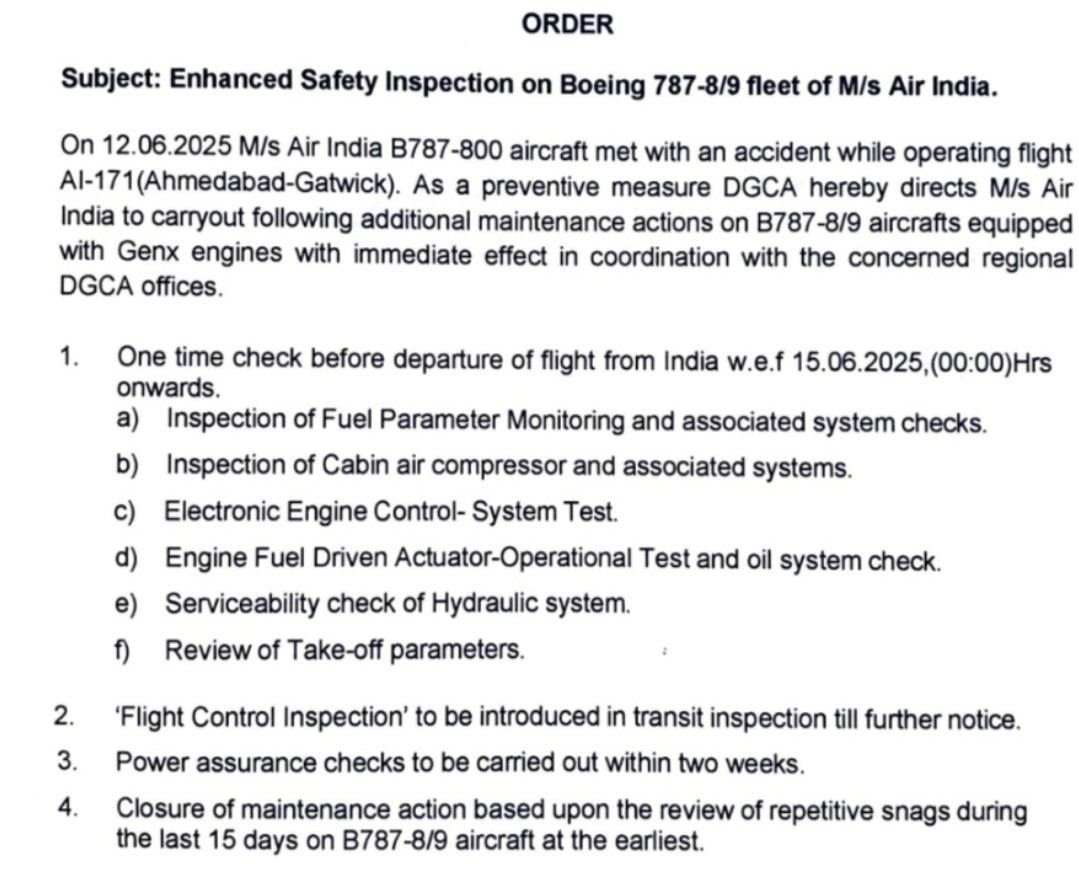
This gives us an insight of what, on Saturday morning, the Indian CAA were focused on - and many of them focus on fuel delivery.
The previous 787 groundings were battery related fires. That was solved by a temporary fix. Is that still in place?
Subjects: None
The thread is closed so there are no user likes are available and no reply is possible.
June 17, 2025, 00:04:00 GMT
permalink Post: 11903859
I also note that the primary source of the information on which I’m basing my post is the content of Boeing’s patent application which, of course, does not contain any of the actual wiring diagrams or modification details of the TCMA, even assuming it has been implemented. (I understand from the now-closed thread, that there is an unresolved question as to whether a petition for an exemption from the TCMA requirement had been successful.)
The point of my post is to get other’s thoughts on one of the design principles of the TCMA system proposed in the patent application.
The ostensibly simple and elegant concept is described in the schematic of the system at figure 1 of the patent application. A copy of figure 1 is below.
The TCMA is the part of the schematic inside the dotted box numbered 16 , sitting with the EEC (others would call it the FADEC) in the solid box numbered 18 .
The heart of the TCMA comprises two switch relays, numbered 22 and 28 in the schematic, wired in series. Each of those switch relays is controlled by its own, dedicated engine control malfunction software, identified as the blobs numbered 130 . (The patent application identifies component 34 as a dedicated processor and 32 as the diode connected to the switch relays, but that is evidently a mistake. Component 34 is the diode and I can’t find a component number 32 anywhere in the schematics.)
Each relay switch and its controlling software is described as a ‘channel’, one A and one B. Both channels run continuously, monitoring throttle position (36 in the schematic) versus engine data fed from ARINC data bus lines (46 in the schematic) and “dedicated input sensors” not shown in the schematic. Those sensors presumably detect things like weight on wheels and perhaps RADALT.
This design is said to achieve redundancy, because if only one ‘channel’ detects the engine is producing excessive thrust while the throttle is set to idle, that channel will set its switch relay to CUTOFF and that is enough to change the state of the high pressure fuel shut off valve (58 in the schematic). No more motion lotion. In the words of the patent application: Both channels are “always actively monitoring engine function and independently have the capability of shutting down the engine.”
That arrangement wrinkled my crusty old avtech brow. In my mind – and this is why I’m seeking other’s thoughts – the advantage of redundancy arising from the two channels, either or both of which can shut the engine down, is not without risk. If it is possible for one of the channels to have some ‘glitch’ or hardware failure such that it does not detect an actual out of envelope condition justifying immediate shut down, with the other channel detecting the condition and shutting the engine down, it inexorably follows – does it not – that it is possible for one (or both) of the channels to have a ‘glitch’ or hardware failure that results in a shut down when there is no out of envelope condition?
Further, even if there are completely separate, duplicated sensors telling each channel things like the position of the throttle and whether or not there is weight on wheels, there remains the possibility of a combination of sensor failures/disconnects resulting in one channel being ‘convinced’ that an out of envelope condition exists, with a consequential cutoff of fuel to the engine.
I of course acknowledge the valid observations made about the remote probabilities of these kinds of glitches and failures.
I’ve heard rumours that there was much resistance to the mandating of TCMA systems. Having seen many, many strange faults caused by random shorts, open circuits, liquid ingress and other foreign objects, I can understand why there was that resistance. Every time you add something to a system and that added thing has electronic components and software and electrical connections and data inputs, you add risk of that thing malfunctioning or working perfectly but with erroneous inputs. In this case, there are effectively two added new things: two channels, each one of which has the ability to shut off the motion lotion to the engine to which they are strapped.
I make no comment on whether TCMA systems, if fitted, have anything to do with this tragedy.
My profound condolences to the families and friends of those killed or injured. My thoughts also go out to the many people who will be agonising over the potential causes and responsibility for it. And thanks to those who are working out the causes.
...

Subjects
ARINC
Condolences
FADEC
Fuel (All)
Fuel Cutoff
Fuel Cutoff Switches
RUN/CUTOFF
Weight on Wheels
Links are to this post in the relevant subject page so that this post can be seen in context.
The thread is closed so there are no user likes are available and no reply is possible.
June 14, 2025, 03:10:00 GMT
permalink Post: 11903884

Subjects: None
The thread is closed so there are no user likes are available and no reply is possible.
June 17, 2025, 01:36:00 GMT
permalink Post: 11903890
Let me explain.
The consensus is that both engines quit shortly after liftoff (that assumes that the RAT did in fact deploy). At least one of the data recorders has battery backup, so it should have kept functioning when all aircraft power was lost.
However...
Over the years, I've looked at lots and lots of digital flight data recorder outputs when investigating some sort of incident or other engine anomaly, So I have become rather familiar with some of the interesting characteristics of DFDR data.
On the 767 and 747-400, when you shutdown an engine and the IDG goes offline, there is a momentary 'glitch' in the electrical power system as it reconfigures for the available power source - this is why you see the flight deck displays flicker and return, and the cabin lights momentarily flicker. As a result, most of the avionics boxes 'reset' - this is quick, but it's not instantaneous. This shows up in the FDR data - sometimes as 'no valid data' for a few seconds, or as garbage readings of zero or 'full scale'. Now, looking at the FDR data, it's easy to simply disregard the data, so normally no big deal.
Starting with the 777 (and on the 787 and 747-8), this electrical power glitch was 'fixed' - there is slight delay (~quarter of a second IIRC) before the fuel cutoff signal is sent to the engine - during which the electrical system reconfiguration takes place so no more 'glitch' during a normal engine shutdown...Except whatever happened to these engines wasn't 'normal'.
If there is a fuel cut at high power, the engine spools down incredibly rapidly - a second or two from max power to sub-idle. Assuming the fuel cut wasn't commanded by the flight deck fuel switches, the electrical system won't know it's coming, so it can't reconfigure until after the engine generators drop offline - and you're going to get that power glitch. Nearly every avionics box on the aircraft will reset due to this electrical glitch, and the FDR isn't going to get useful data for a few seconds (and then, only from the stuff that's on the battery bus).
Whatever happened, happened quickly - it's quite possible that whatever initiated the high-power fuel cut didn't get recorded.
 ).
).
Yet, the answer must be simpler and staring us in the face since logic and experience (everything you have offered TDR), tell us that modern airliner engines generally do not just suddenly quit flying at the same time. In this regard we can recall several instances of double engine failure associated with bird strikes generally involving large birds or large flocks or both. But it seems we have discounted this theory very early in discussion. Why? Because we cant see any birds, or flocks of birds or engine flames/surges or puffs of smokes from the engines which would support this. Really?
I have read all the 100's of posts (sadly) and while some very early posters tried to analyze the imagery, I suspect the very poor quality eventually discouraged most from seeing anything of interest. However, smattered throughout this discussion from the beginning to the end there have about four posts that describe seeing something where others have not. At least two of these were related to possible smoke but which were probably just the dust blown outwards by the wingtip vortices. Two others however have mentioned possible flames and puffs of smoke.
The video of course is very poor. There should be a special place in hell for people who subject us to looking at a video with continuous zooming in and out, inability to retain focus on the subject (it was just a CCTV monitor, not the actual aircraft they had to focus on) and constant camera shake. A video of a video, and then the resolution probably reduced for social media upload. This all results in a very unwatchable record of the aircrafts departure. The only immediate information gleaned seems to be some idea of how far down the runway the aircraft was at takeoff and the parabolic curve as it very clearly described the aircrafts flight path.

Air India Flight 171 on departure
But take a look at this frame. The right engine shows an artifact (pixelation if you like) that might represent a surge flame. I can almost see a puff of smoke just inboard of the aileron that may be associated with that too.
Am I just seeing distortion? Am I just seeing some smoke because that's where I would expect to see it?
We are all very used to seeing everything in 4K today but back in the day when everything was low res we used to join the dots. If pixels existed then something was there. If they didn't, it wasn't.
So if it's just pixels caused by distortion then they have coincidentally appeared in the tailpipe of an aircraft that crashed shortly after takeoff with a presumed double engine failure.
But surely we would see the birds? Well, not in this video. You cant even see the registration number on the side of the aircraft and that is much bigger than a bird. Haze, distortion, focus and low res, and each individual bird wouldn't even make up a pixel.
So make of this what you will, but this problem may have started on the ground. Birds strikes are very common according to Some AI pilots who interviewed for this following article but I have no idea of the authenticity of this report:
https://www.rediff.com/news/report/a...h/20250613.htm "The Air India pilots also added that Ahmedabad airport has long been known for bird activity near the runway, which could have contributed to the incident.
"This issue (of the excessive presence of birds) has been flagged multiple times," a third Air India pilot said, asking not to be named."
Of course, a single engine failure would not have brought this aircraft down, nor would it have deployed the RAT, but we can't see what happened on the left engine when the aircraft slipped behind the radio antenna building.
While these high bypass engines are designed and certified to keep running after experiencing certain types of bird strike, the effect on two engines concerns have been voiced about the contribution of certification to the mitigation of the risk hazardous bird strike in the two engine case.
This from Sky Library:
https://skybrary.aero/articles/aircr...nue%20to%20fly .
" A number of concerns have been quite widely voiced about the contribution of certification to the mitigation of the risk of hazardous bird strikes:
- The case of bird ingestion into more than one engine at the same time is not addressed directly and it is clearly extremely difficult to meaningfully estimate the probability of such an occurrence. However, it has been observed that, since some of the current standards only require that a damaged engine can be safely shut down, this circumstance should be more fully considered when determining the acceptable outcome of ingestion into single engines, especially for the twin engine case.
- It has been noted that the potential effects of bird strikes on modern electronic flight control systems and flight deck instrument displays have not yet been fully assessed.
Maybe someone can do some video enhancing of this image as others have done with the audio enhancement to give strong probability of RAT deployment.
If my suggestion can be corroborated at all, then the question of what happened next becomes somewhat easier to answer. Perhaps neither engine stopped running but they did so with limited thrust? If anything from the pilots mayday call can believed, it wasn't engines shut down..it was no thrust. So why did the RAT deploy? Cant answer that. And, I cant imagine it would be manually deployed if both engines were still running.
However, TDR did say.
"On the 767 and 747-400, when you shutdown an engine and the IDG goes offline, there is a momentary 'glitch' in the electrical power system as it reconfigures for the available power source - this is why you see the flight deck displays flicker and return, and the cabin lights momentarily flicker."
Startle factor that electrically systems were about to fail? Manually deploy RAT?
Edit: I might add, they would have found remains on the runway if this did indeed happen. But we have heard anything from anybody?
Subjects
CCTV
DFDR
Dual Engine Failure
Engine Failure (All)
FDR
Fuel (All)
Fuel Cutoff
Fuel Cutoff Switches
Generators/Alternators
MAYDAY
RAT (All)
RAT (Deployment)
Links are to this post in the relevant subject page so that this post can be seen in context.
The thread is closed so there are no user likes are available and no reply is possible.
June 17, 2025, 17:41:00 GMT
permalink Post: 11904452
Obviously enough, this isn't a real circuit diagram, but shouldn't this link be removed from the patent drawing?

Odd link in TCMA patent drawing
Subjects
High Pressure Shutoff Valve
RUN/CUTOFF
Links are to this post in the relevant subject page so that this post can be seen in context.
The thread is closed so there are no user likes are available and no reply is possible.
June 17, 2025, 18:09:00 GMT
permalink Post: 11904475
Obviously enough, this isn't a real circuit diagram, but shouldn't this link be removed from the patent drawing?
Odd link in TCMA patent drawing
Subjects
High Pressure Shutoff Valve
RUN/CUTOFF
Links are to this post in the relevant subject page so that this post can be seen in context.
The thread is closed so there are no user likes are available and no reply is possible.
June 18, 2025, 02:33:00 GMT
permalink Post: 11904830
https://www.flightradar24.com/blog/f...rom-ahmedabad/

Edit to add - I have made no attempt to correct the raw ADS-B altitude data. There is no need to make any correction to see altitude gain.
Last edited by EXDAC; 18th June 2025 at 02:54 . Reason: revise image to add missing data point
Subjects
ADSB
FlightRadar24
Links are to this post in the relevant subject page so that this post can be seen in context.
The thread is closed so there are no user likes are available and no reply is possible.
June 18, 2025, 05:01:00 GMT
permalink Post: 11904877
Level-off point, approx 11sec after liftoff:

Subjects
ADSB
Links are to this post in the relevant subject page so that this post can be seen in context.
The thread is closed so there are no user likes are available and no reply is possible.
June 18, 2025, 05:34:00 GMT
permalink Post: 11904895
 climb rate
FR24 did do that raw ADS-B data comparison. Remember the GPS position and barometric altitude are sent by the aircraft itself. The altitude is sent in 25 ft intervals, so a shallow curve that is smooth in reality looks janky in the data, due to the rounding of the numbers. From https://www.flightradar24.com/blog/f...rom-ahmedabad/ :

Obviously the altitudes are all uncorrected for barometric pressure, which would've varied with the weather on that day; you kind of have to mentally shift the lines vertically downward. Now I looked for, but couldn't find, the post in the old thread where the rotation was triangulated\xb9, but I remember that it was near the turnoff to the high-speed taxiway, so a few seconds ahead of this ADS-B capture. We only have the video to show us what occurred then.
That means the ADS-B data doesn't really tell us whether the first few seconds of the climb were normal or not.
When we compare the red line to the blue lines, the data tells us the climb rate had already decayed significantly before the accident aircraft passed over the end of the runway, because the red flight path is much more shallow than the blue flight paths.
Please correct me if I'm wrong: to my eye, the data alone does not show that the engines must have failed after rotation, because the data does not demonstrate a normal climb rate.
But likewise, the engines can't have failed much before rotation:
-----
\xb9 I found one of them, anyway. The reference is the CCTV video:
Last edited by Musician; 18th June 2025 at 18:43 . Reason: footnote 1
Subjects
ADSB
AI171
CCTV
Engine Failure (All)
Engine Shutdown
FlightRadar24
Links are to this post in the relevant subject page so that this post can be seen in context.
The thread is closed so there are no user likes are available and no reply is possible.
June 18, 2025, 07:25:00 GMT
permalink Post: 11904947

Subjects: None
The thread is closed so there are no user likes are available and no reply is possible.
June 18, 2025, 14:45:00 GMT
permalink Post: 11905265

Subjects: None
The thread is closed so there are no user likes are available and no reply is possible.
June 18, 2025, 15:14:00 GMT
permalink Post: 11905284
I don't have access to a current 787 manual, but have found a couple of unverified references to the VNAV engagement on the net. It appears the VNAV will engage at 400ft also. Happy to be corrected though.
Level-off point, approx 11sec after liftoff:
I never tried this in the sim on the 777 so I\x92m not sure. I was grateful that the 777 would change to SPD mode on initial altitude capture (as opposed to the -400 VMo here we go). It\x92s been a few years in any case though.
Subjects: None
The thread is closed so there are no user likes are available and no reply is possible.
June 18, 2025, 16:50:00 GMT
permalink Post: 11905350
At that point the FMAs read:

At 50' LNAV engages and the FMAs change to:

At 400' VNAV engages and the FMAs change to:

The height is referenced to a barometric snapshot taken during the take off roll at 100kts.
If an altitude is captured before VNAV engagement (totally bizarre to capture an altitude of less than 400') then the FMAs would change to:
SPD | LNAV | ALT
Subjects
Takeoff Roll
Links are to this post in the relevant subject page so that this post can be seen in context.
The thread is closed so there are no user likes are available and no reply is possible.
June 18, 2025, 17:46:00 GMT
permalink Post: 11905393
While thinking about the consequences of a total hydraulics failure around time of rotation (caused by a suspected dual engine failure), here is a new observation. I searched the previous threads to see if anyone lese had noticed it.
@ treadigraph

In the rooftop video, as it's just approaching the treeline, there are spoiler deflections visible just behind the engines on each wing.
With a total hydraulics failure, the pilots control column using direct wiring, will only control this spoiler pair and the stabiliser. The RAT does not control this spoiler pair (hydraulically), only the most inboard spoilers pair. Its an interesting observation because it means this spoiler pair were being deflected electrically, either by the battery or RAT. But if the RAT provides emergency C hydraulic power why didn't the RAT powered spoilers deflect instead? Does this mean the RAT was unable to provide emergency hydraulic at such low airspeed?
I think this also re-affirms the critical loss of power (dual engine failure), and rules out many other theories. It tragically lost all power, both engines, all hydraulics and electrics (apart from battery and RAT).
I am wondering if anyone else has noticed other flight control deflections?
(Tried posting link to youtube but unhelpfully frames entire video)
Last edited by Aerospace101; 18th June 2025 at 17:48 . Reason: Removed youtube video
Subjects
Dual Engine Failure
Engine Failure (All)
Hydraulic Failure (All)
RAT (All)
Links are to this post in the relevant subject page so that this post can be seen in context.
The thread is closed so there are no user likes are available and no reply is possible.
June 18, 2025, 18:38:00 GMT
permalink Post: 11905418
At that point the FMAs read:
At 50' LNAV engages and the FMAs change to:
At 400' VNAV engages and the FMAs change to:
The height is referenced to a barometric snapshot taken during the take off roll at 100kts.
If an altitude is captured before VNAV engagement (totally bizarre to capture an altitude of less than 400') then the FMAs would change to:
SPD | LNAV | ALT
Could explain the witnesses thought that power came back up before they hit but witness recollections post traumatic event as well as second hand reporting need some time to settle in before accurate facts come out.
Last edited by Shep69; 18th June 2025 at 18:53 .
Subjects
Takeoff Roll
V2
Links are to this post in the relevant subject page so that this post can be seen in context.
The thread is closed so there are no user likes are available and no reply is possible.
June 18, 2025, 22:30:00 GMT
permalink Post: 11905563
Consensus here is, that both engines where stopped by a closing fuel cut off valve, wich yields a fast loss of N2. The generators then shut down very quick as does the thrust in a few seconds. This is supported by the quick RAT extension which allowed the crew to control the flight. The APU did autostart too. A thrust changed with the thrust leaver to idle is much slower and would not result in the dramatic change in performance. Thrust set to idle will not engage the RAT since the electric generators would still work. So a thrust leaver changed to idle or any intervention by Autothrust (AT) would not yield to the RAT extension. Something or someone activated a fuel cut off. How and why that happened is the big question, the investigators have to answer.

Subjects
APU
Fuel (All)
Fuel Cutoff
Fuel Cutoff Switches
Generators/Alternators
RAT (All)
Links are to this post in the relevant subject page so that this post can be seen in context.
The thread is closed so there are no user likes are available and no reply is possible.
June 19, 2025, 01:08:00 GMT
permalink Post: 11905631
The flight controls power supply assemblies (PSA) have several sources of power, including PMGs located within the backup generators.
The EEC control alternators do NOT perform double duty by powering the flight control system PSAs. I can't imagine the B787 being much different.

Last edited by BuzzBox; 19th June 2025 at 02:36 . Reason: Updated drawing to show backup generator location, minor wording
Subjects
FADEC
Generators/Alternators
Links are to this post in the relevant subject page so that this post can be seen in context.
The thread is closed so there are no user likes are available and no reply is possible.
June 19, 2025, 02:40:00 GMT
permalink Post: 11905663

Subjects: None
The thread is closed so there are no user likes are available and no reply is possible.