August 24, 2010, 23:00:00 GMT
permalink Post: 5890366
You were already working with advanced stuff, Roger...
The notorious AICU (air intake control unit) had something like 2 kilo bit RAM, and 42 512- bit PROMs on 5 boards. That's a grand total of 2688 bytes of program storage, look-up tables, etc.
I can only make a stab in the dark, but ... I would say (mentally totting up all the electronics boxes and weighing them) the electronics fit weighed in the order of a couple of tons (maybe somebody has a closer figure?). So on an aircraft of 185T TOW, even if you could bring that down to a quarter of that weight, you'd gain less than 1%.
How much more capable?
Concorde did fine, so what more capability do you want ?

Seriously, you would have a glass cockpit, which would make nav etc. easier.
And of course you would be able to get rid of the flight engineer and his panel, so that would be a few more hundred kilos.... beer and all.
Where an electronics update would make a difference would be in the amount of aircraft wiring. In the olden days, every single signal had its own bit of wire... now everything passes via digital 'buses', where dozens of signals are transmitted over a single twisted pair.
For the computer and electronics buffs among you : it's the difference between the old Centronics printer interface, where every signal has its own wire, and todays USB.
CJ
Subjects
AICU (Air Intake Control Computer)
Auto-throttle
Intakes
Links are to this post in the relevant subject page so that this post can be seen in context.
Reply to this quoting this original post. You need to be logged in. Not available on closed threads.
August 24, 2010, 23:43:00 GMT
permalink Post: 5890440
Loved your AICU stuff. Here's an extract from 'The Concorde Air Intake Control System':
The Control Highway
This highway is a uni-directional databus that carries binary data transmitted by the AISU to it's pair of AICU's. The Control Highway effectively comprises of a single wire, that has transmitted along it multiplexed digital data, clock and address. (In reality this is a twisted wire pair). The AICS Control Highway data word comprises of 64 bits, transmitted at a PRF of (at least by modern standards) an extremely pedestrian 35 Kbits/second.
Sounded mouthwatering in the 1970's though, 35 Kbits/sec' is almost NINE KB/sec'!!!!.
Dude

Last edited by M2dude; 25th August 2010 at 00:11 .
Subjects
AICS (Air Intake Control System)
AICU (Air Intake Control Computer)
Intakes
Links are to this post in the relevant subject page so that this post can be seen in context.
Reply to this quoting this original post. You need to be logged in. Not available on closed threads.
August 25, 2010, 15:30:00 GMT
permalink Post: 5891668
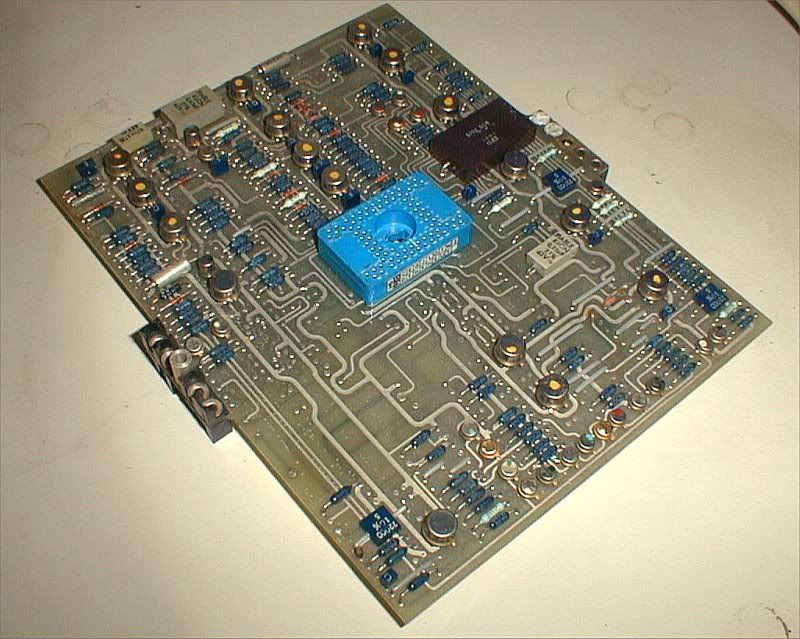
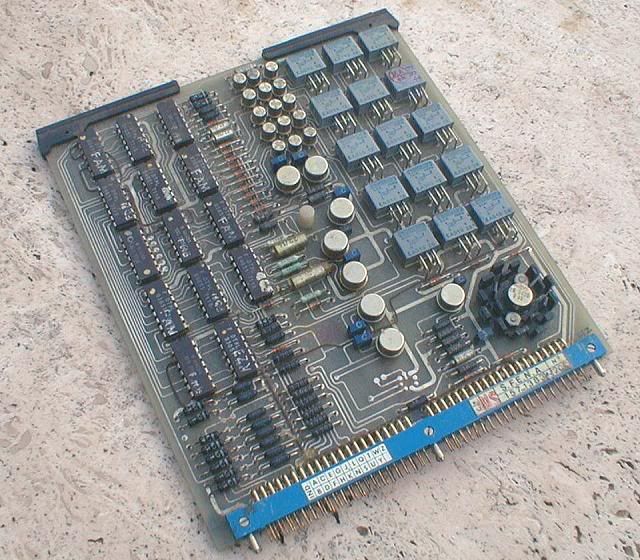
I have the rare privilege of actually having one of those rare "secret" air intake computers (AICU) sitting right next to my desk.
The circuit boards are mostly quite neat, with only the odd wire strap here and there.
However, the wiring of the unit itself, between the connectors, is a nightmare.
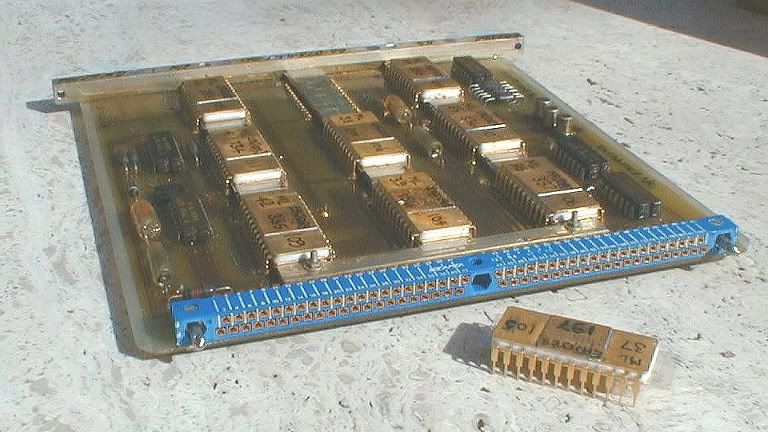
This is one of the PROM boards from the AICU, with one of the PROMs taken out of its socket. I have more photos, but will have to download those first, if anyone is interested.
Landroger
Don't forget that all the computing in the AFCS computers was analog, not digital!
The vast majority were LM101As, with 741s in non-critical locations, and the odd LM108 for the really hiigh-precision stuff.
We did not always do the kind of "butcher job" I described for the A/T. If there was enough time between major mods, the "firm" would redesign the board(s) and send us a new set, and the old ones would be binned... it made for better reliability. I kept a few as souvenirs.
It's the big blue "thing" at the centre of the board, with no less than 80 pins.
This is the back of the card
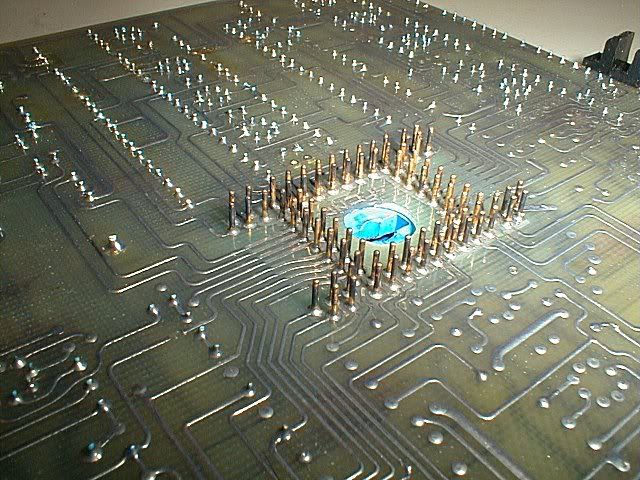
This is the central connector closer up
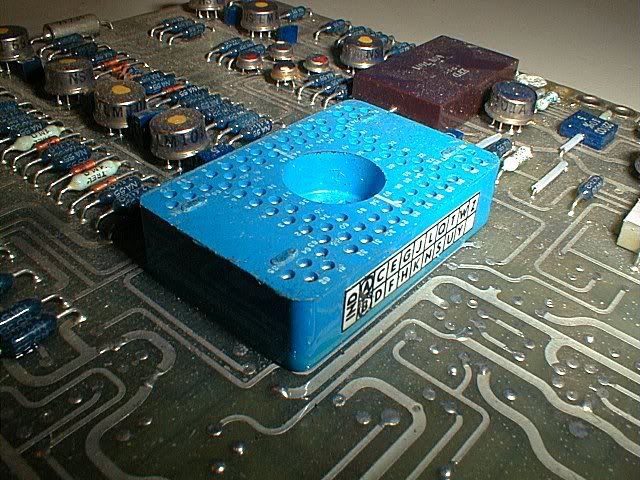
The idea wasn't bad at first sight.... it allowed stacking three boards on top of each other, so that many signals could pass from one board to another without any intermediate wiring. A small motherboard with a fourth conector would then take certain signals to other stacks, etc.
Another claimed advantage was that it made the board layout easier.
What was learned only gradually was that those connectors were hideously difficult to solder in place, and even more difficult to repair. Concorde was too far "on the way" to redesign the entire AFCS, so we learned to live with them, but the concept was abandoned afterwards.
The central connectors were only used for the analog boards ; the logic boards used more conventional 84-pin connectors on one side.
This is one of the logic boards.
Re the weight question, I would say M2dude 's answer is a lot better than mine, so ignore my remarks.....
Re the wiring, Concorde had about 300km of it.
IIRC the A380 Flying Hippo, which is vastly bigger, "only" has about 500km of wiring, and it seems a lot of that is the IFE (in-flight entertainment)

CJ
Subjects
AFCS (Automtic Flight Control System)
AICU (Air Intake Control Computer)
Intakes
Links are to this post in the relevant subject page so that this post can be seen in context.
Reply to this quoting this original post. You need to be logged in. Not available on closed threads.
August 25, 2010, 17:15:00 GMT
permalink Post: 5891869
You are right on the button first time, the white paint finish is for heat reflection purposes. (When I worked at Filton/Fairford I remember reading a document showing the difference in 'hot soak' supersonic skin temperatures for white and black paint finishes. I'm afraid I can't remember any figures (it was a couple of million years ago ) but there was quite a surprising difference.
G SXTY
A hearty welcome to this thread, and thank you for your very kind comments; I'm sure I speak for all the Concorde people here when I say that it is quite amazing that so many people, both aviation professionals as well as more 'normal' people are so fascinated by what most of us still regard as the finest aircraft ever to grace the skies. Your comment about 'men with slide rules' is so totally correct; I still remember the No7 & No8 design offices at Filton, these were huge rooms filled with draughtsmen's boards, a horde of designers, all without a single computer in sight.
Dave Rowland is a total gentleman as well as being an extremely knowledgeable flyer too, and I know he (like most of us) would be happy to talk about Concorde until the cows come home.
ChristiaanJ
Aghhhh The dreaded AICU. I'd almost forgotten the innards, as you say the motherboard wiring was a total nightmare (good piece of knitting I seem to remember). As far as the 'secret' bit of the AICU, I think we all know that is a little bit of Concorde mythology, more science museum than secret really. Around ten years ago we had some fairly substantial modifications done to the units, due to component obsolescence. (I seem to remember that some of the components concerned were not only out of production, but only a few hundred examples existed worldwide}. I do remember that the power supply board, resolver demodulator boards as well as a couple of others were replaced with new ones using modern components. The modification did do wonders for component reliability.
The PROM board that you have the photo of reminds me of a really amusing anecdote, told to me by Dr Ted Talbot a while ago. Now Ted is one of the true fathers of the Concorde air intake, an absolute genius as well as being a really pleasant gentleman indeed. I'm pleased to say that when I met him a few months ago, he was still as sharp as ever in his advancing years.
The story goes like this: Much of the Concorde intake development trials were flown out of Tangiers and Casablanca, where cold stratospheric temperatures would be guaranteed. Software changes as a result of the flight trials had to be done in there and 'the field'. The way that you made programmed the PROMS was by 'burning' each individual logic gate with a 9v battery. It was highly specialised, as well as extremely tedious work indeed, as we can all well imagine. Anyway, in while he was in Tangiers with aircraft G-AXDN, Ted had arranged for a rather lovely looking lady to be flown out to do his ROM programming. The HS 125 from Filton landed at Tangiers and taxied in and parked next to Concorde, and all the flight test people were waiting on the tarmac. The door of the 125 opened and out stepped this really leggy lady. 'who's the bint then ?' pipes up a really gritty airframe fitter, in a really broad Bristol accent. Without giving it a thought, Ted chirps 'she's come to blow my proms'. The little fitter grunts, glares at Ted and comes out with 'typical office staff, you get all the ***ing perks'.
Subjects
AICU (Air Intake Control Computer)
Filton
G-AXDN
Intakes
Links are to this post in the relevant subject page so that this post can be seen in context.
Reply to this quoting this original post. You need to be logged in. Not available on closed threads.
August 25, 2010, 21:05:00 GMT
permalink Post: 5892328
The way I understood the story was that they tried to collect as many reasonably reliable spare AICUs for the last few delivery flights, so as not to have to suddenly cancel a flight.
The AICU was right at the top of the list of "unscheduled removals". IIRC the tea maker was second...
"... 'burning' each individual logic gate with a 9v battery." I believe you, thousands wouldn't... Didn't you have at least some sort of programming unit?
I went through a similar exercise around 1976, but at that time at least we had a programming "suitcase", that let you copy the original in RAM, modifiy bit-by-bit with a keyboard, then 'burn' the PROM (or EPROM, by then) 'automatically'. Still took half the night....
Funny in a way how these things have stuck in our memories... But then, yes, Concorde was unique.
I've said this elsewhere, but I don't mind repeating it... in those days, there were two programmes to be part of. One was Apollo, the other was Concorde. And I've had the chance to be part of one of them.
CJ
Subjects
ADC (Air Data Computer)
AICU (Air Intake Control Computer)
British Airways
Intakes
Links are to this post in the relevant subject page so that this post can be seen in context.
Reply to this quoting this original post. You need to be logged in. Not available on closed threads.
August 25, 2010, 21:52:00 GMT
permalink Post: 5892433
I'm a bit embarrassed about missing that multi pin socket on the AICU board.
I somehow thought it was a specific function chip or a development test socket. Some of those used to appear and remained on some of our boards.
I'm not surprised about the massive cost of replacing certain boards in the later years. Some of those components would have been made of unobtainium long before the millenium. And I just noticed DozyWannabe's question about core memory. I guess it would have been core, because the 8Kb memory boards I spoke about, from the early CT Scanners, were Data General core memory, with a cycle time of 800usec.
 Although with four way interleaving, we could get that down to the read cycle time of 200usec!!

I freely admit I am staggered at how capable were Concorde's electronics - indeed how capable was the whole aeroplane - despite their rather ..... fundamental nature.
 My respect for everyone involved in the project increases with every post to this thread.
Roger.
Subjects
AICU (Air Intake Control Computer)
Links are to this post in the relevant subject page so that this post can be seen in context.
Reply to this quoting this original post. You need to be logged in. Not available on closed threads.
August 25, 2010, 22:17:00 GMT
permalink Post: 5892476
The prototypes used a SAGEM/Ferranti system, replaced by a Litton system on the preprods, then Delco on the production aircraft.
There may have been magnetic core in the prototype INS.
As to the AICS (air intakes) and AFCS (automatic flight control), the answer is a definite NO. The AICUs used PROMs (fuse type, not EPROM) and the AFCS was entirely analog.
Some of the systems were even more 'antique'...
The ADC (air data computer) for instance was still largely electro-mechanical.
And those nifty NAV and COMM frequency selectors, that always stand out on cockpit pictures... no electronics at all, just a set of wafer switches, and about thirty wires linking them to the transmitters/receivers.
CJ
Subjects
ADC (Air Data Computer)
AFCS (Automtic Flight Control System)
AICS (Air Intake Control System)
AICU (Air Intake Control Computer)
INS (Inertial Navigation System)
Intakes
Links are to this post in the relevant subject page so that this post can be seen in context.
Reply to this quoting this original post. You need to be logged in. Not available on closed threads.
August 25, 2010, 23:04:00 GMT
permalink Post: 5892595
Could be Autostab, Lateral Autopilot or Trim, since they all used exactly the same technology, board size, etc.
Looking at the board, I think it's 'Lat A/P' but I can't be certain.
No excuse needed about missing the "central connector" !
It was really a "one-off" feature, invented by Bendix, and abandoned afterwards. I'm not even sure the early A300B AFCS computers, that used much of the Concorde technology, still had them.
CJ
Subjects
AFCS (Automtic Flight Control System)
AICU (Air Intake Control Computer)
Auto-pilot
Auto-stabilisation
Trim
Links are to this post in the relevant subject page so that this post can be seen in context.
Reply to this quoting this original post. You need to be logged in. Not available on closed threads.
August 26, 2010, 00:07:00 GMT
permalink Post: 5892703
It's so great to have a Flight Engineer's input into this fascinating thread. Your write up on the complexities of managing the fuel system was something else; the best such description I've ever read. I'm still wetting myself with your story about the E/O coming out of the loo with his trolleys around his ankles after a surge. (Not you I hope
 ).
).
The original air intake that was in use for the first few years of airline operation was as you know far more prone to surging than the later modified intake with the thinned and lowered bottom lip, which was far more stable and forgiving. Not only was the 'new' intake more stable, a new leading edge fitted to the rear ramp as part of the same modification, at a stroke cured the very serious ramp vibration issue, that was causing intake structural problems at lower supersonic Mach numbers. The most impressive change of all was a fuel saving of around 1.5 Tonnes per Atlantic crossing, with even bigger improvements in cooler temperatures. A major software change obviously accompanied this modification.
ChristiaanJ
YEP! I remember now, the ADC/DAC board definitely WAS one of the candidates that were modified.
I think you will find the tale about AICUs being removed after museum delivery flights was more urban myth. The only units that I can remember being removed or relocated were the ground power protection unit, the TCAS processors and the radar transceivers. (BA had retrofitted their aircraft with a superb Bendix system a few years earlier, and the same units (with windshear detection re-enabled) are used on other aircraft types).
As far as ferrite cores are concerned, asked by DozyWannabe , the original Delco C1VAC INS fitted to the BA Concorde aircraft did utilise ferrite cores. These were replaced with CMOS EPROMs when a modification was carried out in the early 90's, in which a navigation database was fitted to the units. The fuel consumed and total fuel remaining indicators definitely used a ferrite core memory. These electronic displays used an internal memory in case of power interrupts. As far as AFCS goes, can you check your records? Although, as you say, a completely analog system (with the exception of the ITEM test computers) I seem to remember that the Safety Flight Control Computer used a ferrite core for the flying control strain gauge null memory. I could be wrong here, but I can't remember any other NVM in use at the time.
Galaxy Flyer
I'll leave it to one of my pilot (or F/E) friends to answer this one it that's OK.
Dude
Last edited by M2dude; 26th August 2010 at 00:20 .
Subjects
ADC (Air Data Computer)
AFCS (Automtic Flight Control System)
AICU (Air Intake Control Computer)
British Airways
Engine surge
INS (Inertial Navigation System)
Intakes
Links are to this post in the relevant subject page so that this post can be seen in context.
Reply to this quoting this original post. You need to be logged in. Not available on closed threads.
November 05, 2010, 11:56:00 GMT
permalink Post: 6040606
Way back in the late 1970's we did a major modification to the intakes that increased capture area by 2.5% and gave us typically a 1.6% improvement in trans-Atlantic fuel burn, and although this was our biggest performance improvement modification, there were more:
The famous elevon and rudder trailing edge extension modifications (that due to poor design, produced in later life the water ingress induced honeycomb failures) together with the re-profiled fin leading edge modification, I never saw the performance gains quantified (anyone have any ideas?).
Can anyone here remember the riblet trial? In the mid 1990's Airbus supplied 'stick on' plastic riblets, applied to various areas on the under-side of the wing on G-BOAG. These riblets had very fine undulations moulded into the surface; the idea being that as the air flowed through and around the riblet patches, boundary layer turbulence, and hence induced drag would be reduced. Now, the performance gains (if any) were never quantified, mainly because the riblet patches either peeled off or the surface deteriorated with the continuous thermal cycle. (I was over in JFK when the aircraft first arrived after having the riblets fitted, and as the crew were trying to proudly show me these amazing aerodynamic devices, they were sadly embarassed, as several had dissapeared in the course of a single flight).
There was one modification, proposed by Rolls Royce in the late 1990's that did have quite a lot of potential; this was to increase the engine N1 by around 1.5%. This would have had the effect of increasing engine mass flow and therefore reducing the drag inducing spill of supersonic air over the lower lip of the intake. Depending on the temperature, the performance gains were in the order of a 1.5% improvement in fuel burn at ISA Plus upper atmosphere temperatures ('normal' LHR-JFK) to none at all at significant ISA Minus temperatures (LHR -BGI). The modifacation had been trialed on G-BBDG before her retirement in the early eighties, and was proven in terms of performance enhancement and engine stability. In order to keep TET at the pre-modification level, there was a small increase in N2 commanded also. (The higher N1 required an increase in primary nozzle area, reducing TET). The main reason for the modification not being implemented was one of cost; The Ultra Electronics Engine Control Units were analog units, and the modification was a simple replacement of two resistors per unit. However because ultimate mass flow limitation was also controll by the digital AICU (built by British Aerospace Guided Weapons Division) the cost of getting a software update for this exremely 'mature' unit was found to be prohibitive.
A certain 'brainy' SEO and myself were working on a modification to improve fuel burn on ISA minus sectors. The idea was to force the autopilot, in Max Cruise at low temperatures only , to fly the aircraft close to Mmo, rather than at Max Cruise speed of Mach 2 - 2.02; this would have given us gains of up to 1%, depending on the temperature. The basic electronics involved for the modification were relatively straightforward, but it was never pursued due to the complexity of dealing with temperature shears and the cost of certification.

Dude
Last edited by M2dude; 5th November 2010 at 15:49 .
Subjects
AICU (Air Intake Control Computer)
Airbus
Auto-pilot
Elevons
Fuel Burn
G-BBDG
G-BOAG
Intakes
JFK
LHR
LHR-JFK Route
Mmo
N1 (revolutions)
Nozzles
Rolls Royce
Rudder
Temperature Shear
Links are to this post in the relevant subject page so that this post can be seen in context.
Reply to this quoting this original post. You need to be logged in. Not available on closed threads.
November 27, 2010, 18:30:00 GMT
permalink Post: 6087916
Not to mention the vast quantity of spare compressor and turbine blades and stator vanes, spread far and wide after the end-of-service, through the spare parts auctions.
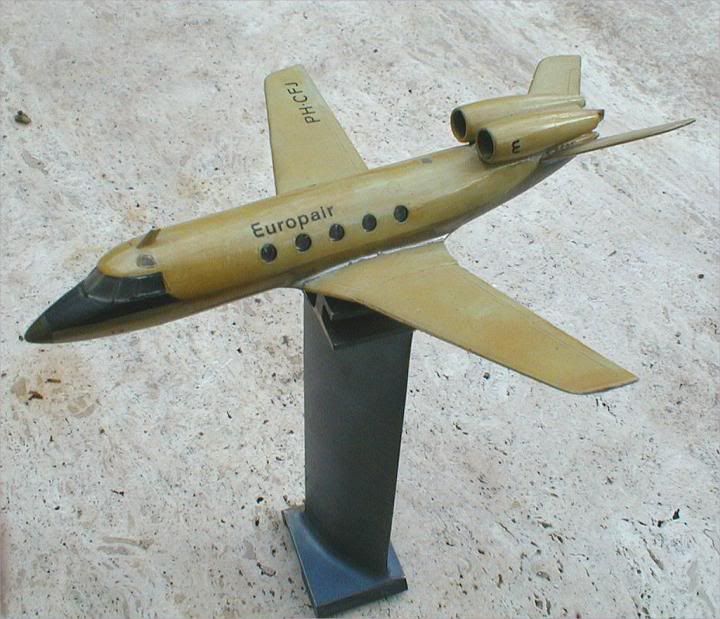
(The model is a design that was part of my engineering studies - late '60s - but the compressor vane is real Concorde.)
M2dude and myself already have mentioned the same problem with the AICU (air intake control computer) in this thread.
People do only rarely realise how rapidly technology was changing in the early Concorde days, and how difficult it was to procure components that sometimes were already obsolete when Concorde entered service.
CJ
Subjects
AICU (Air Intake Control Computer)
Intakes
Links are to this post in the relevant subject page so that this post can be seen in context.
Reply to this quoting this original post. You need to be logged in. Not available on closed threads.
December 07, 2010, 22:18:00 GMT
permalink Post: 6108984
I'm wonder that did Concorde has a neutal of stable stability? Did the elevon work out the same job to produce the stability like the elevator and stabilizer?
Also, I have read your post and wonder why when the temp fall below ISA-7, the AICU order the N1 to decrese?
And the final question. In the early concorde, does the pilot has ability to select the amount of afterburn thrust by rotate the area knob is that right? and why the airline remove it?
Thanks for your reply.
Best Regards
Subjects
AICU (Air Intake Control Computer)
Elevons
N1 (revolutions)
Links are to this post in the relevant subject page so that this post can be seen in context.
Reply to this quoting this original post. You need to be logged in. Not available on closed threads.
December 08, 2010, 18:05:00 GMT
permalink Post: 6110672
howiehowie93
Tom355UK
 ).
).
Jeepers Tom that is one hell of a question. Assuming there was a market for such a venture (personally not sure right now) I think you are looking at BILLIONS of $, and for this reason alone I think you'd find that a multi-national/continental effort would be required. There is little doubt that technology is not the major barrier here, but economics and political will. (Nice thought though, I do agree).
As far as a powerplant goes, well the PW5000 is a really superb engine, although well down on the thrust requirement for an 'NG' SST. More likely I would have thought would be e development of the Olympus, there was/is still such an enormous amount of potential in this basic design. (But who knows, this is all pure speculation anyway).
And have no fears about posting here Tom, most of us are quite happy to answer away (We've said before that there is no such thing as a stupid question; you are most welcome here
).
DavvaP
I am honoured to say that I was lucky enough to be onboard G-BOAF for that flight from LHR-BZZ and as far as I could tell, the liners had no impact whatsoever. One amusing
 part of the flight was when we deliberately allowed tank 3 to run dry and see just what the indicated fuel quantity was as #3 engine flamed out (we were subsonic at this point of course). The gauge slowly crept down (in order for the tank to to run dry, the tank 7 & 8 transfer pumps were switched off) and we all watched in eager anticipation/dread....... as the counters reached zero weeeeeee... the engine flamed out. I am being completely honest here, the engine wound down EXACTLY at
ZERO
indicated contents).
part of the flight was when we deliberately allowed tank 3 to run dry and see just what the indicated fuel quantity was as #3 engine flamed out (we were subsonic at this point of course). The gauge slowly crept down (in order for the tank to to run dry, the tank 7 & 8 transfer pumps were switched off) and we all watched in eager anticipation/dread....... as the counters reached zero weeeeeee... the engine flamed out. I am being completely honest here, the engine wound down EXACTLY at
ZERO
indicated contents).
Those 7 aircraft really did look magnificent I know, it was just sad as to the reason they were all lined up there.
Mr.Vortex
Best regards to all
Dude
Subjects
AICU (Air Intake Control Computer)
Afterburner/Re-heat
Air France
British Airways
C of G
Elevons
G-BOAF
Intakes
N1 (revolutions)
Nozzles
Olympus 593
Links are to this post in the relevant subject page so that this post can be seen in context.
Reply to this quoting this original post. You need to be logged in. Not available on closed threads.
December 21, 2010, 13:04:00 GMT
permalink Post: 6135427
Just for the record, the intake control system was designed to cope with a temperature shear of 21 deg C in one mile (about 3 seconds)
quote:Not meaning to go off onto a (yet another) tangent; Negative temperature shears, very common at lower lattidudes, always plagued the development aircraft; you would suddenly accelerate, and in the case of a severe shear, would accelerate and accelerate!! (Your Mach number, quite naturaly, suddenly increased with the falling temperature of course, but because of the powerplant suddenly hitting an area of hyper-efficiencey, the A/C would physically accelerate rapidly, way beyond Mmo). Many modifications were tried to mitigate the effects of severe shears, in the end a clever change to the intake control unit software fixed it. (Thanks to this change the production series A/C would not be capable of level flight Mach numbers of any more than Mach 2.13, remembering that Mmo was set at 2.04).unquote
Not temperature shears, and not AICU modifications (which I see has been discussed in a later posting). But back to the 'shears':
Most of Concorde's flight testing was, naturally, done out of Toulouse and Fairford, i.e. into moderate latitude atmospheres where the tropopause is normally around 36,000 ft so that the supersonic flight testing was done in atmosphers where the temperature doesn't vary with altitude. The autopilot working in Mach hold would see an increase in Mach and apply up elevator to reduce IAS and recover the macg setting. But at the lower latitudes around the equator the atmosphere is different in its large scale characteristics. In particular the tropopause is much, much higher and can get as high as 55,000 ft. Nobody had been up there to see what it was like! Now when the A/P applied up elevator to reduce IAS it went into a region of colder air. But the speed of sound is proportional to air temperature, so as the aircraft ascended the IAS dropped alright but since the ballistic (true) velocity of the aircraft takes a while to change and since the speed of sound had dropped the Mach number was increased, so the A/P seeing this applied more up elevator and the aircraft went up and the speed of sound dropped and ........
Like solving crossword clues, the answer is obvious once you have spent some time finding it!
This phenomenon rather than temperature shears (encountered mainly over the tops of Cb clouds) was the reason for the autopilot modifications which included that clever use of autothrottle (I can use that adjective since it was my French colleagues that devised it)
And before anyone asks; yes, the same problem would relate to subsonic aircraft operating in Mach hold driven by the elevators and flying below the tropopause, but:
a) Subsonic aircraft are old ladies by comparison with Concorde in that they fly at only half the speed. At Concorde velocities even modest changes in pitch attitude can generate some pretty impressive rates of climb or dive!
b) Subsonic aircraft are normally constrained by ATC to fly at fixed flight levels - the use of elevator to control Mach number is not really an option - you have to use an autothrottle.
There was that other problem, also described in later postings, where the aircraft regularly 'rang the bell' when passing through the Vmo/Mmo corner in the lower latitudes, but this was simply due to the additional performance one got in these ISA minus conditions in comparison to the temperatures encountered around the same corner in higher temperatures.
Anyway, the flight test campaign got me my first sight of sunrise over the Arabian desert and my first trip to Asia, so it goes into my Concorde memory bank.
Subjects
AFCS (Automtic Flight Control System)
AICU (Air Intake Control Computer)
Auto-pilot
Auto-throttle
Fairford
IAS (Indicated Air Speed)
Intakes
Mmo
Temperature Shear
Toulouse
Links are to this post in the relevant subject page so that this post can be seen in context.
Reply to this quoting this original post. You need to be logged in. Not available on closed threads.
December 22, 2010, 21:30:00 GMT
permalink Post: 6138333
CliveL
Subjects
AICU (Air Intake Control Computer)
Links are to this post in the relevant subject page so that this post can be seen in context.
Reply to this quoting this original post. You need to be logged in. Not available on closed threads.
December 23, 2010, 08:54:00 GMT
permalink Post: 6139001
Yes, of course (as ever
 ) you are correct; it was technically a hybrid system: The servo loops, in terms of ramp and spill door demand signals and resolver position feedback signals etc. DID use conventional analogue drive and servo amplifiers within the AICU, it was the massive arithmetic computation UP-STREAM of these that was digital. I always used to like to refer to the AICS as 'an analog front end with a digital brain'. But that's just me
.
) you are correct; it was technically a hybrid system: The servo loops, in terms of ramp and spill door demand signals and resolver position feedback signals etc. DID use conventional analogue drive and servo amplifiers within the AICU, it was the massive arithmetic computation UP-STREAM of these that was digital. I always used to like to refer to the AICS as 'an analog front end with a digital brain'. But that's just me
.
But as you say Clive, none of the control law sophistication (including the synthesising the intake face total pressure and local Mach numbers from mainline aircraft raw air data) would have been possible using analog computation.
Best regards
Dude
Subjects
AICS (Air Intake Control System)
AICU (Air Intake Control Computer)
Intakes
Links are to this post in the relevant subject page so that this post can be seen in context.
Reply to this quoting this original post. You need to be logged in. Not available on closed threads.
January 06, 2011, 19:02:00 GMT
permalink Post: 6163302
One little unique point about 102; she flew with a different intake control system to any other Concorde, being an 'improved' Ultra Electronics analog system. (Although the intake itself was aerodynamically the same as the later aircraft). Never really understood why our French friends chose this particular path with this aircraft. (Perhaps CliveL can shed some light on this??)
One of the things I like about this thread is the way in which it reminds me of things I had forgotten about the design phase - or in this case informs me of things I maybe never knew! I just do not remember any improved Ultra AICU design. So far as the French 'choice' on the matter, they probably weren't given one. Like the rear fuselage alterations referred to in another posting , it was all a matter of timing. 102 came after 101 so 102 got the lengthened rear fuselage (which was done to improve the 'area rule' distribution and gave about 2.5% drag reduction). We (BAC) were going to do the AICU development so it made sense for 101 to get the early hybrid units. [If you were cynical you might equally say that there was no way we were going to let AS have them first!].
CliveL
Subjects
AICU (Air Intake Control Computer)
Area Rule
Filton
Intakes
Links are to this post in the relevant subject page so that this post can be seen in context.
Reply to this quoting this original post. You need to be logged in. Not available on closed threads.
January 06, 2011, 21:06:00 GMT
permalink Post: 6163491
"We (BAC) were going to do the AICU development so it made sense for 101 to get the early hybrid units. [If you were cynical you might equally say that there was no way we were going to let AS have them first!]."
Is that a typo and did you mean "it made sense for 102 to get the early hybrid units."?
I think M2dude had more fun with the air intakes at the time than I had with the AFCS, although getting MAX CLIMB and MAX CRUISE to work was, to say the least, "interesting".
Christian
Subjects
AFCS (Automtic Flight Control System)
AICU (Air Intake Control Computer)
Climb Performance
Intakes
Links are to this post in the relevant subject page so that this post can be seen in context.
Reply to this quoting this original post. You need to be logged in. Not available on closed threads.
January 07, 2011, 11:06:00 GMT
permalink Post: 6164464
No. it wsn't a typo, but you may have been misled by my use of 'hybrid' by which I meant the final AICU version which most people describe as digital.It had digital law generation but analogue servo control loops. We were responsible for development of the AICU 'laws' and with Fairford being less than an hours drive from Filton it was far more convenient to do the flight testing out of Faiford so that results could be evaluated rapidly and the next day's flight test sequence planned.
CliveL
Subjects
AICU (Air Intake Control Computer)
Fairford
Filton
Links are to this post in the relevant subject page so that this post can be seen in context.
Reply to this quoting this original post. You need to be logged in. Not available on closed threads.
January 07, 2011, 13:13:00 GMT
permalink Post: 6164710
Gentlemen, I think you will find that 102 did indeed have a totally 'unique' analog intake control system. Not only were the RDCUs (not AICUs in this case chaps) totally different, there were major architectural changes over the prototype system too. Also, although the basic intake structure was the same as 101 and all subsequent aircraft, there was still the prototype approach to local pressure sensing adapted, ie. Intake face total pressure P∞ sensed directly via the infamous 'magic holes' rather than using digitally synthesised values based on mainline aircraft manometric probe, total (pitot)pressure. As 101's intakes only went 'live' in mid-march 1973, I assumed that maybe they (AS) wanted an operative intake system from the outset on 102 when it first flew in January of that year. What puzzled me was why they went for this seemingly enhanced (and expensive) analog system on 102 and not the original system. (As 102 used a production type intake, I guess that they would have to have at least made some changes to the control system ; there was no exotic double hinged 'Dump Door', but the far simpler and elegant 'Spill Door' with integral Aux' Inlet Vane that was known and loved by us all). Rumour had it that AS still wanted to pursue the 'magic holes' solution and were dead against the decision to go digital. (This particular decision was taken in October 1970, which makes the 102 AICS route seem all the more strange).
And ChristiaanJ; what you guys achieved with the MAX CLIMB/MAX CRUISE was nothing short of remarkable. Just about the most exotic (and complex) autopilot mode that I've ever seen, that solved so MANY problems.
 (Still the only A/P mode I've ever seen where the Autothrottle is engaged in a speed mode at the same time as the AUTOPILOT
).
(Still the only A/P mode I've ever seen where the Autothrottle is engaged in a speed mode at the same time as the AUTOPILOT
).
Best regards
Dude
Last edited by M2dude; 8th January 2011 at 09:58 . Reason: 'All I want for Christmas is the ability to spell'
Subjects
AICS (Air Intake Control System)
AICU (Air Intake Control Computer)
Auto-pilot
Auto-throttle
Intakes
Links are to this post in the relevant subject page so that this post can be seen in context.
Reply to this quoting this original post. You need to be logged in. Not available on closed threads.