August 21, 2010, 16:42:00 GMT
permalink Post: 5884218
I would hate for all the little tit bits of this important part of aviation history be lost.
There is a thread in the Military Forum called Gaining An R.A.F Pilots Brevet In WWII where we are privileged to share some the personal stories of the heroes involved in that war. It is critical for our future generations that these stories are known and the participants, their stories and contributions are not forgotten. While Concorde was not part of any military conflict it is still important that the personal side of this massive engineering feat is not lost.
The technical information that you and M2dude are providing is absolutely absorbing but equally so are the personal contributions. An example is the mention above of the Air France and British Airways Concordes passing each other. Anecdotes like that are unlikely to be in the Concorde history books and I am sure there are thousands of other pieces of information like that from both the ground and air that will eventually be lost for all time unless we can get it written down somewhere. Where better than here.
Subjects: None
No recorded likes for this post (could be before pprune supported 'likes').Reply to this quoting this original post. You need to be logged in. Not available on closed threads.
September 06, 2010, 23:08:00 GMT
permalink Post: 5918422
G-BOAE at Mach 2
Ah, oh, ooooops!!!! Of course it's there, in the little window on the top right of the HSI (Horizontal Situation Indicator, the lower one of the two big central instruments).
Shanewhite , in a way, that illustrates that for flying the aircraft things like TAS and GS are not really that important... that's why there are no big instruments indicating TAS or GS, but only IAS and Mach, with only a little digital window for GS, which IS important for navigation (largely handled by the inertial navigation system, which is the system where the GS display comes from), but not for the minute-to-minute handling of the aircraft.
Bellerophon , dumb question from a techie... the 373 miles is presumably just the distance to the next INS waypoint?
CJ
Subjects
FL600
G-BOAE
IAS (Indicated Air Speed)
INS (Inertial Navigation System)
TAS (True Air Speed)
Links are to this post in the relevant subject page so that this post can be seen in context.
Reply to this quoting this original post. You need to be logged in. Not available on closed threads.
September 13, 2010, 13:23:00 GMT
permalink Post: 5931956
The last two comments at the bottom of that old PPrune thread are interesting since as evidenced by this ongoing thread (as well as the others running in the tech forum), seven years later, many many people are still fascinated by this gorgeous aircraft.
http://www.aaib.gov.uk/cms_resources...pdf_029047.pdf
http://www.pprune.org/archive/index.php/t-109948.html
Subjects
C of G
G-BOAC
Links are to this post in the relevant subject page so that this post can be seen in context.
Reply to this quoting this original post. You need to be logged in. Not available on closed threads.
October 11, 2010, 18:59:00 GMT
permalink Post: 5988352
... on shorter charter flights was there a mininium ammount of fuel that had to be loaded just to always have enough fuel for CofG movement...
Yes, 35,000 kgs, at take-off, for a short supersonic flight. This would allow sufficient fuel to be transferred rearwards in order to achieve a CG approaching 59%.
If the flight was to remain subsonic, the fuel figure dropped to 25,000 kgs, as the required CG for subsonic cruise was 55% not 59%.
Both these figures were at take-off, so the estimated taxy fuel had to be added to these figures in order to arrive at the minimum fuel figure required to be loaded.
...was it possible to be in a position where trip fuel, fuel to an alternate etc was less than the fuel required for CofG movement after take off?...
No, at least it should not have been!
However, a situation was sometimes reached in flight, generally only towards the end of the planned supercruise portion of a LHR-BGI sector, where, with the aircraft at M2.00 and FL600, it was no longer possible to maintain a CG of 59%, as the "ballast" fuel, which had been transferred aft into tank 11, was now required forward again as "fuel" fuel, to top up other tanks which had reached their minimum permitted levels.
In this case, once the forward transfer of fuel had begun, the CG would also be slowly moving FWD, and one would be compelled to commence the decel and descent earlier than desired, something EXWOK touched on here much earlier in this thread.
Best Regards
Bellerophon
Last edited by Bellerophon; 11th October 2010 at 22:17 .
Subjects
C of G
FL600
LHR-BGI Route
Super-cruise
Links are to this post in the relevant subject page so that this post can be seen in context.
Reply to this quoting this original post. You need to be logged in. Not available on closed threads.
October 12, 2010, 09:04:00 GMT
permalink Post: 5989439

There were several appropriate cartoons at the time.
http://www.pprune.org/where-they-now...n-walpole.html
Last edited by ZimmerFly; 12th October 2010 at 11:35 . Reason: Link Added
Subjects: None
No recorded likes for this post (could be before pprune supported 'likes').Reply to this quoting this original post. You need to be logged in. Not available on closed threads.
October 30, 2010, 14:54:00 GMT
permalink Post: 6027442
That question already ended up in a separate TechLog thread... LOL.
Concorde engine intake "Thrust"
Have a look there first, then if things still aren't quite clear, feel free to ask more questions!
CJ
Subjects
Intakes
Links are to this post in the relevant subject page so that this post can be seen in context.
Reply to this quoting this original post. You need to be logged in. Not available on closed threads.
December 10, 2010, 14:30:00 GMT
permalink Post: 6114225
http://www.pprune.org/aviation-histo...ircraft-4.html
H
 wie
wie
Subjects: None
No recorded likes for this post (could be before pprune supported 'likes').Reply to this quoting this original post. You need to be logged in. Not available on closed threads.
December 11, 2010, 22:17:00 GMT
permalink Post: 6116745
 Them darn intakes
Pedalz
 Which hydraulic system actuated these ramps?
) to try and find the cause of the surge.
Which hydraulic system actuated these ramps?
) to try and find the cause of the surge.
My friend EXWOK perfectly answered the intake hydraulics allocations.
You might want to take a look at 'When Intakes Go Wrong Part 1:
http://www.pprune.org/tech-log/42690...-thrust-5.html
and Parts 2 & 3:
http://www.pprune.org/tech-log/42690...-thrust-5.html
Not to mention Part 3:
dixi188
ChristiaanJ


Due to the lateness of the hour (and me being up at 4
 ), that will have to do for now guys.
Best regards to all
Dude

Last edited by M2dude; 12th December 2010 at 04:51 . Reason: Adding a bit and correcting another
Subjects
British Airways
Engine Failure
Engine surge
G-BOAA
G-BOAF
Hydraulic
Intakes
JFK
LHR
Nozzles
Rotating (engine) Stall
Shannon
Links are to this post in the relevant subject page so that this post can be seen in context.
Reply to this quoting this original post. You need to be logged in. Not available on closed threads.
December 17, 2010, 20:53:00 GMT
permalink Post: 6128325
Concorde Books .
Probably too late for Christmas, but maybe useful just the same.
CJ
Subjects: None
No recorded likes for this post (could be before pprune supported 'likes').Reply to this quoting this original post. You need to be logged in. Not available on closed threads.
December 20, 2010, 06:11:00 GMT
permalink Post: 6132575
Thread on the Concorde inlets here http://www.pprune.org/tech-log/42690...ke-thrust.html
Subjects
Intakes
SR-71
Skin Temperature
Links are to this post in the relevant subject page so that this post can be seen in context.
Reply to this quoting this original post. You need to be logged in. Not available on closed threads.
December 21, 2010, 09:35:00 GMT
permalink Post: 6135063

Sure, Concorde was the first aircraft to fly with FBW flight controls...
I thought it was the first civil aircraft, and that the Vulcan had already been there and done that ...
EXWOK
Mercifully no-one had thought of that when Concorde was being designed; I still think it's a diabolical system.
Best Regards
Dude
Subjects
Airbus
FBW (Fly By Wire)
Links are to this post in the relevant subject page so that this post can be seen in context.
Reply to this quoting this original post. You need to be logged in. Not available on closed threads.
December 23, 2010, 13:17:00 GMT
permalink Post: 6139400
Post #879 http://www.pprune.org/tech-log/42398...ml#post6129540 - Just guessing now, but Bellerophon were you a Concorde Pilot by any chance.
I read your vivid description and realised that I must have been peeling onions at the same time.
Thank you for that sensational work of art, drawing us a picture of that take off while at the same time making it sound like it was no harder than taking a breath, though I have no doubts this was an extremely complex and demanding proceedure that required a level of crew synergy unknown of at that time. Again, my THANKS for that precious insight into your world.
This in no way excludes all the other contributors to one of the two best threads on this Forum. All you guys made and were part of a very special piece of history and now like the famous "Few" will never be forgotten partly as a result of this thread.
I do hope Landlady posts back with pieces that didn't make it into her book.
Last edited by Biggles78; 23rd December 2010 at 14:31 .
Subjects
Cabin Crew
Links are to this post in the relevant subject page so that this post can be seen in context.
Reply to this quoting this original post. You need to be logged in. Not available on closed threads.
December 23, 2010, 19:43:00 GMT
permalink Post: 6140089
CliveL
Subjects: None
No recorded likes for this post (could be before pprune supported 'likes').Reply to this quoting this original post. You need to be logged in. Not available on closed threads.
December 24, 2010, 13:02:00 GMT
permalink Post: 6141291
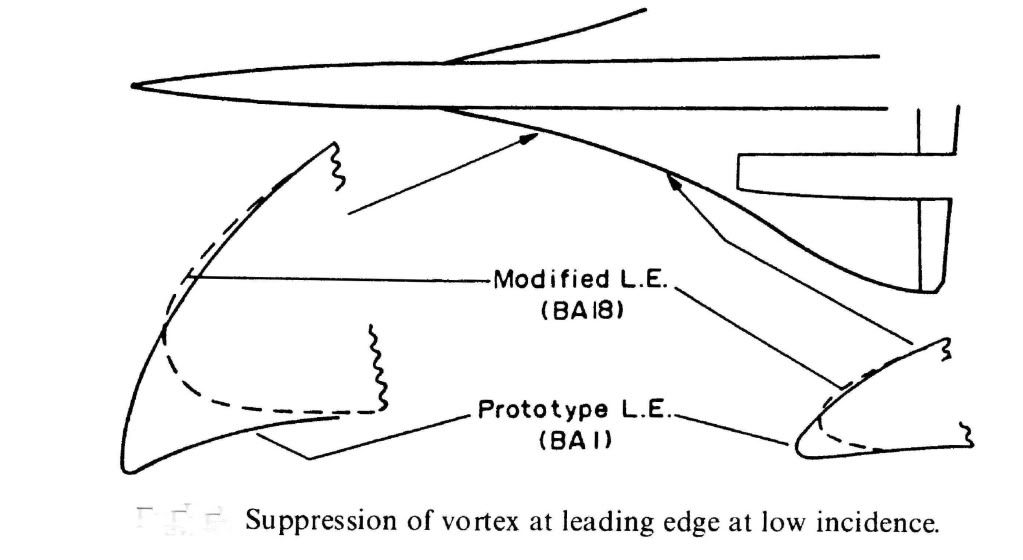 Christian asked if there was an aerodynamicist in the house - I guess that would be me!
The original question was whether there was any vortex activity in subsonic cruise, but the discussion went on to ask about designing for subsonic drag I think.
The answer to the first bit is that the vortex flow started in a gentle manner from about 6 or 7 deg AoA and got steadily stronger. Depending on the chosen cruise speed and the aircraft weight, the subsonic cruise AoA would have been in the region of 4.5 to 5 degrees, i.e. below any significant vortex development. 6/7 deg would correspond to something in the range 250 to 280 kts probably (I haven't done the sums)
What we were trying to do for subsonic cruise was to have what is known in the trade as 'leading edge suction' acting on a nice bit of forward facing area so that it tried to drag the aircraft forwards as it were. As you can see from the diagram the prototype aircraft had a much more cambered LE so that both suction and forward facing area were very reasonable. This prototype shape was nicely rounded so that LE separation and top surface vortex generation started at a higher AoA than on the production aircraft. Unfortunately this shape, which featured a rather sharp LE on the undersurface, generated a vortex on the undersurface of the wing in supersonic flight and low AoA (near zero 'g'). This vortex got into the intake and caused the engine to surge, so we had to redesign the LE ahead of the intakes as shown. This cost us a little subsonic drag, so you can see from the diagram what you need to do to keep subsonic cruise drag down.
Hope this answers the questions
CliveL
Subjects
AoA
Engine surge
Intakes
Vortex
Links are to this post in the relevant subject page so that this post can be seen in context.
Reply to this quoting this original post. You need to be logged in. Not available on closed threads.
December 24, 2010, 18:25:00 GMT
permalink Post: 6141781

 ">
">
Dammit! I thought I had read that [xxxxquote] gave me one of those pretty text boxes ah well, back to the drawing board.....
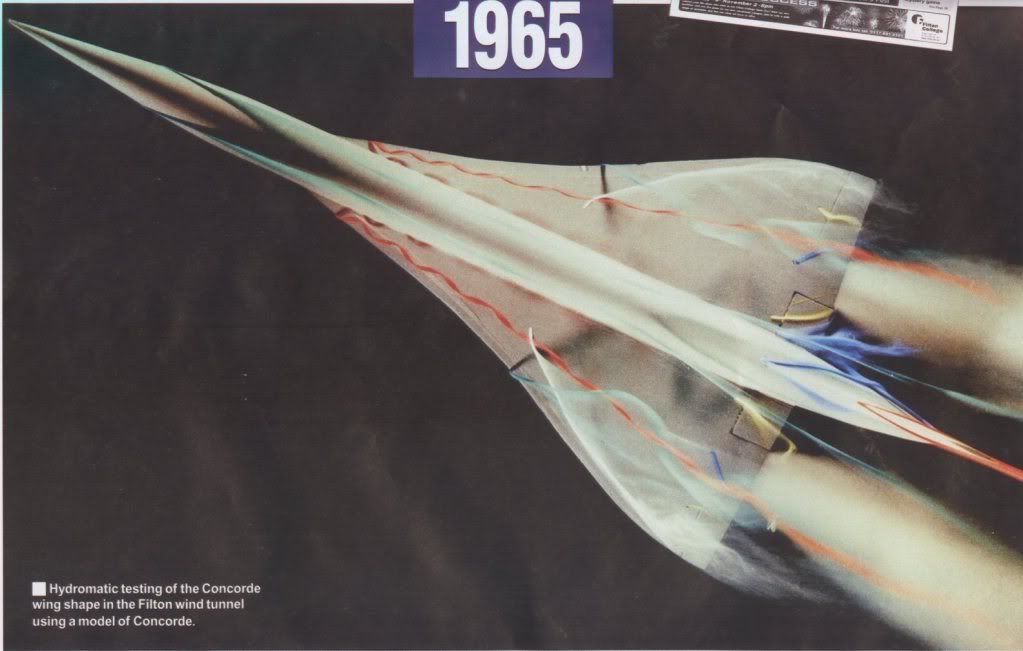
Unfortunately the only flow visualisation pictures I have are taken at AoAs where the tip vortex has been swallowed by the main vortex, but I thought I would paste them anyway as most people would never have seen them. In this one you can see the forebody vortices quite clearly (the bluegreen streaks) but since it is a zero sideslip case they don't go anywhere near the fin.
On closer inspection, maybe you can just see the wingtip vortices as separate bits of curly white smoke very close to each wingtip.
I'm not going to risk losing all that typing trying to attach a second picture, so I will send that separately

CliveL
Subjects
Sideslip
Vortex
Links are to this post in the relevant subject page so that this post can be seen in context.
Reply to this quoting this original post. You need to be logged in. Not available on closed threads.
December 24, 2010, 18:28:00 GMT
permalink Post: 6141784
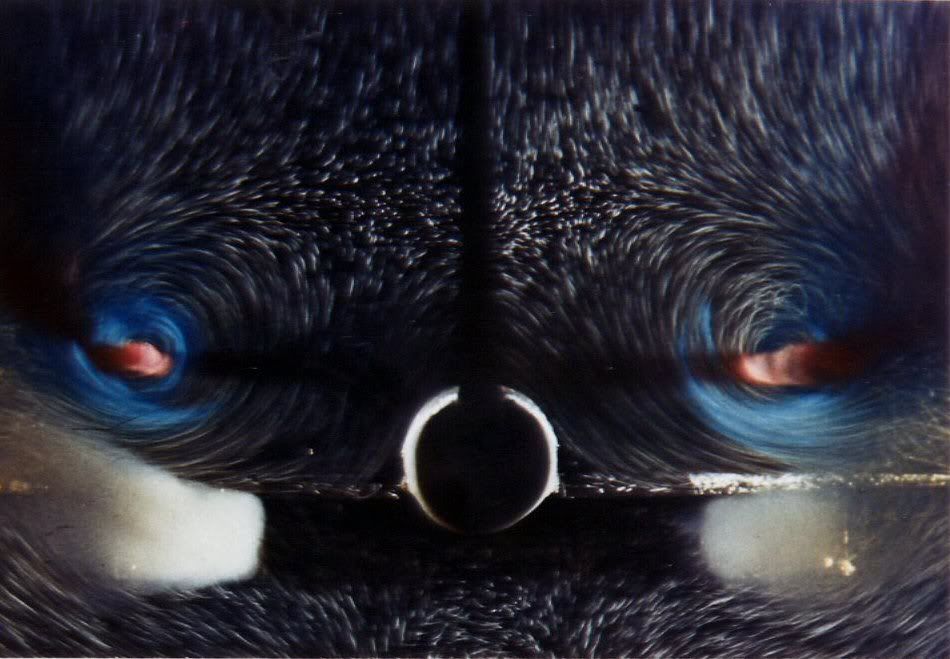
OK, here is another one .....
CliveL
Subjects: None
No recorded likes for this post (could be before pprune supported 'likes').Reply to this quoting this original post. You need to be logged in. Not available on closed threads.
December 25, 2010, 22:37:00 GMT
permalink Post: 6143159
Flight envelope
Those are the official certified limits.
I doubt somehow anybody went beyond those "for the press".....
But during certification, yes, each of those limits was exceeded, slowly and carefully, to be able to draw those official operational limits on the document.
For instance, the certified Mmo is 2.04. During certification, G-BBDG (202) went to Mach 2.21....
Even while staying within the limits, she could could exceed Mach 1 just below 30,000 ft.
Also, during the acceptance flights after major overhauls, most of those envelope limits would be exceeded by a given margin, to prove the aircraft still met all the certification requirements. Whether any of that was done 'closer to the deck', I wouldn't know.
The 'issues' would vary. Performance would be one issue... Delta Golf (and 01, who went to Mach 2.23) basically "ran out of steam" at that speed.
Another issue would be that 'going beyond the borders' shortened the fatigue life of the airframe, and it was difficult to assess exactly by how much. It was one of the reasons why Delta Golf and Sierra Bravo (the certification aircraft) in the end never went into service.
CJ
Subjects
FL600
Fatigue
Flight Envelope
G-BBDG
Mmo
Links are to this post in the relevant subject page so that this post can be seen in context.
Reply to this quoting this original post. You need to be logged in. Not available on closed threads.
December 26, 2010, 09:38:00 GMT
permalink Post: 6143531
Lets start with a comparison of the lft on a conventional subsonic wing with that of a slender wing like Concorde:
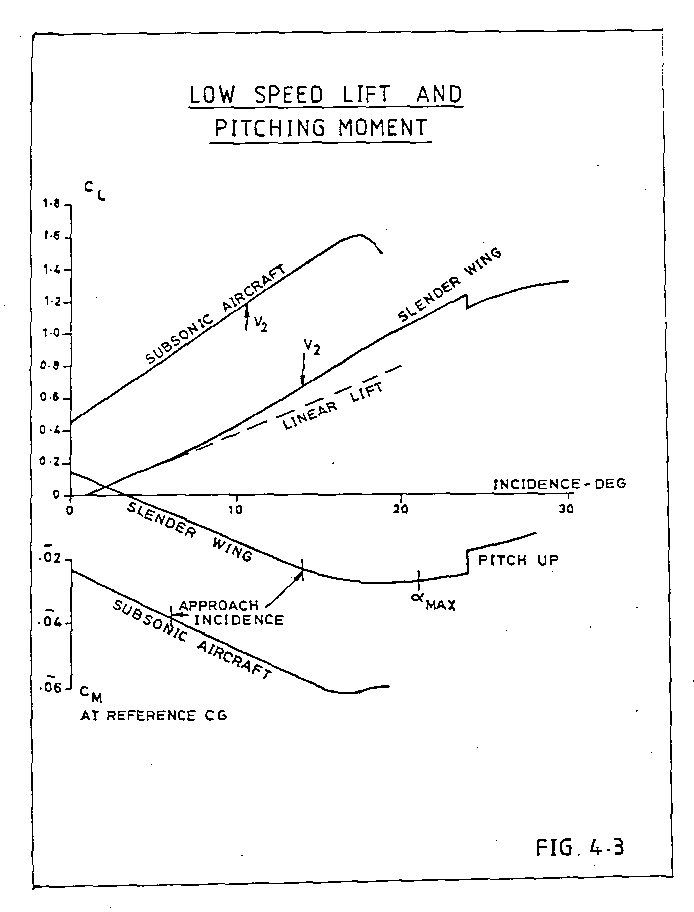
The subsonic line is linear, the slope depends on the geometry of the wing; high aspect ratio wings have a higher slope than low aspect ratio, unswept wings a higher slope than swept. Concorde, being a low aspect ratio swept wing has no chance!
To get a decent approach speed with a delta wing which has 'conventional' wing sections you need either a long U/C and work with high landing AoA or a large wing area to get the wing loading down. I would put the Avro Vulcan in the latter class. A large wing area is bad news for supersonic aircraft, but the Germans, working during WW2 found that if you give the delta sharp leading edges the flow separates at the leading edge and forms a pair of vortices that flow over the upper wing surface.
A vortex, if you could see it, is like a tornado (twister) turned on its side. The essential feature is that it is associated with low static pressures. As you get closer to the centre of the vortex the pressure drops more and more. The red zones at the centre of that transverse view are very low pressure indeed, but even the outer zones have quite low pressure.
I will have to put it up as a separate posting, but there are pictures that show that as AoA increases not only does the vortex get stronger (more suction) but the area of the wing affected by the vortex also inceases. This 'double whammy' gives the vortex a nonlinear effect. This 'nonlinear' lift is what is sometimes called 'vortex lift'.
It doesn't come for nothing - since by definition the flow is separated from the leading edge there is no alleviating 'leading edge suction' to reduce drag, and you won't go very far wrong if you take the drag of an aircraft with such a wing as Profile Drag plus Lift (times) tan AoA.
Concorde is a bit more subtle - the nose of the wing is drooped so that the flow does not separate until the AoA reaches 6 or 7 deg, giving us a good L/D in subsonic cruise whilst still having a healthy lift at approach speed.
Does this fit the bill?
CliveL
Subjects
AoA
Vortex
Links are to this post in the relevant subject page so that this post can be seen in context.
Reply to this quoting this original post. You need to be logged in. Not available on closed threads.
December 28, 2010, 00:58:00 GMT
permalink Post: 6145882
Most contributors to this thread will doubtless have strongly held opinions and views on both these topics. Some have posted comments here, but whilst I respect their views and their knowledge, are not these topics already more than adequately catered for on other threads and forums? Frankly, I have to confess that I have grown weary with most such threads, and, in general, neither read them nor contribute to them.
I do, however, greatly value having just one Concorde thread devoted purely to technical comments, anecdotes and personal reminiscences. Perhaps, if others feel similarly, we might try and keep this thread that way?
Happy New Year
Bellerophon
Subjects
Air France 4590
Links are to this post in the relevant subject page so that this post can be seen in context.
Reply to this quoting this original post. You need to be logged in. Not available on closed threads.
January 02, 2011, 16:17:00 GMT
permalink Post: 6155241
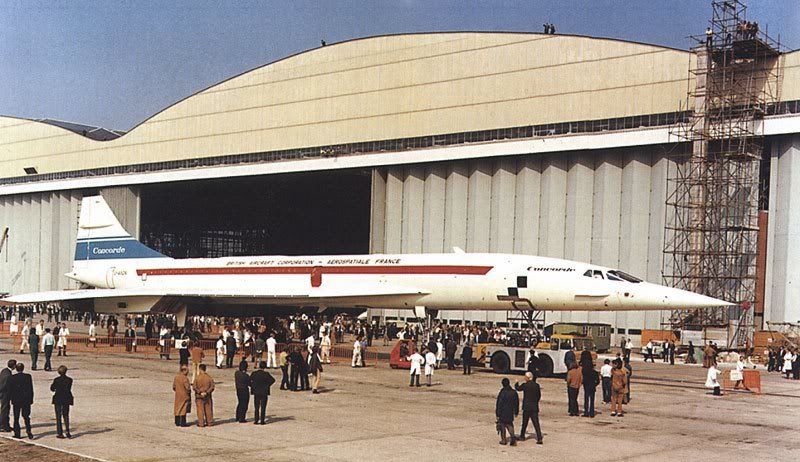
And of course a happy 2011 to all!
CliveL
Last edited by CliveL; 2nd January 2011 at 16:25 . Reason: Additional information
Subjects
Intakes
Links are to this post in the relevant subject page so that this post can be seen in context.
Reply to this quoting this original post. You need to be logged in. Not available on closed threads.