August 14, 2010, 23:15:00 GMT
permalink Post: 5870216
Thanks very much for your comments. It's true, that while supersonic, a windmilling Olympus engine would have sufficient N2 to keep all servics on line. (The hydraulic systems on Concorde also operated at 4000 PSI). The RAT itself was 'said' to be good down to approach speeds, fortunately we never had to find out if that was true. (Although the thing was tested routinely using a hydraulic rig to drive it and check the variable pitch speed control). Thr RAT was in fact located and stowed in the fwd part of the R/H inboard elevon Powered Flying Control Unit Fairing. It was an absolute work of art by Dowty, to make the device fit into such a small space.
Yep, an ash cloud would be particularly bad news, particularly at FL600

Stlton
You are most welcome, thank you for posting this topic also. These forums are a wonderful way for all of us out there in the aviation world to share and learn interesting information from each other.

TURIN
I remember reading By the Rivers of Babylon many MANY years ago. The terrorists, I seem to remember, had a bomb fitted inside Tank 11 (the rear trim tank) during construction 'before it was welded shut'. Not sure if the author had researched how aircraft were built, but still I guess it sold a copy or two. (Well at least you and I read it).
Subjects
By the Rivers of Babylon
Elevons
FL600
Hydraulic
RAT (Ram Air Turbine)
Trim
Links are to this post in the relevant subject page so that this post can be seen in context.
Reply to this quoting this original post. You need to be logged in. Not available on closed threads.
August 19, 2010, 11:16:00 GMT
permalink Post: 5879669
Stupid, you? no way!! (Besides, I'm Mr Stupid of the aviation world, that's my title
 ). The thing is, out here in the world of flying machines, there are almost an infinite number of questions (and hopefully answers too). This applies to just about all aircraft from the Wright Flyer up!!.
Keep asking away, there are so many of us Concorde 'nuts' out here who are more than happy to help out/bore the socks off you.
Fuel burns: The problem was that when flying slow/taxying, Concorde was an extreme gas guzzler, even when idling each engine burnt around 1.1 tonnes/hour (so every 15 minutes after push back meant over a tonne gone). A typical taxi fuel would be around 1.4/1.5 tonnes, depending on the runway in use on the day. I'd have to leave it to some of my pilot/F/E friends to remember some of the specific fuel burns after take off etc, but I can at least give you some interesting consumption figures:
At the beginning of the take off roll, each engine would be burning around 21 tonnes/hour. (Made up of around 12 T/Hr dry fuel (Fe) and 9T/Hr afterburner (reheat to us Brits) fuel (Fr). As Fr was scheduled against Fe, as a function of inlet total temp (T1) by the time V2 was reached (around 220 KTS) the rising T1 has pushed the total fuel flow (Ft) up to a staggering 25 tonnes/hour/engine. As i've pointed out before in previous topics, although the afterburner only gave us a 17% improvement in take off thrust, it was responsible for around an 80% hike in fuel burn. (Hence that is whay it was only used sparingly). However when reheat was used for transonic acceleration, it used a dramatically reduced schedule (roughly a 60% rise in fuel flow) , so it was not quite as scary. The afterburner would be lit at the commencement of the acceleration (0.96 Mach) and cancelled completely at 1.7 Mach. After this time the aircraft would accelerate on dry power only up to mach 2 and beyond. (The cooler the temperature the quicker the time to Mach 2). On an ISA+ day, it sometimes felt that the aircraft was flying through cold porridge, and could take quite a while to get to Mach 2 after reaheat cancellation, where as on a nice ISA - day, she would go like a bat out of hell, and the AFCS would have to jump in to prevent overspeeds.
Before I hit some more numbers, let me say that with Concorde, TOC = TOD!! After reheat cancellation at Mach 1.7, the aircraft would be at FL 430. The aircraft would climb at an IAS of 530 KTS until Mach 2 was reached at fractionally over FL500. From then on the aircraft would cruise/climb as fuel was burnt, up to a maximum of FL600. On warmish days (eg. the North Atlantic) TOD would typically be around FL570-580. On a cool day (the lowes temperatures would of course be reached in the more tropical regions; the LGR-BGI sector encountered this), FL 600 would be reached easily and she would love to climb some more. BUT, the aircaft was only certificated to 60,000' with passengers onboard, for decompression emergency descent time reasons, and so we were stuck with it. The pity is of course, the fuel burn would have been improved, but we never were able to take advantage of this. On test flights however, the aircraft would routinely zoom climb to FL 630. On her maiden flight, aircaft 208 (G-BOAB) reached an altitude of 65000'; the highest recorded Concorde altitude was on one of the French development aircraft, which achieved 68,000'. On a technical point, the analog ADC's were 'only' calibrated to 65,000'.
Anyway, back to some figues; at Mach 2, 50,000', the typical fuel burn per engine would be around 5 tonnes/hour, falling to around 4.2 tonnes/hour at 60,000'.
THE NOSE You are quite correct in your assumption, there were two positions of droop: 5 deg's for taxi/take-off and low speed flight and 12.5 deg's for landing. The glazed visor retracted into the nose and could ONLY be raised once the nose was fully up, and had to be stowed before the nose could move down. There were 2 emergency nose lowering sysyems; one using stby (Yellow) hydraulics and a free-fall system. Free-fall would drop the nose all the way to 12.5 deg's, the visor free falling into the nose also.
Last edited by M2dude; 19th August 2010 at 12:40 . Reason: mistooks
Subjects
ADC (Air Data Computer)
AFCS (Automtic Flight Control System)
Afterburner/Re-heat
Depressurisation
FL600
Fuel Burn
G-BOAB
IAS (Indicated Air Speed)
Intakes
Transonic Acceleration
V2
Visor
Links are to this post in the relevant subject page so that this post can be seen in context.
Reply to this quoting this original post. You need to be logged in. Not available on closed threads.
August 21, 2010, 15:57:00 GMT
permalink Post: 5884141
Thank you for the CoG answer. 6 feet sounds like an awful lot but then I am only able to compare it to the littlies that I fly. The ability to use the trim tanks to only have to use a \xbd\xb0 of elevon must have made a substantial impact on performance and the resulting reduced fuel consumption. To think it was all computer controlled at the time when the PC didn't even exist.
M2, you have said that the fuel system was a work of elegance and the above desciption give me a small insight into this. I know that I am just going to have to find books written about this lady to find out more. I have been lazy when asking about item that I could Google but there was a method behind my laziness. When you and Christiaan share your knowledge there is always a personal anecdote or insight that will never be found in any books that I may be able to find. Gentlemen, for this THANKS seem so insufficient.

The TOC=TOD had me thinking and I believe insomnia may have assisted with some understanding (otherwise the stupid sign for me comes out again
 ). Gee I hope I have this even partly right. I assume that when accelerating to Mach 2, that it was done while climbing. I was initially stuck with the compression factor of Mach 1 and without thinking the same would happen at Mach 2 (A C Kermode was the hardest book I have read that I didn't understand
 ). Therefore with that in mind I was stuck trying to figure TOC=TOD. Am I right or even slightly so in thinking that cruise climb and cruise descent
was
the flight and there was minimal actual level cruise in the "pond" crossing?
). Therefore with that in mind I was stuck trying to figure TOC=TOD. Am I right or even slightly so in thinking that cruise climb and cruise descent
was
the flight and there was minimal actual level cruise in the "pond" crossing?
I had also forgotten to take into account the speed factor, DUH!! Subsonic climbs, what 35 - 45 mins to FL4xx and then it is in level cruise for the next 6 hours before TOD. The lady took what, about 3.5 hours, and the extra 20,000 feet it had to climb and descend ate up or into any level cruise it had (or didn't have). Am I on the right track or am I making an ass out of me and me.
I was in the jump seat of a B767 on a trans Tasman crossing, CAVOK, when about 2,000 feet lower a dot followed by a straight white cloud approached and passed by. I found that impressive so the 2 supersonics passing at the speed of an SR71 must have been spectacular. Shame radar track isn't available on You Tube. Oh yes, did they boom you?
As you have said, fuel flow was reduced the higher you got. I think it was 5T per powerplant at FL500 down to 4.1T at FL600. Was there any figures for higher the Levels? I am curious to see how much less fuel would have been used at the higher FLs considering it was reduced by 900Kg/hr for just 10K feet. Very interesting what you said about when the temps were ISA+. I would never have thought such a small temperature change could have effected such a signifigant performance result. It also sounds odd, as you said, the faster you go the less fuel you use.
Last greedy question for this post. How much of the descent was carried out while supersonic and how did this affect the fuel flow?
Subjects
C of G
Elevons
FL600
Fuel Burn
SR-71
Sonic Boom
Trim
Links are to this post in the relevant subject page so that this post can be seen in context.
Reply to this quoting this original post. You need to be logged in. Not available on closed threads.
August 22, 2010, 03:45:00 GMT
permalink Post: 5884915
... My other query concerns the FE. I understand that he set take off power etc...
Actually the F/E didn’t set T/O power, but did set most of the other power settings.
Broadly speaking, taxy-out to gear up, and gear down to engine shut down, the handling pilot operated the throttles. At other times, it was (almost) always the F/E.
Bear in mind that several of the routine engine power changes were effected through controls other than the throttles. For instance, selection of the re-heats, engine control schedules, engine ratings and intake lanes were all switch selections.
... I also understand that he also checked the pilots inputs into the INS system...
Correct, using INS3.
...So was he/she also a qualified pilot?..
No, they were professional flight engineers, who held a Flight Engineers Licence; they were not pilots biding their time before moving to the right hand seat.
I believe one or two may have held a PPL, but that was purely incidental, not a requirement.
All of the Concorde FEs had spent years on the VC10, B707, DC10, L10-11 or B747 fleets before coming to Concorde.
Biggles78
...Am I right or even slightly so in thinking that cruise climb and cruise descent was the flight...
Cruise climb, yes. Cruise descent, no.
...and there was minimal actual level cruise in the "pond" crossing?..
Correct, any level flight in the “cruise”, was just coincidence, probably caused by the outside air temperature increasing very gradually. Typically, she drifted up at around 30 to 50 fpm, but, if encountering warmer air, she would start to drift back down, in order to maintain M2.0.
... As you have said, fuel flow was reduced the higher you got. I think it was 5T per powerplant at FL500 down to 4.1T at FL600...
Rather optimistic figures for FL500 I’d have said! 6,000kg/hr/engine would have been nearer the mark!
...I am curious to see how much less fuel would have been used at the higher FLs considering it was reduced by 900Kg/hr for just 10K feet...
The reason the fuel flows dropped so much at the higher altitudes was that the aircraft had to be a lot lighter before she would get up there. It was her lighter weight that was the primary reason for the reduced fuel flows, not the higher altitude.
Forgive me if I’ve misunderstood you, but in her cruise climb, Concorde was flown at her optimum speed (M2.00) with (constant) optimum power set (max cruise power) and so (assuming a constant OAT above the tropopause) the only thing which affected her cruising altitude was her weight.
So, in theory at least, in cruise climb, she was always at her optimum altitude.
Any variation from that optimum altitude, such as a premature climb to higher altitudes, would have cost fuel, not saved it.
... How much of the descent was carried out while supersonic...
At the decel point, the cruise climb ceased and she was flown level at constant altitude. The F/E partially throttled back the engines and she stayed in level flight until her speed reduced to 350kts IAS, typically M1.5.
This took about 50nm, and most of the passengers would have sworn that they were already descending.
She then descended at 350kts IAS, meaning the Mach number would reduce constantly. On a straight in approach to JFK, with no subsonic cruise section, she would become subsonic descending through (around) FL350.
For a straight in approach, in zero wind, on a standard day, from FL600 to touchdown, typical figures would be something like a track distance of around 200nm, flying time of 22 minutes and 3,500kg of fuel.
Into LHR, she had to be subsonic much further away from her destination, and then had a subsonic cruise section on airways, so a slightly different procedure was used, and approaching FL410 she was slowed still further, becoming subsonic around FL400.
Anonymous
In response to your PM, earlier posters were correct in what they posted, however the manual reversion they refer to is a reversion from electrical to mechanical signalling to the flying controls.
There was no way to operate the flying controls manually in the absence of hydraulic power.
Subjects
Afterburner/Re-heat
Boeing 747
FL600
Fuel Burn
Hydraulic
IAS (Indicated Air Speed)
INS (Inertial Navigation System)
Intakes
JFK
LHR
Links are to this post in the relevant subject page so that this post can be seen in context.
Reply to this quoting this original post. You need to be logged in. Not available on closed threads.
August 22, 2010, 10:32:00 GMT
permalink Post: 5885259

I too would like to ask what her idle thrust glide ratio was? From Bellerophon's post:
 ?)
?)
Subjects
FL600
Glide
Links are to this post in the relevant subject page so that this post can be seen in context.
Reply to this quoting this original post. You need to be logged in. Not available on closed threads.
August 22, 2010, 13:18:00 GMT
permalink Post: 5885515
...The altitude flown was due to temperature and weight of the areoplane. This is true of all aeroplanes...
Sadly, it isn’t, as subsonic aircraft are allocated a specific cruising flight level and often - for example on the North Atlantic Track system - a specific cruising Mach number as well, and no deviation from that clearance is permitted without specific permission from ATC. Obviously everyone flight plans at the most economic heights and speeds for their aircraft type, but in busy airspace not everyone gets what they want!
Think of your flight plan as being Angelina Jolie, and your ATC clearance as being your wife. Your flight plan is what you’d really like to have, but your ATC clearance is what you’re going to have to live with!
... altitude flown was due to temperature and weight of the areoplane...this was more true of Concorde?...
Subsonic aircraft could equally benefit from using cruise-climb techniques (early long range aircraft crews knew all about cruise-climb techniques and used them when able) but with the large number of subsonic aircraft now using the world’s airways it is impractical for ATC to allow them to drift up and down at will, and so they are assigned specific cruising altitudes.
Few other aircraft got up to Concorde’s cruising levels, and so ATC were able to issue much more flexible clearances to her.
A typical Concorde ATC clearance would have allowed her to accelerate to M2.00 whilst operating within a "block" of altitude, rather than at a specific flight level. Typically this block clearance would have been to operate anywhere between FL450 up to FL600 without restriction.
So, unlike subsonic aircraft assigned a fixed cruising altitude such as FL350, Concorde could, and did, drift up or down, and was thus able to remain at the optimum altitude for the prevailing conditions throughout most of the flight.
... I remember reading the BA Concorde flew with 2 Captain Pilots (and of course the most important Flight Engineer)...
Concorde operated, as did all 3 crew aircraft in BA, with a standard crew of a Captain, F/O and F/E.
A small number of trips had two Captains on board (or two F/Es for that matter) when training or checking was going on, or an extra crew member was carried for PR purposes, but otherwise, the vast majority of occasions, just the standard crew was on board. Everyone preferred it that way, especially the F/O and F/E!
... The subsonics have issues with Coffin Corner (I think I read that one Airbus model had somehting like 7kts between the high and low end of the envelope when up high); did Concorde have this "problem"?...
Have a look at this picture of G-BOAE, cruising at her maximum certificated altitude of FL600, en-route to Barbados on 16 August 2003:
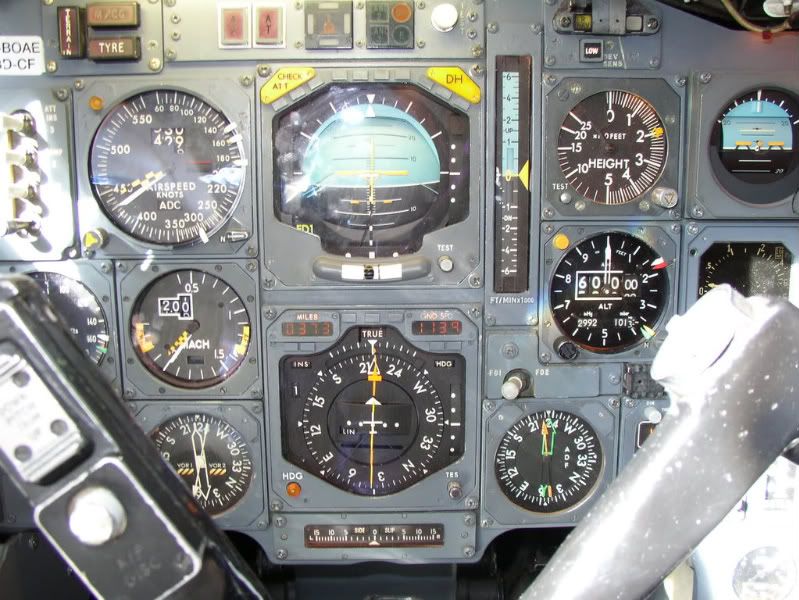
The available IAS speed range is shown on the ASI, and lies between the yellow and black Barbers Pole, currently indicating 440kts, and the white bug set to 300kts, the VLA ( L owest A uthorised speed) at this altitude.
The available Mach speed range is shown on the Mach meter, and lies between the yellow and black Barbers Pole, currently indicating M2.05, and the yellow bug which indicates the lowest Mach number allowed for the current aircraft CG position (the AFT limit) currently showing M1.35.
So, given that at her maximum altitude she had a speed range of 140kts IAS and a Mach range of M0.7, we can see that coffin corner was not a problem!
main_dog
...I too would like to ask what her idle thrust glide ratio was...
By my calculations, the figures quoted for a straight in approach, give an average glide ratio of around 20:1, however these were for a standard decel/descent, and on Concorde the early part of the decel/descent was not flown at idle power.
A considerable amount of power was left on initially, around 94% N2, for various reasons, and only below M1.0 were the throttles usually selected to idle.
I hadn’t noticed it until now but there does not appear to have been a chart giving glide distance at idle thrust!
However, since the speeds to be flown during the “4 Eng Flame Out” procedure were not too far from the normal decel/descent speeds, I’ll hazard a guess (and that is all it is) that the glide distance from FL600, with no thrust, would have been about 150nm, giving a glide ratio of around 15:1.
Subjects
Airbus
Barbados
British Airways
C of G
Captains
FL600
G-BOAE
Glide
IAS (Indicated Air Speed)
Links are to this post in the relevant subject page so that this post can be seen in context.
Reply to this quoting this original post. You need to be logged in. Not available on closed threads.
August 25, 2010, 06:13:00 GMT
permalink Post: 5890744
In your superb photograph you posted earlier in the Mach 2 Cruise level at FL600 I notice that both RMI'S shown seem to be showing a heading of 230 while the heading on the HSI shows 220 with the annunciation TRUE above the HSI.
Were you operating on TRUE headings in this case as it seems and what was the reason for this ?
I am thinking that the RMI's are showing magnetic headings ?
Subjects
FL600
Links are to this post in the relevant subject page so that this post can be seen in context.
Reply to this quoting this original post. You need to be logged in. Not available on closed threads.
September 01, 2010, 22:43:00 GMT
permalink Post: 5907435
The technical insights revealed by the real operators have only added to the appeal of this Aircraft for me.
Bellerophon I found the photograph taken in the Cruise at FL600 and Mach 2 to be quite
stunning, what an amazing set of numbers to have in front of you as an Airline Pilot !
Thanks M2dude, ChristiaanJ, Bellerophon for your insiders view and all other contributors.
Subjects
FL600
Links are to this post in the relevant subject page so that this post can be seen in context.
Reply to this quoting this original post. You need to be logged in. Not available on closed threads.
September 03, 2010, 08:43:00 GMT
permalink Post: 5910383
This of course is one for one of my pilot friends to answer properly again, but as galaxy flyer says, it's an 'eye to wheel' issue here when compared to other aircraft.
galaxy flyer
Again best answered by learned gentlemen such as my friends EXWOK or Bellerophon, but to the best of my feeble knowledge a resounding NO, at least as far as CRUISE flying was concerned. As the majority of the flight was carried out between FL500 and FL600 there was really no weather as such to avoid during supercruise. (As has been previously posted, at Mach 2 you would invariably be above FL500). Only at extremely low latitudes where the tropopause could theoretically extend up to around 70,000' was there ever any chance of seeing any cloud anywhere near your cruise altitudes. The only turbulence as such you would ever encounter was as the result of a temperature shear, but these never felt to be too much in the way of 'bumps' to me. And again, only at very low latitudes did you encounter severe shears anyway; anything encountered on the North Atlantic was generally very mild and civilised.
A CONCORDE PARADOX
The tropopause issue here is an interesting one, in that the coldest stratospheric temperatures we ever encountered were close to the equator, whereas the WARMEST temperatures possible are over the POLES
 , where the tropopause can be as low as 22,000'. This is just one of the many paradoxes involving Concorde, and the reason why the aircraft would never be routed over the poles, BECAUSE THE DARNED TEMPERATURES ARE TOO HIGH, in terms of the stratosphere. The result here would be that the aircraft is temperature (Tmo) limited all the time to 127 deg's C. (I previously mentioned in another post in this thread that only 5 deg's C above ISA, -51.5 deg's C, would mean Tmo being reached at Mach 2; any warmer and we HAD to slow down) The relatively high polar temperatures mean that we are unable to fly anywhere near Mach 2. Another paradox would then come into play, the slower your cruise speed, the HIGHER your fuel burn. It was originally proposed in the early 1970's that Concorde would fly from London to Tokyo, and the routing for that needed two things: It could not be polar, and possibly just as important , you required a refuel stop. The Soviet Union amazingly proposed granting a supersonic corridor over Siberia, refuelling at the Siberian city of Novosibirsk. This was hardly an ideal routing (definitely far from a great circle) but was arguably one of the very few that was possible at all. This by the way was not some early iteration of glasnost, but the Soviets fully expected that flying thoroughbred, the TU-144 (bad dude
 ) to be a success, and could compete side by side with Concorde.
ANOTHER CONCORDE PARADOX
If anyone wonders why when you flew faster you burned less fuel, it was primarily down to drag, actually a thing frighteningly termed as 'pre-entry spill drag'. As most people (???) are aware, the Concorde engine inlet utilised a series of carefully controlled and focused shockwaves to slow the air down entering the engine; in 14 feet of engine intake you lost in the order of 1,000 mph of airspeed! Now most of these different shocks varied with a combination of intake variable surface angle, intake local Mach number and also engine mass flow demand. However the oblique shock coming off the top lip of the intake produced a shock that varied with Mach alone, and would project downwards, just forward of the intake bottom lip. Due to the air downstream of this fairly weak shock still being supersonic, a measured amount of this air spills downwards, away from the intake. If you can possibly picture it, we have this wall of air spilling downwards over the lower lip of all four intakes, the combined effect of this supersonic forespill is a fair amount of drag. The faster we go, the more accute the angle of the shock and therefore the less air is spilled, and in consequence the lower the spill drag. Remembering that cool temperatures could produce a higher Mach number, temperature really could either be our friend or enemy, but cool was COOL
I hope this explanation does not sound like too much gibberish, but it really was a fact that 'More Mach = Less Fuel'. Hope it makes some sense.
Dude

Last edited by M2dude; 3rd September 2010 at 11:08 . Reason: clearing up some gibberish
Subjects
FL600
Fuel Burn
Intakes
Shockwave
Super-cruise
TMO (Temprature Max Operating)
Temperature Shear
Tu-144
Links are to this post in the relevant subject page so that this post can be seen in context.
Reply to this quoting this original post. You need to be logged in. Not available on closed threads.
September 05, 2010, 18:51:00 GMT
permalink Post: 5915727
I have yet another question! Last year I watched a programme where James May went up in a U2. He explained that at FL700 the plane was flying in "coffin corner" and that the difference in IAS between the stall and the max speed was only 10 knots. I understand that it's due to the very low air pressure at such heights. As Concorde could fly up to FL600 I wondered what this safe airspeed window was during the cruise/climb phase of flight and if this window was framed by the air pressure and/or the CofG position?
Once again thanks to everyone for such great answers and also for the background information.
Regards
Nick
Subjects
C of G
FL600
IAS (Indicated Air Speed)
Links are to this post in the relevant subject page so that this post can be seen in context.
Reply to this quoting this original post. You need to be logged in. Not available on closed threads.
September 06, 2010, 09:17:00 GMT
permalink Post: 5916644
Just like Christiaanj I'm trying to dig up an accurate flight envelope diagram. (A lot of my Concorde 'technical library' is out on long term loan), but I would suggest that anywhere within Concorde's published flight envelope you never hit any equivilant to Coffin Corner, a la' U2. The whole issue is really one of air DENSITY, rather that pressure, where as you climb at a given Mach Number, your Indicated airspeed (IAS) falls away with altitude. (Velocity of sound being primarily tied to static air temperature). Now if you are climbing in the stratosphere, where temperature is more or less constant up to around 65,000', you can say that your TRUE Airspeed (TAS) is also constant with climb at a given Mach number. But lift and drag are functions of IAS (the equivalent airspeed that the aircraft would 'feel' at sea level) and not TAS. Because the U2 had a very low Maximum allowable Mach number (Mmo) as IAS fell away with altitude, it would get to the point where it's lowest permitted airspeed (we called this VLA) got to within a few knots of Mmo and severe aerodynamic buffering. i.e. you were screwed with nowhere to go but down
 .
.
In the case of Concorde, Mach 2 at FL500 was 530KTS, falling to 430KTS at FL600. Although we have less lift due to 100KTS lower IAS, the aircraft is now much lighter (this is the whole principal of cruise/climb) which keeps the universe in balance, but drag is now significantly lower too, getting us better MPG
 .
.
On the ASI, the only limitation displayed was Vmo; however the Machmeter did display fwd and aft CG limits at a given Mach number. The ONLY time that Concorde would experience relatively low speeds at altitude was at Top of Descent. I'm a little fuzzy here how it all worked exactly (it's an age thing you know), I'm sure one of the pilots can correct me, but I seem to remember that the autothrottle was disconnected, ALTITUDE HOLD was selected on the AFCS, and the throttles slowly retarded. (If you pulled back too far you'd often get a gentle 'pop surge' from the engines, and you had also to be wary of equipment cooling airflow too). The aircraft was then allowed to gently decelerate, still at TOD altitude, until Mach 1.6, when power was tweaked to give 350KTS IAS and IAS HOLD was selected. The aircraft was now free to carry out her loooong descent to 'normal' altitudes. VLA on Concorde was not directly displayed as you never flew anywhere near it, and also every pilot knew his VLA
 . (Stray into this and you'd get a 'stick' shaker warning.
I hope this blurb helps Nick
Dude
Subjects
AFCS (Automtic Flight Control System)
Auto-throttle
C of G
Engine surge
FL600
Flight Envelope
IAS (Indicated Air Speed)
Lift Drag Ratio
Mmo
Stick Shaker
TAS (True Air Speed)
Vmo
Links are to this post in the relevant subject page so that this post can be seen in context.
Reply to this quoting this original post. You need to be logged in. Not available on closed threads.
September 06, 2010, 17:13:00 GMT
permalink Post: 5917692
Mmo - ditto. As others have said, Mmo was originally going to be higher (M2.2) but was reduced to extend fatigue life as the aircraft design 'grew'.
The significance of the shaded 59% portion of the graph is that it shows the envelope at that CG - in this case the relevant line is the bottom of the shaded area - M1.56. This is the MINIMUM mach number that can be flown with the CG at 59% (normal for supersonic cruise). You will see it represented on the Machmeter (a few pages back) as the "AFT" bug. i.e. you can't fly slower than this without moving the CG forward.
So it can be seen that the decel must be done in concert with CG transfer - and as (mostly) always the designers had made it as straightforward as possible. Transferring forward from Tank 11 using the two electric pumps the rate of txfr pretty well matched the standard decel profile, leaving the FE to make the occasional tweak to keep the flight envelope in concert with the CG envelope through the decel/descent.
In the case of abnormal procedures depriving one of electrical power then some other way had to be found to enable a descent (which required a decel) and that is why there are also two hydraulically driven fuel transfer pumps in tank 11.
It's a bit confusing at first, but there are two overlapping flight envelopes - the speeds/alts drawn on the basic envelope and those determined by the CG postion at the time.
In practice - one had a takeoff CG, a landing CG, a subsonic crz CG, a supersonic cruise CG and the only area one had to keep a close eye on was the transition between the last two. There were several visual and aural warnings to back up the CG and Machmeter bugs.
Subjects
C of G
FL600
Fatigue
Flight Envelope
Mmo
Links are to this post in the relevant subject page so that this post can be seen in context.
Reply to this quoting this original post. You need to be logged in. Not available on closed threads.
September 06, 2010, 17:34:00 GMT
permalink Post: 5917729
FL600 level flt means he was going to BGI. The length of this sector was, in crude terms, about 200NM more than the quoted max range of the aircraft, so the range envelope was being pushed a little.
Because there was no land you could stay supersonic all the way, so at the end of the cruise you would be supersonic, but with relatively little fuel in the tanks, and most of it in Tank 11 (at the back) to keep the CG aft. Even with a tweak to tanks 1&4 to run them at 50% level, eventually the CG would come forward as you burnt fuel out of tank 11. That's what is probably happening in Bellerophon's photo, hence the 'AFT' Mach bug being at a lower Mach. If the FCPI ('ICOVOL') was in the frame I wager you would see the elevons a somewhat above the optimum 1/2degree down position
The bugger was this; if you were a little tight on fuel, just when you wanted to maximise the time spent supersonic you'd have to start an early decel because there just wasn't enough fuel left to maintain the CG far enough aft to sustain M2.
All part of the fun, and why every sector was interesting and rewarding.
Subjects
C of G
Elevons
FL600
Links are to this post in the relevant subject page so that this post can be seen in context.
Reply to this quoting this original post. You need to be logged in. Not available on closed threads.
September 06, 2010, 18:14:00 GMT
permalink Post: 5917809
On Bellerophon's picture, it looks as if the FWD bug on the Mach meter is still at about M=2.2.... and just the barber pole at about M=2.04 as you would expect.
At that exact point in the picture I think he just hit his head against the ceiling... (FL600) but could still stay there a bit more.
Doesn't change any of your other comments, though.
CJ
Subjects
Barber Pole
FL600
Links are to this post in the relevant subject page so that this post can be seen in context.
Reply to this quoting this original post. You need to be logged in. Not available on closed threads.
September 06, 2010, 22:18:00 GMT
permalink Post: 5918330
Following the excellent explanation given by ChristiaanJ about the relationships between OAT, Mach number, TAS and IAS (which I have now copied and shall shamelessly pass off as my own work in future
) if you wish to see how these relationships work in practice you might look back at the photo posted at reply #66.
You will see that at FL600 the aircraft had a GS of 1,139 kts whilst flying at M2.00 and an IAS of 429 kts.
We don\x92t know what the wind was, nor what the TAS or OAT were, but we can easily deduce that:
- If the OAT was standard at FL600, at -56.5\xb0C, then, as at that temperature M2.00 equates to 1,147 kts TAS, in order to have a GS of 1,139 kts, she must have been flying into an 8 kt headwind.
- If the wind at that altitude was calm, then her GS of 1,139 kts must have been the same as her TAS. For M2.00 to be 1,139 kts TAS, then the temperature at FL600 must have been 3\xb0C colder than standard, at -59.5\xb0C.
- If , as was typical on a LHR-BGI sector, the OAT at FL600 was 10\xb0C colder than standard, at -66.5\xb0C, then M2.00 would equate to 1,120 kts TAS, so to have a GS of 1,139 kts, she must have been flying in a 19 kt tailwind.
For obtaining Mach/TAS/Temp values quickly and easily, as well as other useful information on the atmosphere, this Standard Atmosphere Calculator website is extremely useful.
Best Regards
Bellerophon
Subjects
FL600
IAS (Indicated Air Speed)
LHR-BGI Route
TAS (True Air Speed)
Links are to this post in the relevant subject page so that this post can be seen in context.
Reply to this quoting this original post. You need to be logged in. Not available on closed threads.
September 06, 2010, 23:08:00 GMT
permalink Post: 5918422
G-BOAE at Mach 2
Ah, oh, ooooops!!!! Of course it's there, in the little window on the top right of the HSI (Horizontal Situation Indicator, the lower one of the two big central instruments).
Shanewhite , in a way, that illustrates that for flying the aircraft things like TAS and GS are not really that important... that's why there are no big instruments indicating TAS or GS, but only IAS and Mach, with only a little digital window for GS, which IS important for navigation (largely handled by the inertial navigation system, which is the system where the GS display comes from), but not for the minute-to-minute handling of the aircraft.
Bellerophon , dumb question from a techie... the 373 miles is presumably just the distance to the next INS waypoint?
CJ
Subjects
FL600
G-BOAE
IAS (Indicated Air Speed)
INS (Inertial Navigation System)
TAS (True Air Speed)
Links are to this post in the relevant subject page so that this post can be seen in context.
Reply to this quoting this original post. You need to be logged in. Not available on closed threads.
September 12, 2010, 11:46:00 GMT
permalink Post: 5929931
I would first like to thank everyone in this thread for making it so informative and a brilliant read.
If I may I would like to pose a question, the answer to which I can't seem to find in all the books and manuals I have read, this relates to the procedure that was adopted on those ocassions when FL600 was reached.
As far as I am aware Cruise/Climb was carried out with AT1, AP1, FD1 or AT2 AP2 or FD2 and with MAX CLIMB engaged, MAX CRUISE would automatically engage as required. Was 60,000 feet set in the Altitude Select window and was ALT ACQ primed?
If not, what stopped her from continuing to climb past FL600 if conditions were suitable, and, if ALT ACQ was primed and FL600 reached and she then held that altitude what was the procedure if speed started to decay due to external influences? Was a gentle descent initialised using the pitch datum adjust until the speed came back and then MAX CLIMB re-engaged?
Many thanks.
Steve.
Subjects
FL600
Manuals
Links are to this post in the relevant subject page so that this post can be seen in context.
Reply to this quoting this original post. You need to be logged in. Not available on closed threads.
September 12, 2010, 12:05:00 GMT
permalink Post: 5929957
).
Dude
Subjects
AFCS (Automtic Flight Control System)
ALT HOLD
Auto-pilot
FL600
LHR-BGI Route
Links are to this post in the relevant subject page so that this post can be seen in context.
Reply to this quoting this original post. You need to be logged in. Not available on closed threads.
September 12, 2010, 16:08:00 GMT
permalink Post: 5930300
As a Concorde fan for 10 years (since I bought FS2000), and passionate developer of SSTSIM Concorde and FSLabs ConcordeX (flight dynamics, weight and balance), it's simply awesome to have you guys and gal here sharing your memories.
Regarding the CG corridor, here's a fantastic graphic from online Concordepedia, aka ConcordeSST.com, Technical/Fuel System section:

Interestingly, it doesn't show a warning for CG>59.1% above M1.6, opposite to what M2Dude said earlier on the topic.
I got curious on the Max Climb/Cruise and ALT ACQ not being primed. How the levelling at FL600 was done? Manually?
Regarding the fuel tanks, specially tanks 6 and 8: did these tanks' lateral center of gravity change with quantity? Due to their completely assymetrical shape, I'd expect some change in it.
Operationial question: did BA use the 380kts descent profile? Have heard that only AFR used it, but Haynes' book says that BA started using it too.
There are many doubts regarding procedures as manuals and informations available on the internet are mostly from BA 1976 entry-into-service era. But i understand many things changed along the years, as I can see on a Aug 2000 manual I've got, with percentages showing differences from the 76 era, or even completely new tables.
Well, that's it, hope to be able to contribute on the topic, but mainly learn from you that flew the real thing.
Subjects
British Airways
C of G
FL600
Haynes guide to Concorde
Manuals
Links are to this post in the relevant subject page so that this post can be seen in context.
Reply to this quoting this original post. You need to be logged in. Not available on closed threads.
September 13, 2010, 01:18:00 GMT
permalink Post: 5931109
I'm sure there is a simple answer which will leave us saying "oh yeah, how obvious, didn't think of that"
 Just strange it doesn't seem to be written anywhere.
Dude
Subjects
AFCS (Automtic Flight Control System)
ALT HOLD
Auto-pilot
Auto-throttle
Climb Performance
FL600
LHR-BGI Route
Temperature Shear
Links are to this post in the relevant subject page so that this post can be seen in context.
Reply to this quoting this original post. You need to be logged in. Not available on closed threads.