September 13, 2010, 08:07:00 GMT
permalink Post: 5931377
In the MAX Cruise mode the aircraft would sniff about vertically, gently climbing and descending to hold M2 (following the temperature changes), but with an overall general climb.
Heading to BGI you were climbing into very cold air, commonly down to less than -70degs, I saw minus 80 on multiple occasions. (Which was all very good news from a fuel point of view). So the climb was more definite and the likelihood of a subsequent descent lower.
It was pretty easy to spot when the aircraft was definitely going to 'stick' at FL600, and to select Alt Hold, with the already armed AT (with Max Crz mode) engagd in Mach Hold. Very occasionally one may have to subsequently make a subsequent return to Max Crz mode if warmer air was encountered, but I don't recall doing this more than once.
If you had very cold air and a lighter than average load, one would find that the throttles (no 'thrust levers' on Concorde!) were quite a long way back at TOD, maybe 10-14 degrees throttle angle. It was worth noticing this early - the decel/descent was initiated by reducing the throttles to 18degrees, normally this would be from full forward so it can be seen that reducing them by 4 or 5 degrees rather than the usual 18 could result in a disappointing rate of decel. At nearly 20NM a minute this could really screw your descent plan! (I think the record-holders went past BGI still just the wrong side of M1......)
I used to enjoy the last few minutes of the flight at FL600 - before the space station was manned and post-MIR there was a fair chance that at that moment we were the human beings furthest from the surface of the planet. In shirtsleeves, with a cup of tea (or something more palatable if one was in one of the comfy seats).
Subjects
FL600
LHR-BGI Route
Links are to this post in the relevant subject page so that this post can be seen in context.
Reply to this quoting this original post. You need to be logged in. Not available on closed threads.
September 30, 2010, 15:03:00 GMT
permalink Post: 5966077
1) How many fuel tanks were there on Concorde?
LOL... 13.
I suppose that, for the same reason there was no row 13 in the cabin, somebody decided to name two of the tanks "5A" and "7A", rather than call the tail trim tank (named no.11) number 13.
Yes, I forgot the scavenge tank.
And since it was "BA Concordes only" I didn't want to add the hydrazine tank on the two preprod and the two certification aircraft.
2) How many seats were there?
Good question.
As Nick asked, which seats?
Nominally there were 100 pax seats in the cabin, although originally up to 127 were certified.
Five (three plus two jump seats) in the cockpit.
Cabin seats for the cabin crew.... I honestly don't know. Seven?
Wrong twice... six cabin crew seats, AND I forgot to count the loos!
3) At what approximate altitude and KNOTS EAS was Mach 2 achieved?
Roughly, FL500 and 530 kts.
But not being a pilot I had to check an instant on my flight envelope crib sheet, which I have at hand all the time.....
It seemed pointless to be TOO precise, because that assumed ISA and creeping exactly up the right edge of the envelope.
4) Only one BA Concorde had three different registrations, what was it?
Without looking it up, no idea. My guess is G-BOAF, with a white-tail reg, a "British" reg, and a pseudo-American reg.
IIRC, G-BOAG never had a pseudo-American reg, but I'm not sure without looking it up.
Brain not completely addled, then.
5) What was the maximum permitted altitude in passenger service?
FL600, as certified.
6) How many wheels on the aircraft?
Twelve, if you count the two Spitfire wheels at the back
7) How many flying control modes were there?
Four. Blue, green, mechanical and ... what did we call it? Control jam, CWS?
Ah, thanks, Emergency Flight Control. I always considered it as a separate mode, even if it was virtually never used.
8) How many positions of nose droop were there?
Four. 0\xb0, 5\xb0, 12.5\xb0 and 17.5\xb0 (the latter only on the prototypes, and purely mechanically, after removing a stop, on the other aircraft).
9) What was the first microprocessor application on the aircraft?
No idea... you (M2dude) mentioned a Plessey data acquisition system?
It was after "my time"...
10) How many main electrical sources were there?
Again, not sure... You're presumably are talking about primary sources.
There was an AC constant-drive generator on each engine.
Then there were two DC batteries.
And IIRC there was an AC generator running off the RAT hydraulic generator when pillar came to post.
Reading M2dude's answer, I suppose the emergency generator just ran off the hydraulics, not specifically off the RAT. Far more logical.
Nice one, M2dude!
And certainly not all trivia!
CJ
Subjects
British Airways
Cabin Crew
FL600
Flight Envelope
G-BOAF
G-BOAG
Hydraulic
Hydrazine
Microprocessor
Quiz
RAT (Ram Air Turbine)
Trim
Links are to this post in the relevant subject page so that this post can be seen in context.
Reply to this quoting this original post. You need to be logged in. Not available on closed threads.
October 11, 2010, 18:59:00 GMT
permalink Post: 5988352
... on shorter charter flights was there a mininium ammount of fuel that had to be loaded just to always have enough fuel for CofG movement...
Yes, 35,000 kgs, at take-off, for a short supersonic flight. This would allow sufficient fuel to be transferred rearwards in order to achieve a CG approaching 59%.
If the flight was to remain subsonic, the fuel figure dropped to 25,000 kgs, as the required CG for subsonic cruise was 55% not 59%.
Both these figures were at take-off, so the estimated taxy fuel had to be added to these figures in order to arrive at the minimum fuel figure required to be loaded.
...was it possible to be in a position where trip fuel, fuel to an alternate etc was less than the fuel required for CofG movement after take off?...
No, at least it should not have been!
However, a situation was sometimes reached in flight, generally only towards the end of the planned supercruise portion of a LHR-BGI sector, where, with the aircraft at M2.00 and FL600, it was no longer possible to maintain a CG of 59%, as the "ballast" fuel, which had been transferred aft into tank 11, was now required forward again as "fuel" fuel, to top up other tanks which had reached their minimum permitted levels.
In this case, once the forward transfer of fuel had begun, the CG would also be slowly moving FWD, and one would be compelled to commence the decel and descent earlier than desired, something EXWOK touched on here much earlier in this thread.
Best Regards
Bellerophon
Last edited by Bellerophon; 11th October 2010 at 22:17 .
Subjects
C of G
FL600
LHR-BGI Route
Super-cruise
Links are to this post in the relevant subject page so that this post can be seen in context.
Reply to this quoting this original post. You need to be logged in. Not available on closed threads.
December 20, 2010, 04:51:00 GMT
permalink Post: 6132536
Subjects
FL600
SR-71
Links are to this post in the relevant subject page so that this post can be seen in context.
Reply to this quoting this original post. You need to be logged in. Not available on closed threads.
December 25, 2010, 21:33:00 GMT
permalink Post: 6143106
We all know Concorde went at Mach 2 at FL600, but were there instances (for the press, certification, etc) that you went supersonic considerably closer to the deck? and what issues (if any) did that bring up?
Subjects
FL600
Links are to this post in the relevant subject page so that this post can be seen in context.
Reply to this quoting this original post. You need to be logged in. Not available on closed threads.
December 25, 2010, 22:37:00 GMT
permalink Post: 6143159
Flight envelope
Those are the official certified limits.
I doubt somehow anybody went beyond those "for the press".....
But during certification, yes, each of those limits was exceeded, slowly and carefully, to be able to draw those official operational limits on the document.
For instance, the certified Mmo is 2.04. During certification, G-BBDG (202) went to Mach 2.21....
Even while staying within the limits, she could could exceed Mach 1 just below 30,000 ft.
Also, during the acceptance flights after major overhauls, most of those envelope limits would be exceeded by a given margin, to prove the aircraft still met all the certification requirements. Whether any of that was done 'closer to the deck', I wouldn't know.
The 'issues' would vary. Performance would be one issue... Delta Golf (and 01, who went to Mach 2.23) basically "ran out of steam" at that speed.
Another issue would be that 'going beyond the borders' shortened the fatigue life of the airframe, and it was difficult to assess exactly by how much. It was one of the reasons why Delta Golf and Sierra Bravo (the certification aircraft) in the end never went into service.
CJ
Subjects
FL600
Fatigue
Flight Envelope
G-BBDG
Mmo
Links are to this post in the relevant subject page so that this post can be seen in context.
Reply to this quoting this original post. You need to be logged in. Not available on closed threads.
December 26, 2010, 08:21:00 GMT
permalink Post: 6143472
Generally speaking the region from say 0.98 to 1.2M is one to pass through and be thankful!
CliveL
Subjects
C of G
FL600
Links are to this post in the relevant subject page so that this post can be seen in context.
Reply to this quoting this original post. You need to be logged in. Not available on closed threads.
January 12, 2011, 15:52:00 GMT
permalink Post: 6175268
Also wondering what was the max altitude ? Was high altitude stall (for the lack of a better word) ever experimented during tests or training ?
Subjects
Depressurisation
FL600
G-BBDG
Links are to this post in the relevant subject page so that this post can be seen in context.
Reply to this quoting this original post. You need to be logged in. Not available on closed threads.
January 13, 2011, 09:45:00 GMT
permalink Post: 6176684
Really an answer for CliveL, but I'll have a go. The short answer to your question is 'oh yeah, big time'. Total temperature varies with the SQUARE of Mach number and static temperature. Depending on the height of the tropopause itself as well as other local factors, there can be little or no significant variation of static temperature between FL600 and FL700. The 400\xb0K (127\xb0C) Tmo limit was imposed for reasons of thermal fatigue life, and equates to Mach 2.0 at ISA +5. (Most of the time the lower than ISA +5 static air temperatures kept us well away from Tmo). In a nutshell, flying higher in the stratosphere gains you very little as far as temperature goes. (Even taking into account the very small positive lapse above FL 650 in a standard atmosphere). As far as the MAX SPEED bit goes, Concorde was as we know flown to a maximum of Mach 2.23 on A/C 101, but with the production intake and 'final' AICU N1 limiter law, the maximum achievable Mach number in level flight is about Mach 2.13. (Also theoretically, somewhere between Mach 2.2 and 2.3, the front few intake shocks would be 'pushed' back beyond the lower lip, the resulting flow distortion causing multiple severe and surges).
On C of A renewal test flights (what I always called the 'fun flights') we DID used to do a 'flat' acceleration to Mach 2.1 quite regularly, as part of the test regime, and the aircraft used to take things in her stride beautifully. (And the intakes themselves were totally un-phased by the zero G pushover that we did at FL630). This to me was an absolute TESTAMENT to the designers achievement with this totally astounding aeroplane , and always made me feel quite in awe of chaps such as CliveL.

Shaggy Sheep Driver
So glad you are enjoying the thread, and absolutely loved the description of your flight in OAD and your photo is superb. I don't think it is possible to name a single other arcraft in the world that could be happily flown hands off like this, in a turn with 20\xb0 of bank at Mach 2. (One for you ChristiaanJ; The more observant will notice that we are in MAX CLIMB/MAX CRUISE with the autothrottle cutting in in MACH HOLD. Oh, we are in HDG HOLD too
 ).
).
Now for your question
As far as your air conditioning question goes, you needed an external air conditioning truck to supply cabin air on the ground. Not needed in the hangars of course, but come departure time if these trucks were not working, then the cabin could become very warm/hot place indeed (depending on the time of year). Oh for an APU

Best regards
Dude

Subjects
AICU (Air Intake Control Computer)
APU (Auxiliary Power Unit)
Anti-skid
Auto-throttle
Braking
Depressurisation
Engine surge
FL600
Fatigue
Intakes
Landing Gear
N1 (revolutions)
TMO (Temprature Max Operating)
Links are to this post in the relevant subject page so that this post can be seen in context.
Reply to this quoting this original post. You need to be logged in. Not available on closed threads.
January 13, 2011, 11:10:00 GMT
permalink Post: 6176851
On C of A renewal test flights (what I always called the 'fun flights') we DID used to do a 'flat' acceleration to Mach 2.1 quite regularly, as part of the test regime, and the aircraft used to take things in her stride beautifully. (And the intakes themselves were totally un-phased by the zero G pushover that we did at FL630)
As usual Dude you beat me to it! I really must give up having another life

As Dude says, the 'cruise' condition was set by the aircraft specification for transatlantic range on an 85% (ISA +5) day and the chosen mach Number was 2.0 (of which more anon). This gives a Total Temperature of 400.1 deg K. [Dude, I know your pipe-smoking thermodynamicist and he was having you on - he is quite capable of memorising the square/square root of 407.6 or whatever!]
To give margins for sudden changes in ambient temperature (we had to cater for a 21 deg change in one mile) the Mmo was set at 2.04 which matches 400 degK at ISA +1. In theory then we could have flown faster than our chose Mmo at anything colder than this, but there are two limits:
1) The object is not to fly as fast as you can but to fly with minimum miles/gallon. If you have a nice cold day and enough thrust to go either faster or higher which do you choose? For best specific range you go higher every time.
2) The thing that everyone forgets is that civil aircraft have to have margins around their authorised envelope. In Concorde's case these were set principally by the intake limits and engine surge.
Dude also says quite correctly that 101 flew to 2.23M but the production aircraft was limited to 2.13M. Now you may not believe this, but 101 could fly faster than the production aircraft because she (101) leaked like a sieve!.
I doubt I will get away with that without some explanation

Once you get past a certain Mach Number the airflow into the intake is fixed. The performance (intake pressure recovery and engine face flow distortion) then depends on how this air is shared between the engine and the throat 'bleed'. This bleed was ducted over the engine as cooling air and then exhausted (in principle) throught the annulus formed between the expanding primary jet and the fixed walls of the con-di nozzle. But if you took, or tried to take, more bleed air the intake pressure recovery went up and the primary jet pipe pressure went up with it. This meant that the primary jet expanded more and squeezed the available annulus area which restricted the amount of bleed air one could take.
Obviously if there are alternative exit paths between intake and final nozzle then you can take more bleed air off and the engine face flow distortions will benefit along with the surge margin. 101 was fairly 'leaky' in this respect, particularly around the thrust reverser buckets on the original nozzle design. This meant that 101's intake distortions were lower than the production aircraft so she could fly faster without surge - at least with the first attempt at intake control 'laws'. We managed to tweak most of the margin back eventually. Engine bay leaks were good for surge margin but VERY bad news for m.p.g.!
Here are a couple of diagrams to show what I mean. the first shows the surge lines for the various aircraft variants and also the N1 limiter Dude was talking about. NB: the X-axis is LOCAL Mach Number not freestream. The difference comes from the compression of the underwing flow by the bit of the wing ahead of the intake. Mmo + 0.2 is shown
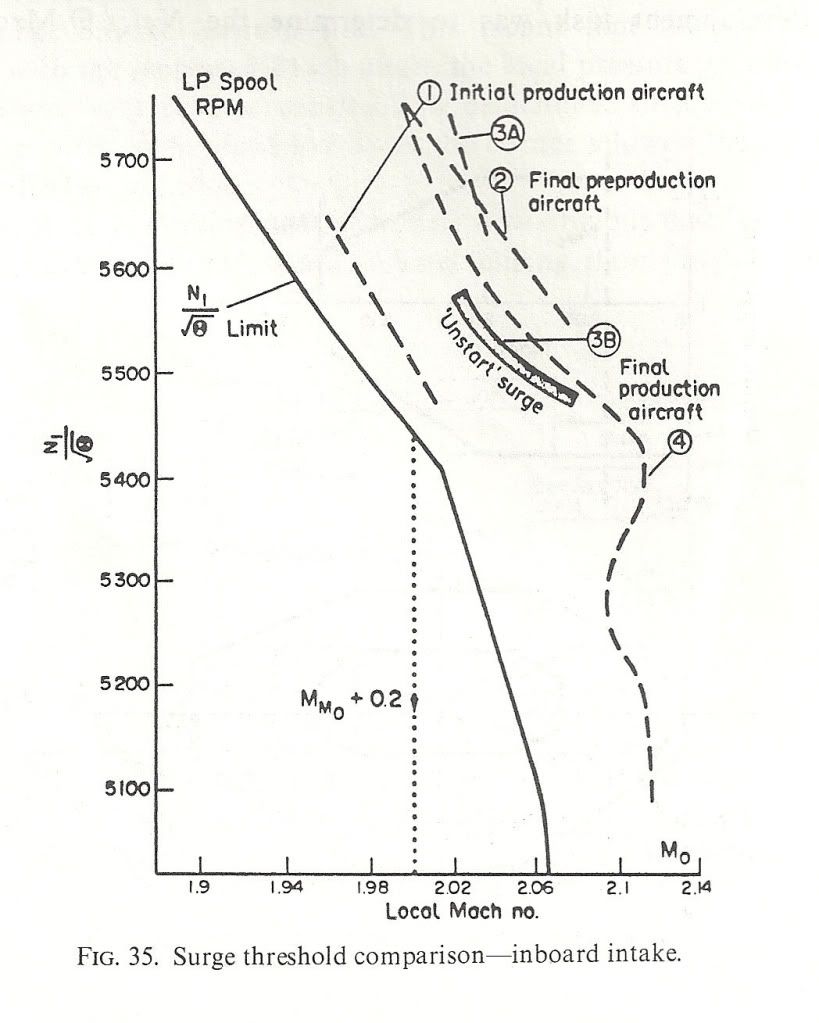 ">The next shows the surge free boundaries in sideslip and normal acceleration. You can see the zero 'g' capability Dude was enthusing over.
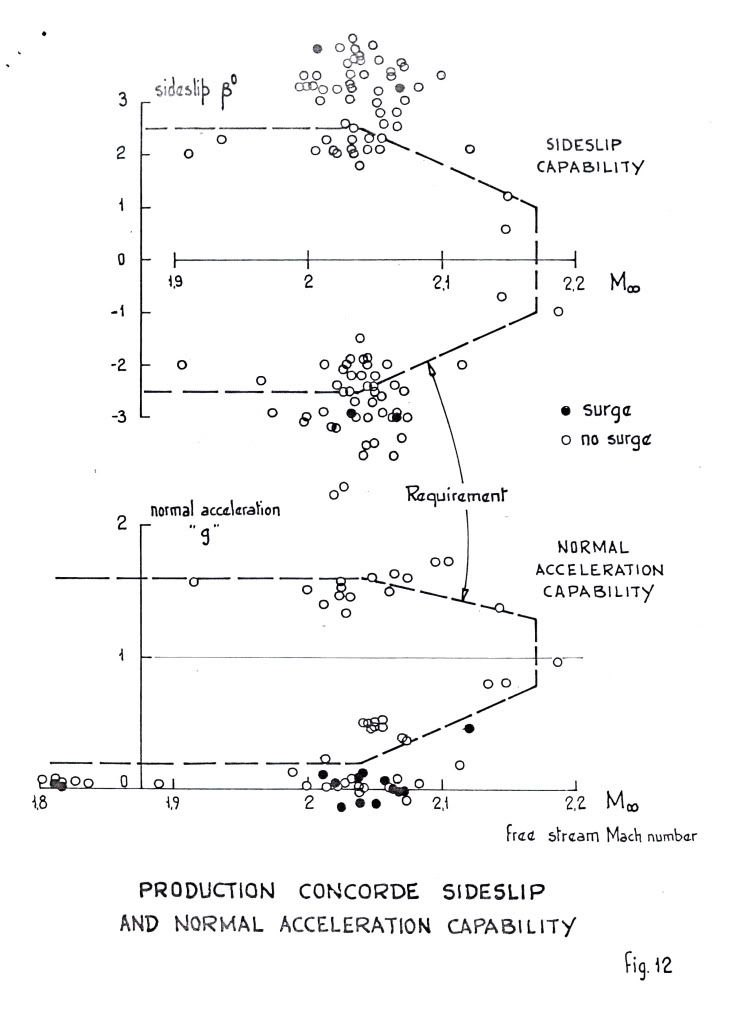 ">
">
As for 'high speed stall', I don't think we ever contemplated trying it! Our requirements in 'g' capability were defined and that was it. Besides, the aircraft would fly like the proverbial stone-built outbuilding at those sorts of conditions so I don't think one would have been able to get anywhere near a stall in the conventional sense. Stall as commonly defined for subsonics (deterrent buffet) might have been another matter, but I don't remember anything.
Cheers
Last edited by CliveL; 13th January 2011 at 11:17 . Reason: additional explanation
Subjects
AICU (Air Intake Control Computer)
Bleed Air
Engine surge
FL600
Fatigue
Intakes
Mmo
N1 (revolutions)
Nozzles
Sideslip
TMO (Temprature Max Operating)
Thrust Reversers
Links are to this post in the relevant subject page so that this post can be seen in context.
Reply to this quoting this original post. You need to be logged in. Not available on closed threads.
April 06, 2011, 07:16:00 GMT
permalink Post: 6353303
My question is: disregarding the certified FL600 / M2.04 / 127\xbaC restrictions, how high and/or fast do you Concorde builders and designers think she could have gone?
Subjects
FL600
Links are to this post in the relevant subject page so that this post can be seen in context.
Reply to this quoting this original post. You need to be logged in. Not available on closed threads.
May 06, 2011, 23:29:00 GMT
permalink Post: 6433883
You got me a little worried there, so I've just checked the figures I quoted in case I'd slipped up! They were extracted from the Cruise Control Manual (rather than from observation on an actual flight) for a lecture some years ago.
I'm relieved to say they appear to be correct. By way of contrast, to show the variation in fuel flow there could be, the following is perhaps typical of Concorde approaching her decel/descent point into BGI.
Concorde Cruise/Climb . 110,000 kgs, FL600, ISA -15\xb0C:
- 4e...FL600...M2.00...1,107 kts...4,308 kg/eng/hr...17,232 kg/hr
Best Regards
Bellerophon
Subjects
Afterburner/Re-heat
FL600
Fuel Burn
Links are to this post in the relevant subject page so that this post can be seen in context.
Reply to this quoting this original post. You need to be logged in. Not available on closed threads.
February 04, 2012, 11:51:00 GMT
permalink Post: 6998987
CliveL, are there any documented records of the trials in "Boom Alley" we could use to settle some of the issue? Unquote:
Christiaan, there isn't anything particular to "Boom Alley", but there is enough data around to quantify the issue.
SSD, you were quite right when you said that the shock waves diverge as they get farther from the aircraft; that could be as much as 25% of the aircraft length at the ground. Near the aircraft the rise time would be proportional to length/speed of sound.
To cut a long story short, plotting all the available data leads to a pretty good expression for the rise time:
T = 0.011*LOA + 0.0001*FL
To give you a feel for the numbers, the measured value for an F18 at FL600 is 0.18 secs, for Concorde at FL520 about 0.25 secs or for an F104 at FL190 0.08 secs.
After that it would depend on your own perceptions I think, but I could easily envisage either a single or double bang for a fighter size aircraft depending on altitude.
Subjects
FL600
Sonic Boom
Links are to this post in the relevant subject page so that this post can be seen in context.
Reply to this quoting this original post. You need to be logged in. Not available on closed threads.
March 13, 2015, 22:01:00 GMT
permalink Post: 8900775
It sounds like you could get down pretty quickly when needed. I believe it was capable of higher altitudes and sometimes reached FL600 in cruise, I forget the highest achieved during flight test although that is probably in this thread !
Incidentally what was the envelope for using reverse ? Your description of it's operation makes it sound less than practical ?
Why was that ?
Best wishes.
Subjects
Depressurisation
FL600
Links are to this post in the relevant subject page so that this post can be seen in context.
Reply to this quoting this original post. You need to be logged in. Not available on closed threads.
March 18, 2015, 09:30:00 GMT
permalink Post: 8906242
I don't believe the ramp schedules were designed to operate far above FL600, I vaguely recall that FL635 was the highest reached during testing but, again, others will know better. A typical LHR-JFK or JFK-LHR would get to between 570 and 590 depending on weight and OAT, LHR-BGI almost invariably ended up level at FL600 due to lower weight and much lower outside temps.
As for reverse inflight, off the top of my head the limits were; Max FL300, speed 250-380kts, max use 4 mins. It didn't make a vast difference to RoD, although it was noticeable.
Inflight rvs was limited to engs 2 and 3 but to enable sufficient air to deploy the reversers, engs 1 and 4 spooled up slightly (in fwd thrust) to help deployment. While this is going on the primary nozzles open fully (for the same reason) but after reverse position is reached, the 2 and 3 primary nozzles have to close to 15% otherwise you get a 'CON' light which means reverse has to be cancelled on that engine (this was not a rare event).
Common sense and airmanship also dictated that you had an escape plan if one or both the engines didn't get the secondary nozzles out of reverse, so you didn't want to do this if fuel was tight.
All-in-all it was far better to make sure you didn't need reverse inflight!
Subjects
FL600
LHR-BGI Route
LHR-JFK Route
Nozzles
Links are to this post in the relevant subject page so that this post can be seen in context.
Reply to this quoting this original post. You need to be logged in. Not available on closed threads.
April 05, 2015, 08:55:00 GMT
permalink Post: 8933615
There was a certification requirement for descent time from FL600 down to FL100 if I recall correctly. Can't remember the value though. In flight reverse was developed to trim some fraction of a minute off the time to get inside the requirement
@ a_q
Not sure what you mean by a "leaky" intake. At about 2.2M the first shock would hit the intake lower lip and from that point on the total intake mass flow was frozen. Increased engine mass flow could only be obtained by reducing bleed flow and that gave higher engine face flow distortions driving the engine towards surge and lower intake recovery. So engine mass flow was effectively fixed also.
Then the amount of "dry" fuel which could be added was limited because the higher Mach number increased the engine entry temperature but the maximum turbine entry temperature was fixed.
You could add thrust by using reheat, but you would not get as much as you would like because the final nozzle, being designed for 2.0M would be too small for optimum efficiency at higher Mach numbers.
Overall, IIRC we got to 2.23M in flight test. If you pushed me I would say it might be possible with reheat etc to get to 2.25 or 2.26M, but it would be a blind guess!
Subjects
Afterburner/Re-heat
Bleed Air
Engine surge
FL600
Intakes
Nozzles
Trim
Links are to this post in the relevant subject page so that this post can be seen in context.
Reply to this quoting this original post. You need to be logged in. Not available on closed threads.
October 15, 2015, 09:27:00 GMT
permalink Post: 9148296
My short answer would be not much more than the certified limits - at least not without significant modifications.
FL680 was achieved at the end of a zoom climb, so the Mach No was a lot less than 2.0
M2.23 was in a shallow dive. The object was to demonstrate sufficient margin to avoid surge following the worst temperature transient specified in the TSS regulations. To that end both the intake laws and engine operating lines were tweaked as functions of Mach No to minimise intake flow distortions and maximise surge margin. The result was a long way from the performance optimum one would need for steady cruise.
The power plant was being pushed to its limits at this Mach No.
(As an aside, the subsonic rules make no mention of temperature transients as a cause of Mach exceedences. Some recent incidents suggest this could usefully be reviewed)
The altitude limit could perhaps be more readily expamded. The aircraft normally flew a cruise climb bcause at Concorde cruising altitudes there was no ATC conflict. The altitude was very sensitive to ambient temperature and aircraft weight. FL600 would be associated with end of cruise on a coolish day.
To usefully increase cruise altitude would require more engine thrust, but this could only be obtained by increasing engine TET which would screw the engine fatigue life.
Increasing Mmo from 2.04 would need an increase in Tmo (400 deg K) at any temperature above (from memory) ISA. This in turn would affect the airframe fatigue life unless the structural material were changed. Even then, there were a lot of nonmetallic bits (seals etc) that would also have needed replacement.
Sorry if this is a gloomy assessment, but that is the way I see it!
Subjects
Engine surge
FL600
Fatigue
Intakes
Mmo
TMO (Temprature Max Operating)
Links are to this post in the relevant subject page so that this post can be seen in context.
Reply to this quoting this original post. You need to be logged in. Not available on closed threads.
July 16, 2016, 04:06:00 GMT
permalink Post: 9441431
Subjects
FL600
Links are to this post in the relevant subject page so that this post can be seen in context.
Reply to this quoting this original post. You need to be logged in. Not available on closed threads.
April 29, 2017, 07:18:00 GMT
permalink Post: 9755769
It appears as a thin red line on the face of the instrument itself opposite 190 knots
approximately.
The picture i'm referring to is on page 4 of this thread reply #66 posted by yourself !
And on further examination I think I can see what you're saying, it does look like
the lower red edge of the warning flag just visible in that window.
Thanks again BP and for the person that did the very useful indexing which made finding that picture a breeze.
Last edited by stilton; 29th April 2017 at 07:28 .
Subjects
Captains
FL600
Links are to this post in the relevant subject page so that this post can be seen in context.
Reply to this quoting this original post. You need to be logged in. Not available on closed threads.