August 22, 2010, 01:47:00 GMT
permalink Post: 5884837
So yes, on the whole, TOC did equal TOD.
The 'subsonic climb' wasn't quite as you thought; you'd normally subsonic climb to FL280, staying there (at Mach 0.95) until the acceleration point. Mach 0.95 was 'subsonic cruise'. But you were on the right track.

Oh, and NOPE, they never boomed us either

Nick Thomas
The only problem you ever had with the dual nacelle arrangement was if you had an engine surge above Mach 1.6 (These were relatively rare, but could happen with an engine or intake control system malfuntion). If one engine surged, the other would surge in sympathy, because of the shock system being expelled from one intake severely distorting the airflow into it's neighbour. These surges were loud, quite scary (to the crew that is, most passengers never noticed much), but in themselves did no damage at all. Delicate movement of the throttles (employed during the subsequent surge drill) would invariably restore peace and harmony again to all. (The intake on Concorde was self-starting, so no manual movement of the intake variable surfaces should be needed in this event). After this was over, normal flying was resumed again As I said before, these events were relatively rare, but when they did occur, they would be dealt with smartly and professionally; the engine and intake structure being undamaged. (Post surge inspetion checks were always carried out on the ground after an event, on both engine and intake, but nothing much was EVER found).
Subjects
AFCS (Automtic Flight Control System)
Engine surge
Fuel Burn
G-BOAF
Intakes
JFK
LHR
LHR-JFK Route
LP Compressor
Rolls Royce
Shannon
Vmo
Links are to this post in the relevant subject page so that this post can be seen in context.
Reply to this quoting this original post. You need to be logged in. Not available on closed threads.
August 23, 2010, 08:28:00 GMT
permalink Post: 5886815
Nick Thomas
Last edited by M2dude; 19th January 2011 at 13:42 .
Subjects
Auto-pilot
British Airways
C of G
Fairford
Fuel Burn
G-BOAC
Landing Gear
Mmo
Olympus 593
Rolls Royce
Tail Cone
Tail Skid
Vmo
Links are to this post in the relevant subject page so that this post can be seen in context.
Reply to this quoting this original post. You need to be logged in. Not available on closed threads.
August 24, 2010, 09:48:00 GMT
permalink Post: 5889012
Does anyone have a tech drawing of the "sliding seals" used in the hydraulics. I have trouble visualising something that could withstand the 4,000psi pressure. Why was such a high pressure used? After all the control surfaces couldn't have required that much input to effect an authority movement. I understand it was also a special fluid that was used. Was this because of the pressure it was under or the temperature extremes?
 ).
).
As far as the hydraulic expansion joints go, I will scour around and see if I can find a diagram for you. Try and picture two titanium (or stainless) tubes, on inside the other, with a sealed chamber being formed at the join. Inside this chamber were multiple lands fitted with special viton GLT seals. They did work incredibly well, although occasionally one of the seals gave out, and things got wet, VERY WET.
As far as the 4000 PSI hydraulic system, as EXWOK quite rightly pointed out, the loading on the flying control surfaces were immense throughout the whole flight envelope. (Picture alone just the T/O from JFK RWY 31L, where the aircraft is tightly turning and the gear retracting, all at the same time). As well as the flying controls and landing gear, you also had the droop nose to consider, four variable engine intakes as well as a couple of hydraulically operated fuel pumps. Oh, and in emergencies, a hydraulically driven 40 KVA generator too. The reason that 4000 PSI was chosen was that if a large amount of hydraulic 'work' was to be done, the only way to keep the size of jacks and actuators to a reasonable size/weight was to increase the system pressure by 25% from the normal 3000 PSI. (On the A380 they've gone a step further and gone for 5000 PSI, saving them over a tonne on the weight of the aircraft).
Concorde used a special hydraulic fluid, Chevron M2V. This is a mineral based fluid, as opposed to the ester based Skydrol, used by the subsonics. The reason that we went for a different fluid was a simple one; Skydrol is rubbish at the high temperatures that Concorde operated at, no good at all in fact, so we needed something better and in M2V we found the PERFECT fluid. As an aside, unlike Skydrol, that attacks paintwork, certain rubber seals, skin, EYES etc., M2V is completely harmless, wash your hair in it. (I did, several times when we had leaks. Thinking about it, maybe THAT is why my hair is such a diminished asset

EXWOK
It's so great having another of my pilot friends diving in to this post, welcome welcome
I remember the Mech' Signalling part of the air tests, my lunch has just finished coming back up thank you.
 (for interest chaps and chapesses, with mechanical signalling, using just the conventional control runs under the floor, there was no auto-stabilisation).
The artificialfeel system worked incredibly well I thought, I always found it curious that the peak load law in the computer was at the transonic rather that the supersonic speed range. It was explained to me long ago that this was because the controls really are at their most sensitive here, but at high Mach numbers are partially 'stalled out', due to shockwave movements along the surfaces, and were therefore less effective. (For this reason I was told, the inner elevons were so critical for supersonic control, being the most effective of all elevons at high speed).
To all , I forgot to mention in my previous post regarding the engine failure in G-BOAF in 1980; I remember an FAA surveyor, who was taking a look at the carnage within the engine bay, saying that in his opinion, no other aircraft in the world could have survived the intensity of the titanium fire that ensued. Analysis showed that the fire was successfully extinguished, possibly at the first shot of the fire bottle. This was a testament to the way that the Concorde engine bay could be completely 'locked down' when the fire handle was pulled, as well as to the way that the whole engine installation was technically encased in armour plate. To put all this in context, acording to Rolls Royce a titanium fire, once it takes hold, can destroy the compressor of a jet engine in four seconds.
Dude
Subjects
Airbus
Elevons
Engine Failure
Expansion
Flight Envelope
Fuel Pumps
G-BOAF
Hydraulic
Intakes
JFK
Landing Gear
Rolls Royce
Shockwave
Tailwheel
Links are to this post in the relevant subject page so that this post can be seen in context.
Reply to this quoting this original post. You need to be logged in. Not available on closed threads.
August 24, 2010, 12:02:00 GMT
permalink Post: 5889280
Like so many in the Concorde family, I have millions, I'd like to share a couple here. I remember at Fairford in mid 1974, a CAA test pilot (I honestly forget the gentleman's name) was taking the British pre-production A/C 101 (G-AXDN) for a special test flight. The reason that this flight was so special was that for the first time, the CAA were going to do an acceptance flight trial of the brand new digital air intake system. This revolutionary system had been retro fitted to 101 barely a year earlier, and being a brand new (and totally unique, in electronics terms) system had been plagued with teething troubles. It was quite reasonable for any airworthiness authority to have serious misgivings about any system that was going to wave great big metal lumps around in front of the engine compressor face, and that if only a few degrees out from the commanded position out could cause the engine to 'backfire' etc.
So anyway, 101 took off and disappeared into the very blue sky and we waited, and waited, AND WAITED. (I'd only left the RAF and joined the project a few months previously, and did not want my new association with this amazing aircraft to end). I was biting my nails, drinking coffee, losing my hair... (without the help of M2V
). Anyway after about 2 1/2 hours the aircraft returned to Fairford, and everybody crowds around the crew for the debrief. A very stern faced CAA pilot looked at us all, broke into a grin and said "as far as I'm concerned gentlemen, you've got yourselves an airliner". At that point the room was a study of total happiness, blessed relief, and a need to go to the loo..... But from my point of view, I will remember those words forever.
101, which now resides at the Imperial War Museum Duxford was the fastest Concorde ever. She achieved Mach 2.23, which was an incredible irony, as Concorde can trace a large part of it's developement history back to the BAC 223, proposed SST.
As far as flying memories go, I just don't know where to start; My first ever Concorde flight was in November 1976, out of Fairford on a pre-delivery test flight on G-BOAD. (Now sadly bobbing up and down on the Hudson, next to the USS Intrepid). I was staggered how fast and high we flew (Mach 2.08, FL580). Most of my flying up to that date had been in C-130's in the RAF, at around 340 KTS and FL300; Concorde also being infinately quiter in flight than the good old Herc'. I remember a BA QA guy showing me how I could touch the skin of the aircraft at Mach 2 (You reached behind a door busstle flap, moved your hand through some insulation until you felt bare metal). OUCH!! it was hot, very hot.
But I think one of my most memorable flight memories was aboard G-BOAG, (now residing in the Boeing Museum of Flight in Seattle) returning from BKK, having stopped off to refuel in BAH. We were forced to fly subsonic over Saudi, and got caught in this amazing electrical storm, There was St Elmo's fire cracking and bubbling all over the visor panels, but just as incredible was the long blue electrical discharge coming off of the nose probe; it seemed to extend about 50' in front of the aircraft. The crime was, none of us on the F/D had a camera. Every time I bump into the captain on that day (are you reading this Ian?), we go back to remonissing about that incredible flight. Also, later on the same sector, after we had decelerated to subsonic cruise again, this time flying up the Adriatic, we had another fascinating sight: It was getting quite dark now, and here we were, travelling at Mach 0.95 at FL290, when above us was all this Mach 0.8 ish traffic at around FL330-350. All we could see were all these navigation and ant-coll' lights above us, seemingly travelling backwards. It was quite a sight. On the original BAH-BKK sector a week earlier, we flew through some of the coldest air I'd ever seen; The air was at ISA -25, and at Mach 2 our TAT was only about 85 deg's C. (You could feel the difference too; the cabin windows felt only warm-ish to the touch). The upside also of all this was that your fuel burn was much lower than usual. (The only downside of course is that your TAS is a little lower). Rolls Royce did some analysis on the flight, and were amazed at how well the propulsion systems coped with some of the temperature sheers that we encountered, sometimes 4 to 5 deg's/second. They said that the prototype AFCS had been defeated by rises of only 0.25 deg's/second ).
Not meaning to go off onto a (yet another) tangent; Negative temperature shears, very common at lower lattidudes, always plagued the development aircraft; you would suddenly accelerate, and in the case of a severe shear, would accelerate and accelerate!! (Your Mach number, quite naturaly, suddenly increased with the falling temperature of course, but because of the powerplant suddenly hitting an area of hyper-efficiencey, the A/C would physically accelerate rapidly, way beyond Mmo). Many modifications were tried to mitigate the effects of severe shears, in the end a clever change to the intake control unit software fixed it. (Thanks to this change the production series A/C would not be capable of level flight Mach numbers of any more than Mach 2.13, remembering that Mmo was set at 2.04).
There was one lovely story, involving the Shah of Iran, having one of MANY flights in a developmment aircraft. The aircraft encounterd quite a hefty series of temperature shears that plagued havoc with some Iranian F4's that were attempting to close on the Concorde, to act as an escort for the Shah. (or so the strory goes). I'm still trying to picture these F4's, on full afterburner trying to get close to a Concorde cruising away on dry power). It is said that the F4's were having such difficulties, due to their relatively crude powerplant, coping with the temperature changes, that the Concorde was ordered to slow down, 'so the escorting F4's could catch up'!! True or not, it is part of Concorde folklore.
Dude
Last edited by M2dude; 24th August 2010 at 15:31 . Reason: spelling (again) :-(
Subjects
AFCS (Automtic Flight Control System)
Afterburner/Re-heat
Boeing
British Airways
Captains
Fairford
Fuel Burn
G-AXDN
G-BOAD
G-BOAG
Intakes
Mmo
Rolls Royce
TAS (True Air Speed)
TAT (Total Air Temperature)
Temperature Shear
Visor
Links are to this post in the relevant subject page so that this post can be seen in context.
Reply to this quoting this original post. You need to be logged in. Not available on closed threads.
August 31, 2010, 21:26:00 GMT
permalink Post: 5904832
GF
Subjects
Rolls Royce
Links are to this post in the relevant subject page so that this post can be seen in context.
Reply to this quoting this original post. You need to be logged in. Not available on closed threads.
September 05, 2010, 11:56:00 GMT
permalink Post: 5915045
 In-Flight Reverse (A case of Bucket and See)
Concorde was, as EXWOK says, could use reverse in flight, on the inboard engines only, and only as far as reverse idle, the mechanism of which was quite complex and did on occasion not do work as advertised. Bear in mind here that the Rolls Royce Olympus 593 was a pure turbojet with no bypass, and so a hot stream reverser only had to be used; the reverser buckets acting directly on the efflux as it did any reverser in the 'old' days. Also the same buckets that were used for reverse were also progressively opened up between Mach 0.55 and wide open at Mach 1.1, this giving a vital control enhancement to the divergencing efflux. The overall effect of this was to give a true overall convergent/divergent nozzle assembly, the ideal for any supersonic aircraft.
As far as inflight reverse goes, the amount of HP compressor delivery air (P3) required to actuate the bucket airmotor in flight at an idle thrust settings, was quite minimal to say the least, and some help was definitely needed here. The moment that inflight reverse was selected (on the inboard engines only remember) the OUTBOARD engines would have their idle N2 automatically increased, and some of THEIR P3 air supply was also automatically ported over (via an isolation valve) to the inboard buckets. This whole process was required in order to give a little added muscle to the bucket airmotors, and give the system a fighting chance. Even this however was still not quite enough, the inboard travelling buckets required minimal air loading on their surface, and so the primary nozzles for the affected engines (the primary nozzle lived just aft of the LP turbine, aft of the reheat assembly) was automatically signalled wide open in order to assist matters here, by reducing gas velocity. One the buckets had reached full reverse the primary nozzle was then signalled full close (this applied for normal ground reverse also) and the automatic increased idle on the outboard engines was cancelled. To enable the described process to occur, provided all four engines were at idle, a solenoid latched button on the F/E's station could be selected. This signalled a circuit that enabled the selection of idle reverse on the inboard engines only, the opening of the P3 isolation valve, the raising of the outboard engine's idle and maximum primary nozzle angle for the outboards as soon as reverse was then selected..
The whole system was just a little fragile here; failure of either the extra air supply, or the raised idle on the 'other' engine was usually enough to stop the process working correctly.
EXWOK
While flying 'up front' I only ever experienced the use of inflight reverse once. (The captain was a bit of an Animal, if you flying guys see what I mean
 ). I would not say that it felt as if we'd hit a brick wall, as I'd expected the sensation to feel, more like we were flying into the dumped contents of a very large manure truck
. The whole operation was so slick, we'd dumped the required amount of IAS more or less within a second or two, and normal thrust was immediately selected. As so often happened with you guys, you made it look too easy.
). I would not say that it felt as if we'd hit a brick wall, as I'd expected the sensation to feel, more like we were flying into the dumped contents of a very large manure truck
. The whole operation was so slick, we'd dumped the required amount of IAS more or less within a second or two, and normal thrust was immediately selected. As so often happened with you guys, you made it look too easy.
As far as the speed of the airmotor goes, I seem to remember that it was something in the order of 80,000 RPM at max chat; as you say faster (around twice as fast) as the standby horizon motor.
The basic core airmotor (not the whole assembly) was the same Garrett unit used on the P&W JT9 as well as the RB-211.
Dude
Last edited by M2dude; 5th September 2010 at 13:25 .
Subjects
Afterburner/Re-heat
Captains
HP Compressor
IAS (Indicated Air Speed)
LP Turbine
Nozzles
Olympus 593
Rolls Royce
Thrust Reversers
Links are to this post in the relevant subject page so that this post can be seen in context.
Reply to this quoting this original post. You need to be logged in. Not available on closed threads.
September 07, 2010, 08:39:00 GMT
permalink Post: 5918963
Yes ChristaanJ, I FINALLY managed to upload stuff here.


Subjects
Afterburner/Re-heat
Nozzles
Olympus 593
Rolls Royce
Thrust Reversers
Links are to this post in the relevant subject page so that this post can be seen in context.
Reply to this quoting this original post. You need to be logged in. Not available on closed threads.
September 19, 2010, 18:41:00 GMT
permalink Post: 5943949
But this is aviation, and we can never say no, to absolutely ANYTHING in our particular 'world'. There is so much money spent on far more ridiculous ventures than trying to return a single example of the finest aircraft ever built to the air.
(But again, what do I know? This is just my OPINION; crystal balls are extra)
Dude
Subjects
Olympus 593
Rolls Royce
Links are to this post in the relevant subject page so that this post can be seen in context.
Reply to this quoting this original post. You need to be logged in. Not available on closed threads.
October 09, 2010, 17:50:00 GMT
permalink Post: 5984357
No I would not say you're "far too dumb".... yours are valid questions.
You're right, "it would have been too big an undertaking for too little benefit".
Don't forget the history... it was the governments that financed development, manufacture and (initially) operations.
By the time the last few aircraft came off the production line they were already unsaleable 'white tails'.
Now, the "B" modifications to the wing were quite major (droop leading edge, extended wingtip, other tweaks) and to reftrofit them would have been difficult and costly.
The "B" engine had a larger frontal diameter, so the engine nacelles would have had to be redesigned and re-manufactured.
All those modifications would then have to have been revalidated and recertified, then applied to each of the aircraft, plus the manufacture of new spares, etc.
Still saddled with five unsold aircraft at the time, there was no way the governments were going to finance such a major upgrade.
As to G-BOAG...
Applying some or all of the modifications to G-BOAG only would have been pure folly, because it would have meant a large separate spares store, revalidation and recertification, separate documentation, etc. etc. all for one aircraft.
Finally, the story doesn't tell if Rolls Royce ever got as far as running a prototype "B" type engine on a test bed. Certainly, none were ever manufactured.
CJ
Subjects
G-BOAG
Rolls Royce
Links are to this post in the relevant subject page so that this post can be seen in context.
Reply to this quoting this original post. You need to be logged in. Not available on closed threads.
October 09, 2010, 19:10:00 GMT
permalink Post: 5984488
The story I heard when I was an apprentice at Hurn was that, compared to the prototype multi finger nozzle and separate reverser, the production nozzle was:-
1. More efficient.
2. Lighter.
3. Simpler.
4. Cheaper to make and maintain.
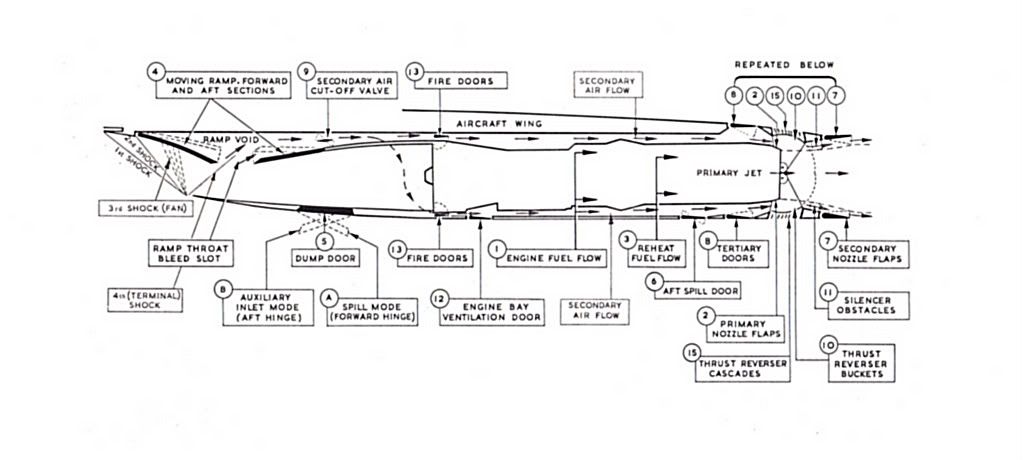
The original secondary nozzle was 'freely floating, with no actuation; the thrust revereser itself was a pair of cascade doors, driven by an air motor. Tertary air doors opened at low speeds to admit ambient air into the nozzle anulus, instead of the eyelids of the later 'buckets'.
If you look at the diagram below you can see what a complicated animal the prototype powerplant was. The intake dump door (alternative name for spill door) was hinged both at the front AND the rear; either hinge mechanisms automatically releasing at specific Mach numbers. It was the mechanical nightmare that the diagram suggesrs.
Dude
Last edited by M2dude; 9th October 2010 at 21:54 .
Subjects
Intakes
Nozzles
Rolls Royce
Thrust Reversers
Links are to this post in the relevant subject page so that this post can be seen in context.
Reply to this quoting this original post. You need to be logged in. Not available on closed threads.
October 24, 2010, 22:18:00 GMT
permalink Post: 6015446
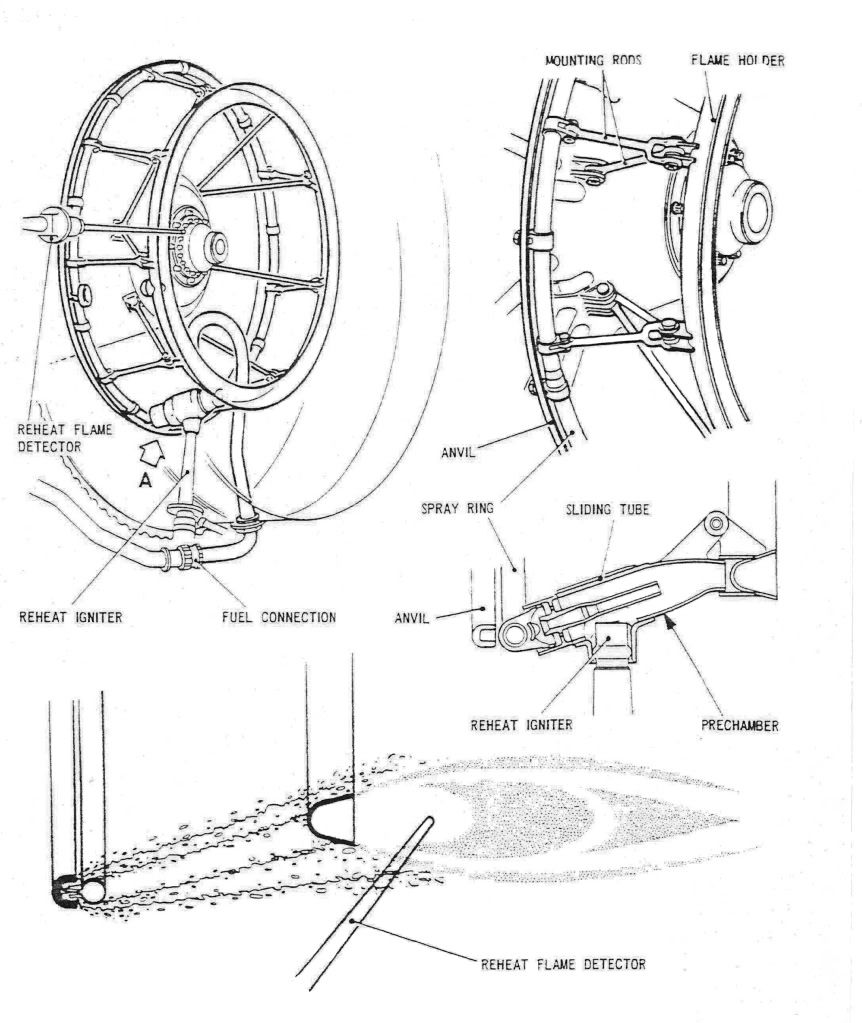
 Concorde Reheat

As promised, here are a few diagrams of the Concorde reheat (afterburner, for our American friends) system. The ORIGINAL design was done by SNECMA, but due to them getting into all sorts of trouble with the fuel injection system and flame stabilisation, Rolls Royce baled them out, and it became a Rolls Royce/SNECMA design. (The core engine was a 100% Rolls design, with no French input whatsoever. However some engine sub-assembles were manufactured by SNECMA).
The basic way the afterburner worked was by spraying the fuel FORWARDS intially at high pressure, against the jet stram about one inch, until it hit the anvil. . As the fuel strikes the anvil it is blown back by the jet stram and atomises, passing over the of the spray ring and the over the flame holder. The ignition operated by passing 15KV across a dual cylindrical tube, the resulting arc was 'swirlied' into the fuel stream by blowing engine 5th stage HP compressor air into the tube (there were 7 stages in all).
The key to successful ignition was a healthy spark, a good supply of air to the ignitor and accurate scheduling of fuel flow. (This was scheduled against dry engine flow as a funtion of total temperature). The other important factor (as with any afterburner) was correct and rapid operation of the exhaust nozzle. Fortunately, Concorde used it's primary nozzle for control of engine N1 anyway, so adapting this to operate as an afterburning nozzle also was a relative walk in the park, and it operated superbly.
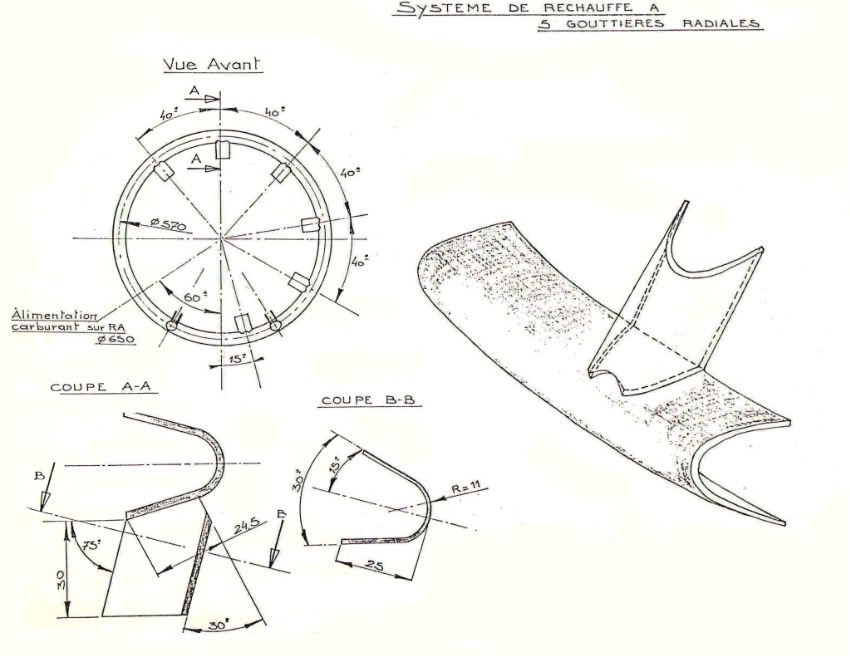
During the light up phase of 3.5 seconds, the fuel ratio is a fixed 0.45 (ie. reheat fuel is 45% of dry fuel). After the light up phase the full scheduling commenced. As far as the FLIGHT RATING figures go (not take-off) the ratios were 0.6 at a TAT of 54 deg's C, falling linearly to 0.3 at 107 deg's C and above. (Remember that Concorde used afterburning really sparingly, just for take-off and then transonic acceleration; cut off at Mach 1.7 altogether.
Dude
Subjects
Afterburner/Re-heat
Fuel Burn
HP Compressor
Ignitors
N1 (revolutions)
Nozzles
Rolls Royce
TAT (Total Air Temperature)
Transonic Acceleration
Links are to this post in the relevant subject page so that this post can be seen in context.
Reply to this quoting this original post. You need to be logged in. Not available on closed threads.
October 25, 2010, 22:06:00 GMT
permalink Post: 6017288
 ) it was 2 1/2 minutes. (The only time that I can recall the limit being accidently exceeded we told Rolls Royce who after a few minutes of head scratching came back with a 'no problem man, don't worry about it
).
) it was 2 1/2 minutes. (The only time that I can recall the limit being accidently exceeded we told Rolls Royce who after a few minutes of head scratching came back with a 'no problem man, don't worry about it
).
Regards
Dude
Last edited by M2dude; 25th October 2010 at 22:22 .
Subjects
Rolls Royce
Links are to this post in the relevant subject page so that this post can be seen in context.
Reply to this quoting this original post. You need to be logged in. Not available on closed threads.
October 28, 2010, 05:31:00 GMT
permalink Post: 6022071
norodnik
I can not personally recall a triple reheat fail ever happening, as Bellerophon explained in his answer to your post, but I can recall one occasion several years ago where the 15 minute time limit was inadvertantly exceeded for a couple of minutes. This was reported to both Rolls Royce and SNECMA, but no checks etc were instigated. The reheat ignition system, as I posted previously, was far too fragile; we did some investigations with Rolls Royce about 15 years ago into using 'hot streak' injection as a backup ignition source, but this was ruled out on cost grounds.
Dude
Last edited by M2dude; 28th October 2010 at 06:04 .
Subjects
Afterburner/Re-heat
Rolls Royce
Links are to this post in the relevant subject page so that this post can be seen in context.
Reply to this quoting this original post. You need to be logged in. Not available on closed threads.
October 29, 2010, 16:11:00 GMT
permalink Post: 6025385
rod

Subjects
Rolls Royce
Sir Stanley Hooker
Links are to this post in the relevant subject page so that this post can be seen in context.
Reply to this quoting this original post. You need to be logged in. Not available on closed threads.
October 29, 2010, 16:25:00 GMT
permalink Post: 6025418
Now as far as the rumour goes, I'm afraid that it is nonsense, however the truth is an even more complex story of collusion, betrayal and intrigue. You may read that 'Concorde was retired by BA and Air France purely due to economic reasons', however that is not quite the case (and as far as THIS side of the English Puddle goes, is total poppycock!!). Now BA lost a huge amount of her regular traffic as a result of the 9/11 tragedy and also as a result of the 2003 Iraq war, but things were improving nicely. In her 27 years of operation, Concorde had survived countless dips in her traffic, only to return stronger as market conditions improved.
It is early 2003, and French Concorde traffic to the USA has almost vanished, down to single digit loads. This is due mainly to total French opposition the impending US/UK invasion of Iraq, and US businessmen using BA Concorde almost exclusively. (French business seems to be boycotting the US altogether, so their contribution to passenger loads virtually ceased). Due to the apalling loads, AF are losing absolutely MILLIONS of Euros, at a time when the carrier is trying to privatise itself ... but there is more:
In the same February, AF very nearly lost ANOTHER Concorde, yet again largely down to total incompetence and lack of adherence to established procedures. Aircraft F-BTSD was flying between CDG and JFK when there was a failure of the reheat delivery pipe that runs from the engine 1st stage fuel pump to the reheat shut-off valve. This failure, although not particularly serious, led to a chain of events that very nearly resulted in the loss of the aircraft, and all those onboard. (Air France engines were overhauled seperately to BA, who never experienced this particular failure). What was required in the case of this failure was a precautionary engine shut-down, closing off the fuel supply to the engine totally, and a descent/deceleration to subsonic speed, carefully monitoring fuel consumption all the time. Unfortunately the crew 'forgot' to shut down the fuel LP valve, and this resulted in the fuel continuing to gush out of the failed pipe at an alarming rate. (Oh, and also they forgot to monitor the fuel consumption). Only after the crew FINALLY noticed that they were still losing fuel did they remember to close the engine LP valve, but it was almost too late. The aircraft just managed to land in Halifax, with barely enough fuel left in the tanks to taxi!! So, herer we are, AF are horrified that they have come very close to yet another disaster, knowing full well that yet again human error was a major factor.
But there is more....
One week later another AF aircraft loses part of a rudder panel due to de-lamination of the honeycomb surface, not particularly serious in itself, but it put even more jitters up the trousers of AF. (Rudder failures had happened to BA aircraft many years previous to this, but BA had purchased brand new and improved rudders from Airbus UK in Filton, but Air France chose not too).
So it seems that the chairmen of both Air France and Airbus (who regards Concorde as a waste of its valuable resources) have a 'secret' meeting to plan what was effectively the murder of Concorde. There is no way that AF want BA to carry on flying Concorde while they have to cease operations, so the plan is for Airbus to make a huge hike in their product support costs; these costs would have to be borne by BA exclusively, which they both knew would not be possible. If these support costs were not met, there would be no manufacturers support, and without this there would be no type certificate, and without this, no more Concorde.
Their (AF & Airbus) hope was that BA would not challenge this move legally, and sadly for the world of aviation they did not. At a meeting, BA AND AIR FRANCE!!!! were told by Airbus about the hike in product support costs, and BA would also have to cease operations. BA were not even allowed to continue until March 2004 (the Barbados season was nearly fully booked already), and so would have to cease operations in October 2003.
But the British were far from blameless in all this; a now retired very senior British airline person had always obsessively HATED Concorde, so the French conspiracy was a very early Christmas present for him; he finally got what he had always wanted. The 'end of Concorde' anouncement by both airlines was made in April 2003; AF had got what their executives wanted and finished flying in May, reluctantly leaving BA to fly until late October. If you want a full (and extremely well informed) explanation of what happened in that whole debacle, the article by Don Pevsner is worth reading. It can be found at this website:
THE BETRAYAL OF CONCORDE
There is absolutely no doubt in my mind that without the truly disgusting events in France in early 2003, Concorde would still be proudly flying for BA. (And with modifications and enhancements would fly safely for many more years).
quote** "in the hands of true professionals, Concorde was the safest aircraft that ever flew. and in the hands of BA crews at least, she was always just that..*
Oh and yes you were correct, the Olympus (the world's first ever 2 spool engine) was originally a 'Bristol-Siddeley' design, before BS were absorbed into Rolls-Royce. Stanley Hookers book is in my view totally superb, a true classic.
Dude
Last edited by M2dude; 29th October 2010 at 16:52 . Reason: spelling (yet again) :-(
Subjects
Afterburner/Re-heat
Air France
Air France 4590
Airbus
Barbados
British Airways
CDG
Engine Shutdown
F-BTSD
Filton
Fuel Pumps
JFK
Rolls Royce
Rudder
Sir Stanley Hooker
Links are to this post in the relevant subject page so that this post can be seen in context.
Reply to this quoting this original post. You need to be logged in. Not available on closed threads.
October 29, 2010, 16:31:00 GMT
permalink Post: 6025434
You're right, it was the Me163 that was rocket-powered using a hydrazine-based fuel.
I think the "Me162" in the early post was a simple typo, or an unintentional confusion with either the Me262 or the He162.
jodeliste ,
The original design was indeed by Bristol Aero Engines, which then became Bristol Siddeley. But the latter was taken over by Rolls Royce in 1966, so by the time Concorde first flew, it already had become a Rolls Royce engine.
CJ
Subjects
Bristol Siddeley
Rolls Royce
Links are to this post in the relevant subject page so that this post can be seen in context.
Reply to this quoting this original post. You need to be logged in. Not available on closed threads.
October 29, 2010, 19:13:00 GMT
permalink Post: 6025777
1] They deviate from the checklist as was suggested in the crash
OR
2] Stick to the checklist as in this case
And although I might have said 'precautionary engine shut-down', we are talking about a quite an eventful episode here indeed, you can NOT excuse the further mistakes made on that day, 'just because they are poor old Air France. With the greatest of respect Brit, there are 3 crew members on that flight deck, do you not think that the loss of over over 5 tonnes of fuel over a period of time might just be noticed????? The subsonic 3 engined leg was carried out for quite a time before it computed to them that they were still losing fuel. There is no excuse for flying with your eyes closed, I'm sorry.
For goodness sake, this is probably the biggest single episode that was behind the demise of Concorde, poor Air France my eye!!!

Dude
Last edited by M2dude; 29th October 2010 at 22:55 . Reason: more spelling :-(
Subjects
Air France 4590
Checklists
Engine Shutdown
Engine surge
Hydraulic
Intakes
N1 (revolutions)
Rolls Royce
Links are to this post in the relevant subject page so that this post can be seen in context.
Reply to this quoting this original post. You need to be logged in. Not available on closed threads.
October 31, 2010, 21:06:00 GMT
permalink Post: 6029944
As a grotty old engineer I tend to lack the subtlety and diplomatic skills of you guys, but this coming at the end of such a long catalogue of gross errors, this possibly last straw in the life of Concorde was in my view also the very last straw in terms of these serious procedural failures too.
There are so many events in Concorde's history that we would like to 'roll back the clock' on, but this extremely pivotal one has to be just about at the top of a very big pile (save of course for the Gonesse tragedy).
Dude
Last edited by M2dude; 31st October 2010 at 22:06 .
Subjects
Air France
Air France 4590
Engine surge
Rolls Royce
Links are to this post in the relevant subject page so that this post can be seen in context.
Reply to this quoting this original post. You need to be logged in. Not available on closed threads.
November 05, 2010, 11:56:00 GMT
permalink Post: 6040606
Way back in the late 1970's we did a major modification to the intakes that increased capture area by 2.5% and gave us typically a 1.6% improvement in trans-Atlantic fuel burn, and although this was our biggest performance improvement modification, there were more:
The famous elevon and rudder trailing edge extension modifications (that due to poor design, produced in later life the water ingress induced honeycomb failures) together with the re-profiled fin leading edge modification, I never saw the performance gains quantified (anyone have any ideas?).
Can anyone here remember the riblet trial? In the mid 1990's Airbus supplied 'stick on' plastic riblets, applied to various areas on the under-side of the wing on G-BOAG. These riblets had very fine undulations moulded into the surface; the idea being that as the air flowed through and around the riblet patches, boundary layer turbulence, and hence induced drag would be reduced. Now, the performance gains (if any) were never quantified, mainly because the riblet patches either peeled off or the surface deteriorated with the continuous thermal cycle. (I was over in JFK when the aircraft first arrived after having the riblets fitted, and as the crew were trying to proudly show me these amazing aerodynamic devices, they were sadly embarassed, as several had dissapeared in the course of a single flight).
There was one modification, proposed by Rolls Royce in the late 1990's that did have quite a lot of potential; this was to increase the engine N1 by around 1.5%. This would have had the effect of increasing engine mass flow and therefore reducing the drag inducing spill of supersonic air over the lower lip of the intake. Depending on the temperature, the performance gains were in the order of a 1.5% improvement in fuel burn at ISA Plus upper atmosphere temperatures ('normal' LHR-JFK) to none at all at significant ISA Minus temperatures (LHR -BGI). The modifacation had been trialed on G-BBDG before her retirement in the early eighties, and was proven in terms of performance enhancement and engine stability. In order to keep TET at the pre-modification level, there was a small increase in N2 commanded also. (The higher N1 required an increase in primary nozzle area, reducing TET). The main reason for the modification not being implemented was one of cost; The Ultra Electronics Engine Control Units were analog units, and the modification was a simple replacement of two resistors per unit. However because ultimate mass flow limitation was also controll by the digital AICU (built by British Aerospace Guided Weapons Division) the cost of getting a software update for this exremely 'mature' unit was found to be prohibitive.
A certain 'brainy' SEO and myself were working on a modification to improve fuel burn on ISA minus sectors. The idea was to force the autopilot, in Max Cruise at low temperatures only , to fly the aircraft close to Mmo, rather than at Max Cruise speed of Mach 2 - 2.02; this would have given us gains of up to 1%, depending on the temperature. The basic electronics involved for the modification were relatively straightforward, but it was never pursued due to the complexity of dealing with temperature shears and the cost of certification.

Dude
Last edited by M2dude; 5th November 2010 at 15:49 .
Subjects
AICU (Air Intake Control Computer)
Airbus
Auto-pilot
Elevons
Fuel Burn
G-BBDG
G-BOAG
Intakes
JFK
LHR
LHR-JFK Route
Mmo
N1 (revolutions)
Nozzles
Rolls Royce
Rudder
Temperature Shear
Links are to this post in the relevant subject page so that this post can be seen in context.
Reply to this quoting this original post. You need to be logged in. Not available on closed threads.
November 07, 2010, 00:09:00 GMT
permalink Post: 6044263
Ahh yes, the super hi-tech 'HUD'. It was right up there with the 'eye level datum' indicator and not to forget, the reheat capabiliy indicator in terms of sophistication. (Extremely reliable though
 ).
).
As far as 3 engined ferries went; well NW1, not sure if you'd call me seasoned or just just clapped out and wrinkly, but it did happen a very few times in days of yore, mostly from SNN back to LHR. There were at least two; OAF in 1980 when she had the infamous LP1 blade fail (and Monty Burton's immortal words during the 'event' "what *** ing drill?). The second one that I can remember was OAA in 1991 when there was another far less serious compressor blade failure. In each case for the ferry flight, the broken engine was 'swaged' to prevent it windmilling and the aircraft would be flown back to the LHR garage by a management crew. There was however another required ferry measure as well as the engine swaging, this measure was to prevent the good engines going into contingency, due to the very slightly flamed out dead 'donk'. This procedure required the Engine Speed Unit to be removed from the electronics rack and a special jumper plug fitted in it's place (without the jumper fitted the start switch would never latch in. In this case also the E/O would also need to manually disengage the start switch at 25% N2). I have to admit that I never in my life ever saw this jumper plug, and in the cases that I can remember the aircraft departed SNN with the three engines at contingency. I remember that the case of OAA back in '91 most certainly was; I was flown out to SNN equiped with a pile of circuit diagrams and test boxes to investigate what we all thought was just a surge related engine shutdown. only to find a slightly more hairy state of afairs, with a very broken engine indeed. As a matter of interest, this particular failure was the only one ever in the history of Concorde in BA attributed to the engine having run for a protracted time in rotating stall. (This had happened on the previous day). A lot was learned by both BA and Rolls Royce after this event, and this failure never occured again.
Dude
Last edited by M2dude; 7th November 2010 at 01:34 .
Subjects
Afterburner/Re-heat
British Airways
Engine Shutdown
Engine surge
HUD (Head Up Display)
LHR
Rolls Royce
Rotating (engine) Stall
Links are to this post in the relevant subject page so that this post can be seen in context.
Reply to this quoting this original post. You need to be logged in. Not available on closed threads.