December 20, 2010, 06:11:00 GMT
permalink Post: 6132575
Thread on the Concorde inlets here http://www.pprune.org/tech-log/42690...ke-thrust.html
Subjects
Intakes
SR-71
Skin Temperature
Links are to this post in the relevant subject page so that this post can be seen in context.
Reply to this quoting this original post. You need to be logged in. Not available on closed threads.
January 15, 2011, 00:27:00 GMT
permalink Post: 6180385
Serious question now. At 60,000 feet outside and 6,000 feet inside, what was the PSI pressure the cabin was subjected to? If I was clever I could probably work it out, but I'm not.

Subjects
Skin Temperature
Links are to this post in the relevant subject page so that this post can be seen in context.
Reply to this quoting this original post. You need to be logged in. Not available on closed threads.
April 27, 2012, 17:17:00 GMT
permalink Post: 7159426
1) I undertsnd that skin temperature is calculated from OAT and Mach number. Why wasn't it simply measured directly by sensors on the nose skin?
2) The Air Data Computer calculates Mach (so skin temp is a calculation on a calculation!). Presumably one parameter it uses is IAS. What else is used in the calculation of Mach?
Subjects
IAS (Indicated Air Speed)
Skin Temperature
Links are to this post in the relevant subject page so that this post can be seen in context.
Reply to this quoting this original post. You need to be logged in. Not available on closed threads.
April 27, 2012, 17:37:00 GMT
permalink Post: 7159449
2) AFAIK pretty standard:
Q from pitots
S from statics
T from temp probe
Modified by ADC for position error. It's possible that ADC used beta inputs and I'm sure it used alpha inputs to achieve this.
Subjects
ADC (Air Data Computer)
Skin Temperature
Stagnation Point
TAT (Total Air Temperature)
Links are to this post in the relevant subject page so that this post can be seen in context.
Reply to this quoting this original post. You need to be logged in. Not available on closed threads.
April 27, 2012, 20:29:00 GMT
permalink Post: 7159636
2) AFAIK pretty standard:
Q from pitots
S from statics
T from temp probe
Modified by ADC for position error. It's possible that ADC used beta inputs and I'm sure it used alpha inputs to achieve this.
1) So there is a direct temp reading, from the TAT probe. But where is TAT probe? Is it in the needle nose probe that also measures pitot/static for the intake computers? And how many TAT sensors are there (failure of a single one if that's all there is would not be good)?
2) Mach comes from dynamic pressure (pitots), from static ports, and from temp. But what temp? OAT perhaps?
Subjects
ADC (Air Data Computer)
Intakes
Skin Temperature
Stagnation Point
Static Ports
TAT (Total Air Temperature)
Links are to this post in the relevant subject page so that this post can be seen in context.
Reply to this quoting this original post. You need to be logged in. Not available on closed threads.
April 28, 2012, 10:03:00 GMT
permalink Post: 7160309
Can you confirm just how that tells the crew the skin temp? Are there no direct-reading temp sensors on or under the nose skin or in the probe?
Subjects
Skin Temperature
Links are to this post in the relevant subject page so that this post can be seen in context.
Reply to this quoting this original post. You need to be logged in. Not available on closed threads.
April 28, 2012, 10:15:00 GMT
permalink Post: 7160324
There was, so far as I recall, no measure of skin temperature - the aircraft limit (Tmo) was simply based on a measured TAT of 400 degK. The implied limits on skin temperature at various points were built into the design cases.
Subjects
Skin Temperature
TAT (Total Air Temperature)
TMO (Temprature Max Operating)
Links are to this post in the relevant subject page so that this post can be seen in context.
Reply to this quoting this original post. You need to be logged in. Not available on closed threads.
April 28, 2012, 20:53:00 GMT
permalink Post: 7161084

So the TAT probe provides TAT (obviously) which effectively is skin temp (as evidenced by the TMO legend of 127C just below the TAT window?).
(TAT being static air temp plus the temp due adiabatic heating).
Last edited by Shaggy Sheep Driver; 28th April 2012 at 21:14 .
Subjects
Skin Temperature
TAT (Total Air Temperature)
TMO (Temprature Max Operating)
Links are to this post in the relevant subject page so that this post can be seen in context.
Reply to this quoting this original post. You need to be logged in. Not available on closed threads.
April 28, 2012, 21:49:00 GMT
permalink Post: 7161147
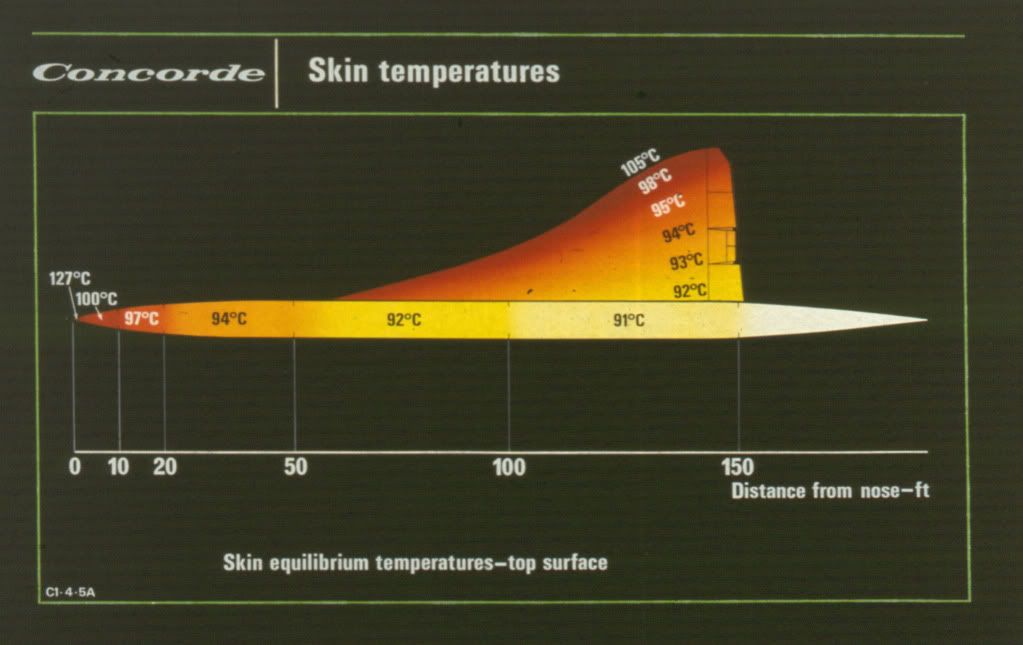
Not exactly skin temperature, just the maximum temperature on the nose. The rest of the aircraft was cooler.
Subjects
Skin Temperature
Links are to this post in the relevant subject page so that this post can be seen in context.
Reply to this quoting this original post. You need to be logged in. Not available on closed threads.
April 28, 2012, 22:25:00 GMT
permalink Post: 7161182
Not exactly skin temperature, just the maximum temperature on the nose. The rest of the aircraft was cooler.
So TAT is skin temp at the probes, which are rearward of the hottest skin according to that diagram. Was there a 'compensation' built into the TAT readout to account for the relatively rearward position of the TAT probes?
And.. How was static temp readout derived?
Sorry to keep asking, but I really want to understand this!
Thanks.
Last edited by Shaggy Sheep Driver; 28th April 2012 at 22:45 .
Subjects
Skin Temperature
TAT (Total Air Temperature)
Links are to this post in the relevant subject page so that this post can be seen in context.
Reply to this quoting this original post. You need to be logged in. Not available on closed threads.
April 29, 2012, 08:11:00 GMT
permalink Post: 7161595
And.. How was static temp readout derived?
They are mounted off the skin and in freestream, so they measure the same temperature as would a probe on the nose.
Somewhere near the nose (not exactly on it, as the aircraft flies with a small AoA) there will be a 'stagnation' streamline where the oncoming air is brought to rest. At this point the skin temperature will be equal to the stagnation temperature (TAT). Behind that it gets more complicated! The skin temperature would depend on SAT, local Mach No, local skin friction coefficient (Mach and Re dependent, so varies with distance from nose), amount of heat radiated into space (paint colour!) and the amount of structure available to conduct heat away from the skin into the fuel (so roughly varying with thickness/chord and fuel distribution perhaps?
Static temperature and total temperature are related by a simple expression:
TAT = SAT *(1+0.2m^2) all in deg K
So in the troposphere at ISA +5 and Mach 2, SAT = 222 and TAT = 400.
Subjects
AoA
Skin Temperature
Stagnation Point
TAT (Total Air Temperature)
Links are to this post in the relevant subject page so that this post can be seen in context.
Reply to this quoting this original post. You need to be logged in. Not available on closed threads.
May 03, 2012, 15:13:00 GMT
permalink Post: 7169165
They are mounted off the skin and in freestream, so they measure the same temperature as would a probe on the nose.
Somewhere near the nose (not exactly on it, as the aircraft flies with a small AoA) there will be a 'stagnation' streamline where the oncoming air is brought to rest. At this point the skin temperature will be equal to the stagnation temperature (TAT). Behind that it gets more complicated! The skin temperature would depend on SAT, local Mach No, local skin friction coefficient (Mach and Re dependent, so varies with distance from nose), amount of heat radiated into space (paint colour!) and the amount of structure available to conduct heat away from the skin into the fuel (so roughly varying with thickness/chord and fuel distribution perhaps?
The temperature shown in the top window of the flight deck gauge is TAT, with the legend 'TMO 128C' beneath it. So the aircraft was flown with reference to TAT, and provided TAT was no greater than 128C then the skin rearward of the stagnation point would be <128C?
Subjects
AoA
Skin Temperature
Stagnation Point
TAT (Total Air Temperature)
TMO (Temprature Max Operating)
Links are to this post in the relevant subject page so that this post can be seen in context.
Reply to this quoting this original post. You need to be logged in. Not available on closed threads.
May 15, 2012, 10:03:00 GMT
permalink Post: 7190732
The temperature shown in the top window of the flight deck gauge is TAT, with the legend 'TMO 128C' beneath it. So the aircraft was flown with reference to TAT, and provided TAT was no greater than 128C then the skin rearward of the stagnation point would be <128C?
MACH 0.5 . ISA -5: TAT = -50.6 \xb0 C . ISA: TAT = -45.3 \xb0 C. ISA +5 TAT = -40 \xb0 C
MACH 1.0 . ISA -5: TAT = -18.5 \xb0 C . ISA: TAT = -12.5 \xb0 C. ISA +5 TAT = -6.5 \xb0 C
MACH 1.5 . ISA -5: TAT = 34.8 \xb0 C . ISA: TAT = 42 \xb0 C. ISA +5 TAT = 49.3 \xb0 C
MACH 2.0 . ISA -5: TAT = 109.5 \xb0 C . ISA: TAT =118.6 \xb0 C. ISA +5 TAT = 127.6 \xb0 C
Hopefully it all makes a little more sense with some 'real' numbers. You can see that as Mach Number increases the gap between SAT and TAT increases hugely. The Mach 2, ISA +5 case was particularly significant for Concorde, as it breached the 127 \xb0 C/400 \xb0 K airframe temperature limit (TMO) and Mach Number would therefore be automatically reduced by the autopilot. (An overspeed warning would be generated at TMO +7 (134. \xb0 C). Fortunately sustained ISA +5 or above conditions were relatively rare over the North Atlantic but not unheard of either.
Last edited by M2dude; 16th May 2012 at 23:06 . Reason: ISA+5 Typo
Subjects
Auto-pilot
Skin Temperature
Stagnation Point
TAT (Total Air Temperature)
TMO (Temprature Max Operating)
Links are to this post in the relevant subject page so that this post can be seen in context.
Reply to this quoting this original post. You need to be logged in. Not available on closed threads.
April 03, 2015, 19:33:00 GMT
permalink Post: 8931947
I am afraid I have only been on Concorde around a dozen times, and as I live a few miles from Duxford, you'll probably guess that's 101 now in Hangar 1. Standing in the cabin I can only imagine the experience of actually flying in her, but you guys have certainly bought her back to life in my mind at least.
While reading the thread I came up with many questions (around ten or so) and these have been answered in later exchanges on the thread, however I do have a few left over:
1. The speed freak in me always wants to know "how fast"? Notwithstanding the principles outlined on p.55 by CliveL and M2Dude, if the intake system were somehow made "more leaky" and reheat were applied, in theory at least, how much more thrust could the 4 engines produce, in "ideal" conditions (I saw somewhere that -80C had been encountered)? If you then extrapolate the drag, what sort of peak Mach number might be attainable in short bursts (ignoring for now the detrimental effect on the airframe?)
2. There was a discussion or two of the (highly theoretical, expensive and unlikely) prospect of restoring one of the airframes back to flight around p22. However I don't think I saw 101 or 102 mentioned in any of these discussions, are these even further 'gone' (101 having sat outside for 20 years)? On the other hand, would the lack of sponge-like insulation mean less corrosion might have set in?
3. Again on p.55 there is mention of (naff) paint schemes and their bad effect on skin temperature. Was the paint on Concorde specifically chosen to radiate infrared (for example) to help cooling? The SR-71 (which I also visit at Duxford regularly - how lucky am I!) of course is matt black, which presumably radiates even better? When the airframe attained thermal equilibrium at the top of the cruise, what were the relative contributions to cooling of: radiation, cold uncompressed air passing over parts of the skin, the internal aircon (cooling from the inside), etc?
4. M2Dude referred a couple of times to robbing spares from other airframes. Spares that may have been 5-8 years old? What sort of testing regime must these spare parts go through to ensure they are still fit for flight? Is it labour-intensive?
If I can opine (at the risk of having M2Dude chastise me if he still reads this - as I am not staff) the computer he mentioned on page 37 sounds to me very much like a "bit slice" computer. These were typically constructed from discrete logic and quite often had very long words - 64 or 128 bits. I only ever saw one of these in my 30-year career in computing, a rare beast indeed. And yes I remember that Mil Spec TTL - back in the day I used to pop the lid off the ceramic packages and you can look at the gates, and even watch the silicon glow if you apply a bit too much Vcc! But I digress.
Thanks again for a fascinating thread.
Last edited by a_q; 4th April 2015 at 20:12 .
Subjects
Afterburner/Re-heat
Corrosion
Intakes
Radiation Exposure
SR-71
Skin Temperature
Links are to this post in the relevant subject page so that this post can be seen in context.
Reply to this quoting this original post. You need to be logged in. Not available on closed threads.