December 18, 2010, 15:20:00 GMT
permalink Post: 6129540
Speedbird 2, cleared take-off 31L.
You call 3-2-1 Now , start your stopwatch, pre-set to countdown from 58 seconds, and slam the throttles fully forward till they hit the stops. Four RR Olympus engines start to spool up to full power and four reheats kick in, together producing 156,000 lbs of thrust, but at a total fuel flow of 27,000 US gallons per hour. A touch of left rudder initially to keep straight, as the #4 engine limiter is limiting the engine to 88% until 60 kts when it will release it to full power. The F/O calls Airspeed building, 100 kts, V 1 , and then, at 195 kts, Rotate . You smoothly rotate the aircraft, lift-off occurs at around 10\xb0 and 215 kts. You hear a call of V 2 but you keep rotating to 13.5\xb0 and then hold that attitude, letting the aircraft accelerate.
The F/O calls Positive Climb and you call for the Gear Up . On passing 20 feet radio height, and having checked the aircraft attitude, airspeed and rate of climb are all satisfactory, the F/O calls Turn and you slowly and smoothly roll on 25\xb0 left bank to commence the turn out over Jamaica bay. Some knowledgeable passengers will have requested window seats on the left side of the aircraft at check-in, and are now being rewarded with a very close look at the waters of Jamaica Bay going by very fast! As you accelerate through 240 kts, the F/O calls 240 and you pitch up to 19\xb0 to maintain 250 kts and keep the left turn going to pass East of CRI.
54 seconds from the start of the take off roll you hear the F/O counting down 3-2-1 Noise whereupon the F/E cancel the re-heats and simultaneously throttles back to noise abatement power, around 96% as you pitch the nose down to 12\xb0 to maintain 250 kts. It is less than a minute from start of roll and already 435 US gallons of fuel have been used.
Speedbird 2, contact departure, so long.
Turning through heading 235\xb0M, the F/E quickly re-applies full dry power as you pitch up to 17\xb0 to maintain 250 kts, but simultaneously reduce the left bank to 7.5\xb0, in order to increase both the radius of turn (to stay on the optimum noise abatement track) and the rate of climb (less bank, higher RoC).
On climbing through 2,500 ft you increase the bank angle back to 25\xb0 left bank and as you approach the 253\xb0 radial JFK, you hear 3-2-1 Noise from the F/O for the second time. The F/E actions the second noise-abatement power cut back, you pitch down to 12\xb0 and, if not in cloud, sneak a quick peek out of your left hand window, looking for the car park by the Marine Parkway bridge, as you would ideally like to pass right over the car park, if possible, as we tip-toe quietly across the Rockaway Beaches, in order to minimise the noise impact on the residents.
Keep the left turn going and intercept the 176\xb0 radial outbound from CRI, and at 5 miles DME from CRI, call for the F/E to slowly re-apply full climb power as you pitch up to maintain 250 kts. We are still in US territorial airspace, below 10,000 ft, and subject to statutory speed control.
Speedbird 2, present position direct to SHIPP, climb FL230, no speed control.
The F/O selects direct SHIPP in the INS and tells you that she has selected that information into your Flight Director. Having checked that the gear lever is at neutral, you call for the Nose Up , and then the Visor Up . Flight deck noise levels drop dramatically as the Visor locks up. Now more than 12 miles away from the coast, we are clear of US speed control requirements so lower the attitude to 9\xb0, accelerate to V MO , currently 400 kts, and ask for the After Take Off Checks.
Speedbird 2, present position direct to LINND, climb in the block FL550-600, accelerate Mach 2.0
Call for the Climb Checklist at Mach 0.7, which will trigger the F/E to start pumping fuel rearwards to move the CG aft, then when he's done that, straight into the Transonic Checklist . Maintain 400 kts IAS, and around 24,500 ft, at M0.93, ask for the re-heats back on, in pairs, and raise the nose by 3\xb0 to maintain 400 kts as they kick in.
Precise, smooth flying is required through the high drag transonic region, as the mach meter creeps up towards Mach 1. A sudden flicker on the VSI and Altimeter confirms that the shock wave has just passed over the static ports, and the aircraft is now supersonic. A quick glance at the elapsed time indicator shows that you\x92ve been hand flying for just over 9 minutes since the start of the take off roll.
Another fun start to a day in the office, and to think we got paid for doing it!
Best Regards
Bellerophon
Subjects
Afterburner/Re-heat
C of G
Checklists
Fuel Burn
Hand Flying
IAS (Indicated Air Speed)
INS (Inertial Navigation System)
JFK
Noise Abatement
Rolls Royce
Rudder
Static Ports
V1
V2
Visor
Links are to this post in the relevant subject page so that this post can be seen in context.
Reply to this quoting this original post. You need to be logged in. Not available on closed threads.
January 28, 2011, 20:39:00 GMT
permalink Post: 6209589
Subjects
Intelligent Television and Video
Static Ports
Links are to this post in the relevant subject page so that this post can be seen in context.
Reply to this quoting this original post. You need to be logged in. Not available on closed threads.
January 28, 2011, 20:59:00 GMT
permalink Post: 6209625
Dynamic pressure is what the pitot heads produce - those forward-pointing tubes either under the wings or (as in the case of Concorde) alongside and on the nose which simply measure the pressure of the air generated by the aircraft's forward movement through the air.
By the way - engine bay doors; we open one on OAC for our Technical Tours (not the shorter, 'Classic', tours where there wouldn't be time) so we can show the 593 Olympus and tell our visitors about it. Those doors certainly are heavy!
Subjects
Olympus 593
Static Ports
Links are to this post in the relevant subject page so that this post can be seen in context.
Reply to this quoting this original post. You need to be logged in. Not available on closed threads.
January 28, 2011, 22:19:00 GMT
permalink Post: 6209746
When passing Mach 1, the nose shock wave moves rearwards, and passes over the static ports.
As a result, there is a "twitch" on both the altimeter (barely visible) and on the VSI (verical speed indicator, very visible) when exceeding Mach 1.
People on another (French) forum were asking about the engines on G-BOAC...
Are they still all in place? Or were any dropped for display outside the aircraft?
CJ
Subjects
G-BOAC
Olympus 593
Static Ports
Links are to this post in the relevant subject page so that this post can be seen in context.
Reply to this quoting this original post. You need to be logged in. Not available on closed threads.
January 30, 2011, 07:35:00 GMT
permalink Post: 6212066
As a result, there is a "twitch" on both the altimeter (barely visible) and on the VSI (verical speed indicator, very visible) when exceeding Mach 1.
CL
Subjects
Static Ports
Links are to this post in the relevant subject page so that this post can be seen in context.
Reply to this quoting this original post. You need to be logged in. Not available on closed threads.
January 30, 2011, 09:43:00 GMT
permalink Post: 6212195
The air intake system, although it used Ps from THREE sources (the side static ports and the static ports built into the nose probe; this being a pressure head and not just a pitot as were the side probes) did not apply any individual aircraft corrections, it just made different corrections between side and nose pressure sources (Ps and Pt). Having a digital processor at it's heart, these corrections were signalled by using 'program pins' at the rear of the AICU rack.
As steam driven as the Concorde ADC was, when it came to RVSM implementation in the late 1990s we found that the air data system was in fact superbly accurate, and no modifications to the computers themselves were required. Such a testament to the original superb design.
Best regards
Dude

Subjects
ADC (Air Data Computer)
AICU (Air Intake Control Computer)
British Airways
Intakes
Static Ports
Links are to this post in the relevant subject page so that this post can be seen in context.
Reply to this quoting this original post. You need to be logged in. Not available on closed threads.
April 27, 2012, 20:29:00 GMT
permalink Post: 7159636
2) AFAIK pretty standard:
Q from pitots
S from statics
T from temp probe
Modified by ADC for position error. It's possible that ADC used beta inputs and I'm sure it used alpha inputs to achieve this.
1) So there is a direct temp reading, from the TAT probe. But where is TAT probe? Is it in the needle nose probe that also measures pitot/static for the intake computers? And how many TAT sensors are there (failure of a single one if that's all there is would not be good)?
2) Mach comes from dynamic pressure (pitots), from static ports, and from temp. But what temp? OAT perhaps?
Subjects
ADC (Air Data Computer)
Intakes
Skin Temperature
Stagnation Point
Static Ports
TAT (Total Air Temperature)
Links are to this post in the relevant subject page so that this post can be seen in context.
Reply to this quoting this original post. You need to be logged in. Not available on closed threads.
February 19, 2014, 12:26:00 GMT
permalink Post: 8327390
Subjects
Static Ports
Links are to this post in the relevant subject page so that this post can be seen in context.
Reply to this quoting this original post. You need to be logged in. Not available on closed threads.
February 20, 2014, 08:09:00 GMT
permalink Post: 8328956
SSD
I'm afraid I can't tell you what they actually do, but I am pretty sure they aren't part of the anemometry because those static ports are "pepperpots" mounted on specially machined and jigged flat plates. This was necessary because static pressure at Mach 2 is sensitive to local skin waviness.
Do you have a photo?
Subjects
Static Ports
Links are to this post in the relevant subject page so that this post can be seen in context.
Reply to this quoting this original post. You need to be logged in. Not available on closed threads.
February 20, 2014, 09:54:00 GMT
permalink Post: 8329078
I'll look for a photo. If I can't find one, I'll take one next time I'm with G-BOAC (next week).
There are others as well, as in the pictures below (but these are not the ones I'm referring to):
https://www.google.co.uk/search?q=co...%3B3912%3B2599
Last edited by Shaggy Sheep Driver; 20th February 2014 at 10:18 .
Subjects
G-BOAC
Static Ports
Links are to this post in the relevant subject page so that this post can be seen in context.
Reply to this quoting this original post. You need to be logged in. Not available on closed threads.
February 22, 2014, 01:48:00 GMT
permalink Post: 8332748
...I've noticed static ports under the fuselage at the back, between the engines. Are these just additional ports for the aircraft's general static pressure measurement system, or do they have a specific function?...
I'm not the right person to be answering this, and the reference diagram I'm looking at, whilst very detailed, is not particularly clear - at least to a pilot!
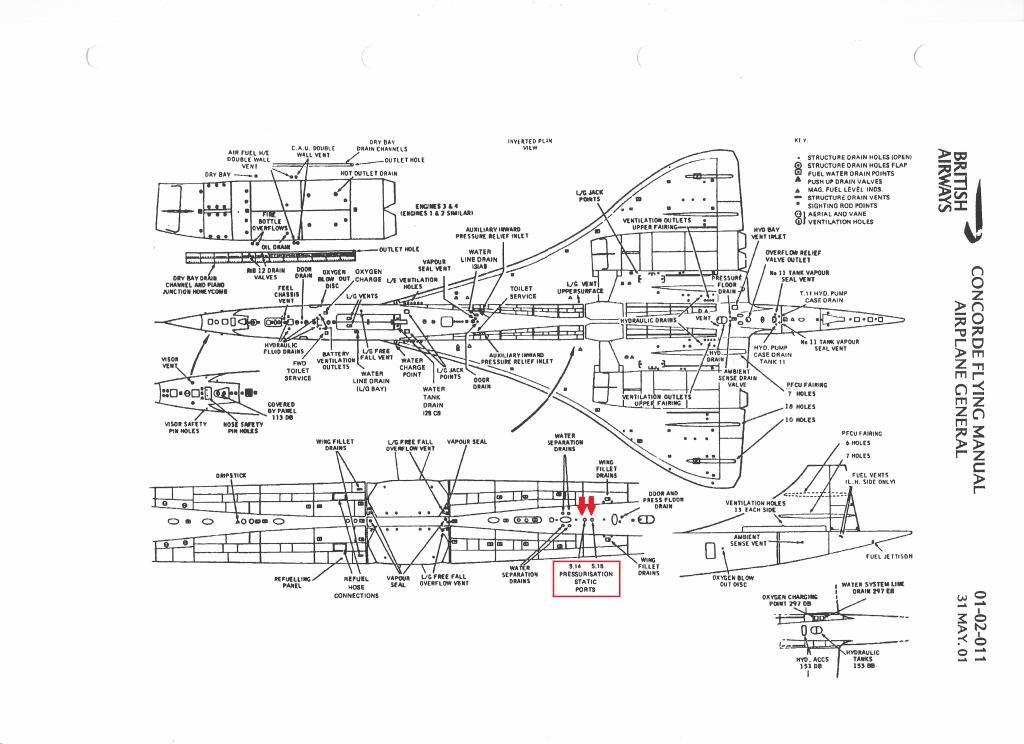
However, from your description, I wonder if they might possibly be the two pressurisation static ports that are located in that area?
Subjects
Pressurisation
Static Ports
Links are to this post in the relevant subject page so that this post can be seen in context.
Reply to this quoting this original post. You need to be logged in. Not available on closed threads.
February 22, 2014, 12:30:00 GMT
permalink Post: 8333331
S14 and S15 decode as "Pressurisation Static Ports".
Anything more than that and I'm afraid I'm out of my depth, so you'll need one of our resident engineer experts to chip in. The one I'm thinking of might be at sea at the moment!
Here's the page from the Flying Manual:
Concorde Static Ports S14 and S15
Subjects
Pressurisation
Static Ports
Links are to this post in the relevant subject page so that this post can be seen in context.
Reply to this quoting this original post. You need to be logged in. Not available on closed threads.
February 22, 2014, 13:04:00 GMT
permalink Post: 8333372
I know they aren't anything to do with AICUs but seeing where they are located and looking at Bellerephon's diagram I would think they are reference static ports for the air conditioning system - needed to monitor differential pressure.
Dude where are you when we need you?
Subjects
AICU (Air Intake Control Computer)
Static Ports
Links are to this post in the relevant subject page so that this post can be seen in context.
Reply to this quoting this original post. You need to be logged in. Not available on closed threads.