September 12, 2010, 08:57:00 GMT
permalink Post: 5929667
As far as your point about moving the CG further aft; you never had oodles of fuel to play with , and I'm sure that the guys will mention about handling the aircraft on approach with the CG too far aft. (After landing four tonnes of fuel were transferred from Tanks 5 & 7 into the empty fwd Trim Tank 9, 'to aid ground stability'. ie, help stop the aircraft from trying to sit on it's rear end as the passengers got off).
As far as your visor query goes, well the visor is either up, or retracted into the nose. The nose itself (which I suspect is what you are really referring to) would already be at the fully down 12 1/2 degree setting for landing anyway.
Oh, and back to the ground stability issue, was Concorde ever sat on it's tail by accident? Oh yes, just once to my knowledge. In May 1977, aircraft G-BOAA was returned to Filton for some modifications that were required, and part of these 'mods' was some improvements to the main trim-transfer pipes connecting the three trim transfer tanks 9, 10 & 11, as well as the trim tanks 5 & 7. Now the flow into tank 11 (the rear tank) had to be checked, but there was insufficient fuel at the front of the aircraft for stability. This shortcoming was passed on to the BAe manager in charge of everything, who stuffily refused to listen, and INSISTED that these transfer checks were carried out, 'do as I tell you, I am the manager here'. The man's sole concession to any sort of common sense was to allow a BAe employee to sit on the flight deck 'and watch the CG indicator', what the point of this was, well your guess is as good as mine. The name of the guy sitting on the flight deck was... John Thomas. (Hilarious I know, but true). So in goes the fuel, and in a very short period of time, John Thomas notices that the roof of the Filton assembly hangar seems to be slowly getting closer, and closer, and BANG!! The aircraft nose is high into the roof section of the hangar, but fortunately because the hangar is so huge, the nose did not hit anything, it was just stuck up there, complete with a very worried/terrified John Thomas who is sitting terrified in the captain's seat, staring at the hangar roof. The rear of the aircraft however was not so lucky. The right hand inner elevon came down on top of a hydraulic rig, damaging the elevon badly, as well as FLATTENING the rig. The opened #3 engine bay door came down on some large access steps, tearing the corner of the door. (not much left of the steps either). The rear fuselage, in the area of the hydraulic tanks, was holed quite badly by some access staging, entire spectacle coming to a very 'grinding' halt.
So now we have this Concorde G-BOAA, due to be returned to BA the following day, sat down on top of a lot of equipment, it's nose high in the air with a terrified John Thomas requiring a change of underwear.
 (The brilliant manager of course was nowhere to be seen). The aircraft was eventually returned to it's rightful attitude by someone WITH some sense instructing Mr Thomas on how to slowly, a little at a time, pump the fuel from Tank 11 forward into Tank 9.
And was OAA returned to BA the following day? errr no. The best skin repair man that BAe had to offer was sent from Weybridge to sort out the holes in the rear fuselage (he did an amazing job) and the crunched bits of aeroplane were repaired or replaced. OAA flew back to Heathrow four short (??) days later.
Dude

Subjects
Air France 4590
British Airways
C of G
Captains
Elevons
Filton
G-BOAA
Hydraulic
LHR
Trim
Visor
Links are to this post in the relevant subject page so that this post can be seen in context.
Reply to this quoting this original post. You need to be logged in. Not available on closed threads.
September 12, 2010, 20:04:00 GMT
permalink Post: 5930647
The logic of the C of G limit warnigs were
1st stage warning then the F/E rectifys it by moving the fuel
2nd stage warning was considered a more dangerous exceedence and would be remedied by the F/E moving fuel and the pilot slowing or speeding up the aircraft depending on which limit had been triggered
The aft limit second stage warning was a flashing light and a stick shaker to which the natural response from the pilot is to speed up Now you can see from your diagram that above M1.6 increasing will not improve the siuation if the aft boundry has been infringed. Therefore to prevent an auto response from the pilot to a stick shaker [ push the nose down and speed up] the 2nd stage aft warning was not available after M1.6
Tanks 5 and 7 were operated as a pair as were tanks 6 and 8
Because of the odd shapes of the tanks when you were transferring from the set 5 and 7 the F/E had to pump fuel across the ship to keep lateral trim.
Once they were empty and 6 and 8 were being used then again due to their shape the F/E had to transfer fuel across the aircraft to keep lateral trim ,but this time in the opposite direction . well it stopped him getting bored
Subjects
C of G
Stick Shaker
Trim
Links are to this post in the relevant subject page so that this post can be seen in context.
Reply to this quoting this original post. You need to be logged in. Not available on closed threads.
September 12, 2010, 22:55:00 GMT
permalink Post: 5930942


Because of the odd shapes of the tanks when you were transferring from the set 5 and 7 the F/E had to pump fuel across the ship to keep lateral trim.

1) with the same quantity on tanks 6 and 8, for example, 10 tons, there would be a roll tendency? I suspect yes, but not sure.
2) Using valves 6/7 and 5/8 would make lateral unbalance gone or they just leveled the fuel height on each pair of tanks? (Assuming that all these 4 tanks had the same height, what sounds logical to me)
3) Is there any table with these tanks quantities to reach lateral balance or the F/E did fine tune just by making elevons level?
I have these doubts for a looooooooong time, as I never found the lateral arm of the tanks, just the longitudinal (in % MAC that is equal to root chord in Concorde). So I assumed in FSLabs ConcordeX that if all these 4 tanks were FULL and symmetrical as a group, there would be no imbalance, that means: different quantities and different arms gives the same momentum.
Due to this, I always keep 300~500 kgs more on the 7 and 8 (right) tanks than on 5 and 6, but I'm really not sure if it's a realistic value.
The fuel system was just FANTASTIC... and making it work engineer-less under any abnormal condition would be something VERY difficult, in my humble opinion.
Nice week for everyone!!
Subjects
C of G
Elevons
Trim
Links are to this post in the relevant subject page so that this post can be seen in context.
Reply to this quoting this original post. You need to be logged in. Not available on closed threads.
September 14, 2010, 10:49:00 GMT
permalink Post: 5933750
-------------------------------------------------------------------------
Yes, so my not-so-trivial questions, aimed more for F/E and Ground Engineers are:
1) with the same quantity on tanks 6 and 8, for example, 10 tons, there would be a roll tendency? I suspect yes, but not sure.
2) Using valves 6/7 and 5/8 would make lateral unbalance gone or they just leveled the fuel height on each pair of tanks? (Assuming that all these 4 tanks had the same height, what sounds logical to me)
3) Is there any table with these tanks quantities to reach lateral balance or the F/E did fine tune just by making elevons level?
----------------------------------------------------------------------------
In answer to your questions , unlike the chart for C of G purposes there was no such chart for lateral trim rreasons. We would just transfer fuel across the ship so as to keep the elevons level at between 0 and 1 degree down. However when transfering fuel across the ship as the paired tanks are fore and aft of the C of G then when getting lateral trim you also affect the
C of G.
It is along time ago now and I cannot recall actual figures but your suggestion of between 500 and 700 kgs is I think a good ball park figure
The interconnect valves were never used under normal circumstances, but give it a go it might just over come your problem.
Nick Thomas
---------------------------------------------------------------------
remember that around 1980 one Concorde was painted on one side in the Singapore livery. Obviously the flight to Singapore would need at least one fuel stop. What I have always wondered is which part of the route was flown supersonic? Was she granted any overland supersonic rights? Also was it feasible to have a short supersonic section followed by a subsonic bit and then back to supersonic? I guess that having to use reheat to accelerate
twice to mach 2 would use too much fuel.
It was actually G-BOAD that was 1/2 painted in Singapore Airlines colours in the last part of !977
For more info on this subject check out this web site
CONCORDE SST : Singapore Concorde Services
The original route LHR- Bahrain flew subsonic across Europe and then accelerated to supersonic just off the coast in the north of the Adriatric. It was Supersonic then all the way to Bahrain avoiding islands in the Med but crossing the coast of the Lebenon still at supersonic speeds. This sector even with the long subsonic period [0.95 Mach] still cut the journey time LHR to BAH by 2.5 hours. For the crews the return trip to LHR was more exciting as once the throttles were opened to full power their position never changed until TOD. Once airbourne ---- reheat off at----------------- 500 ft
climb rating[switches] at----1000ft
climb/accel at 0.95r/heats back on and
away you go
The Bahrain - Singapore sector were my favourite though with only a short delay after Take Off before being cleared supersonic and because of the cold air temps at 50000ft plus the old girl would go up to 60,000ft and cruise there at Mach 2.0 and we would roar just south of Sri Lanka north of Indonesia and down the Malacca Straits slowing down and trying to avoid all the thunder heads
Although nothing actually to stop accelerating twice in a sector the fuel use on a long trip would usually not make this viable
NOTE How do you get the posh blue quote inserts
Subjects
Afterburner/Re-heat
Elevons
G-BOAD
LHR
Trim
Links are to this post in the relevant subject page so that this post can be seen in context.
Reply to this quoting this original post. You need to be logged in. Not available on closed threads.
September 14, 2010, 17:50:00 GMT
permalink Post: 5934510
In answer to your questions , unlike the chart for C of G purposes there was no such chart for lateral trim rreasons. We would just transfer fuel across the ship so as to keep the elevons level at between 0 and 1 degree down. However when transfering fuel across the ship as the paired tanks are fore and aft of the C of G then when getting lateral trim you also affect the
C of G.
It is along time ago now and I cannot recall actual figures but your suggestion of between 500 and 700 kgs is I think a good ball park figure
The interconnect valves were never used under normal circumstances, but give it a go it might just over come your problem.
Nick Thomas
NOTE How do you get the posh blue quote inserts
Regarding the quote box: add a [xxxxQUOTE] at the beginning and [xxxx/QUOTE] at the end of the section you want to be quoted, without the xxxx after the "[".
Ladyland, very nice! felt myself being served while reading.
How was this around-the-world trip? Did the crew have time to enjoy the so different locations visited?
Subjects
Elevons
Trim
Links are to this post in the relevant subject page so that this post can be seen in context.
Reply to this quoting this original post. You need to be logged in. Not available on closed threads.
September 17, 2010, 22:20:00 GMT
permalink Post: 5941003
In your superb video link that you posted there is another 'face from the past'. Without naming the man there is the same production manager featured in the video that was directly responsible for G-BOAA sitting on its hind quarters that I mentioned in post #238.
To further clarify my post; the fuel was NOT being transferred from the front of the aircraft into tank 11 as I previously stated, but it was being pumped directly into the 'broken down' fuel transfer pipes and then into the tank. The forward trim tanks were in fact EMPTY, and that soiled underwear wearing Mr Thomas was little more than a spectator in the flight deck, with not much that he could do. (But he at least had a much closer view of the assembly hangar roof than most people ever did).
Thanks again for the video link, it was superb.
Dude
Subjects
G-BOAA
Trim
Links are to this post in the relevant subject page so that this post can be seen in context.
Reply to this quoting this original post. You need to be logged in. Not available on closed threads.
September 28, 2010, 22:07:00 GMT
permalink Post: 5962397

Dude
Last edited by M2dude; 28th September 2010 at 22:29 .
Subjects
Auto-stabilisation
C of G
Hand Flying
Mach Trim
Trim
Links are to this post in the relevant subject page so that this post can be seen in context.
Reply to this quoting this original post. You need to be logged in. Not available on closed threads.
September 29, 2010, 14:30:00 GMT
permalink Post: 5963828
Re the autostabs: it felt like the puppet's strings were cut with them off, but switching to Mechanical Signalling as well made it truly horrible. I only ever flew the sim in this config, I understood they used to do it at base but stopped it because they feared lives would be lost. A pal once memorably described it as like trying to fly a dustbin lid around. And so it was! Plug it all back in (Electrical Signalling and Autostabs) and it all snapped back into shape beautifully. So ahead of its time...
There were no doubt pitch trim changes transonic due to the mach trim system, but a more obvious effect in the 0.99-1.3 range was due to shockwaves forming and fading assymetrically causing minor oscillations in all axes: if you watched out front while hand flying the accel or decel you could make out the nose descibing what felt like figures of eight as the trim changed in pitch and yaw. Roll too, and gentle pressure was required on the cc to avoid overcontrolling and PIO - a bigger problem with the Conc than some other types...
Memory lane - this is fun!
Subjects
Auto-stabilisation
Hand Flying
Mach Trim
Shockwave
TAS (True Air Speed)
Trim
Links are to this post in the relevant subject page so that this post can be seen in context.
Reply to this quoting this original post. You need to be logged in. Not available on closed threads.
September 30, 2010, 13:58:00 GMT
permalink Post: 5965928
 Concorde Trivia Quiz.. The Answers

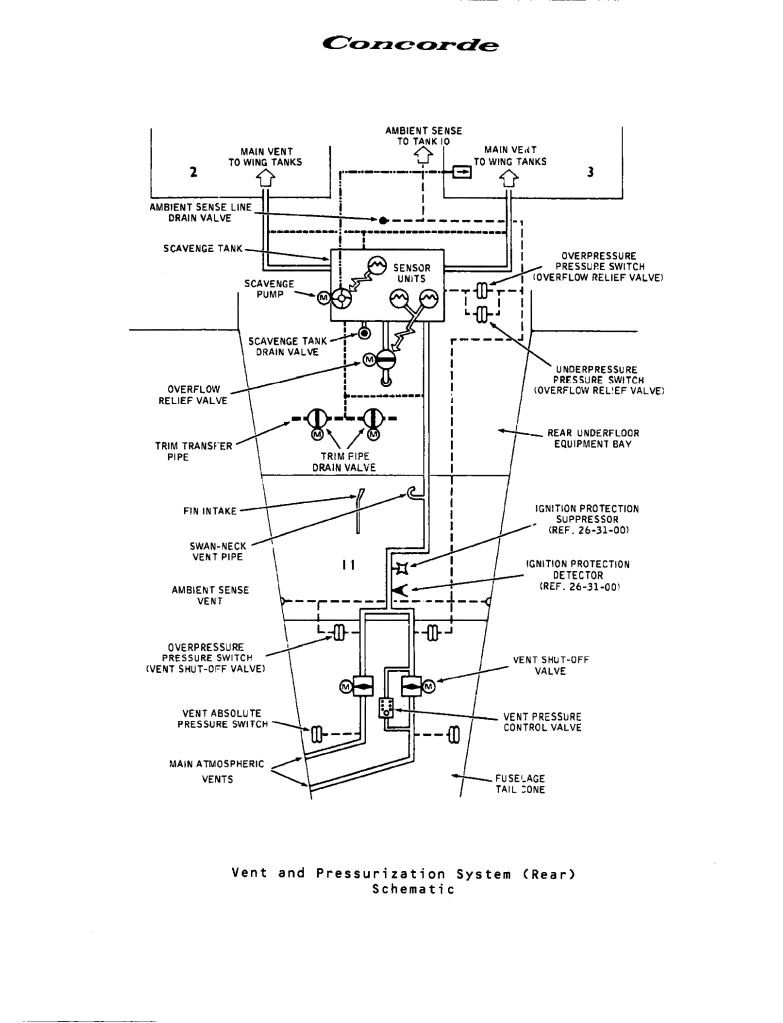
As a total aside to all this (or me going off on a tangent yet again) the fuel tanks themselves were gently air pressurised above 44,000' to around 2.2 PSIA. This was to prevent the beginnings of any boiling of the fuel in the tanks, due to the low ambient pressure/high fuel temperatures, causing pump cavitation. (Boiling itself could not occur much below 65,000'). A small NACA duct at the right side of the fin was used to supply the ram air for tank pressurisation, the two vent valves in the tail cone, one per trim gallery, closing off automatically at around 44,000', the pressure being controlled by a pneumatic valve, with full automatic over-pressure protection. OK sorry guys and gals, back to the answers:


 ). Oh, and there were 9 wheel brakes, one for each main wheel and as was mentioned in a previous post, a single steel disc brake for the nose wheels (the nose having a live axle), for automatic use during gear retraction only.

 There were a total of seven main power sources: 4 x 60KVA AC generators, one per engine, a single 40KVA hydraulically powered emergency generator and 2 lead acid (or ni-cad in the case of G-BOAG) main aircraft batteries. (Not a terribly Re-Volting question I hope).

I hope this quiz was fun and not too perplexing to any of you guys.
Dude
Subjects
Braking
Braniff
British Airways
Cabin Crew
Depressurisation
Elevons
Filton
Fuel Vent System
G-BOAB
G-BOAF
G-BOAG
Microprocessor
Pressurisation
Quiz
Trim
Links are to this post in the relevant subject page so that this post can be seen in context.
Reply to this quoting this original post. You need to be logged in. Not available on closed threads.
September 30, 2010, 15:03:00 GMT
permalink Post: 5966077
1) How many fuel tanks were there on Concorde?
LOL... 13.
I suppose that, for the same reason there was no row 13 in the cabin, somebody decided to name two of the tanks "5A" and "7A", rather than call the tail trim tank (named no.11) number 13.
Yes, I forgot the scavenge tank.
And since it was "BA Concordes only" I didn't want to add the hydrazine tank on the two preprod and the two certification aircraft.
2) How many seats were there?
Good question.
As Nick asked, which seats?
Nominally there were 100 pax seats in the cabin, although originally up to 127 were certified.
Five (three plus two jump seats) in the cockpit.
Cabin seats for the cabin crew.... I honestly don't know. Seven?
Wrong twice... six cabin crew seats, AND I forgot to count the loos!
3) At what approximate altitude and KNOTS EAS was Mach 2 achieved?
Roughly, FL500 and 530 kts.
But not being a pilot I had to check an instant on my flight envelope crib sheet, which I have at hand all the time.....
It seemed pointless to be TOO precise, because that assumed ISA and creeping exactly up the right edge of the envelope.
4) Only one BA Concorde had three different registrations, what was it?
Without looking it up, no idea. My guess is G-BOAF, with a white-tail reg, a "British" reg, and a pseudo-American reg.
IIRC, G-BOAG never had a pseudo-American reg, but I'm not sure without looking it up.
Brain not completely addled, then.
5) What was the maximum permitted altitude in passenger service?
FL600, as certified.
6) How many wheels on the aircraft?
Twelve, if you count the two Spitfire wheels at the back
7) How many flying control modes were there?
Four. Blue, green, mechanical and ... what did we call it? Control jam, CWS?
Ah, thanks, Emergency Flight Control. I always considered it as a separate mode, even if it was virtually never used.
8) How many positions of nose droop were there?
Four. 0\xb0, 5\xb0, 12.5\xb0 and 17.5\xb0 (the latter only on the prototypes, and purely mechanically, after removing a stop, on the other aircraft).
9) What was the first microprocessor application on the aircraft?
No idea... you (M2dude) mentioned a Plessey data acquisition system?
It was after "my time"...
10) How many main electrical sources were there?
Again, not sure... You're presumably are talking about primary sources.
There was an AC constant-drive generator on each engine.
Then there were two DC batteries.
And IIRC there was an AC generator running off the RAT hydraulic generator when pillar came to post.
Reading M2dude's answer, I suppose the emergency generator just ran off the hydraulics, not specifically off the RAT. Far more logical.
Nice one, M2dude!
And certainly not all trivia!
CJ
Subjects
British Airways
Cabin Crew
FL600
Flight Envelope
G-BOAF
G-BOAG
Hydraulic
Hydrazine
Microprocessor
Quiz
RAT (Ram Air Turbine)
Trim
Links are to this post in the relevant subject page so that this post can be seen in context.
Reply to this quoting this original post. You need to be logged in. Not available on closed threads.
October 02, 2010, 08:45:00 GMT
permalink Post: 5969581
The Inner Elevon Light, plus 'PFC' red Master Warning is triggered by:
a) The Green Flying ControlComparator
b) The Blue Flying Control Comparator
c) Either Comparator
The correct answer is (b).
Another flying controls question I can remember is:
Outer Elevon Neutralisation is triggered at:
a)Vmo + 10 KTS
b)Vmo + 15 KTS
c)Vmo + 25 KTS
The correct answer here is (c).
The pass mark in these exams was 75%, with penalty marking applied for any wrong answers. I always found the worst part was the fact that the exams were on a Friday afternoon after lunch

Nick Thomas
From what you said about the 'lady' being ahead of her time, I would certainly agree with you here; in my view she was generations ahead of everything else.
nomorecatering
As far as ground school notes, mine are all out on long term loan (MUST get them back). The ground school are totally priceless and I am sure that there are many complete sets lying around in atticks/bedrooms/garages/loos etc.
Dude
Last edited by M2dude; 2nd October 2010 at 13:40 .
Subjects
British Airways
Brooklands
C of G
Elevons
Filton
Fuel Pumps
Hydraulic
Intakes
JFK
LHR
LHR-JFK Route
Simulator
Trim
Links are to this post in the relevant subject page so that this post can be seen in context.
Reply to this quoting this original post. You need to be logged in. Not available on closed threads.
October 11, 2010, 18:48:00 GMT
permalink Post: 5988337

If the charter flight did not involve a supersonic flight, then of course it wouldn't have been a problem, you would just have loaded enough fuel into that vast collection of tanks to maintain a 'subsonic' CG.
So, second answer, which is what I think you're thinking of: the case of a short charter with a supersonic "loop" over the Bay of Biscay, as both BA and AF did quite a number of times, with less fuel.
This is where I start thinking... and I admit I may be wrong.
Take a normal transatlantic flight, with all the tanks full at take-off.
By the time you started the supersonic acceleration (so with still a lot of fuel forward, only the fuel used in take-off and subsonic climb no longer there) the 10-odd tons in tank 11 (the trim tank in the tail) were already enough to shift the CG backwards to what was needed when supersonic.
So, with a smaller fuel load, getting the CG backwards to the right position would already be easier, even without fully filling tank 11. And of course no problem returning to the 'subsonic' CG.... plenty of space in the already partly empty tanks..
So I think the answer to your question is "no".
CJ
Subjects
Air France
British Airways
C of G
Trim
Links are to this post in the relevant subject page so that this post can be seen in context.
Reply to this quoting this original post. You need to be logged in. Not available on closed threads.
October 16, 2010, 22:27:00 GMT
permalink Post: 5999454
I've carefully avoided looking at them, but I'll might as well plug in mine now.
So the questions dealing with the in-service period are totally outside my field of experience... all I can do is guess, in case I saw the answers somewhere.
1) How many Concorde airframes were built?
Twenty-two.
Two static-test airframes.
- One at Toulouse, for purely static tests, and tests such as vibration and flutter.
- One at Farnborough, for the long-duration thermal fatigue tests.
(A few bits and pieces of the Farnborough test specimen have survived, and can still be seen at the Brooklands museum).
Two prototypes (001 and 002)
Two pre-production aircraft (01 and 02)
Two production aircraft used for certification, that never entered service (201 - F-WTSB and 202 - G-BBDG)
Fourteen production aircraft, seven that served with British Airways, seven that served with Air France.
2) As far as the British constructed aircraft went, name the destinations that were served?. Regular flight numbers only, excludes charters etc.
Not a clue as to the full list.
- Bahrain, obviously.
- JFK.
- IAD (not sure if that's rated as regular, or only incidental)
- Dallas (with Braniff)
- Barbados (of course, right until the end)
- Sngapore (with Singapore Airlines, and G-BOAD in Singapore Airlines colours on one side)
- Sydney (again no idea if that rated as a regular flight or only a few tries)
3) What was the departure time for the ORIGINAL morning LHR-JFK Concorde services? (Not called the BA001 then either).
Not a clue either. Vague memory of about 10:00 am which gave you a full working day in New York.
4) Further to question 3 above, what WERE the original flight numbers for the BA001 and BA003? (The morning and evening LHR-JFK services?)..
Never flew on them, never had to deal with them.
BA174 comes to mind from the depths of my memory, in that case BA003 would have been BA176?
5) There were no less than FORTY SIX fuel pumps on Concorde. What was the breakdown for these? (Clue; don't forget the scavenge pump )
M2dude, I did AFCS, not the fuel system. I believe you, but without pulling out some diagrams I honestly have NO idea.
I expect each tank had at least two pumps, which gets me up to 26.
Then there were a few emergency pumps for the trim tanks, and I suppose each engine had additional pumps associated with it.
Still nowhere near the 46 I need to find.....
6) What airframe had the only TOTALLY unique shape?
That would have been my old friend, 01 (G-AXDN), first pre-production aircraft, now at Duxford.
It was the first Concorde with the new transparent visor, but it still had the short tail that characterised the prototypes.
It was 02 (F-WTSA), the first French pre-production aircraft, that was close to the final shape of the production aircraft.
7) This one is particularly aimed at ChristiaanJ. What was the total number of gyros on the aircraft?
Good question.... never counted them all. But I'll try a guess.
First a nice one, the SFENA Emergency Standby Artificial Horizon (made by the firm I worked for).
Ran off the Emergency Battery Bus via a small independent inverter.
And if that failed too, it would still run reliably for several minutes on its own inertia.
Next, the rate gyros used by the autostabilisation system ; these measured the angular rate of the aircraft along the three main axes, pitch, roll and yaw.
There were six, three each for the two autostab systems.
Now the rest....
Each IMU (inertial measurement unit, part of the inertial naviagation system) had three gyros.
With three INS on board, that would make nine.
Much as I try, I can't remember other ones, so I'll look forward to the final answer.
I can imagine the weather radar using an additional gyro for stabilisation, but I never went there.
8) How many wheel brakes?
Unless this is a trick question, I would say eight, for each of the main gear wheels.
The nose gear did not have any brakes - unless there were some small ones to stop the wheels rotating after retraction of the gear, but not used during landing.
9) What Mach number was automatic engine variable intake control enabled?
No idea.
Mach 1.0 or thereabouts is my personal guess only.
10) Above each bank of engine instruments were three lights, a blue, a green and an amber. What did they each signify?
I know that they each monitored the status of one of the engines, because it was too complex for the pilots to fully monitor all the parameters of all four engines in the short time between start-of-roll and V1... they had too many other things to do.
But I don't remember what each light meant, would have to look it up in the manual.
11) At what airfied were the first BA crew base training details held?
No idea.
Was it Brize Norton, or Casablanca?
12) What LHR runways did Concorde use for landing and take-off? (Trick question, not as obvious as it might seem).
No idea.
Vague memory of it being systematically the North runway for noise issues.
13) What operator had serious plans to operate Concorde from SNN to JFK in the early 1980's?
No idea.
14) What development aircraft did not exceed Mach 2 until fifteen months after her maiden flight?
I would expect the obvious answer to be 002.
Working up from first flight to Mach 2 was a slow and laborious process, and in the end it was 001 that both flew first, and also went to Mach 2 first.
I don't think any of the other aircraft took that long.
A I said, I tried to answer all questions "off the top of my head", without looking at any other sources.
CJ
Subjects
AFCS (Automtic Flight Control System)
Auto-stabilisation
Barbados
Braking
Braniff
British Airways
Brize Norton
Brooklands
F-WTSA
F-WTSB
Fatigue
Fuel Pumps
G-AXDN
G-BBDG
G-BOAD
INS (Inertial Navigation System)
Intakes
JFK
LHR
LHR Operations
LHR-JFK Route
Landing Gear
Quiz
Toulouse
Trim
V1
Visor
Links are to this post in the relevant subject page so that this post can be seen in context.
Reply to this quoting this original post. You need to be logged in. Not available on closed threads.
October 22, 2010, 09:26:00 GMT
permalink Post: 6010620
Ze Concorde Quiz Mk 2 (Or is it Mach 2?).... Ze Answers
, we have: London LHR (duhhh!!), Bahrein BAH, Singapore SIN, New York JFK, Washington IAD, Dallas DFW, Miami MIA, Toronto YYZ, Barbados BGI, and Riyadh RUH. As well as charters being ommited, so are some of the special 'surprise' shuttle appearances that Concorde would make, substituting a subsonic to and from destinations such as Manchester and Edinburgh.
 ).
).
Landing - 27L & R, 9L & R (prior to LHR mag' deviation update were 28L & R & 10L & R) together with 23/05.
Take off - 27L (28L), 9R (10R) and 9L. (10L never happened as take offs on this runway only occurred in 2003).
I hope you guys had fun with this one, regards to all
Dude
Last edited by M2dude; 22nd October 2010 at 11:21 . Reason: oops, misssed out question 2
Subjects
Afterburner/Re-heat
Air France 4590
Auto-stabilisation
Barbados
Braking
British Airways
Brize Norton
Fairford
Fatigue
Filton
Flight Envelope
Fuel Burn
Fuel Pumps
G-AXDN
INS (Inertial Navigation System)
Intakes
JFK
LHR
LHR Operations
LHR-JFK Route
Landing Gear
N1 (revolutions)
Nozzles
Quiz
RAE Farnborough
Relight
Shannon
Thrust Reversers
Toulouse
Trim
Links are to this post in the relevant subject page so that this post can be seen in context.
Reply to this quoting this original post. You need to be logged in. Not available on closed threads.
October 30, 2010, 12:46:00 GMT
permalink Post: 6027195
Requirements :
- Manual landing, at V REF , only
- Minimum of one autothrottle operative at start of approach
- Contingency power available
- Specific fuel distribution achieved
- Record in Maintenance Log
Not permitted with :
- Slippery runway
- Precipitation covered runway
- 3-engine ferry
- 2-engine approach and landing
- Reduced noise approach
- Fuelled with wide-cut fuel
- Secondary nozzle locked out
- Brake unit isolated
- Total loss of Electric Trim
- Total loss of Pitch Stab
- Total loss of Electrical Signalling
- Suspected tyre failure
Notes
3-engine landings were permitted. For all landings the landing gear would be lowered earlier than normal to ensure the brakes were stone cold to start with, maximum reverse thrust would be used on landing, and braking modulated so as to use (nearly) all of the full length of the runway. Landing performance figures at 130,000 kgs were in the performance manual for most runways. Any runway for which this procedure had not been pre-authorised required some rather tedious calculations, using the generalised basic data and graphs found in the performance manual.
If manual performance calculations were necessary, the F/E and I usually seemed to find that another problem that required our urgent and undivided attention had come up, and we would reluctantly be compelled to hand over all the manuals, charts and graphs for the F/O to perform the calculations!

If the aircraft had an AFT ZFW CG (perhaps loaded with a lot of heavy bags in the rear hold), and given the specific fuel distribution requirements for a fuel saving landing, it was possible that the landing weight might have to be reduced below 130,000 kgs, in order to achieve a landing CG of 53.5%.
After landing, record the actual landing weight in the Maintenance Log using code 2899XXOO, sign it, and then leg it swiftly, to avoid M2Dude and the boys, who somehow always managed to imply that you were responsible for anything that had gone wrong with their pride and joy since they last handed her over to you!
Reasons
The clue is in the name! A possible saving of roughly 5,200 gallons of fuel, nearly 19,000 kgs, which need not be jettisoned, thus reducing the time spent in the air before re-landing, fuel costs and pollution.
Best Regards
Bellerophon
Subjects
Auto-throttle
Braking
C of G
Fuel Saving Landing
Landing Gear
Manuals
Nozzles
Reverse Thrust
Trim
Links are to this post in the relevant subject page so that this post can be seen in context.
Reply to this quoting this original post. You need to be logged in. Not available on closed threads.
November 24, 2010, 03:12:00 GMT
permalink Post: 6080736
I've just wonder that does the Concorde use a surge tank or
some a kind of a NACA duct like on B737 for pressurize the fuel in a tank?
Also, in Concorde F/E panel around the fuel control panel there're switch call
trim pipe drain switch. Which I tried to read and figure it out but finally I don't
know what it actually do
and in which circumstance do we need to use it.
Thanks for yours reply.
Best Regards
Vortex

Subjects
Engine surge
Trim
Vortex
Links are to this post in the relevant subject page so that this post can be seen in context.
Reply to this quoting this original post. You need to be logged in. Not available on closed threads.
November 26, 2010, 08:47:00 GMT
permalink Post: 6085163
where there any failures during her time in the skies ?
Mr Vortex
some a kind of a NACA duct like on B737 for pressurize the fuel in a tank?
 and in which circumstance do we need to use it
Islander539 and ChristiaanJ
The actions of Airbus at Filton are nothing short of disgusting. By 'removing the insulation' you will need to strip the cabin completely bare (seats, galleys, ceiling panels and all of the side-wall panels). They say that 'Filton was only ever going to be an interim home for Concorde', what total
crap
!!
The idea is to 'cocoon' the aircraft 'until a permanent home is found'. I hope all readers here realise that this will involve BREAKING UP THE AIRFRAME to make it road transportable. The reasons that scarebus are giving for all this are vague and misleading, but here's my take. There are pressures around from various people and bodies 'to return a British Concorde to flying condition.' Now a lot (NOT ALL) of these people although very well intentioned are not that well informed and their wishes are not reasonably possible. But the pressures exist nonetheless, and scarebus will do anything to prevent this possibility, nomatter how unlikely, from being progressed. So we have G-BOAF, the youngest Concorde in the world, with the lowest airframe hours, in pretty good structural condition (she's suffered from being outside for 7 years, but nothing terminal) and actually in the hands of the dreaded scarebus (who would rather forget that Concorde ever existed, and was almost certainly the reason why they even noe exist). Doesn't take much working out now, does it?

Dude
Subjects
Airbus
Elevons
Engine surge
Filton
G-BOAF
Galley
Pressurisation
Trim
Vortex
Links are to this post in the relevant subject page so that this post can be seen in context.
Reply to this quoting this original post. You need to be logged in. Not available on closed threads.
December 01, 2010, 11:32:00 GMT
permalink Post: 6094864

Regards Dude
Subjects
Fuel Vent System
Intakes
Trim
Vortex
Links are to this post in the relevant subject page so that this post can be seen in context.
Reply to this quoting this original post. You need to be logged in. Not available on closed threads.
December 19, 2010, 18:24:00 GMT
permalink Post: 6131750
Sure the autopilot made it superfluous to some extent, but to certificate the aircraft it had to be conventionally stable when flow manually, and applying a nose down command to get a speed increase is a basic airworthiness requirement for all aircraft.
Subjects
Auto-pilot
C of G
Trim
Links are to this post in the relevant subject page so that this post can be seen in context.
Reply to this quoting this original post. You need to be logged in. Not available on closed threads.
December 21, 2010, 11:19:00 GMT
permalink Post: 6135263
It is a little complicated, but let me go back half a step.
Concorde was not certificated to FARs or BCAR (the French code was essentially a straight translation of FAR) but to completely new set of requirements known as TSS (Transport Supersonique Standards). The old UK ARB had initiated discussions about these even before cooperation negotiations had started. The result was that young, junior engineers got to debate the basics of airworthiness rules with older, experienced airworthiness specialists. In hindsight it was wonderful training!
But to get to the point, it was this thinking that allowed us to ignore some of the older rules which, although great for the aircraft flying at the time they were written, had little or no relevance to SSTs. We could interpret that as trying to find out what the pilots really wanted the aircraft to do and then to try and provide it.
In the particular case of trim/speed stability it was quite clear that what they wanted was an aircraft that could be flown with minimal trim changes and which once trimmed would not go wandering off all over the place. We also knew that in some cases the 'elevator angle per 'g' ' could get as low as one degree/g in some cases and that the pilot could not tell exactly where his hands were positioned to that precision, although he would always know if he was pushing or pulling. So we could abandon the old rules for stick movement and instead supply classic stick force stability for deviations from the trimmed state.
All this had to be matched to the varying aerodynamics through the transonic region (where everything varies rapidly) and the fuel transfer system characteristics. The resulting Mach trim laws were quite complex and were not, in fact just Mach Number sensitive. We also had two airspeed (Vcas) terms, one of which had a variable gain which was itself Mach dependent and kicked in above Vmo = 5kts and the other was a straight nose up elevator command as a function of Vcas. The Mach trim itself was highly nonlinear. The best way to illustrate this is probably a diagram but now I've run into another gap in my knowledge of this thread - how do I do that?
Anyway, the result was that the fuel transfer held the trim setting variation down to between 2 deg down to 1.5 deg up through the acceleration from 0.95M up to 0.5 deg down at Mach 2.0. Without fuel transfer the trim at Mach 2 would have been closer to 10 deg. The trim between say 0.95 and 1.2 varies in a nonlinear fashion and the Mach trim law shows roughly similar variations.
But the best measure of our success is the comments we are getting here from the guys who actually had to fly it.
Clive
[IMG]file:///C:/Users/Clive/AppData/Local/Temp/moz-screenshot.png[/IMG][IMG]file:///C:/Users/Clive/AppData/Local/Temp/moz-screenshot-1.png[/IMG]
Subjects
Auto-trim
Mach Trim
Trim
Vmo
Links are to this post in the relevant subject page so that this post can be seen in context.
Reply to this quoting this original post. You need to be logged in. Not available on closed threads.