January 26, 2026, 22:01:00 GMT
permalink Post: 12027674
The docket at https://data.ntsb.gov/Docket/?NTSBNumber=DCA25MA108 is unchanged from the previous hearing, with the exception of some personal items that have been removed.
Last edited by Musician; 27th January 2026 at 16:52 .
Subjects
NTSB
NTSB Docket
Links are to this post in the relevant subject page so that this post can be seen in context.
Reply to this quoting this original post. You need to be logged in. Not available on closed threads.
January 27, 2026, 16:55:00 GMT
permalink Post: 12028094
There are, in the facts developed by the NTSB investigation, not merely holes in the Alpine-country cheese which "line up." There are instead multiple lines through the cheese. It's more like the cheese has been shot through with a dozen rounds by Dirty Harry.
Subjects
NTSB
Links are to this post in the relevant subject page so that this post can be seen in context.
Reply to this quoting this original post. You need to be logged in. Not available on closed threads.
January 27, 2026, 21:50:00 GMT
permalink Post: 12028235
@Osinttechnical
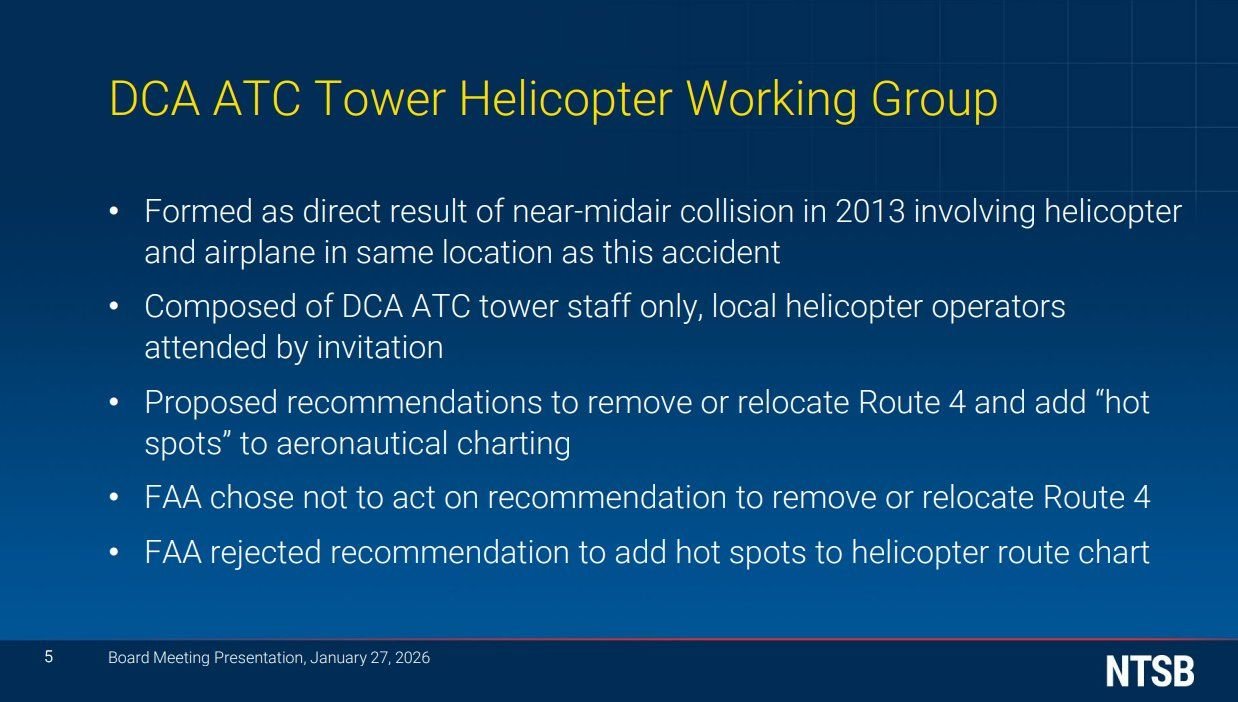
Possibly one of the more damning slides in NTSB history found in the Blackhawk-American Airline
s crash investigation.
In 2013, a group of local ATC and helicopter pilots proposed moving flight paths to avoid aircraft-helicopter collisions on landing at DCA. The FAA ignored them.
Subjects
ATC
DCA
FAA
NTSB
Links are to this post in the relevant subject page so that this post can be seen in context.
Reply to this quoting this original post. You need to be logged in. Not available on closed threads.
January 27, 2026, 22:35:00 GMT
permalink Post: 12028253
It responds to them, with either acceptance or rejection, and in the latter case provides its reasons for doing so. It may also suggest alternative means of compliance with the Board's wishes, and in some cases this leads to quite a bit of to-and-froing between the two organisations until a final position is reached.
The hearing is about to start on the Probable Cause statements, having had a prolonged debate on proposed amendments to several of the Findings (which are now all agreed).
Subjects
FAA
Findings
NTSB
Probable Cause
Safety Recommendations
Links are to this post in the relevant subject page so that this post can be seen in context.
Reply to this quoting this original post. You need to be logged in. Not available on closed threads.
January 27, 2026, 22:48:00 GMT
permalink Post: 12028261
It responds to them, with either acceptance or rejection, and in the latter case provides its reasons for doing so. It may also suggest alternative means of compliance with the Board's wishes, and in some cases this leads to quite a bit of to-and-froing between the two organisations until a final position is reached.
But the discussion was about a working group organized, convened and conducted by people from the FAA DCA staff and other concerned parties. The output of that group is what got "ignored"
Subjects
DCA
FAA
NTSB
Safety Recommendations
Links are to this post in the relevant subject page so that this post can be seen in context.
Reply to this quoting this original post. You need to be logged in. Not available on closed threads.
January 27, 2026, 22:50:00 GMT
permalink Post: 12028262
Subjects
ATC
FAA
NTSB
Safety Recommendations
Links are to this post in the relevant subject page so that this post can be seen in context.
Reply to this quoting this original post. You need to be logged in. Not available on closed threads.
January 27, 2026, 23:08:00 GMT
permalink Post: 12028271
The caption/transcript is at https://transcript.verbit.co/?transc...WidthMode=true
The docket has had more than 60 items added. https://data.ntsb.gov/Docket/?NTSBNumber=DCA25MA108
Boardmeeting Overview Animation
https://youtu.be/2H_A6mHsHk0
Aircraft Visibility Study
https://youtu.be/LJ10ZOcWuC4
Control Tower Visibility Study
https://youtu.be/IpcPaBbvwnM
I don\x92t know why they chose to create it from the IP\x92s (RHS)\x92s point of view though, the PF was LHS and arguably had a better view of the CRJ the entire time
IP seemed like he had his hands full with the RT (they were blocked a few times) and monitoring the PF\x92s flying (she busted the altitude constraint multiple times)
definitely an absurd environment and accident waiting to happen (plenty of near misses have been reported subsequently in the same airspace). Americans have all the gear and money but somehow their cowboy side comes out all too often and aviation seems to be one of the biggest candidates. They are lucky they didn\x92t have the obnoxious clown JFK Steve screaming in their ears
Subjects
Accident Waiting to Happen
CRJ
Close Calls
NTSB
NTSB Docket
Links are to this post in the relevant subject page so that this post can be seen in context.
Reply to this quoting this original post. You need to be logged in. Not available on closed threads.
January 27, 2026, 23:09:00 GMT
permalink Post: 12028272
Their failure to regularly review and evaluate helicopter routes and available data, and their failure to act on recommendations to mitigate the risk of a mid-air collision near Ronald Reagan Washington National Airport, as well as the air traffic system's overreliance on visual separation.
In order to promote efficient traffic flow without consideration for the limitations of the see and avoid concept.
Also causal was the lack of effective pilot applied visual separation by the helicopter crew, which resulted in a mid-air collision.
Additional causal factors were were the tower team's loss of situational awareness and degraded performance due to a high workload of the combined helicopter and local control positions, and the absence of a risk assessment process to identify and mitigate real time operational risk factors, which resulted in miss prioritization of duties, inadequate traffic advisory advisories, and the lack of safety alerts to both flight crews.
Also causal was the Army's failure to ensure pilots were aware of the effects of air tolerances on barometric altimeter in their helicopters, which resulted in the crew flying above the maximum published helicopter route altitude.
Contributing factors include the limitations of the traffic awareness and collision alerting systems on both aircraft, which precluded effective alerting of the impending collision to the flight crew's.
An unsustainable airport arrival rate, increasing traffic volume with a changing fleet mix and airline scheduling practices at DCA, which regularly strain the DCA Atct workforce and degraded safety over time.
The Army's lack of a fully implemented safety management system, which should have identified and addressed hazards associated with altitude exceedances on the Washington, D.C. Helicopter routes.
The FAA's failure across multiple organizations to implement previous NTSB recommendations, including Ads-b in and to follow and fully integrate its established safety management system, which should have led to several organizational and operational changes based on previously identified risk that were known to management and the absence of effective data sharing and analysis among the FAA aircraft operators and other relevant organizations.
Subjects
Altimeter (All)
Barometric Altimeter
DCA
FAA
NTSB
Probable Cause
Route Altitude
See and Avoid
Separation (ALL)
Situational Awareness
Visual Separation
Links are to this post in the relevant subject page so that this post can be seen in context.
Reply to this quoting this original post. You need to be logged in. Not available on closed threads.
January 27, 2026, 23:50:00 GMT
permalink Post: 12028296
Subjects
ATC
FAA
NTSB
Probable Cause
Separation (ALL)
Visual Separation
Links are to this post in the relevant subject page so that this post can be seen in context.
Reply to this quoting this original post. You need to be logged in. Not available on closed threads.
January 28, 2026, 03:09:00 GMT
permalink Post: 12028338
The PC statement should be read in its entirety, and at the conscious risk of ripe cliche, context matters. The Board did not assign the probable cause to the intersecting flight routes as such. For one thing, Chair Homendy repeatedly since the early days of the Board investigation has hammered upon the fact that the vertical separation was as little as 75 feet without any procedural separation (such as the helos holding at Haines Point). And also since the start of the investigation, time and again the complexity of the DCA airspace, and the (in my strident opinion) very messed up operation of DCA with regard to - as ATC staff testified - just "making it work", have been emphasized. Plus the refusal of FAA ATO to act upon the input from the helicopter working group several years ago, plus FAA's declining to note "hot spots" on charts. And the staffing issues, and lack of fidelity to SMS on the part of FAA and to some extent the Army as well. And there were, quite obviously, many findings of fact which are necessarily part of the context for reading . . . and understanding, the PC determination.
A person need not be an aeronautical engineer, airspace architect, or civilian or military aviator to understand from the get-go that intersecting flight paths might be found across the NAS. I'll stand to be corrected but I do not think - having watched the entirety of the hearing today - that the criticism of the Probable Cause finding is a valid, fair or accurate assessment of the Board's work in this investigation.
WillowRun 6-3
Subjects
ATC
DCA
FAA
Findings
Helicopter Working Group
Hot Spots
NTSB
NTSB Chair Jennifer Homendy
Probable Cause
Separation (ALL)
Vertical Separation
Links are to this post in the relevant subject page so that this post can be seen in context.
Reply to this quoting this original post. You need to be logged in. Not available on closed threads.
January 28, 2026, 03:16:00 GMT
permalink Post: 12028339
The PC statement should be read in its entirety, and at the conscious risk of ripe cliche, context matters. The Board did not assign the probable cause to the intersecting flight routes as such. For one thing, Chair Homendy repeatedly since the early days of the Board investigation has hammered upon the fact that the vertical separation was as little as 75 feet without any procedural separation (such as the helos holding at Haines Point). And also since the start of the investigation, time and again the complexity of the DCA airspace, and the (in my strident opinion) very messed up operation of DCA with regard to - as ATC staff testified - just "making it work", have been emphasized. Plus the refusal of FAA ATO to act upon the input from the helicopter working group several years ago, plus FAA's declining to note "hot spots" on charts. And the staffing issues, and lack of fidelity to SMS on the part of FAA and to some extent the Army as well. And there were, quite obviously, many findings of fact which are necessarily part of the context for reading . . . and understanding, the PC determination.
A person need not be an aeronautical engineer, airspace architect, or civilian or military aviator to understand from the get-go that intersecting flight paths might be found across the NAS. I'll stand to be corrected but I do not think - having watched the entirety of the hearing today - that the criticism of the Probable Cause finding is a valid, fair or accurate assessment of the Board's work in this investigation.
WillowRun 6-3
Subjects
ATC
DCA
FAA
Findings
Helicopter Working Group
Hot Spots
NTSB
NTSB Chair Jennifer Homendy
Probable Cause
Separation (ALL)
Vertical Separation
Links are to this post in the relevant subject page so that this post can be seen in context.
Reply to this quoting this original post. You need to be logged in. Not available on closed threads.
January 28, 2026, 03:39:00 GMT
permalink Post: 12028346
First, I have taken something posted on this thread some time ago as a deeply important article of faith. It was (I'm not quoting it exactly but from memory) "they owned the airspace of the last several hundred feet of the final approach to 3-3." The effort to paint them as negligent by the (estimable and highly successful) plaintiff lawyers frankly makes me want to puke. And I don't care one iota that some or several of those lawyers own their own aircraft and have pilot licenses. They didn't build hours, did they? And, .... it's one thing to try build a case against the airline company, but something else to assail the deceased pilots.
Relatedly, and second, I tend to think the NTSB sees this in somewhat the same way. But the NTSB really excoriated the FAA, and it richly deserved it too. This was - it cannot be said too often AFAI-am concerned - a systemic failure. So between being revolted by the effort to invade the ownership of those last few hundred feet of airspace or flight path of Bluestreak 5342 on final to 3-3 on the night of 29 January 2025, and gunning for bear in the form of a complacent, ridiculously evasive if not obstructionist if not dishonest FAA, the Board had zero-decimal-zero tolerance or inclination for assigning causal factors to two dead pilots on final to 3-3. And that's EVEN IF the airline company should have done more.
Third, and I don't know if it would be viable, but to the extent that the accountability for this accident lies mostly with FAA, and somewhat with the Army pilots and Army, then aren't the pilots victims too, rather than negilgent party-defendants? Shouldn't their estates have legal representation, as a party-intervenor in the case? That is what I meant earlier, who speaks for them? As we all know, the Board does not find fault. I somewhat think the lawyers seeking their contingency fee will probably, I guess, be talking about "fault." But the Army pilots are a bit different. It is distasteful and unseemly to criticize them, as they were in service, and just as much victims of the systemic failures as Bluestreak 5342's two pilots. And Uncle Sam, why, he's already admitted fault.
Fourth and last, yes, the airline company will get raked over the coals for not having outsmarted the failures of the FAA. Jackpot justice, what a way to improve the architecture and operation of the NAS. (With apologies to a very estimable and deservedly highly well-respected airline industry attorney - a real one - who at a conference in Paris oh, a couple three years or so ago, made the point that plaintiff lawyers should not be the ones setting aviation policy through liability lawsuits.)
What good is a lawyer clodding around a pilot's forum on the internet without a rant now and again, eh?
Subjects
Accountability/Liability
FAA
NTSB
Probable Cause
Links are to this post in the relevant subject page so that this post can be seen in context.
Reply to this quoting this original post. You need to be logged in. Not available on closed threads.
January 29, 2026, 12:41:00 GMT
permalink Post: 12029104
You can find it here: https://paulross.github.io/pprune-th...DCA/index.html
All 1,829 posts are organised into 68 subjects.
Changes:
- Added link to NTSB findings, probable cause and final recommendations.
- Added subjects: 'Accountability/Liability', 'Findings', 'NTSB Docket', 'Barometric Altimeter', 'Route Altitude', 'Hot Spots', 'Final Report', 'Probable Cause', 'Safety Recommendations', 'Helicopter Working Group'.
The project is here: https://github.com/paulross/pprune-threads .
Issues can be raised here: https://github.com/paulross/pprune-threads/issues or PM me with ideas.
Subjects
Altimeter (All)
Barometric Altimeter
Final Report
Findings
Helicopter Working Group
Hot Spots
NTSB
NTSB Docket
Probable Cause
Route Altitude
Safety Recommendations
Links are to this post in the relevant subject page so that this post can be seen in context.
Reply to this quoting this original post. You need to be logged in. Not available on closed threads.
January 29, 2026, 13:55:00 GMT
permalink Post: 12029155
https://www.ntsb.gov/investigations/...CA25MA108.aspx
Subjects
Altimeter (All)
Barometric Altimeter
Blackhawk (H-60)
CRJ
Findings
NTSB
PAT25
Route 4
Separation (ALL)
Traffic in Sight
Visual Separation
Links are to this post in the relevant subject page so that this post can be seen in context.
Reply to this quoting this original post. You need to be logged in. Not available on closed threads.
January 30, 2026, 12:48:00 GMT
permalink Post: 12029671
28. With several other targets located directly in front of the helicopter represented by points of light with no other features by which to identify aircraft type, and without additional position information from the controller, the instructor pilot likely identified the wrong target.
The question was why the NTSB chose the right seat of the helicopter, and that was because the instructor assumed responsibility for the visual separation. There is no cockpit communication about the identification, so the PF wasn't involved in that.
One problem the helicopter had was that the CRJ was flying a turn. Flying straight, you know you're going to collide with something (even if it is just a dot of light) if it doesn't move visually. The CRJ's lights were moving left, so that would've looked like it was safely passing the helicopter by. The crew needed the situational awareness that the CRJ was going to turn towards them as it lined up for runway 33, but they didn't have it. ATC did, but didn't share, for reasons also addressed in the findings.
Subjects
ATC
CRJ
Findings
NTSB
Separation (ALL)
Situational Awareness
Visual Separation
Links are to this post in the relevant subject page so that this post can be seen in context.
Reply to this quoting this original post. You need to be logged in. Not available on closed threads.
January 31, 2026, 05:11:00 GMT
permalink Post: 12030060
Runs 25 minutes.
I would argue that both NTSB and Flying for Money used complacency when the term Normalization of deviance,
American sociologist Diane Vaughan defines the process where a clearly unsafe practice becomes considered normal if it does not immediately cause a catastrophe: "a long incubation period [before a final disaster] with early warning signs that were either misinterpreted, ignored or missed completely".
I don't understand why the helicopter routes do not have a lateral dimension i.e. track via XXX, remain EAST of a line XXX to XXX. Defined lateral dimensions then allows lateral separation applied to be based on a thinner line, rather than a broad line as per the current charting.
Subjects
NTSB
Normalization of Deviance
Separation (ALL)
VFR
Visual Separation
Links are to this post in the relevant subject page so that this post can be seen in context.
Reply to this quoting this original post. You need to be logged in. Not available on closed threads.
January 31, 2026, 06:24:00 GMT
permalink Post: 12030070
Relevant recommendations are
10. Implement anti-blocking technology that will alert controllers and/or flight crews to potentially blocked transmission when simultaneous broadcasting occurs.
Current Voice Switching Systems allow multiple frequencies and provide re-transmit options, and as such provide instantaneous splitting of frequencies to seperate control positions.
Subjects
NTSB
Separation (ALL)
Links are to this post in the relevant subject page so that this post can be seen in context.
Reply to this quoting this original post. You need to be logged in. Not available on closed threads.
January 31, 2026, 10:06:00 GMT
permalink Post: 12030113
Runs 25 minutes.
The Potomac Crash was Bound to Happen by Flying for Money
No sign yet of the transcript being added to the public docket, hopefully it will appear in the next few days.
Subjects
NTSB
NTSB Docket
Links are to this post in the relevant subject page so that this post can be seen in context.
Reply to this quoting this original post. You need to be logged in. Not available on closed threads.
January 31, 2026, 11:31:00 GMT
permalink Post: 12030150
Current Voice Switching Systems allow multiple frequencies and provide re-transmit options, and as such provide instantaneous splitting of frequencies to separate control positions.
The standard way to couple frequencies in ATC is what was avail in DC , you can transmit on both, listen to both simultaneously but not retransmitting on both . potentially reducing eventual blocked transmissions , or at least improves the detection of blocked transmissions .
in ATC , VHF anti blocking systems are being discussed since Tenerife ( 1977) , CONTRAN was the first one , tested but never really implanted , ,later some copies were made , introduced here and there but with a switch to disable, when traffic got too high ,. not sure what the situation is today but I doubt it changed much. ( waiting to be contradicted)
,
In the air , most new 8,33 VHFs have a "dual" function , where you can listen to 2 frequency simultaneously , but when the master is receiving , the slave is blocked out , some have a replay function but useless in flight , especially when flying manual VFR at 200 ft .. I doubt this would have made any difference in this case . Plus it would not solve UHF/VHF ground coupling issue.
Subjects
ATC
FAA
NTSB
VFR
Links are to this post in the relevant subject page so that this post can be seen in context.
Reply to this quoting this original post. You need to be logged in. Not available on closed threads.
February 06, 2026, 17:52:00 GMT
permalink Post: 12033392
_________________________
Joint Statement of House Transportation and Infrastructure Committee and House Armed Services Committee Bipartisan Leaders on NTSB\x92s Recommendations to Address DCA Crash
For Immediate Release: February 06, 2026
[Committee contacts omitted]
Washington, DC \x96 The bipartisan leaders of the House Transportation and Infrastructure Committee and the House Armed Services Committee today issued a joint statement regarding the National Transportation Safety Board\x92s (NTSB) recently approved recommendations to address the January 29, 2025, midair collision at Ronald Reagan Washington National Airport (DCA).
Joint statement from House Transportation and Infrastructure Committee Chairman Sam Graves (R-MO), House Transportation and Infrastructure Committee Ranking Member Rick Larsen (D-WA), House Armed Services Committee Chairman Mike Rogers (R-AL), and House Armed Services Committee Ranking Member Adam Smith (D-WA):
\x93Now that we have received the approved recommendations and probable cause from the NTSB on the tragic DCA midair collision that claimed 67 lives, and with the NTSB\x92s final report expected in a matter of days, we are working on a comprehensive legislative solution to address what we\x92ve learned. It is our firm belief that meaningful improvements to the safety of our airspace require the full and fair consideration of all of the NTSB\x92s recommendations. We are continuing to evaluate the information and analysis gathered and put forward by the NTSB, and we will work together expeditiously on legislation to ensure a crash like this can never happen again.\x94
Subjects
DCA
Final Report
NDAA
NTSB
Probable Cause
Section 373 of the FY26 NDAA
Links are to this post in the relevant subject page so that this post can be seen in context.
Reply to this quoting this original post. You need to be logged in. Not available on closed threads.