January 27, 2026, 06:43:00 GMT
permalink Post: 12027802
Therefore,cockpit voices and sounds are recorded by the front EAFR
even in the event all 28VDC power failure.
Subjects
EAFR
RIPS
Links are to this post in the relevant subject page so that this post can be seen in context.
Reply to this quoting this original post. You need to be logged in. Not available on closed threads.
February 01, 2026, 22:18:00 GMT
permalink Post: 12030849
There's this rumor and/or question going around:
Someone was promoting the idea that a diode failure in the backup battery had disabled the battery and both buses.
He claimed that the FDR inputs from the switch sensors were coming from opto-isolators, and since they had lost power, they showed the switches going into the open state until power returned from the RAT.
For this theory to be valid, a single diode failure would have had to disable the entire aircraft.
Please,
- just comments on technical aspects?
- It's unclear this refers to the forward EAFR backup battery or
the Hot Battery Bus (Hot BB).
Thanks
Notwithstanding the fact that this failure mode is also technically implausible/impossible. Here's a 787 that landed with the battery on fire:
https://skybrary.aero/accidents-and-...and-japan-2013
The original perpetrator of this idea is Jeremy John Thompson, with a Youtube video titled "How Air India AI171 B787 crashed - Lithium Battery Diode Module Failure" positing that the battery diode module failed, the battery overcharged and short-circuited, and disaster ensued. This was half a year ago.
Last edited by Musician; 1st February 2026 at 22:41 .
Subjects
AI171
EAFR
FDR
Fuel (All)
Fuel Cutoff Switches
RAT (All)
Links are to this post in the relevant subject page so that this post can be seen in context.
Reply to this quoting this original post. You need to be logged in. Not available on closed threads.
February 02, 2026, 09:50:00 GMT
permalink Post: 12030995

Subjects
AI171
AvHerald
Links are to this post in the relevant subject page so that this post can be seen in context.
Reply to this quoting this original post. You need to be logged in. Not available on closed threads.
February 02, 2026, 15:07:00 GMT
permalink Post: 12031133
Subjects: None
4 recorded likes for this post.Reply to this quoting this original post. You need to be logged in. Not available on closed threads.
February 02, 2026, 15:26:00 GMT
permalink Post: 12031139
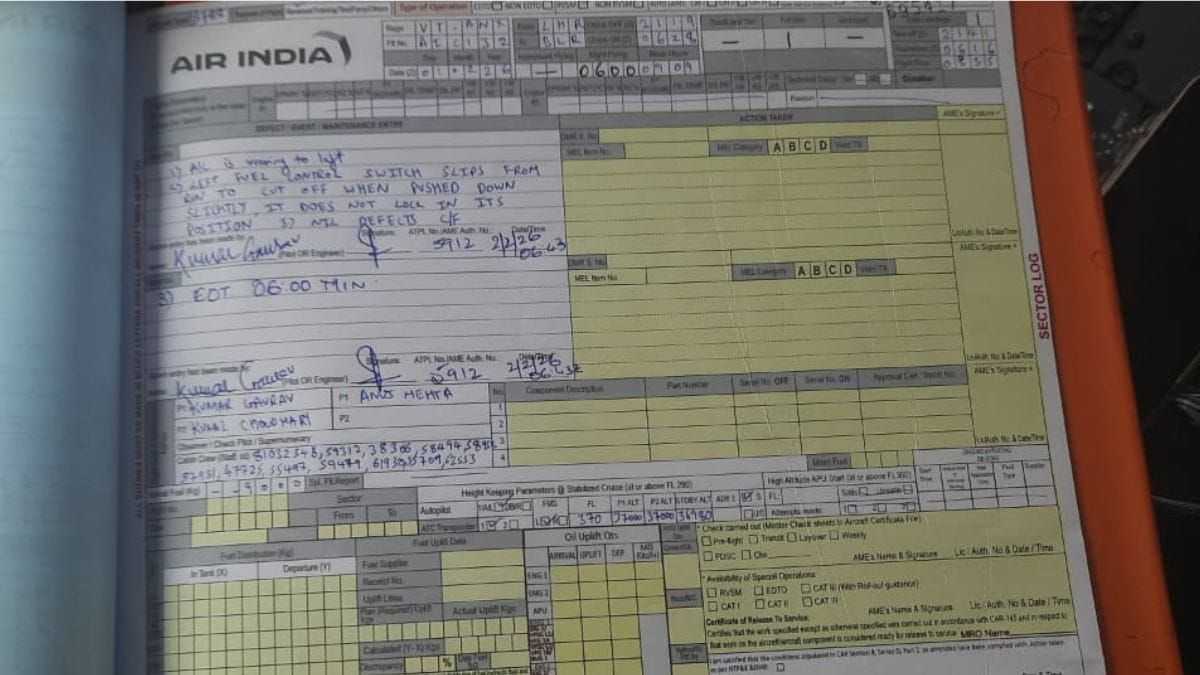
and they continued on with no other dramas to their home base where the plane is now in the hands of maintenance
clearly *something* happened as I don\x92t think airlines are on the habit of grounding their $300m airliners for no reason.
i remember when the consensus was this issue (fuel cutoffs not seating properly) was nearly impossible yet this crew found differently.
maybe we should discuss new information on the merits of that and not frame everything as x party trying to shift blame
this is certainly noteworthy even if it ultimately has nothing to do with 171
A mechanic/engineer looking at the switch could twist it back so that it locks ok, with very little effort.
If so, Air India should replace these switches with the safer switch model ASAP.
Subjects
Fuel (All)
Fuel Cutoff Switches
Fuel Cutoff Switches (detent)
Links are to this post in the relevant subject page so that this post can be seen in context.
Reply to this quoting this original post. You need to be logged in. Not available on closed threads.
February 02, 2026, 18:15:00 GMT
permalink Post: 12031256
Subjects
Fuel (All)
Fuel Cutoff Switches
Links are to this post in the relevant subject page so that this post can be seen in context.
Reply to this quoting this original post. You need to be logged in. Not available on closed threads.
February 03, 2026, 11:03:00 GMT
permalink Post: 12031515
If the log entry is correct, VT-ANX has a thrust control module with a demonstrably defective switch, which AI needs to pull, and the AAIB can examine.
They also have the burnt TCM of VT-ANB, and that has been to the lab as well, and the AAIB should know exactly by now whether these switches were latching or not.
Subjects
AAIB (All)
Links are to this post in the relevant subject page so that this post can be seen in context.
Reply to this quoting this original post. You need to be logged in. Not available on closed threads.
February 03, 2026, 14:02:00 GMT
permalink Post: 12031615
https://www.pib.gov.in/PressReleaseP...6®=3&lang=1
.
Subjects
DGCA
Fuel (All)
Fuel Cutoff
Fuel Cutoff Switches
Parameters
RUN/CUTOFF
Links are to this post in the relevant subject page so that this post can be seen in context.
Reply to this quoting this original post. You need to be logged in. Not available on closed threads.
February 03, 2026, 14:45:00 GMT
permalink Post: 12031656
The significance of this new finding is that it makes accidental movement more likely. We already know about the incident where a sun visor fell and moved the switch. We are learning now that the mechanism of "pull up, then move the switch" can be circumvented, and that the switch can be moved by a single application of force. It appears that the engineers were able to reproduce this behaviour, so it's no longer just that crew's word.
So while on VT-ANB both switches moved at the same time, and that is unlikely to happen by itself, it now appears possible that an external force such as a loose object or an inadvertant pilot motion could have moved both switches. At least, this requires further study to narrow down the conditions for it, and to check whether these conditions were present on the accident flight.
Subjects
AI171
Links are to this post in the relevant subject page so that this post can be seen in context.
Reply to this quoting this original post. You need to be logged in. Not available on closed threads.
February 03, 2026, 18:53:00 GMT
permalink Post: 12031774
Preceding a "however" This was reported:
If a "however" is written after that statement, it is either meaningless and to be ignored, or it has the effect of negating the statement. There is no "partly airworthy" for these switches. It can't be both statements. Thus, my doubt about the credibility/applicability of this whole situation in the context of the 171 crash, subject to these two statements being reconciled with each other.
I imagine one way for this to be true would be if the lever has some wiggle room, such that the teeth on it can move sideways past the teeth on the base, and then stick in that position where the lever is up and the flanks of the teeth are still touching. In that position, you could flip the switch back off without overcoming the detent. But if you operate the switch properly, with no sideways force, and seat the lever correctly in the ON position, then it'd be secure. That fits with the part of the press release about telling the pilots how to operate these switches properly.
Obviously I have no idea if this is true. I just want to give an example of how that switch might be operated one way to be unsafe, and another way to be safe. I'd really want to see Boeing's take on this, and not a third-hand press release that went from Boeing to Air India engineering to ??? to the ministry. It may say something impossible that differs from the possible thing the engineers actually found.
Subjects
Fuel (All)
Fuel Cutoff Switches
Fuel Cutoff Switches (detent)
Links are to this post in the relevant subject page so that this post can be seen in context.
Reply to this quoting this original post. You need to be logged in. Not available on closed threads.
February 04, 2026, 11:16:00 GMT
permalink Post: 12032148
Obviously Boeing can't easily change "standard practice", especially if they want to keep training costs for pilots switching types low, but that doesn't mean it's not a good idea in general.
If this logic fails "when it is really needed", the pilot can still pull the fire handle. Or the engine won't start, but then they'd still be sitting at the airport. But I don't think the aircraft that already have this have had issues?
Subjects
Engine Failure (All)
Engine Shutdown
Fuel (All)
Fuel Cutoff Switches
Links are to this post in the relevant subject page so that this post can be seen in context.
Reply to this quoting this original post. You need to be logged in. Not available on closed threads.